
Showing posts with label Materialism. Show all posts
Showing posts with label Materialism. Show all posts
Tuesday, August 18, 2026
Loving God Whom You Don't See
"There is nothing finer, nothing sweeter, than God. Now you are going to tell me: I do not see Him; how am I to love one whom I do not see? Behold how you may learn to love one whom you do not see. I will show you how you may try to see what you cannot behold with these eyes. See, now, you love a friend; what do you love in him? You love him without any return. Perhaps that friend of yours, to omit other facts, is an old man; for you can have an old man as a friend. What do you love in the old man? A crooked body, a white head, the wrinkles on his forehead, his drawn jaw? If it is the body which you see, compared with old age nothing is so ugly; yet you love something, even if you do not love the body which you see because it is ugly. How do you see what you love? For if I were to ask you: Why do you love? you would answer me: The man is faithful. Therefore, you love fidelity. If you love fidelity, God is seen with the same eyes with which fidelity is perceived." (unknown source, in Mary Magdeleine Mueller, trans., St. Caesarius: Sermons, Volume I [1-80] [Washington, D.C.: The Catholic University of America Press, 2004], Sermon 21:4, p. 109)


Friday, February 19, 2021
Materialism and mysteries
Prof. James Anderson responds to Bart Ehrman's (I guess one could call it) mysterian materialism in his post "Materialism and Mysteries".
Tuesday, February 16, 2021
Ed May's Materialism
Alex Tsakiris recently interviewed Stephen Braude. He makes a lot of significant comments during the interview, but a segment I found especially interesting was one about Ed May. You can click on the link just provided to watch that segment on the YouTube video of the interview. Braude's comments about his private interactions with May are worth hearing. You can listen to Tsakiris' interview with May here. And here's a post I wrote about the significance of the interview.
Sunday, May 24, 2020
Friday, May 17, 2019
Abortion and the soul
1. I notice that many prolifers shy away from appealing to the soul. They confine their arguments to genetics and embryology. They rest their case on physical properties. The moment of conception. A heartbeat. Unique DNA. A separate body.
But treating a baby as just a physical organism can be counterproductive. If human beings are reducible to body parts and organic molecues, is that an adequate basis for human rights?
It leads to equivocation about the "humanity" of the "fetus". Human hair, toenails, and even excrement are human. Just because something is human–in that sense–doesn't ipso facto make it entitled to protection.
2. The strategy appears to be in part that that's a scientific argument. In addition, that's a secular argument. Many prolifers seem to think that appealing to the soul is inherently religious, and therefore lacks common ground when reasoning with unbelievers.
However, arguments for the soul aren't necessarily religious. Take the hard problem of consciousness, or veridical near-death experiences and postmortem apparitions. We can present philosophical and empirical arguments for the soul.
3. Also, we shouldn't avoid religious argument. For one thing, it's impossible to justify human rights or women's rights on a secular basis. So we can put the abortionist on the defensive. That's an opportunity to deploy the moral argument for God's existence.
You can't simply assert religious claims when addressing unbelievers. That begs the question from their standpoint. An illegitimate argument from authority.
But you can give reasons for Christianity. And that, in turn, undergirds appeal to Christian ethics. Many unbelievers have no idea that there is any evidence for Christianity. They think it's all a matter of sheer faith. Make-believe and wishful thinking. By avoiding religious arguments, prolifers reinforce that damaging stereotype.
Monday, March 18, 2019
Saturday, January 19, 2019
Explaining evil, part 3
Wielenberg is a secular ethicist who labors to be a moral realist.
Part of the answer…is that for something to be evil is for there to be a reason to avoid or eliminate a thing (123).
But that's indiscriminate since what people take to be something to avoid or eliminate is so variable from one person to the next.
Whether a person is happy depends on the attitude of someone–namely, the person himself–but it does not depend upon the attitudes of observers towards him (125).
As social creatures, our happiness is typically dependent on the attitudes of others.
Like Chalmers, I endorse the existence of nonphysical properties (128).
i) Isn't Chalmers a panpsychic? So that's an appeal to mental properties. But Wielenberg's position seems to be moral platonism rather than panpsychism.
ii) Assuming he's a Platonist, he must believe basic ethical facts are abstract objects They exist even if there was no universe.
iii) If so, what are they? They're not physical or mental properties. So they have no analogy in human experience.
iv) How are they instantiated? What's the mechanism? His nonphysical properties aren't agents and his evolutionary physical processes aren't agents.
v) Assuming these impersonal immaterial properties exist, how do they obligate human conduct? They didn't create us. They aren't intelligent entities. They are indifferent to human flourishing. Why are we duty-bound to conform our behavior to these impersonal properties?
vi) If human beings are merely physical organisms, how do we gain access to nonempirical moral facts? How do unintelligent evolutionary processes tap into immaterial moral facts in order to instill them in human beings? It can't be a physical causal connection if one relatum of the cause/effect relation is immaterial.
Wednesday, November 07, 2018
Case studies in terminal lucidity
Provides some empirical evidence for dualism:
https://notendur.hi.is/erlendur/english/Apparitions/lucidity%20paper%202012.pdf
https://notendur.hi.is/erlendur/english/Apparitions/lucidity%20paper%202012.pdf
"The Myth of an Afterlife"
I'm going to comment on two chapters from Michael Martin & Keith Augustine, eds. The Myth of an Afterlife: The Case against Life After Death (Rowman & Littlefield Publishers 2015). Much of the book consists of "scientific" arguments against Cartesian dualism, near-death experiences, and out-of-body experiences. There's lots of empirical evidence they disregard on that front, as well as philosophical objections to physicalism. But I'll bypass that discussion and focus on the objections of Michael Martin (chap 20) and Theodore Drange (chap 12), beginning with Martin.
I must say that for professional philosophers, I find their objections stupefyingly obtuse. They are completely lacking in philosophical imagination.
Wednesday, October 17, 2018
The metaphysics of resurrection
There are different models of resurrection. I don't mean the resurrection of Christ, in particular. I mean the more radical case of resurrecting someone whose body completely disintegrated.
One model is replication. God creates a new body that duplicates your old body. The new body is discontinuous with the old body, although it's indistinguishable in the sense of being an exact copy of the original. (Of course, on any model, the resurrection body will be somewhat different because it lacks the same susceptibility to disease and senescence.)
This raises questions regarding personal identity. Is it the same you?
Since I'm a Cartesian dualist, I think the soul contains the core person rather than his body. That's not to deny the formative influence of embodied experience, which conditions our outlook. But that's imprinted on the soul (as it were). We take that with us when we die.
If the soul is immortal, then there's no gap between death and resurrection at that level. The person enjoys continuous existence. Resurrection reembodies the soul. The same soul is transferred to a new duplicate body.
There are, however, Christian physicalists (I use "Christian" advisedly in this context) who don't have that fallback. For them, brain death cancels out consciousness. On that view, there's a complete gap between death and resurrection. An interval during which you cease to exist.
Even if God recreates your body, the question is whether that's the same you. Due to the break in personal identity, is this still the original you, or is this a copy of you–a doppelgänger? Were you restored to life, or is the original you gone forever, while you were replaced by someone else with the same memories?
That's eerie, like those body-snatcher scenarios. Since I'm not a Christian physicalist, that's not my problem. But to be fair, I'm not sure that's an insuperable problem for Christian physicalism. If God stores your memories (in his own mind) during the hiatus, then uploads your memories to the new brain, is that still you? Perhaps.
But I think there's actually more to personal identity, even at a psychological level, than memory. A mind is more than its memories. A mind includes innate character traits, liquid IQ, &c. So a physicalist model of the resurrection requires God to recreate the whole package.
But I think there's actually more to personal identity, even at a psychological level, than memory. A mind is more than its memories. A mind includes innate character traits, liquid IQ, &c. So a physicalist model of the resurrection requires God to recreate the whole package.
Tuesday, October 02, 2018
Wednesday, May 30, 2018
David Robertson On The Enfield Poltergeist
Shortly after Guy Playfair's death, I received an email from David Robertson. He's the last of the major initial investigators of the Enfield case who's still alive. He's also done other paranormal research with John Hasted and in other contexts. In addition to being the last of the major initial investigators of the Enfield case, he's the individual who was most involved in the efforts at filming the poltergeist and, to my knowledge, the last person alive who's seen some of the videos that weren't released to the public. His filming work has had a major role in how Enfield has been analyzed over the years. Anita Gregory cited some of his videos as evidence against the authenticity of the Enfield case, Gregory and Maurice Grosse carried on a public exchange about those videos for years, and The Conjuring 2, a popular movie loosely based on Enfield, makes reference to Robertson's videos. He performed scientific tests on Janet Hodgson that provided evidence of her paranormal abilities. He spent a lot of time in the Hodgsons' home and was largely responsible for arranging and documenting the events of December 15, 1977. You may have heard or seen him in Enfield documentaries over the years. For example, here's a video of him discussing the testing he did to demonstrate Janet's ability to bend metal paranormally. And here you can listen to him discussing the December 15 events.
Robertson has given me permission to post some of what he wrote in our email exchange. His comments are lengthy, they address a large number and variety of topics, and some of what he mentions about Enfield has, as far as I know, never been said publicly before. Much of it is highly significant.
Two independent sources have verified that the email address of the individual who contacted me is Robertson's. There's also good internal evidence, within the emails, that the individual is Robertson.
Since his comments are easier to understand if you know the general layout of the Hodgsons' house, here's a floor plan from the original edition of Playfair's book (This House Is Haunted [Briarcliff Manor, New York: Stein and Day, 1984]):

I'll occasionally interrupt Robertson's comments to offer some explanatory material, but the large majority of what follows will be what he wrote.
Robertson has given me permission to post some of what he wrote in our email exchange. His comments are lengthy, they address a large number and variety of topics, and some of what he mentions about Enfield has, as far as I know, never been said publicly before. Much of it is highly significant.
Two independent sources have verified that the email address of the individual who contacted me is Robertson's. There's also good internal evidence, within the emails, that the individual is Robertson.
Since his comments are easier to understand if you know the general layout of the Hodgsons' house, here's a floor plan from the original edition of Playfair's book (This House Is Haunted [Briarcliff Manor, New York: Stein and Day, 1984]):
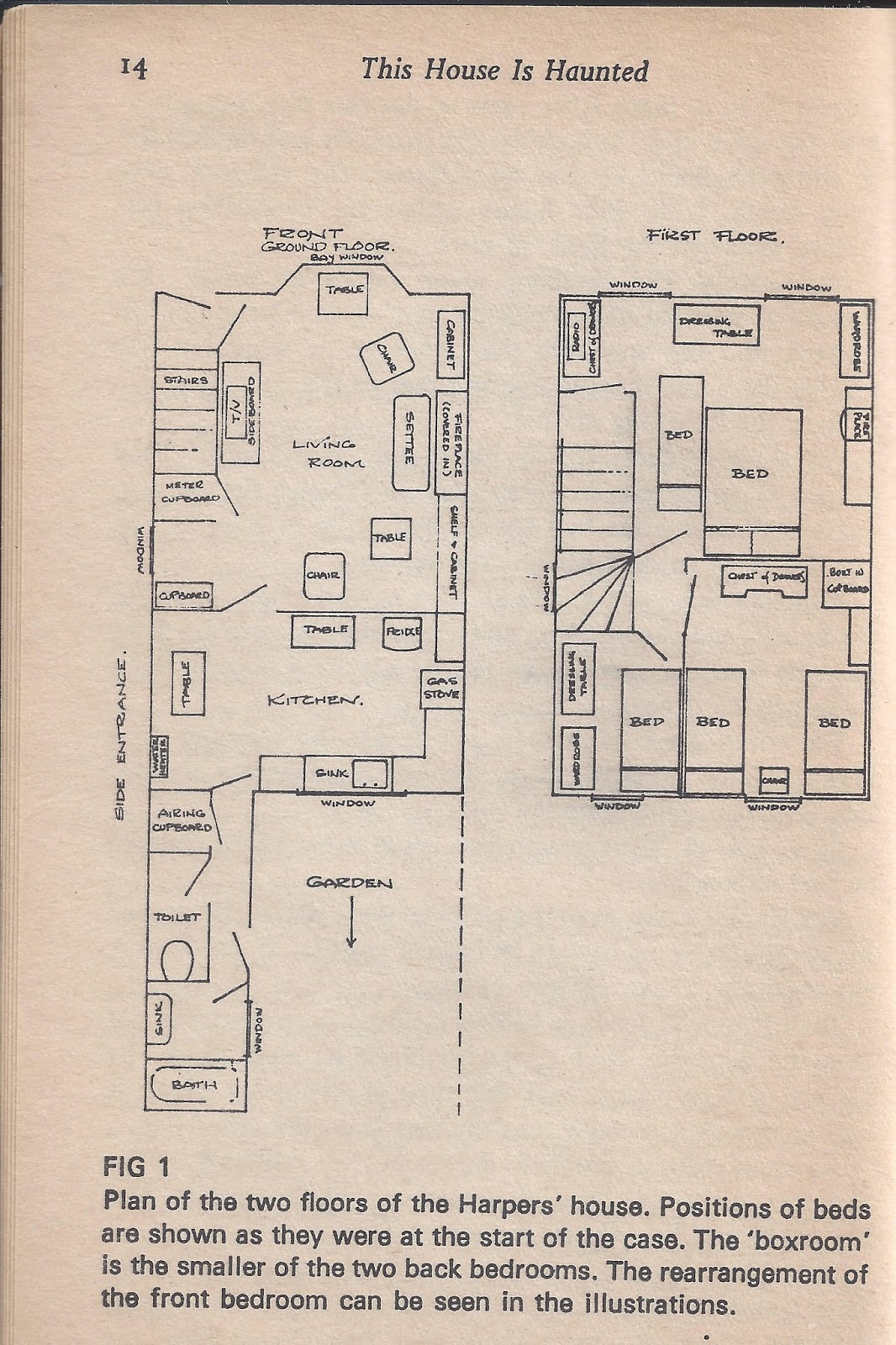
Click the floor plan for a larger image of it.
I'll occasionally interrupt Robertson's comments to offer some explanatory material, but the large majority of what follows will be what he wrote.
Sunday, September 24, 2017
Bedlam
i) I'd like to briefly compare the orthodox position on the Christian afterlife with physicalist annihilationism. I'm going to focus on the afterlife of the saints rather than the damned.
ii) On the orthodox position, humans have immortal souls which survive the death of the body. On this view, the postmortem state has both a vertical and horizontal dimension. Vertically, the human race dies in stages. The older generation dies, then the younger generation dies. Great-grandparents die, then grandparents die, then parents die, then children die, then grandchildren die, then great-grandchildren die, and so on and so forth.
This means that, to a great extent, the intermediate state mirrors a historical sequence. The first human generation died first, then the next human generation, and so on. From the earliest to the latest.
In that respect, the intermediate state preserves the cultural memories of every time and place. Each period and culture and is represented in the memories of particular saints. And that's laid down in a natural sequence, based on their arrival date. In that respect, dying is a bit like stepping into a time machine.
That also raises the question of whether the intermediate state has a blended culture, as saints from different times and places socialize.
Related to the vertical dimension is a horizontal dimension. We don't simply die as discrete individuals. Rather, we die with our contemporaries. Death is roughly grouped according to age-mates. People of the same generation tend to die within the same basic time span. That's a part of what defines a generation. They were born around the same time and they die around the same time.
Of course, there are partial exceptions. Sometimes a member of the younger generation predeceases a member of the older generation. Yet they are still contemporaries. It's just a distinction between younger and older contemporaries.
On this view, when you die, there are members of your own generation waiting to receive you. Likewise, there are members from the generation before you. And in this life, you knew members of the generation before you. There are roughly three generations alive at any particular time in the here and now–sometimes more.
When you die, the greeting party includes, or consists of, your contemporaries. You and they speak the same language. Not merely the same language, but the same period language. You and they have the same cultural background.
In addition, the intermediate state contains people from different periods. But because new arrivals disembark in a historical sequences, and because they disembark incrementally, rather than all at once, new arrivals are gradually acculturated to the intermediate state. There are people there whom they can instantly relate to on their own level. And that eases the transition as they get acquainted with saints from different times and places.
iii) Now let's compare that to physicalist annihilationism. On that view, the brain generates the mind. When your body dies, when you undergo brain death, that erases your personality. You cease to exist. The mind is gone.
Then, at the resurrection of the just, God recreates your body and uploads your mind (consciousness, memories) into the new brain. God had a copy of your mind, which he transfers to the new brain.
Millennia may separate your death from your resurrection, but you're oblivious to the interval, long or short. There's no you to be aware of the gap. There's the moment of death, when you pass into oblivion, for however long, then the next thing you know, you're alive in your new body.
There is no intermediate state, just the final state on the new earth. Because the resurrection of the just is simultaneous, all the saints who died at different times and places are suddenly restored to consciousness at the same time. There's no transitional stage. No phasing one generation of decedents into the company of former generations. It happens all at once.
On the face of it, that would be extremely disorienting. OT saints, medieval saints, saints from the 18C, 19C, 20C and so on, all thrown together. Bedlam.
I'm not saying this is a deal-breaker for physicalist annihilationism. But it's a jarring scenario compared to the orthodox position.
Thursday, June 29, 2017
Thursday, May 11, 2017
The ghost in the cellphone
Gilbert Ryle is famous for a catchy, quotable phrase he used to caricature Cartesian dualism: "the ghost in the machine".
The connotation of that metaphor is that if substance dualism is true, the soul is located somewhere in the body. If the soul exists, you ought to be able to find it by poking around inside the body.
My point isn't to do an exposition of Ryle's philosophy, but to use a different metaphor to illustrate substance dualism. Nowadays, not only do people have cellphones that enable to them to talk to other people, but cellphones can function as miniature TV screens which enable them to see the person they are talking to.
To take a cliche situation, suppose anthropologists discovered a tribe in the rain forest. The natives have no idea what a cellphone is or how it works. When they see faces and hear voices emanating from the cellphone, they imagine the cellphone took possession of the speaker's soul. His soul is trapped inside that little box.
But as we know, the speaker isn't actually in the device. Rather, the device is just an interactive medium to project himself.
That's analogous to the mind-body relation.
Thursday, March 30, 2017
Spooked
I believe Rod Dreher is Eastern Orthodox. I don't share his belief in Purgatorial punishment.
Evidence of the existence of ghosts disproves atheism inasmuch as atheists typically deny the afterlife. Most atheists, at least Western atheists (in contrast to Buddhist), are physicalists.
Oddly enough, many Christians agree with atheists regarding the nonexistence of ghosts even though Christians traditionally believe in the immortal soul, which is separable from the body.
Although I think death seals our eternal fate (I reject postmortem salvation), that of itself doesn't imply that there can be no contact between the living and the dead (or the damned). Of course, necromancy is forbidden, but that doesn't mean contact is impossible. And there's an elementary moral distinction between soliciting initiating contact with the dead, which is prohibited, and having the dead initiate contact.
Monday, March 27, 2017
Nazca lines
My response to a particle physicist on Facebook:
Brian Colquhoun
Not really; that's just an argument from ignorance. Things boggle my mind every day. That makes the case that I don't understand something for whatever reason, and not that it points to some purpose.
Hays
Would you say the same thing about Nazca lines? These are puzzling because it's unclear how the artists are able to draw these patterns when they couldn't see the pattern from ground level. So should we infer that these are made by humans, or is that an argument from ignorance? Should we instead presume that these are natural patterns?
Brian Colquhoun
There isn't any reason to suppose we're anything other than matter.
Hays
You mean, other than the hard problem of consciousness, precognition, psychokinesis, veridical apparitions, veridical NDEs, veridical OBEs, terminal lucidity, demonic possession, and John Lorber's hydrocephalic patients? There are multiple lines of evidence for substance dualism.
Brian Colquhoun
That doesn't necessarily mean that's definitely the case and can't be shown otherwise, but matter is all we know about.
Hays
Really? What about abstract objects, viz. numbers, logic, possible worlds? Even W. V. Quine resigned himself to being a "reluctant platonist". Likewise, Roger Penrose, although agnostic, is a mathematical realist.
Monday, March 06, 2017
The Licona/Dillahunty debate
I recently watched the Licona/Dillahunty debate (although I skipped the minimal facts section). Before that, I watched James White trashing Licona's approach in that debate. (Didn't listen to White's entire DL screed.)
I've been severely critical of some of Licona's positions. But I think he did a generally fine job in this debate, and I appreciate Licona's strategy. He's using independent evidence (e.g. veridical NDEs/OBEs, veridical apparitions, "extreme" answered prayer) to debunk naturalism/physicalism. See 7:00-18.00. Licona gives another example between 1:00-1:02. At 1:42-43, Licona makes a telling observation about the dearth of well-documented group hallucinations.
Many unbelievers say they find the Bible incredible because we don't live in that kind of world. We don't experience events like that. Everything we experience is naturalistically explicable.
Licona is challenging and removing that intellectual obstacle in preparation to make a case for the Resurrection. That can be a necessary preliminary step.
Perhaps White doesn't approve of paranormal evidence. But if there are well-documented phenomena that run counter to naturalism, why not adduce that evidence?
From what I heard, before tuning out, White also took issue with Licona's suggestion that Paul may well have seen Jesus prior to the Resurrection. That, however, is not a new idea. For instance, Paul Barnett says "It is likely that Paul was in Jerusalem at the same time as Jesus, and that he [Paul] heard him [Jesus] speak." The Truth about Jesus: The Challenge of Evidence (Aquila Press, 2004), 40.
More recently, Stanley Porter has made a book-length case for that proposition:
Keep in mind that Licona is simply responding to the oft-repeated claim that Paul never saw Jesus before the Resurrection. That's a claim with its own burden of proof.
Some of Licona's statements smack of historical positivism. That's philosophically naive. Licona made some cringe-worthy statements in the course of the debate. He has his limitations. But it was a strong performance overall.
In some basic respects, the debate suffered from lack of clarity. Licona could be clearer on the relevance of his examples from the paranormal and answered prayer.
i) Atheists overwhelmingly champion physicalism. If physicalism is true, then all mental activity takes place inside our heads. We can only interact with the world through physical media. And we can only know about the world through the senses, although we might have some instinctive know-how.
That rules out the possibility of ESP, psychokinesis, ghosts, &c. Conversely, if there is credible evidence of ESP, psychokinesis, ghosts, &c., then that rules out physicalism–which leaves most atheists up a paddle without a creek.
In theory, atheism can allow for the possibility of ESP, psychokinesis, &c., but that overlaps with the supernatural dimension of Christian theism, making it exceptionally difficult for atheists to rule out God, angels, demons, miracles, and the afterlife.
In general, the sticking point was establishing the supernatural. Dillahunty is a dogmatic methodological atheist. Indeed, he's a promissory methodological atheist.
He dismisses the supernatural as a vacuous placeholder. But that's a confused objection:
ii) To begin with, it's self-defeating for Dillahunty to act as though the supernatural is indefinable. After all, atheism depends on the ability to distinguish between what's natural and what's not. Atheists deny miracles because they think miracles are contrary to nature, and they think nature is conterminous with reality. How can Dillahunty be an atheist, how can he champion metaphysical naturalism and methodological naturalism, if he's unable to define supernaturalism and thereby demarcate supernaturalism from naturalism, or vice versa? For an atheist, these are correlative, mutually definable categories. Naturalism stands in contrast to supernaturalism. So unless an atheist has a clear idea of what naturalism is not, of what stands in contrast to naturalism, of what's incompatible with naturalism, it is self-refuting for him to say that supernaturalism has no meaning or content.
iii) Here's a stab at a philosophical definition:
Many ontological naturalists thus adopt a physicalist attitude to mental, biological and other such “special” subject matters. They hold that there is nothing more to the mental, biological and social realms than arrangements of physical entities.
https://plato.stanford.edu/entries/naturalism/#MakCauDif
In the final twentieth-century phase, the acceptance of the casual closure of the physical led to full-fledged physicalism. The causal closure thesis implied that, if mental and other special causes are to produce physical effects, they must themselves be physically constituted. It thus gave rise to the strong physicalist doctrine that anything that has physical effects must itself be physical.
https://plato.stanford.edu/entries/naturalism/#RisPhy
On that definition, a miracle or supernatural cause is not reducible to physical properties and their interactions. Evidence for events that don't fit the definition of naturalism automatically defaults to supernaturalism as the logical alternative.
iv) In addition, Christians can and do define properties of supernatural agents. We specify the divine attributes. We state that angels, demons, and ghosts are discarnate minds. Those are claims with positive content.
v) Another comparison would be telepathy or psychokinesis. Even if we can't explain "how" that's possible, there'd still be evidence for the phenomena. Indeed, the question of "how" begs the question, as if every effect must be facilitated by an intervening medium. But what if some events are directly caused, with no intervening medium?
vi) Dillahunty appears to have no clear definition of a miracle. One way to define a miracle is to say a miracle is an event contrary to what happens when we let nature take its course. That's the way secular philosopher J. L. Mackie defines a miracle. On this view, nature is how the world works when operating as a closed system. A miracle is what happens when an external agent intervenes.
vii) That, however, depends on how "nature" is defined. In debates over miracles, "nature" is usually shorthand for the physical universe. Matter and energy. Inanimate physical processes. Physical cause and effect.
They operate like automated machines that do whatever they were programmed to do, no more and no less. Although natural physical processes may be the product of intelligence, then are not intelligent in their own right.
In the same context, "nature" includes animate agents, including humans. Humans have reason. But humans have limited power and intelligence.
A miracle reflects rational discretion as well as superhuman ability. A miracle is more discriminating than natural processes. And it requires greater knowledge and/or power than human agents.
I think that's a ballpark definition of a miracle. Events which fit that basic description justify the inference of a miracle. Dillahunty denied that anything could ever count as evidence for a miracle, or the supernatural, but that's because he has no clear definition of what a miracle is.
viii) Dillahunty acts as though classifying an event as a miracle is always an argument from ignorance. For all we know, there might be some future scientific theory, some physical law yet to be discovered, that furnishes a naturalistic explanation for the event.
But to repeat a comparison I recently used, a detective may have to determine whether a death was accidental, suicidal, or homicidal. A clever killer will stage a murder to make it appear to be accidental, suicidal, or death by natural causes. Yet there may be subtle indications that it was murder. Imagine an atheist objecting on the grounds that we should always be patient and assume death was accidental or due to natural causes. Even if we can't explain it that way, we should wait until we develop a theory to do so. To invoke a personal agent (murderer) is homicide of the gaps.
ix) If, moreover, naturalism is so flexible as to be consistent with anything and everything, then it has no content. To stand for something, it must be opposed to something. If no evidence can ever count against naturalism, even in principle, then naturalism isn't based on evidence.
x) Dillahunty labored to discredit Licona's paranormal evidence by appealing to magician's tricks. But Licona's examples don't involve professional magicians, so there was no sleight-of-hand. The attempted analogy is fallacious.
xi) Dillahunty committed the schoolboy blunder of contending that you must prove God's existence before you can prove a miracle. But that's illogical. While God's existence is ontologically necessary for a miracle to be possible, it doesn't follow that belief in God must be prior to belief in miracles.
xii) After objecting that the supernatural is indefinable, Dillahunty raises the additional objection that if God exists, he can provide convincing evidence to everyone. But these are contradictory objections. If, according to Dillahunty, we can't define the supernatural, then how could anything constitute evidence for the supernatural? He needs to pick one objection and stick with it. Better yet, ditch both objections!
Wednesday, March 01, 2017
Is consciousness an illusion?
From one atheist philosopher to another:
This is significant because the standard atheist paradigm is committed to physicalism. And if physicalism entails eliminative materialism (i.e. consciousness is an illusion), then that's a defeater for the standard atheist paradigm.
In principle, an atheist can be a substance dualist, platonic realist, or even an idealist, but atheists resist that for good reason. Physicalism, if true, automatically disproves Christianity at one stroke. No God, angels, demons, souls, precognition, or miraculous action at a distance.
Conversely, opening the door a crack for discarnate minds is a divine foot in the door.
Subscribe to:
Posts (Atom)