
Showing posts with label Apparitions Of The Dead. Show all posts
Showing posts with label Apparitions Of The Dead. Show all posts
Sunday, May 17, 2026
Creating A Ghost
In a post last week, I mentioned the possibility that an apparition of the dead involves a place memory or an appearance of a deceased human rather than a demon. I want to discuss another explanatory option.


Sunday, May 10, 2026
Interacting With The Dead
Greg Koukl addressed the issue of interacting with the dead on a recent podcast. Start listening at 50:16 here. He was responding to a Christian caller whose parents have recently been having some allegedly paranormal experiences that they've interpreted as contact from their deceased daughter. I suspect ninety-some percent of the Evangelicals who would typically listen to a program like Greg's would agree with the answer he provides. But I want to address some problems with it. In addition to addressing what Greg and the caller said, I want to talk about some other misconceptions I suspect many people have about these issues.
Sunday, May 03, 2026
How much were the Zeitoun Marian apparitions associated with Coptic Christianity?
The subject is important not only because of the use of Zeitoun by Roman Catholics, but also because of how positively other non-Copts view the apparitions. Given the closeness of Coptic Christianity and the Zeitoun apparitions, how do non-Copts reconcile an acceptance of the apparitions as Marian with their rejection of Coptic Christianity?
Thursday, April 30, 2026
The Resurrection Debate Between Alex O'Connor And Trent Horn
You can watch it here. Trent made some good points against Alex's position during the debate, but I want to supplement what he said with some of my own responses to Alex. And I want to respond to Trent to some extent. I've responded to Alex on resurrection issues in the past, and some of what he said in his discussion with Trent covers the same ground. I'll link to some of my previous responses to Alex, since what he said in this recent discussion doesn't advance his side of the argument in any significant way. I also want to add some further comments to what I said in response to him in the past.
Tuesday, April 28, 2026
Problems With Roman Catholic Apparitions Of Mary
Fatima has been getting an unusual amount of attention lately, largely because of a recent debate on the subject between Ethan Muse and Sean Luke. The Zeitoun apparitions got a lot of attention last year. I don't know enough about Fatima to address it as much as I have Zeitoun. But I want to discuss some of the factors involved in evaluating Marian apparitions in general.
Tuesday, February 24, 2026
Problems With Attributing Too Much To Demons
Since Christians so often suggest that something or other is demonic, and much of the time they seem to do it with a lot of carelessness, it's worth considering the problems with falsely attributing things to demons. My focus here will be on attributing paranormal activity to demons, but the principles I'll be discussing also have a broader application. I'm not trying to be exhaustive. I'm just providing some examples:
Sunday, March 23, 2025
The Weaknesses Of The Zeitoun Marian Apparitions
I've written about my overall view of the Zeitoun case elsewhere, such as here and here. What I want to do in this post is expand upon an aspect of the case I've previously addressed more briefly. The apparitions exhibited some weaknesses that make more sense coming from a source of a lower nature than God or Mary.
Tuesday, February 18, 2025
More About Zeitoun And The Resurrection
Cameron Bertuzzi just posted a video responding to Gavin Ortlund regarding the Zeitoun Marian apparitions. I want to address several of the issues involved.
Tuesday, February 11, 2025
What should we make of the Zeitoun Marian apparitions?
I've discussed the subject in other threads over the years, but only briefly, and the Zeitoun case has been getting a lot of attention lately. So, I want to expand upon my previous comments.
Tuesday, March 07, 2023
Miracles That Are Closely Associated, But Come From Different Sources
We often find out that we have physical abilities we previously didn't know we had, like the ability to recover from an illness better than the average person or an ability to lift more weight than we thought we could. And our physical abilities often develop over time, such as the growth of muscles as a result of exercise. Similar things could occur with our souls. We have latent abilities we're unaware of, which are activated under certain circumstances. Or the more a spiritual ability is exercised, the stronger it gets. We often speak of discerning and developing our own or other people's spiritual gifts, for example. Similar concepts are found in paranormal research. People who have near-death experiences often report an increase in paranormal activity in their lives afterward. I've discussed examples of a similar nature that I've come across in my research on the Enfield Poltergeist. See the section on telepathy in the article here, for instance, and the discussion of scientific experiments with Janet Hodgson here.
One of the reasons I'm bringing this subject up is its relevance to how we interpret certain paranormal events. People often treat paranormal events as having come from one source when there's a significant chance that they came from different sources instead. Paranormal activity caused by source A could trigger some paranormal activity by source B, yet people will assume that all of the activity came from A.
Think of a Marian apparition, for example. As I've discussed many times, there are historical problems with the views of Mary that are held by the groups most associated with Marian apparitions. And the apparitions often behave in problematic ways, such as how visually unclear, noncommunicative, and noninteractive the Zeitoun apparition was. Sometimes apparitions, Marian and other types, behave in ways that are reminiscent of stone tape phenomena or seem more like what you'd expect from a projection of the human mind than what you'd expect from a source like Mary or a demon. But what do we make of something like a healing, precognition, or something else that's paranormal that accompanies the apparition?
One of the explanatory options we should consider is that the experience with the apparition activated other paranormal events that didn't come from the same source. An experience with an apparition could trigger an ability somebody has to heal, for example, to heal himself or heal other people.
Whether that's the best explanation in a given case has to be judged by the details involved. My point here is that it's one of the potential explanations we should keep in mind.
One of the reasons I'm bringing this subject up is its relevance to how we interpret certain paranormal events. People often treat paranormal events as having come from one source when there's a significant chance that they came from different sources instead. Paranormal activity caused by source A could trigger some paranormal activity by source B, yet people will assume that all of the activity came from A.
Think of a Marian apparition, for example. As I've discussed many times, there are historical problems with the views of Mary that are held by the groups most associated with Marian apparitions. And the apparitions often behave in problematic ways, such as how visually unclear, noncommunicative, and noninteractive the Zeitoun apparition was. Sometimes apparitions, Marian and other types, behave in ways that are reminiscent of stone tape phenomena or seem more like what you'd expect from a projection of the human mind than what you'd expect from a source like Mary or a demon. But what do we make of something like a healing, precognition, or something else that's paranormal that accompanies the apparition?
One of the explanatory options we should consider is that the experience with the apparition activated other paranormal events that didn't come from the same source. An experience with an apparition could trigger an ability somebody has to heal, for example, to heal himself or heal other people.
Whether that's the best explanation in a given case has to be judged by the details involved. My point here is that it's one of the potential explanations we should keep in mind.
Wednesday, November 09, 2022
The Recent Exchange Between Mike Licona And Dale Allison On Jesus' Resurrection
They appeared on Sean McDowell's YouTube channel in a video released today. Both make a lot of good points, and there's some significance in what they agree about, but far more can and should be said about other relevant issues. And they both substantially underestimate the evidence for Christianity beyond Jesus' resurrection.
Sunday, May 08, 2022
Dreams Of The Afterlife
Over the past several months, I've come across some resources I want to recommend on paranormal issues. These are subjects often discussed among nurses, hospice workers, and other people working in relevant fields, covered on television, and brought up in books, YouTube videos, conversations about family experiences, and elsewhere. But the large majority of Christians are very poorly prepared to address these topics.
Wednesday, April 22, 2020
Sunday, April 12, 2020
The Resurrection and grief hallucinations
1. NT scholar Dale Allison has popularized the idea that the Resurrection appearances of Christ might have their basis in so-called grief hallucinations. I should mention that it's been some years since I read his original argument, and I believe he's continued to debate it, so his current position may be more refined than his original formulation. At this point I might be fuzzy on the details. But with those caveats in mind:
2. An initial problem is terminology. If we classify the phenomenon as a "hallucination", then, by definition, it's a psychological illusion. So the label is prejudicial. A hallucination is a psychological impression of something outside the observer, but in reality the impression originates in the mind. There is nothing objective to the observer that corresponds to what he perceives.
This is not to deny that some people hallucinate under well-known conditions. But whether all or most reported postmortem apparitions are hallucinatory begs the question. I doubt there's an abstract presumption one way or the other. It helps to have some background info about the reporter.
So I prefer to use the term grief apparition, with the caveat that some, but not all, of these may be hallucinatory. For the record, I think there are genuine postmortem apparitions.
3. To my knowledge, this explanation isn't offered as an interpretation of the Resurrection accounts as they stand. Indeed, it's inconsistent with the Resurrection accounts as written. Rather, it attempts to go behind the narratives to reconstruct what really happened. The Resurrection accounts have their origin in grief apparitions, but Luke and John have transformed them to read more like physical restoration to life.
A problem with that explanation is a theory that has to explain away inconvenient evidence which stands at odds with the theory. A theory that's consistent with some of the evidence, but discounts other evidence from the same source that runs counter to the theory. That smacks of special pleading.
4. In fairness, there are situations where you can justifiably offer an explanation in the teeth of the documentary evidence. For instance, Joseph Smith has a well-earned reputation that impugns his credibility as a witness. Therefore, you are justified or even obliged to present an alternative explanation that disregards the record if there's good reason to believe the record is fraudulent.
But unless we're dealing with dubious sources like that, theories that are several steps removed from the documentary evidence are not to be preferred over theories consistent with the documentary evidence.
5. One problem with appealing to grief apparitions is that I doubt that was the primary emotion which the disciples experienced. To the contrary, the primary emotion was fear. Their leader had just been executed, and they were terrified that they were next on the hit list. They were hiding in fear that the authorities would round them up. That's not conducive to grief. Between the crucifixion and resurrection, I don't think there's an opportunity for them to grieve. Their dominant state of mind would be fear of arrest by the authorities, not bereavement.
6. As I recall, women (esp. widows) are far more likely to experience grief apparitions than men. But we don't find that gender disparity in the Resurrection accounts. Perhaps the explanation would be that the accounts aren't meant to be accurate in that regard. While grief apparitions are the template, Luke and John creatively manipulate their sources or traditions. If so, that's an explanation that must disregard counterevidence in the record.
7. A further problem is that post-resurrection appearances cluster around a particular time and place. But if these are grief apparitions, why would they be so close in time and place to Easter and succeeding weeks? Wouldn't we expect them to be more spaced out rather than coordinated? Do grief apparitions normally bunch up that way, where friends and family experience them around the same time and place?
8. Then there's the problem of mass hallucination. Two observers can report seeing these same tree because there's an external object in their field of vision causing them to perceive the same thing. But if the Resurrection appearances are hallucinatory, then there is no external stimulus to generate the same psychological impression. There is no common cause.
So even if you deny that the observers saw Jesus in the flesh, these would still be genuine postmortem apparitions rather than hallucinations. They saw the ghost of Jesus. So this interpretation still affirms the afterlife, but falls short of resurrection. As an alternative explanation it creates a dilemma because it's less than then NT requires but more than debunkers want to allow for.
9. Then there's the question of why observers would confuse a ghost with a physical, embodied agent. Many ancient people, including ancient Jews, believed in ghosts. But they didn't confound that with physical restoration to life. So, once again, the claim would be that Luke and John touched up their sources to make it seem like a bona fide resurrection.
10. Grief apparitions fail to explain the empty tomb. So a proponent of that alternative explanation must come up with an additional, separate explanation for the empty tomb accounts.
11. Allison cites a few atypical cases of postmortem apparitions that simulate physicality in this or that particular. But in the case of the Resurretion appearances, that requires postulating a patchwork of different cases, to combined all the necessary features. That's highly artificial and far more anomalous than the already exceptional examples.
Monday, February 17, 2020
Are the dead aware of the living?
1. The dead
What, if anything, do the dead know about the living? Catholicism has an elaborate mythology, as do various pagan faiths.
There's a danger when Christians leave a vacuum that others are only too eager to fill. Are there any reasonable, responsible suggestions we can give?
The Bible has little to say on the subject, although it sets necessary boundaries for pious conjecture. Some Christians think we shouldn't seek answers outside of Scripture. That's often prudent, but the Bible is not an encyclopedia. We rely on reason and evidence for much of what we believe. So it's partly a question of intellectual modesty. Recognizing the limits of speculation. In addition, some lines of speculation are more reasonable, better grounded, than others. Some lines of evidence have some evidence. While we shouldn't build a theological edifice on speculation and stake our immortal soul on theological conjectures, it's permissible to consider orthodox possibilities and sift the evidence we have. It's a mistake to vacate the field to let Catholics or pagans offer the answers.
2. Angels
Before discussing the dead, we might say something about the angels. How much do angels know about us? Certainly angels have some knowledge of human history. Angelic history intersects with human history at multiple points.
It's possible that angels have detailed, up-to-date knowledge of what's going on here below. One issue might be how much heavenly angels know about the goings on of fallen angels. Since fallen angels are deeply involved in human affairs, if heavenly angels to some degree counteract the inference of fallen angels in human affairs, then heavenly angels must be pretty aware of what's happening on earth.
It may also be on a need-to-know basis. A heavenly angel whom God has dispatched on a mission to earth will be briefed for his mission.
3. The damned
One possible explanation for poltergeists and haunted houses is that during the intermediate state, one way God punishes some of the damned is to condemn them to be wandering or restless spirits. They go back to their old neighborhoods, but they can no longer participate in the life they had. They are frustrated bystanders, on the outside, yearning to get back in.
It's a temporary punishment, a prelude to hell. I don't mean damnation is temporary, but the intermediate state is temporary, and there's a type of punishment suitable to the intermediate state of the damned.
4. The saints
i) I mean "saints" in a Protestant sense, not a Catholic sense. I mean Christians who go straight to heaven at the moment of death.
ii) One possibility is that they have no knowledge of what's happening on earth. They put all that behind them. They remember their own life and times, but they have no new information. No updates. The only change is when one of their Christian loved ones dies and rejoins them in heaven.
Of course, newcomers can brief the saints on the latest news, assuming that interests them.
Of course, newcomers can brief the saints on the latest news, assuming that interests them.
iii) On the face of it, the saints have no sensory awareness of what's happening on earth. They are disembodied souls.
iv) Up to a point, saints might still be interested in earthly affairs. Suppose a pious Christian mother dies. She's survived by some children and grandchildren, perhaps a sister. So she's naturally interested in their pilgrimage, their spiritual welfare. Intensely interested.
v) Perhaps she has some telepathic awareness of when a living loved one is going through a terrible ordeal. That might be analogous to relatives to who have premonitory dreams about the death of a loved one, or a loved one in mortal danger. That mechanism might explain grief apparitions and crisis apparitions.
vi) Or perhaps it's not telepathic. Perhaps God reveals to her when one of her loved ones is going through a terrible ordeal. And perhaps God gives her permission to appear to them in a dream or apparition to encourage them.
vii) However, there comes a point when all her loved ones have died. Some of them rejoin her in heaven and some go to hell. She may have no direct awareness of those who go to hell. But with the passage of time, it becomes evident that they must have died by now, yet they didn't go to heaven.
At that juncture it might be natural for her to lose interest in what's happening on earth. Her younger relatives were born after she died. She was never a part of their lives; they were never a part of her life. So there's no one left on earth that she personally knows and cares about. The younger generation are perfect strangers to her. For better or worse, all her loved ones are now on her side of the grave–in heaven or hell.
viii) Due to mortality, human experience is segmented over generations. While there's some overlap between generations, most humans are separated from each other in time and space. Human experience is highly compartmentalized in that regard. Heaven is, among other things, an opportunity to play catchup. What was scattered in time and space is regathered in one time and place. The saints, who lived and died at different times, are now moving forward together. In that regard, heaven as the world's finest history department.
Thursday, November 21, 2019
Apparitions At Enfield
The Enfield case arguably began with an apparition, and apparitions were still being reported around thirty years later. Margaret Hodgson referred to an apparition she saw while using a Ouija board in 1974, and she reported seeing the same apparition when the poltergeist was at the height of its activities a few years later (Guy Playfair, This House Is Haunted [United States: White Crow Books, 2011], 238-39). When the Bennetts moved into the house after Peggy Hodgson's death in 2003, one of them reported that, "The night before we moved out, I woke up and saw a man come into the room."
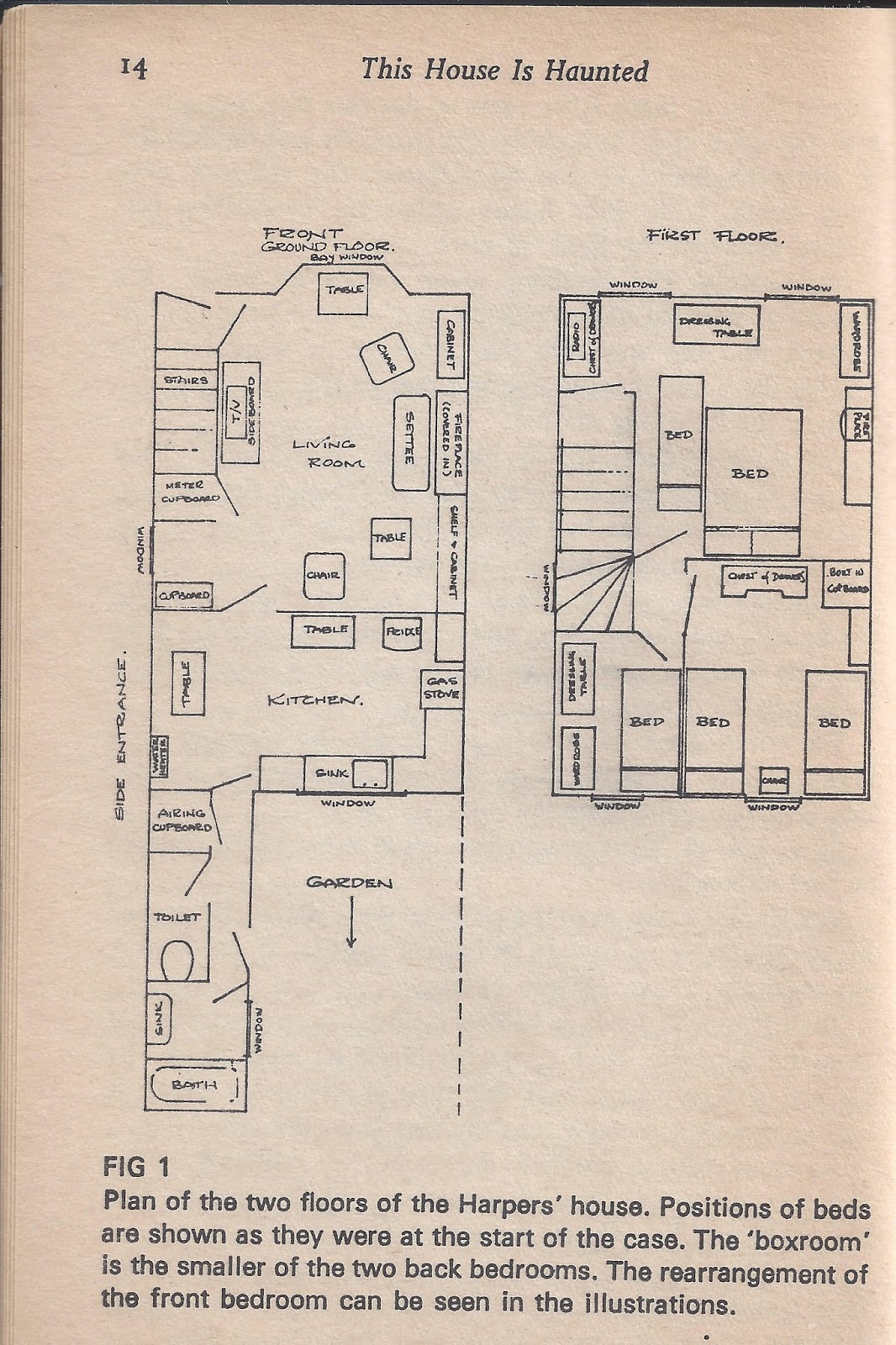
What I want to focus on in this post is the evidence we have for apparitions between those two points in the case. I'll largely be drawing from Maurice Grosse and Guy Playfair's Enfield tapes. I'll use "MG" to cite Grosse's tapes and "GP" to cite Playfair's. MG99B refers to Grosse's tape 99B, GP14A refers to Playfair's tape 14A, and so forth. It's helpful in some contexts to be able to picture the layout of the Hodgsons' house, so go here to see a floor plan.
What I want to focus on in this post is the evidence we have for apparitions between those two points in the case. I'll largely be drawing from Maurice Grosse and Guy Playfair's Enfield tapes. I'll use "MG" to cite Grosse's tapes and "GP" to cite Playfair's. MG99B refers to Grosse's tape 99B, GP14A refers to Playfair's tape 14A, and so forth. It's helpful in some contexts to be able to picture the layout of the Hodgsons' house, so go here to see a floor plan.
Monday, October 07, 2019
Moreland–is there life after death?
In this post I'll use "dualism" as shorthand for substance dualism. I subscribe to Cartesian interactionist dualism. I don't subscribe to Thomistic dualism (hylomorphism).
A. This is a fairly useful exchange as far as it goes:
But it tries to cover far too much ground in far too little time. Also, Moreland and the interviewer are talking at cross-purposes for a while, which squanders precious time.
B. Moreland probably has far more to say about religious pluralism, but due to time constraints, deflected that issue.
C. Up to a point, dualism and physicalism are empirically equivalent explanations. Both are consistent with the data that the interviewer cited, viz. memory loss, inability to form new memories, and loss of cognitive function.
According to dualism, the brain is an interface between the mind and the physical world. It mediates action or information in both directions. If damaged, the brain blocks input or output at both ends.
If the brain is damaged, that may block new sensory input. That prevents the mind from receiving new information from and about the sensible world.
If, conversely, the brain is damaged, that may block the ability of the mind to communicate with the outside world. Memories are stored in the mind, not the brain. If the brain is damaged, that impedes retrieval. The memories can't get through a washed out bridge. So long as the mind is embodied, that imposes limits on mental activity.
All things being equal, the scales tip slightly in favor of physicalism as the simpler explanation. All things considered, additional evidence weighs heavily on the dualist side of the scales.
D. Moreland greatly understates the evidence for the afterlife. I'll begin by proposing a more complex taxonomy:
1. Indirect philosophical evidence for the afterlife
2. Indirect empirical evidence for the afterlife
3. Direct theological evidence for the afterlife
4. Direct empirical evidence for the afterlife
Let's run back through these:
(1)-(2) constitute evidence for dualism. If there's evidence that the mind is ontologically independent of the brain, then that's indirect evidence for the afterlife. That's what makes disembodied consciousness possible.
1. Indirect philosophical evidence for the afterlife
i) The hard problem of consciousness.
Philosophical arguments that the characteristics of consciousness are categorically different from physical structures and events.
ii) Roderick Chisholm's argument:
2. Indirect empirical evidence for the afterlife
i) Veridical near-death experiences and veridical out-of-body experiences.
ii) ESP, psychokinesis. If all mental activity takes place inside the brain, then the mind can't know about the physical world or act on the physical world apart from sensory input or the body interacting with its environment. If, conversely, there's empirical evidence that mental activity is not confined to the brain, then that's evidence for the metaphysical possibility of disembodied postmortem survival.
3. Direct theological evidence for the afterlife
i) The biblical witness to the intermediate state. If there's good evidence that the Bible is a trustworthy source of information, then that's indirect evidence for whatever it teaches.
ii) The resurrection of Christ
That's evidence, not for the immortality of the soul, but a reembodied state.
That's what "Christian physicalists" pin their hopes on. However, the immortality of the soul is a bridge to the resurrection of the body. A philosophical objection to "Christian physicalism" is that if consciousness ceases at death, then what God resurrects isn't the same person who died but a copy of the person who died. And that raises questions of personal identity. If your existence is discontinuous, if there's a break or gap in your existence, then what does God restore? Is a copy of you you?
4. Direct empirical evidence for the afterlife
i) A subset of near-death experiences report meeting a decedent who wasn't known to be dead at the time. In a variation, the decedent imparts information that could not naturally be known. If the report is true, that's direct empirical evidence for postmortem survival.
ii) Veridical postmortem apparitions, viz. poltergeists, grief apparitions, crisis apparitions, Christophanies.
Monday, June 03, 2019
Bell, Book, and Candle updated
Patrick Chan and I have updated the bibliography for this post:
https://triablogue.blogspot.com/2009/02/bell-book-candle.html
In addition, he fixed the dead links on the old post.
https://triablogue.blogspot.com/2009/02/bell-book-candle.html
In addition, he fixed the dead links on the old post.
Friday, May 24, 2019
Ghost-layers
Exorcists are associated with expelling demons from the possessed. A related, but neglected category, is ghost-layers. Unlike an exorcist, a ghost-layer is associated expelling ghosts or poltergeists from a haunted house. Traditionally, exorcists are associated with Roman Catholic priests while ghost-layers are associated with Anglican country parsons. My immediate point is not to comment on the merits of ghost-laying, but draw attention to a neglected designation and curiosity of church history.
Saturday, October 13, 2018
Communion of the saints
i) Is there any empirical evidence for life after death? Much has been written about near-death experiences. By comparison, postmortem apparitions are neglected in contemporary Christian apologetics–although that was of great interest in Victorian England. For instance, Cambridge Ghost Society (founded in 1851) included the Cambridge Triumvirate (Westcott, Hort, and Lightfoot), as well as future Archbishop of Canterbury Edward Benson.
ii) Unlike near-death experiences, postmortem apparitions can't be explained away by a dying brain hypothesis (not that that's a good explanation for near-death experiences). It's not about the alleged experience of the patient when he was clinically dead, but living observers who say they witnessed a ghost. Some of these reports include corroborative evidence. Some of these reports are premonitions rather than postmortem apparitions.
iii) A fringe benefit is that this provides empirical disconfirmation of annihilationism.
iv) There are different kinds of purported apparitions, viz. angelic apparitions, Marian apparitions, and dominical apparitions. As an evangelical, I rule out Marian apparitions. I've discussed that elsewhere.
In reference to postmortem apparitions, the primary categories are grief apparitions and crisis apparitions. Reports may be further subdivided into visual, auditory, tactile, and olfactory apparitions. Even if you don't believe in ghosts, it's useful to have the terminology for purposes of assessment and analytical clarity.
The professional literature uses the word "hallucination," but that's prejudicial.
v) One theological concern might be whether apparitions of the dead imply universalism or postmortem salvation. If there's a reported apparition to someone who's not a Christian, or an apparition of someone who wasn't a Christian at the time of death, does that undermine the spiritual finality of death?
When we review case-studies of apparitions, there may be no information on the Christian status of the decedent or the observer. I don't think Christian theology rules out apparitions of the damned. What it precludes is a change in one's postmortem destiny. If damned angels can appear to the living, why can't the souls of damned humans?
vi) In Scripture, God sometimes sends revelatory dreams to pagans. And that's just a sample. What happens to be recorded in Scripture. If dreams, why not apparitions? Indeed, some apparitions take the form of dreams.
vii) Assuming Christianity is true, I don't think it's surprising that dead Christian friends or relatives might appear to some Christians. If the saints are aware of what's happening to their living loved ones, or sometimes aware that a living loved one is undergoing an ordeal, I don't think there's any antecedent objection to the possibility that they might appear to them to give them some encouragement or warn them of danger–unless God prevents contact between the living and the dead.
I'm not saying for a fact that the saints keep tabs on what's happening to their living loved ones. Maybe they're out of the loop. I don't think that can be settled a priori. That's an evidential question.
Scripture forbids the living from initiating contact with the dead, but that's not the same thing as the dead initiating contact with the living. Whether or not that ever happens is an evidential question.
viii) Sola Scriptura doesn't mean Scripture has all the answers. The Bible is not an encyclopedia. We depend on extrabiblical sources of information for much of what we know or believe. Scripture rules out certain possibilities, but where Scripture is silent, it's permissible and often necessary to have recourse to extrabiblical sources of information.
ix) There are hazards in both directions. On the one hand, some people are led astray by the New Age. On the other hand, if Christians have never seriously considered the status of ghosts, if they're theologically unprepared for that eventuality, then that can leave then vulnerable to the New Age in case they have an experience which they can't interpret in terms of their Christian paradigm. If they've be told that's inconsistent with the Christian theology, that leaves them ill-equipped if it does happen.
x) An alternative explanation for postmortem apparitions is that these are telepathic projections by living agents rather than the dead. But if ostensible apparitions of the dead are really projections by living agents, why do they take the form of the dead or dying rather than the living agents who (allegedly) project them? Moreover, many of the details select for postmortem apparitions rather than telepathy by living agents.
xi) Here are some criteria for veridical postmortem apparitions:
Either (1) two or more observers might independently witness the apparition; or (2) the apparition might convey information, afterwards confirmed to be true, of something which the observer had never known ; or (3) the apparition might be someone whom the observer himself had never seen, and of whose appearance he was ignorant, and yet his description of it might be sufficiently definite for identification. But though one or more of these conditions would have to be fully satisfied before we could be convinced that any particular apparition of the dead had some cause external to the observer's own mind, there is one more general characteristic of the class which is sufficiently suggestive of such a cause to be worth considering. I mean the disproportionate number of cases which occur shortly after the death of the person represented. Such a time-relation, if frequently enough encountered, might enable us to argue for the objective origin of the apparition. For, according to the law of probabilities, an apparition representing a known person would not by chance present a definite timeframe to a special cognate event-viz., the death of that person—in more than a certain percentage of cases. Cf. Gurney, Edmund & Myers, Frederic. ON APPARITIONS OCCURRING SOON AFTER DEATH, Proceedings 5, 1888-9, 404.
The hallucinations which have prima facie claim to be regarded as veridical may be divided into three classes. The first is the class in which the hallucination coincides in time with an external event in such a way as to suggest a causal connection between them–as when the apparition of a dying person is seen at the time of his death. The second is the class in which some information previously unknown to the percipient is conveyed to him through the hallucination. These two classes often overlap, as when a hallucination coinciding in time with a death distinctly conveys the information that the death has occurred or when an apparition represents some actual characteristics of the dress or appearance of the dying person which was unknown to the percipient The third class consists of "collective" hallucinations; that is, hallucinations occurring simultaneously to two or more persons, which cannot be traced to sensory suggestion from the same external cause, and cannot be explained as transferred from one percipient to the other through suggestion by word or gesture. Cf. Sidgwick, Henry et al. REPORT ON THE CENSUS OF HALLUCINATIONS, Proceedings 10, 1894, 207-9.
xii) In assessing reported apparitions, it's useful to have a large sample. That provides a margin for error. It only takes a few veridical cases to falsify naturalism. Likewise, if we have multiple, independent, firsthand accounts of the same kind of phenomena, that's provides cumulative evidence that the phenomena are real.
xiii) Here's some general statistics:
Kalish and Reynolds (1981) found that 44% of a random sample said they had experienced or felt the presence of someone who had died. The dead appeared and spoke in 73.6% of the experiences, the dead were psychologically felt in 20.3%, and in 6%, there was a sense of touch. Rees (1975) found that 46.7% of the Welsh widows he interviewed had occasional hallucinations for several years. Most common was the sense of the presence (39.2%), followed by visual (14%), auditory (13.3%),and tactile senses (2.7%). Glick, Weiss, and Parkes (1974) found among widows a persistent continuing relationship with the inner representation of the dead husband. They reportIn contrast to most other aspects of the reaction to bereavement, the sense of the persisting presence of the husband did not diminish with time. It seemed to take a few weeks to become established, but thereafter seemed as likely to be reported late in the bereavement as early (p147). "Hallucinations of Widowhood," J Am Geriatr Soc. 1985 Aug;33(8):543-7. Cf. Kalish. R. A. & Reynolds, D. K. (1981). Death and ethnicity: A psychocultural study. Farmingdale, NY: Baywood Publishing Company. Rees, W. D. (1975). The bereaved and their hallucinations. In Bernard Schoenberg et al. (Eds.), Bereavement: Its Psychosocial Aspects. New York: Columbia University Press, 66-71.
xiv) A question is where we can find reputable collections of case-studies. In this post I'll quote from several different sources. #1 is from a medical journal. #2 is from a neurosurgeon in a medical journal. #3 is from a philosophy prof. at San Francisco State U. It's a firsthand account. In addition, he researched the background of the phenomenon. #'s 4-14 are from Alas, Poor Ghost! (USU Press 1999), based on Gillian Bennett's a doctoral dissertation for the University of Sheffield. Most of the respondents were English Methodist churchgoers. #'s 15-28 are from the Society of Psychical Research. Although SPR investigators accept the paranormal, they have an aversion to orthodox Christian explanations, so that's actually hostile testimony. They record these incidents despite their secular bias.
I've excluded reports based on seances, mediums, automatic writing, and other occult elements. I've included reports that have veridical elements or reports that strike me as theological fitting. This is just a sample. I left out many additional reports because it becomes repetitious.
Subscribe to:
Posts (Atom)