
Showing posts with label Ghosts. Show all posts
Showing posts with label Ghosts. Show all posts
Sunday, July 19, 2026
Healings In UFO And Other Non-Christian Contexts (Part 2)
Picking up where I left off in my last post, I want to respond to chapter 6 in Rey Hernandez, et al., edd., Beyond UFOs (United States: The Dr. Edgar Mitchell Foundation, 2018). The chapter was written by Joseph Burkes, a retired doctor and UFO researcher, and Preston Dennett, a UFO researcher, and it addresses alleged healings that occurred in the context of UFO experiences. They examine ten cases and discuss some other research on the topic.


Thursday, July 16, 2026
Healings In UFO And Other Non-Christian Contexts (Part 1)
Because Christians have been so negligent about paranormal issues for so long, they're poorly prepared to address a large number and variety of the topics involved. I've discussed some examples in my most recent posts, in response to the release of Jonathan Kendall's The Metaphysics Of UFOs (Woodbury, Minnesota: Llewellyn Publications, 2026).
One of the subjects Christians tend to handle poorly is the existence of healings and some other miracles in non-Christian, and sometimes more specifically non-Protestant, contexts. Healings affiliated with UFOs are part of that category.
One of the subjects Christians tend to handle poorly is the existence of healings and some other miracles in non-Christian, and sometimes more specifically non-Protestant, contexts. Healings affiliated with UFOs are part of that category.
Sunday, May 17, 2026
Creating A Ghost
In a post last week, I mentioned the possibility that an apparition of the dead involves a place memory or an appearance of a deceased human rather than a demon. I want to discuss another explanatory option.
Sunday, May 10, 2026
Interacting With The Dead
Greg Koukl addressed the issue of interacting with the dead on a recent podcast. Start listening at 50:16 here. He was responding to a Christian caller whose parents have recently been having some allegedly paranormal experiences that they've interpreted as contact from their deceased daughter. I suspect ninety-some percent of the Evangelicals who would typically listen to a program like Greg's would agree with the answer he provides. But I want to address some problems with it. In addition to addressing what Greg and the caller said, I want to talk about some other misconceptions I suspect many people have about these issues.
Saturday, October 01, 2022
A Reconsideration Of The Enfield Voice
A few years ago, after I'd finished listening to the Enfield tapes, I wrote at length about my view of the voice allegedly produced by the poltergeist. I've listened to the tapes again since then. I want to revisit the issues surrounding the voice, which are large and complicated, to supplement what I said earlier.
My citations of the tapes will use "MG" to designate one from Maurice Grosse's collection and "GP" to refer to one from Guy Playfair's. Thus, MG33B is Grosse's tape 33B, GP90A is Playfair's tape 90A, and so on.
My citations of the tapes will use "MG" to designate one from Maurice Grosse's collection and "GP" to refer to one from Guy Playfair's. Thus, MG33B is Grosse's tape 33B, GP90A is Playfair's tape 90A, and so on.
Thursday, September 01, 2022
The Cleverness Of The Enfield Poltergeist
I've often discussed apparent differences between the entity behind the poltergeist and the individuals sometimes alleged to have faked it or produced it through their psychic abilities. See my article on the poltergeist voice, for example, which provides many examples of paranormal knowledge exhibited by the voice, its being ignorant of information the Hodgson children were aware of, etc. One of the categories I referred to there was knowledge the voice had that was above that of the children. I want to expand on what I said there, but with regard to the poltergeist in general rather than only the voice, and I want to focus on a particular form of knowledge it exhibited. It sometimes seemed more clever than you'd expect the Hodgson children to be.
By its nature, that sort of characteristic is going to provide weaker evidence than what we have for the poltergeist's authenticity and identity in other contexts. A child, or an adolescent in particular, could be unusually clever. As I've mentioned before, the magician Milbourne Christopher explained the Enfield case as a hoax perpetrated by the Hodgson girls and referred to Janet as "very, very clever". (The Skeptical Inquirer, Vol. 9, No. 2, Winter 1984-85, "A Final Interview With Milbourne Christopher", 161) But we don't begin with a default assumption that a person is so unusually clever, we have evidence I've discussed before that Janet and Margaret weren't so clever (e.g., what we know about their academic records, how poorly they faked phenomena on the occasions when they're known to have done so, the lack of such cleverness reflected in their later lives), and cleverness falls well short of explaining everything that needs to be explained. Furthermore, the argument from cleverness doesn't have to give us certainty or even a high degree of probability in order to have some significance. If the cleverness of the entity behind the poltergeist seems better explained by some entity other than the ones alleged to have faked the case or alleged to have produced genuine phenomena through paranormal abilities they had, that better explanation doesn't have to be better by a large margin. It just has to be better. A larger margin would be preferable, but a preference isn't a necessity.
By its nature, that sort of characteristic is going to provide weaker evidence than what we have for the poltergeist's authenticity and identity in other contexts. A child, or an adolescent in particular, could be unusually clever. As I've mentioned before, the magician Milbourne Christopher explained the Enfield case as a hoax perpetrated by the Hodgson girls and referred to Janet as "very, very clever". (The Skeptical Inquirer, Vol. 9, No. 2, Winter 1984-85, "A Final Interview With Milbourne Christopher", 161) But we don't begin with a default assumption that a person is so unusually clever, we have evidence I've discussed before that Janet and Margaret weren't so clever (e.g., what we know about their academic records, how poorly they faked phenomena on the occasions when they're known to have done so, the lack of such cleverness reflected in their later lives), and cleverness falls well short of explaining everything that needs to be explained. Furthermore, the argument from cleverness doesn't have to give us certainty or even a high degree of probability in order to have some significance. If the cleverness of the entity behind the poltergeist seems better explained by some entity other than the ones alleged to have faked the case or alleged to have produced genuine phenomena through paranormal abilities they had, that better explanation doesn't have to be better by a large margin. It just has to be better. A larger margin would be preferable, but a preference isn't a necessity.
Sunday, July 10, 2022
In what ways can we interact with the dead?
Here are some comments I posted in a YouTube discussion about prayers to the dead. This was written in response to somebody's citation of the Mount of Transfiguration as alleged support for the practice of praying to the deceased:
For a collection of posts arguing against the practice of praying to the deceased, see here. You can find other relevant posts in our archives. The collection I just linked isn't exhaustive.
Moses and Elijah had returned to life on earth. No prayer is involved. And the only one who spoke with them was Jesus. Peter, James, and John didn't speak to them. Even if we were to conclude, without good reason, that Jesus had been praying to Moses and Elijah, Jesus isn't merely human. He's also God. To cite his conversation with Moses and Elijah as justification for Christians to pray to the dead is to assume that anything Jesus did must be acceptable for Christians to do. But it's possible that praying to the deceased, if Jesus had ever done such a thing, was done through his unique attributes as God or other attributes we don't have. We'd have to take other evidence into account to make a judgment about the best explanation. Given the large amount of evidence against praying to the dead, which I've outlined above, any prayers to the dead on Jesus' part (if he did such a thing) would be best explained as exceptional rather than normative. The more significant point here, though, is that interacting with people who have returned to life on earth, as Moses and Elijah did, isn't equivalent to praying to the deceased who aren't known to have returned to life on earth. It was wrong for Saul to try to contact Samuel in 1 Samuel 28, but once Samuel had returned to the earthly realm, it became acceptable for Saul to interact with him (as reflected in Samuel asking Saul questions, which implies that it would be acceptable for Saul to answer those questions, as well as Samuel's assumption that Saul would listen to what Samuel was saying). So, your citation of the Mount of Transfiguration is faulty on multiple levels, and it leaves the other points I made untouched.
For a collection of posts arguing against the practice of praying to the deceased, see here. You can find other relevant posts in our archives. The collection I just linked isn't exhaustive.
Tuesday, December 08, 2020
Christians Should Believe In Ghosts
Earlier this year, Billy Hallowell published a book on demons, ghosts, and other paranormal topics. He was recently interviewed by Sean McDowell. Here's something I just posted in the comments section below the video. It's several paragraphs long, so I doubt many people will read it. But, for those who are interested, I explain why Christians should believe in ghosts, how we're often overly dependent on the demonic hypothesis, what harm that does, and what other explanatory options are available to a Christian.
Monday, February 17, 2020
Are the dead aware of the living?
1. The dead
What, if anything, do the dead know about the living? Catholicism has an elaborate mythology, as do various pagan faiths.
There's a danger when Christians leave a vacuum that others are only too eager to fill. Are there any reasonable, responsible suggestions we can give?
The Bible has little to say on the subject, although it sets necessary boundaries for pious conjecture. Some Christians think we shouldn't seek answers outside of Scripture. That's often prudent, but the Bible is not an encyclopedia. We rely on reason and evidence for much of what we believe. So it's partly a question of intellectual modesty. Recognizing the limits of speculation. In addition, some lines of speculation are more reasonable, better grounded, than others. Some lines of evidence have some evidence. While we shouldn't build a theological edifice on speculation and stake our immortal soul on theological conjectures, it's permissible to consider orthodox possibilities and sift the evidence we have. It's a mistake to vacate the field to let Catholics or pagans offer the answers.
2. Angels
Before discussing the dead, we might say something about the angels. How much do angels know about us? Certainly angels have some knowledge of human history. Angelic history intersects with human history at multiple points.
It's possible that angels have detailed, up-to-date knowledge of what's going on here below. One issue might be how much heavenly angels know about the goings on of fallen angels. Since fallen angels are deeply involved in human affairs, if heavenly angels to some degree counteract the inference of fallen angels in human affairs, then heavenly angels must be pretty aware of what's happening on earth.
It may also be on a need-to-know basis. A heavenly angel whom God has dispatched on a mission to earth will be briefed for his mission.
3. The damned
One possible explanation for poltergeists and haunted houses is that during the intermediate state, one way God punishes some of the damned is to condemn them to be wandering or restless spirits. They go back to their old neighborhoods, but they can no longer participate in the life they had. They are frustrated bystanders, on the outside, yearning to get back in.
It's a temporary punishment, a prelude to hell. I don't mean damnation is temporary, but the intermediate state is temporary, and there's a type of punishment suitable to the intermediate state of the damned.
4. The saints
i) I mean "saints" in a Protestant sense, not a Catholic sense. I mean Christians who go straight to heaven at the moment of death.
ii) One possibility is that they have no knowledge of what's happening on earth. They put all that behind them. They remember their own life and times, but they have no new information. No updates. The only change is when one of their Christian loved ones dies and rejoins them in heaven.
Of course, newcomers can brief the saints on the latest news, assuming that interests them.
Of course, newcomers can brief the saints on the latest news, assuming that interests them.
iii) On the face of it, the saints have no sensory awareness of what's happening on earth. They are disembodied souls.
iv) Up to a point, saints might still be interested in earthly affairs. Suppose a pious Christian mother dies. She's survived by some children and grandchildren, perhaps a sister. So she's naturally interested in their pilgrimage, their spiritual welfare. Intensely interested.
v) Perhaps she has some telepathic awareness of when a living loved one is going through a terrible ordeal. That might be analogous to relatives to who have premonitory dreams about the death of a loved one, or a loved one in mortal danger. That mechanism might explain grief apparitions and crisis apparitions.
vi) Or perhaps it's not telepathic. Perhaps God reveals to her when one of her loved ones is going through a terrible ordeal. And perhaps God gives her permission to appear to them in a dream or apparition to encourage them.
vii) However, there comes a point when all her loved ones have died. Some of them rejoin her in heaven and some go to hell. She may have no direct awareness of those who go to hell. But with the passage of time, it becomes evident that they must have died by now, yet they didn't go to heaven.
At that juncture it might be natural for her to lose interest in what's happening on earth. Her younger relatives were born after she died. She was never a part of their lives; they were never a part of her life. So there's no one left on earth that she personally knows and cares about. The younger generation are perfect strangers to her. For better or worse, all her loved ones are now on her side of the grave–in heaven or hell.
viii) Due to mortality, human experience is segmented over generations. While there's some overlap between generations, most humans are separated from each other in time and space. Human experience is highly compartmentalized in that regard. Heaven is, among other things, an opportunity to play catchup. What was scattered in time and space is regathered in one time and place. The saints, who lived and died at different times, are now moving forward together. In that regard, heaven as the world's finest history department.
Thursday, November 21, 2019
Apparitions At Enfield
The Enfield case arguably began with an apparition, and apparitions were still being reported around thirty years later. Margaret Hodgson referred to an apparition she saw while using a Ouija board in 1974, and she reported seeing the same apparition when the poltergeist was at the height of its activities a few years later (Guy Playfair, This House Is Haunted [United States: White Crow Books, 2011], 238-39). When the Bennetts moved into the house after Peggy Hodgson's death in 2003, one of them reported that, "The night before we moved out, I woke up and saw a man come into the room."
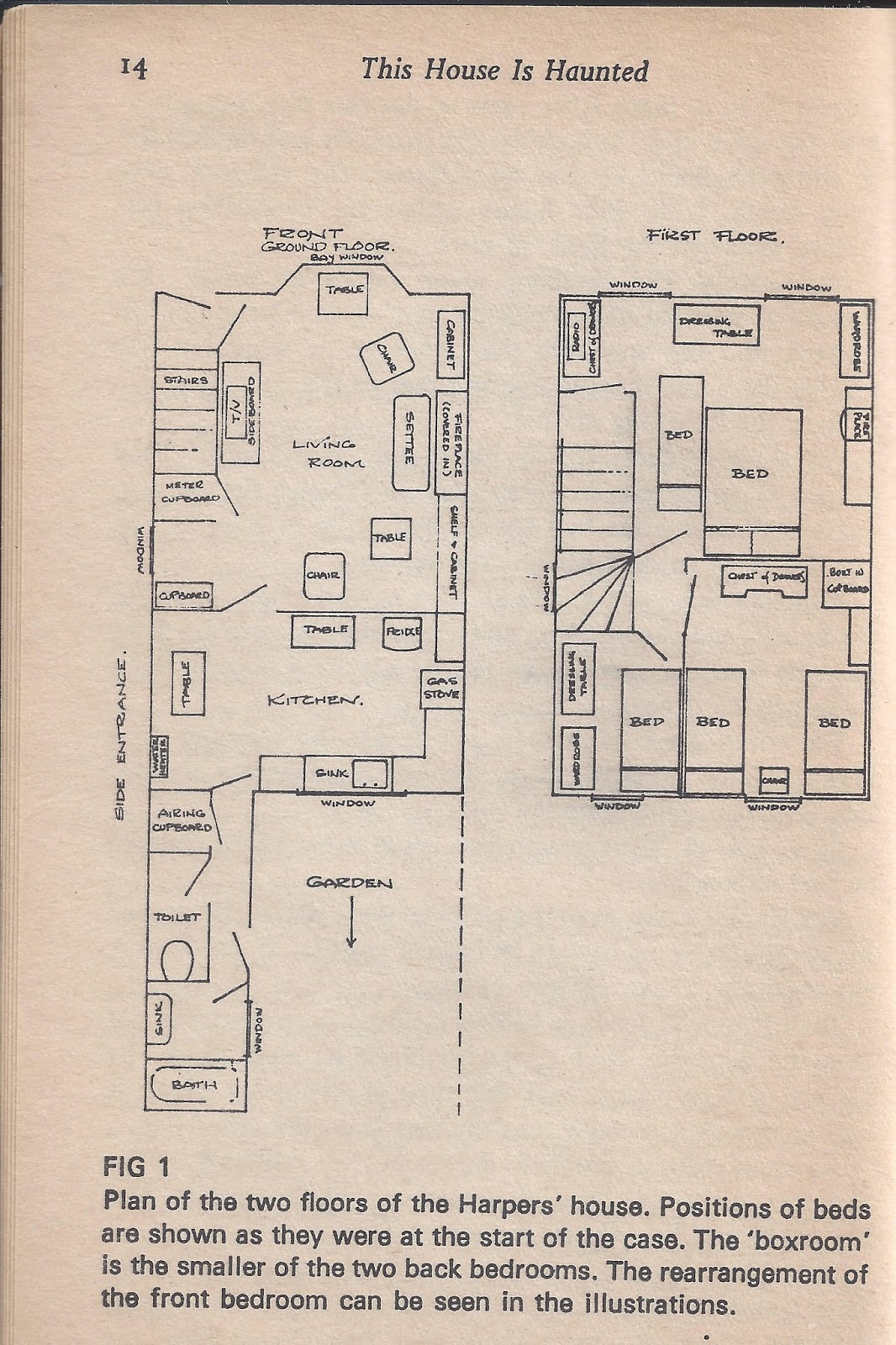
What I want to focus on in this post is the evidence we have for apparitions between those two points in the case. I'll largely be drawing from Maurice Grosse and Guy Playfair's Enfield tapes. I'll use "MG" to cite Grosse's tapes and "GP" to cite Playfair's. MG99B refers to Grosse's tape 99B, GP14A refers to Playfair's tape 14A, and so forth. It's helpful in some contexts to be able to picture the layout of the Hodgsons' house, so go here to see a floor plan.
What I want to focus on in this post is the evidence we have for apparitions between those two points in the case. I'll largely be drawing from Maurice Grosse and Guy Playfair's Enfield tapes. I'll use "MG" to cite Grosse's tapes and "GP" to cite Playfair's. MG99B refers to Grosse's tape 99B, GP14A refers to Playfair's tape 14A, and so forth. It's helpful in some contexts to be able to picture the layout of the Hodgsons' house, so go here to see a floor plan.
Saturday, October 26, 2019
Knocking In The Enfield Case
Paranormal cases often involve knocking of some sort. But it's unusual to have as much evidence for the paranormality of the knocking as we do with Enfield.
Since the layout of the Hodgsons' house is significant in some of the contexts I'll be addressing below, click here to see a floor plan. I'll be citing Maurice Grosse and Guy Playfair's tapes a lot in the discussion that follows. I'll use "MG" to designate a tape from Grosse's collection and "GP" to designate one from Playfair's, so that MG2B refers to tape 2B in Grosse's collection, GP60A refers to 60A in Playfair's, and so on.
If you click here, you can listen to some of the knocking and watch a few witnesses discussing its characteristics. However, the large majority of the knocking on the tapes doesn't sound as unusual as what's played in the clip I just linked, and the knocking didn't always move around the way Grosse describes. It did sometimes have those characteristics, though, as well as other traits I'll be discussing below. I suspect the qualities of the knocking varied for reasons similar to why an individual's speech patterns, diet, dress, and other characteristics vary in everyday life. The poltergeist could have behaved differently on different occasions depending on how much energy it had at the time, its mood, what it was trying to accomplish, and so forth.
Since the layout of the Hodgsons' house is significant in some of the contexts I'll be addressing below, click here to see a floor plan. I'll be citing Maurice Grosse and Guy Playfair's tapes a lot in the discussion that follows. I'll use "MG" to designate a tape from Grosse's collection and "GP" to designate one from Playfair's, so that MG2B refers to tape 2B in Grosse's collection, GP60A refers to 60A in Playfair's, and so on.
If you click here, you can listen to some of the knocking and watch a few witnesses discussing its characteristics. However, the large majority of the knocking on the tapes doesn't sound as unusual as what's played in the clip I just linked, and the knocking didn't always move around the way Grosse describes. It did sometimes have those characteristics, though, as well as other traits I'll be discussing below. I suspect the qualities of the knocking varied for reasons similar to why an individual's speech patterns, diet, dress, and other characteristics vary in everyday life. The poltergeist could have behaved differently on different occasions depending on how much energy it had at the time, its mood, what it was trying to accomplish, and so forth.
Sunday, October 13, 2019
Evangelical Neglect Of The Paranormal
Steve linked to a video by Jon Topping about paranormal issues. I've addressed these subjects many times before. You can find an overview here. That overview discusses some Biblical evidence for ghosts that Topping doesn't interact with, among other subjects.
What I want to focus on here is some comments Topping made about paranormal research. Start watching (here) at the point where there's about 6:30 left in the video. He makes the broad comment that "anything to do with the occult" is prohibited. He goes on to say that "we should have nothing to do with that" in reference to practices like speaking to a ghost or using a Ouija board. He then cites academics who have come out of the occult, people who do a lot of research in other contexts, saying that we shouldn't even do research on matters pertaining to the occult. We shouldn't even "touch" them. We shouldn't allow them to have "a place" in our lives.
I've already addressed why we should study the paranormal, including what's often labeled as "the occult". (The ambiguity of so much of the terminology involved in these contexts is problematic.) I think the article I just linked is largely sufficient to answer Topping's comments, but I want to supplement it.
What I want to focus on here is some comments Topping made about paranormal research. Start watching (here) at the point where there's about 6:30 left in the video. He makes the broad comment that "anything to do with the occult" is prohibited. He goes on to say that "we should have nothing to do with that" in reference to practices like speaking to a ghost or using a Ouija board. He then cites academics who have come out of the occult, people who do a lot of research in other contexts, saying that we shouldn't even do research on matters pertaining to the occult. We shouldn't even "touch" them. We shouldn't allow them to have "a place" in our lives.
I've already addressed why we should study the paranormal, including what's often labeled as "the occult". (The ambiguity of so much of the terminology involved in these contexts is problematic.) I think the article I just linked is largely sufficient to answer Topping's comments, but I want to supplement it.
Saturday, October 12, 2019
The spirit realm
I have a few quibbles with some of what Jon Topping says, but this is a generally helpful presentation:
https://www.facebook.com/p2c.students/videos/2404980893052016/
https://www.facebook.com/p2c.students/videos/2404980893052016/
Tuesday, August 20, 2019
The Voice And Personality Of The Enfield Poltergeist
If a poltergeist talks, there's potential to get more information from it. But the value of the information you get is going to depend, in part, on the poltergeist's personality.
One of the most controversial aspects of the Enfield case, an aspect that often gets more attention than is warranted, is the voice that allegedly was manifested by the poltergeist. Despite the large amount of attention the phenomena receive, interpretations of the voice, both in support of its paranormality and against it, are usually remarkably simplistic. That's partly because the large majority of people commenting on the subject have only heard a small percentage of what the voice said. But even what they say about that small percentage is often unreasonable.
I'm revisiting the issues surrounding the voice because I finished listening to Maurice Grosse and Guy Playfair's Enfield tapes earlier this year. The voice is present or discussed on dozens of those tapes, covering many hours, so that the tapes provide a lot of additional information on the issues involved.
When I cite the tapes below, I'll use "MG" to designate a tape from Grosse's collection and "GP" to designate one from Playfair's. For example, MG102B is tape 102B in Grosse's collection, and GP59A is tape 59A in Playfair's.
I'll be including the voice's vulgar language when I quote it. I don't use that sort of language, and I disapprove of it, but it has relevance to some of the points I'll be making. And given how often the voice is vulgar, leaving out the vulgarity would be too disruptive.
I want to start by summarizing the evidence for the authenticity (paranormality) of the voice. That will provide some motivation upfront for working through these issues. I'll then move on to address some objections to the authenticity of the voice. After that, I'll discuss some other subjects. Since this article is so long, some readers may want to use Ctrl F to find what they're most interested in.
The extent to which the evidence for and against the voice is significant, or even relevant, will vary from one view of the voice to another. If somebody thinks that one or more of the Hodgson children had dissociative identity disorder or some other such condition, for example, then that view has different implications than one in which the children faked everything without any of those other psychological issues involved. I'm offering some general considerations with more than one view in mind.
One of the most controversial aspects of the Enfield case, an aspect that often gets more attention than is warranted, is the voice that allegedly was manifested by the poltergeist. Despite the large amount of attention the phenomena receive, interpretations of the voice, both in support of its paranormality and against it, are usually remarkably simplistic. That's partly because the large majority of people commenting on the subject have only heard a small percentage of what the voice said. But even what they say about that small percentage is often unreasonable.
I'm revisiting the issues surrounding the voice because I finished listening to Maurice Grosse and Guy Playfair's Enfield tapes earlier this year. The voice is present or discussed on dozens of those tapes, covering many hours, so that the tapes provide a lot of additional information on the issues involved.
When I cite the tapes below, I'll use "MG" to designate a tape from Grosse's collection and "GP" to designate one from Playfair's. For example, MG102B is tape 102B in Grosse's collection, and GP59A is tape 59A in Playfair's.
I'll be including the voice's vulgar language when I quote it. I don't use that sort of language, and I disapprove of it, but it has relevance to some of the points I'll be making. And given how often the voice is vulgar, leaving out the vulgarity would be too disruptive.
I want to start by summarizing the evidence for the authenticity (paranormality) of the voice. That will provide some motivation upfront for working through these issues. I'll then move on to address some objections to the authenticity of the voice. After that, I'll discuss some other subjects. Since this article is so long, some readers may want to use Ctrl F to find what they're most interested in.
The extent to which the evidence for and against the voice is significant, or even relevant, will vary from one view of the voice to another. If somebody thinks that one or more of the Hodgson children had dissociative identity disorder or some other such condition, for example, then that view has different implications than one in which the children faked everything without any of those other psychological issues involved. I'm offering some general considerations with more than one view in mind.
Monday, July 15, 2019
Dreams And Trances At Enfield
The hardest Enfield tapes to listen to are the ones that feature the Hodgson children in altered states of consciousness, primarily in November of 1977. The states are often referred to as dreams and trances, so I've titled my post according to that convention, but we can't say much beyond the fact that some altered state of consciousness was involved. In a discussion with Hans Bender, Guy Playfair commented on Janet Hodgson's condition in the closing days of November:
We found the girl screaming, yelling, lying on the floor. She was underneath the table, trying to kick it over…The mother was absolutely desperate, you know. She didn't know what to do. And Luiz [Gasparetto, a Brazilian medium] spent about half an hour with her [Janet], and she immediately became quiet. I have all this on the tape. He talked to her very quietly in Portuguese, and she went to sleep. She went to sleep at 7 o'clock in the evening and she woke up the next morning only at 9 o'clock. That's fourteen hours of sleep. And she never had another hysterical fit. She just had one bad dream, and, after that, there was no more….The mother told me that she doesn't mind the tables falling over, but these hysterical attacks were absolutely too much, you know. She was really very, very distressed. And, I must say, that I was, too. It's one of the most horrible things I've ever seen, because they would go on for three, four hours. They would go on until 3 o'clock in the morning. And she would even wake up in a conversion. She was completely out for four days…Twice we called a doctor, emergency doctor, who gave her an injection of Valium…An interesting detail was that half an hour after she was given an injection of Valium, she was thrown out of bed, right across the room….the two girls would dream together….And we would open their eyes, and we would shine the torches [flashlights], and the pupil [wouldn't] contract. And we would also tickle under the arms, and they were completely asleep. And they would talk to each other….Again, we have it on tape. (tape 39B in Playfair's collection, 0:41)
Monday, June 03, 2019
Bell, Book, and Candle updated
Patrick Chan and I have updated the bibliography for this post:
https://triablogue.blogspot.com/2009/02/bell-book-candle.html
In addition, he fixed the dead links on the old post.
https://triablogue.blogspot.com/2009/02/bell-book-candle.html
In addition, he fixed the dead links on the old post.
Friday, May 24, 2019
Ghost-layers
Exorcists are associated with expelling demons from the possessed. A related, but neglected category, is ghost-layers. Unlike an exorcist, a ghost-layer is associated expelling ghosts or poltergeists from a haunted house. Traditionally, exorcists are associated with Roman Catholic priests while ghost-layers are associated with Anglican country parsons. My immediate point is not to comment on the merits of ghost-laying, but draw attention to a neglected designation and curiosity of church history.
Wednesday, March 06, 2019
The Night Hag
Concerns regarding sleep disorders in Hmong immigrants in the US emerged when an astonishingly high mortality rate of Sudden Unexplained Nocturnal Death Syndrome (SUNDS) was documented in Hmong men.
In 1981, an unusual new condition came to the attention of the medical community: based on mortality reports first appearing in 1977, the Centers for Disease Control (CDC) issued an international note that Southeast Asian refugees, primarily Hmong, to the US were dying in their sleep (Centers for Disease Control, 1981). What made this occurrence unusual was, not only the circumstances of the nocturnal deaths, but the fact that the victims were young men, previously in good health. Reports of these cases increased over the following six years; a mortality rate of 92/100,000 showed these Hmong men were dying at a rate equivalent to the leading five causes of death for American-born men of the same age range.
In contrast to the novelty of SUNDS to Western science in 1981, Hmong and other South–East Asian populations have long feared the personal experience epitomized by SUNDS. Culture-specific names have been given to this experience; Hmong refer to the terrifying nighttime occurrence of the crushing spirit on their chest as dab tsog (Adler, 1995; Bliatout, 1982; Fukuda, Miyasity, Inugami, & Ishihara, 1987; Holtan et al., 1984). Victims of visits from this spirit report that dab tsog sat on their chest with crushing force, making it impossible to move and “took their breath”. Although parallels are drawn between SUNDS and the dab tsog experience, the high fatality of the medical syndrome of SUNDS differs from that of dab tsog: historical and ethnographic reports indicate that the experience of dab tsog is not rare or fatal, and is often experienced repeatedly by the victims (Adler, 1995, 2011). Thus, the cultural pattern, collective knowledge and universal description of dab tsog suggest a prevalent bio-psychosocial condition of which only a limited number of cases results in a SUNDS fatality. In a study of 118 Hmong in California, 58% reported at least one experience of the dab tsog visit; in-depth interviews clearly indicated widespread fear, stress, and dread of sleep abnormalities in the Hmong population (Adler, 1994).
Victims discovered in the night terrors are unarousable, and in the few successfully aroused patients, terrifying dreams were often experienced.40 In addition, frequent experiences of “dab tsog (frightening night spirit pressing on chest),” nightmares, sleep paralysis, and hypnogogic hallucinations still exist in Hmong after immigrating to the United States for decades, probably putting Hmong at high risk for SUNDS.41
Sunday, January 06, 2019
The worlds of spirits
In the year of his death, Richard Baxter, a preeminent Puritan, published The Certainty of the Worlds of Spirits. As he explains:
When God first awakened me, to think with preparing seriousness of my condition after death, I had not any observed doubts of the reality of spirits, or the immortality of the soul, or the truth of the gospel…But when God had given me peace of conscience, Satan assaulted me with those worse temptations…I still saw that to be an atheist was to be mad. But I found that my faith of supernatural revelation must be more than a believing man, and that if it had not a firm foundation and rooting, even sure evidence of verity, surely apprehended, it was not like to do those great works that faith had to do, and to overcome the world, the flesh, and the devil, and to make my death to be safe and comfortable. Therefore I found that all confirming helps were useful…And finding that almost all the atheists, Sadducces and infidels, did seem to profess, that were they but sure of the reality of the apparitions and operations of spirits, it would cure them, I thought this the most fruitable helped for them... (Preface).I confess, very many cheats of pretended possessions have been discovered, which hath made some weak, injudicious men think that all are such. Two sorts of persons have oft been found deceivers: (i) persons prepared and trained up purposely by Papist priests to honor their exorcisms; (ii) Lustful, rank girls and young widows, that plot for some amorous, precacious design, or have imaginations conquered by lust.Tis hard to know by their words or signs when it is a devil, and when a human soul that appeareth…we are not fully certain whether these aerial regions have not a third sort of wights, that are neither angels (good or fall) nor souls of men, but those called fairies and goblins… (chap. 1).
It's a mixed bag. I think a few of his examples are just ecclesiastical legends (e.g. incubi and succubi, blood-sucking imps, the devil's familiars). Some may reflect ignorance of botany which undergoes legendary embellishment (e.g. Glastonbury thorn).
Likewise, the primitive state of 17C medicine invites misdiagnosis in some cases. And some folk medical treatments aggravate the condition. For instance, some cases might have a natural explanation (e.g. gallstones, kidney stones). By the same token, some people might have undiagnosable conditions, by 17C standards, that result in mental illness.
He cites reports of grain falling from the sky (chap 10). Perhaps that has a natural explanation.
They don't understand the nature of lightning. He also mentions a case of ball-lightning (chap. 8). From what I've read, that remains a mysterious phenomenon.
He mentions the case of a maid who was hexed by having a pin thrust in her thigh. It's well-documented, and more examples like that might demonstrate malicious spells, but he only gives one example.
He mentions a few cases of xenoglossy. That would be evidence for spirit-possession, but his examples aren't well-documented.
More impressive are cases of people spitting up pins, needles, knives, shards of glass. There may be natural explanations why some people are motivated to swallow sharp objections. In some cases it might be staged, although that's a very hazardous hoax. And there are ways to detect imposture.
What's harder to explain naturalistically is how they could swallow and cough up such objects without incurring fatal internal bleeding. And these aren't single incidents, but repeated.
Likewise, objects levitating and flying in a room have no natural explanation.
I find his collection of anecdotes is quite uneven. That reflects his limited access to relevant reports. I think modern scientific knowledge renders some of his examples dubious. Conversely, modern science and telecommunications cast a far wider net, so the available evidence for miracles and occult phenomena is much greater than Baxter had at his disposal.
With those caveats in mind, I'll quote what struck me as the more uncanny examples:
Thursday, November 01, 2018
Kanashibari
This seems to be the Japanese equivalent of Old Hag syndrome:
https://randalrauser.com/2011/02/awake-in-japan-a-first-person-account-of-demonic-oppression/
https://randalrauser.com/2011/02/awake-in-japan-a-first-person-account-of-demonic-oppression/
Subscribe to:
Posts (Atom)