My last post discussed some significant comments Graham Morris made about his famous photographs of Janet Hodgson allegedly levitating in the context of the Enfield Poltergeist. I want to quote some of his relevant comments here.
Aside from the importance of his comments in the context of his levitation photos, there's the issue of the general quality of Maurice Grosse and Guy Playfair's investigation of the case. They've been criticized a lot over the years - by Anita Gregory, Tony Cornell, and others - for allegedly handling the Enfield case poorly. You can click on the links just provided for responses to their criticisms. (And I've written other responses.) Some of the criticisms have had some validity, like what I've discussed here and in other posts, but the criticisms have been largely inaccurate. Many of the best aspects of Grosse and Playfair's work have been overlooked or underestimated. See my discussion with David Robertson about the scientific documentation they gathered for Janet's paranormal abilities, for example, such as testing her ability to bend metal at the Hodgsons' house in 1977 (as described in the video clip here) and a weight gain experiment conducted at Birkbeck College (part of the University of London) in 1982. Skeptics often object to the lack of video evidence, but Grosse and Playfair arranged for a video team from Pye Business Communications to come into the house the same month the investigation of the case began. Go here to listen to Ron Denney of Pye describing how their camera equipment malfunctioned in apparently paranormal ways while they were in the house, ways he describes as "absolutely impossible" and "one chance in a million". And Stewart Lamont's video captured what seems to be the poltergeist's knocking occurring elsewhere in the house while the Hodgson girls were being filmed sitting on a couch (with the other Hodgson children also accounted for), contrary to the typical skeptical argument that they faked all of the phenomena. I've discussed other examples of the quality of the investigation here. Graham Morris' recent comments about how they handled photography issues, quoted below, are worth adding to the list.

Showing posts with label Guy Playfair. Show all posts
Showing posts with label Guy Playfair. Show all posts
Wednesday, July 22, 2026


Tuesday, July 21, 2026
A Skeptic's Concessions About The Enfield Poltergeist
The Uncanny podcast recently did an episode on Enfield. The podcast is hosted by Danny Robins and includes analysis from a couple of paranormal researchers, Ciaran O'Keeffe (representing the skeptical perspective) and Evelyn Hollow (representing belief in the paranormal). There was a segment with Graham Morris as well, a photographer who covered the Enfield case for the Daily Mirror and witnessed some paranormal events. He made some significant comments, including ones I hadn't heard before, from him or any other source.
I'll be responding to several aspects of the program and other people's responses to it, but I want to begin where the video linked above does. It begins with a clip of some of O'Keeffe's concessions. He didn't even come close to offering a good skeptical explanation of the case, and he made some significant concessions about the quality of the evidence for it.
I'll be responding to several aspects of the program and other people's responses to it, but I want to begin where the video linked above does. It begins with a clip of some of O'Keeffe's concessions. He didn't even come close to offering a good skeptical explanation of the case, and he made some significant concessions about the quality of the evidence for it.
Tuesday, October 21, 2025
A Response To Tony Cornell And Ben Machell Regarding The Enfield Poltergeist
Ben Machell recently published a book about the paranormal that's focused on the late paranormal researcher Tony Cornell, titled Chasing the Dark (New York, New York: Grand Central Publishing, 2025). I found Ben's book to be good for the most part and would recommend it as a resource on the paranormal and on Cornell in particular. But its material on Enfield is bad enough to warrant a response.
Thursday, July 31, 2025
How Close, And Yet How Far Apart, Were The Worlds Of The Familiar And The Extraordinary
Guy Playfair wrote about an occasion when he was inside the Hodgsons' house while investigating the Enfield Poltergeist. He's contrasting the paranormal events inside the house to what was going on with the people walking by outside, who were focused on other things:
"It was late afternoon, and commuters were going home from the station, snatches of their conversation drifting through the window. Once again I was reminded of how close, and yet how far apart, were the worlds of the familiar and the extraordinary." (This House Is Haunted [United States: White Crow Books, 2011], 50)
"It was late afternoon, and commuters were going home from the station, snatches of their conversation drifting through the window. Once again I was reminded of how close, and yet how far apart, were the worlds of the familiar and the extraordinary." (This House Is Haunted [United States: White Crow Books, 2011], 50)
Thursday, July 03, 2025
Skeptical Myths About The Enfield Poltergeist
There's a constant stream of new videos, podcasts, articles, and other material coming out about the Enfield case. There are certain skeptical misrepresentations that are recurring themes. I've addressed many objections to the case here and elsewhere over the years, but my material has been scattered across a lot of locations. I want to gather in one place some concise responses to particular objections, including some of the most common ones, with links to lengthier responses for those who are interested.
The objections vary a lot in their quality, but they're ones I think are worth responding to because of their popularity or for whatever other reason. Sometimes an objection is inaccurate because it's assigned too much significance to one degree or another, even though it would be accurate if kept in proportion. Since some otherwise valid objections seem to often be taken out of proportion, that's one of the problems I want to address here.
This post is meant to give people a better understanding of the case, whether as a cure for the myths after encountering them or as an inoculation before encountering them in the future. I'm not trying to resolve every issue here. You can read my other posts on Enfield, like the ones linked above, for more.
Each myth will be summarized in bold print, followed by a response. I'll probably add responses to more myths as time goes on. Below is a list of each one, with a link that will take you to the relevant section of the post.
The objections vary a lot in their quality, but they're ones I think are worth responding to because of their popularity or for whatever other reason. Sometimes an objection is inaccurate because it's assigned too much significance to one degree or another, even though it would be accurate if kept in proportion. Since some otherwise valid objections seem to often be taken out of proportion, that's one of the problems I want to address here.
This post is meant to give people a better understanding of the case, whether as a cure for the myths after encountering them or as an inoculation before encountering them in the future. I'm not trying to resolve every issue here. You can read my other posts on Enfield, like the ones linked above, for more.
Each myth will be summarized in bold print, followed by a response. I'll probably add responses to more myths as time goes on. Below is a list of each one, with a link that will take you to the relevant section of the post.
Tuesday, July 02, 2024
Television Fame
"After I had appeared on Thames Television's evening news discussing my fourth book, I was greeted excitedly by one of the counter staff at my bank with, 'Oh, I saw you on telly last night!' She had seen me at least once a week for a couple of years and never mentioned having read anything of mine. Now, after five minutes' chat on the screen, I was somebody famous. Television fame, I learned, meant being famous not for actually having done anything but just for being on television." (Guy Playfair, The Evil Eye [London, England: Jonathan Cape, 1990], 21)
Sunday, August 01, 2021
Was the Enfield case faked for money?
The recent release of The Conjuring 3 has brought up issues about the Warrens and their financial interests in the paranormal cases they investigated. I discussed the subject in a post about the latest Conjuring movie several weeks ago. I want to address a related issue concerning the subject of the second movie in the series, the Enfield Poltergeist. What financial motives might the people involved in that case have had? One of the most common motives proposed for any sort of fraud is a desire to make money. That's relevant not just to the Warrens, but also to the rest of the people involved in the Enfield case.
Movies can, and often do, make people wealthy. But The Conjuring 2 came along too late to be a good candidate for motivating anybody to fabricate the Enfield case. The same can be said of the television series on Enfield that came out in 2015. Nobody in 1977 was expecting that sort of television series or movie, much less would anybody have been expecting it to make a lot of money. Something like a movie that comes out nearly four decades after a poltergeist case started offers a poor explanation for why the case originated. What critics of the Enfield case need to be more focused on is the opportunities for making money early on, such as by means of media coverage or the publishing of books.
In the process of discussing these issues, I'll be making reference to Maurice Grosse and Guy Playfair's Enfield tapes. I'm going to use "MG" to refer to tapes from Grosse's collection. "GP" will refer to those from Playfair's. MG64B is tape 64B in Grosse's collection, GP3A is Playfair's tape 3A, and so on.
Movies can, and often do, make people wealthy. But The Conjuring 2 came along too late to be a good candidate for motivating anybody to fabricate the Enfield case. The same can be said of the television series on Enfield that came out in 2015. Nobody in 1977 was expecting that sort of television series or movie, much less would anybody have been expecting it to make a lot of money. Something like a movie that comes out nearly four decades after a poltergeist case started offers a poor explanation for why the case originated. What critics of the Enfield case need to be more focused on is the opportunities for making money early on, such as by means of media coverage or the publishing of books.
In the process of discussing these issues, I'll be making reference to Maurice Grosse and Guy Playfair's Enfield tapes. I'm going to use "MG" to refer to tapes from Grosse's collection. "GP" will refer to those from Playfair's. MG64B is tape 64B in Grosse's collection, GP3A is Playfair's tape 3A, and so on.
Saturday, August 01, 2020
A Tribute To Guy Playfair

(I'll be making reference to the Enfield tapes of Maurice Grosse and Guy Playfair. I'll use "MG" to refer to Grosse's tapes and "GP" to refer to Playfair's. So, MG90B is Grosse's tape 90B, GP87A is Playfair's tape 87A, and so on.)
It was a September 11, 1977 program on BBC Radio that convinced Guy Playfair to get involved in the Enfield case. Part of what he heard on the program that convinced him was the exhaustion that was evident in Maurice Grosse's voice. Playfair would later write, "I knew what Grosse could expect at Enfield. Sleepless nights, a great deal of constant confusion, and at the end of it all the same feeling of utter bewilderment. I had helped research several cases in Brazil…'Let me know if you get really stuck,' I said to Grosse as we left the meeting room of Kensington Public Library. I cannot have sounded very sincere…[A few days later] I happened to hear the [BBC Radio] programme while eating my Sunday lunch. It was dramatic stuff, and Grosse, who had not had a proper night's sleep that week, sounded really worn out….I rang Maurice Grosse and asked if he needed some help. He did, he said. And so, on Monday 12 September 1977, I postponed (as I thought) my holiday plans, and went along to the 'house of strange happenings.'" (This House Is Haunted [United States: White Crow Books, 2011], 23, 30) That September 11 radio program is in Playfair's collection of Enfield tapes (GP36B). On the program, Grosse's weariness is obvious, and so is the significance of the case. Grosse later told Playfair, "Well, I mean, if you hadn't have come on the case, it would have been bloody awful for me, to say the least." (MG20Bi, 36:06)
Grosse made that comment in November of 1977, which probably was the most difficult month of the case, largely because of Janet Hodgson's trance states. But even before that, Grosse had been sick for a while, and the poltergeist's embodied voice was to begin the next month, in December, which involved a lot of additional work. So, Playfair's assistance was beneficial on many fronts from the start.
Friday, May 01, 2020
What Enfield Skeptics Actually Experienced At The Hodgsons' House
Some of the most prominent critics of the Enfield case are individuals who visited the house where most of the poltergeist phenomena occurred. People like Milbourne Christopher, John Beloff, and Anita Gregory claimed to have not experienced anything at the house, and their skepticism has been cited against the case for decades. Because I've now listened to Maurice Grosse and Guy Playfair's audio cassettes and because of some other information that's recently come to light, I want to revisit the subject of what these skeptics actually experienced when they were at the house. As we'll see, their experiences have often been misrepresented, and they do more to support than to undermine the authenticity of the case.
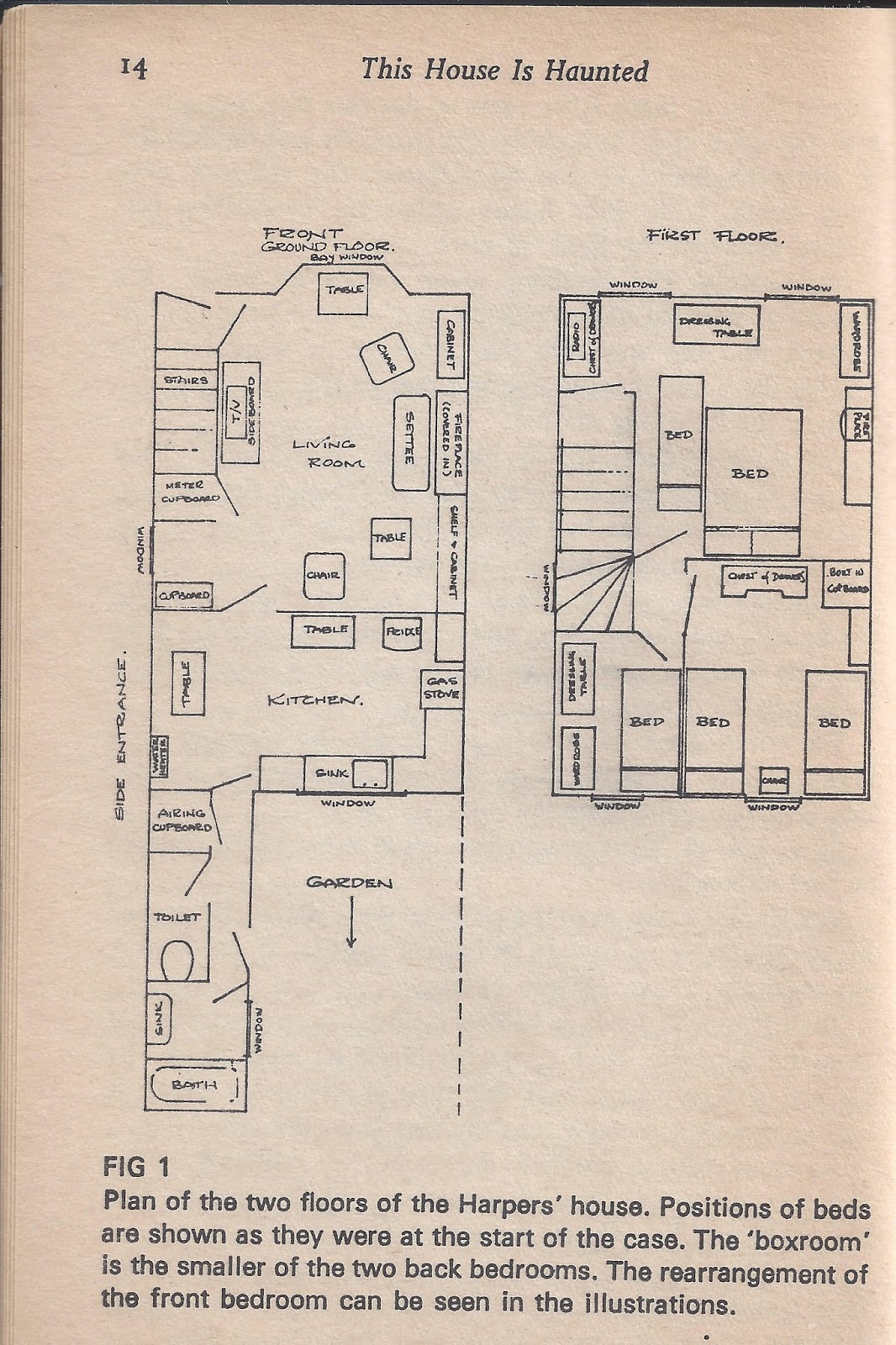
It's useful to know the layout of the house, so go here to see a floor plan. I'll use "MG" to designate a tape from Grosse's collection and "GP" to designate one from Playfair's. MG8A is Grosse's tape 8A, GP21A is Playfair's 21A, etc.
It's useful to know the layout of the house, so go here to see a floor plan. I'll use "MG" to designate a tape from Grosse's collection and "GP" to designate one from Playfair's. MG8A is Grosse's tape 8A, GP21A is Playfair's 21A, etc.
Tuesday, March 03, 2020
The Quality Of The Initial Enfield Investigation
Maurice Grosse and Guy Playfair have often been criticized for how they went about investigating the Enfield case. You can find a lot of examples in my previous articles, like this one on Anita Gregory and this one on Joe Nickell. I've mentioned some of my own disagreements with Grosse and Playfair, though I have a generally positive view of how they handled the case. They acknowledged that they made some mistakes. Nobody would be one of the lead investigators of such a large and complicated case without getting some things wrong. The quality of their work is often underestimated, though, largely because so many of the relevant details haven't been publicized much. What I want to focus on in this post is the evidence we can gather on this subject from Grosse and Playfair's tapes. I'll use "MG" to designate Grosse's tapes and "GP" to refer to Playfair's, which means that MG99B refers to Grosse's tape 99B, and GP51B refers to Playfair's tape 51B, for example.
Think of the significance of how I just concluded the paragraph above. The fact that we have so many audio recordings related to the original investigation of the case, including recordings of so many allegedly paranormal events, is a testament to the quality of the investigators' work. And I had to distinguish between the tapes and other sources above because there's such a large amount of material outside of the tapes as well. The amount of tapes, signed witness statements, notes, transcripts, and other documentation Grosse and Playfair produced is highly impressive and, in some ways, unprecedented.
I can't be exhaustive, but here are several examples of the quality of their work from the tapes:
Think of the significance of how I just concluded the paragraph above. The fact that we have so many audio recordings related to the original investigation of the case, including recordings of so many allegedly paranormal events, is a testament to the quality of the investigators' work. And I had to distinguish between the tapes and other sources above because there's such a large amount of material outside of the tapes as well. The amount of tapes, signed witness statements, notes, transcripts, and other documentation Grosse and Playfair produced is highly impressive and, in some ways, unprecedented.
I can't be exhaustive, but here are several examples of the quality of their work from the tapes:
Tuesday, December 17, 2019
Some Enfield Photos Rarely Seen
In 1983, the now-defunct magazine The Unexplained ran a series of articles on the Enfield Poltergeist. The first two were written by Guy Playfair, and the third was written by Anita Gregory (vol. 11, issue 121, "Enfield: The Trouble Begins", 2401-5; vol. 11, issue 122, "Enfield: Whatever Next?", 2426-29; vol. 11, issue 123, "Enfield On Trial", 2458-60). All three articles feature a lot of photographs, with accompanying captions providing some context. Many of the photos are ones I'd never seen before. What I want to do here is post several that I consider the most significant ones. I don't think they're available anywhere else on the web. I'll provide some additional information based on what I know of the context of the photos. I also want to discuss some significant information provided in the caption for one of the photos that's better known.
Go here to see a floor plan of the house where the poltergeist's activities typically occurred. References to Maurice Grosse and Guy Playfair's tapes will use "MG" to designate Grosse's tapes and "GP" to designate Playfair's. MG43A is Grosse's tape 43A, GP32A is Playfair's tape 32A, etc.
What's below is a picture of Janet Hodgson either leaving a bed or landing (on her neck or head) during a throwing incident. The photo is attributed to Grosse. I doubt he'd have told the magazine (or have told Playfair, if Playfair gave Grosse's photo to the magazine) that Janet was being thrown if that wasn't the context. Based on what I know of his behavior on his tapes and elsewhere, I'd expect him to have had good evidence that what he was photographing was a throwing incident. When the subject of levitation comes up, people usually talk about the photos of Janet in a posture that resembles jumping, but the poltergeist lifted her or threw her in a large variety of ways. There are some photographs, like the one below, in which Janet's posture doesn't resemble jumping. (And see here for evidence that the ones with a jumping posture are authentic.) The magazine has two photos overlapping. The upper right portion of the photo below is covered by the bottom left of another one:
Go here to see a floor plan of the house where the poltergeist's activities typically occurred. References to Maurice Grosse and Guy Playfair's tapes will use "MG" to designate Grosse's tapes and "GP" to designate Playfair's. MG43A is Grosse's tape 43A, GP32A is Playfair's tape 32A, etc.
What's below is a picture of Janet Hodgson either leaving a bed or landing (on her neck or head) during a throwing incident. The photo is attributed to Grosse. I doubt he'd have told the magazine (or have told Playfair, if Playfair gave Grosse's photo to the magazine) that Janet was being thrown if that wasn't the context. Based on what I know of his behavior on his tapes and elsewhere, I'd expect him to have had good evidence that what he was photographing was a throwing incident. When the subject of levitation comes up, people usually talk about the photos of Janet in a posture that resembles jumping, but the poltergeist lifted her or threw her in a large variety of ways. There are some photographs, like the one below, in which Janet's posture doesn't resemble jumping. (And see here for evidence that the ones with a jumping posture are authentic.) The magazine has two photos overlapping. The upper right portion of the photo below is covered by the bottom left of another one:
Tuesday, August 20, 2019
The Voice And Personality Of The Enfield Poltergeist
If a poltergeist talks, there's potential to get more information from it. But the value of the information you get is going to depend, in part, on the poltergeist's personality.
One of the most controversial aspects of the Enfield case, an aspect that often gets more attention than is warranted, is the voice that allegedly was manifested by the poltergeist. Despite the large amount of attention the phenomena receive, interpretations of the voice, both in support of its paranormality and against it, are usually remarkably simplistic. That's partly because the large majority of people commenting on the subject have only heard a small percentage of what the voice said. But even what they say about that small percentage is often unreasonable.
I'm revisiting the issues surrounding the voice because I finished listening to Maurice Grosse and Guy Playfair's Enfield tapes earlier this year. The voice is present or discussed on dozens of those tapes, covering many hours, so that the tapes provide a lot of additional information on the issues involved.
When I cite the tapes below, I'll use "MG" to designate a tape from Grosse's collection and "GP" to designate one from Playfair's. For example, MG102B is tape 102B in Grosse's collection, and GP59A is tape 59A in Playfair's.
I'll be including the voice's vulgar language when I quote it. I don't use that sort of language, and I disapprove of it, but it has relevance to some of the points I'll be making. And given how often the voice is vulgar, leaving out the vulgarity would be too disruptive.
I want to start by summarizing the evidence for the authenticity (paranormality) of the voice. That will provide some motivation upfront for working through these issues. I'll then move on to address some objections to the authenticity of the voice. After that, I'll discuss some other subjects. Since this article is so long, some readers may want to use Ctrl F to find what they're most interested in.
The extent to which the evidence for and against the voice is significant, or even relevant, will vary from one view of the voice to another. If somebody thinks that one or more of the Hodgson children had dissociative identity disorder or some other such condition, for example, then that view has different implications than one in which the children faked everything without any of those other psychological issues involved. I'm offering some general considerations with more than one view in mind.
One of the most controversial aspects of the Enfield case, an aspect that often gets more attention than is warranted, is the voice that allegedly was manifested by the poltergeist. Despite the large amount of attention the phenomena receive, interpretations of the voice, both in support of its paranormality and against it, are usually remarkably simplistic. That's partly because the large majority of people commenting on the subject have only heard a small percentage of what the voice said. But even what they say about that small percentage is often unreasonable.
I'm revisiting the issues surrounding the voice because I finished listening to Maurice Grosse and Guy Playfair's Enfield tapes earlier this year. The voice is present or discussed on dozens of those tapes, covering many hours, so that the tapes provide a lot of additional information on the issues involved.
When I cite the tapes below, I'll use "MG" to designate a tape from Grosse's collection and "GP" to designate one from Playfair's. For example, MG102B is tape 102B in Grosse's collection, and GP59A is tape 59A in Playfair's.
I'll be including the voice's vulgar language when I quote it. I don't use that sort of language, and I disapprove of it, but it has relevance to some of the points I'll be making. And given how often the voice is vulgar, leaving out the vulgarity would be too disruptive.
I want to start by summarizing the evidence for the authenticity (paranormality) of the voice. That will provide some motivation upfront for working through these issues. I'll then move on to address some objections to the authenticity of the voice. After that, I'll discuss some other subjects. Since this article is so long, some readers may want to use Ctrl F to find what they're most interested in.
The extent to which the evidence for and against the voice is significant, or even relevant, will vary from one view of the voice to another. If somebody thinks that one or more of the Hodgson children had dissociative identity disorder or some other such condition, for example, then that view has different implications than one in which the children faked everything without any of those other psychological issues involved. I'm offering some general considerations with more than one view in mind.
Monday, July 01, 2019
The Ripping Out Of The Fireplace In The Enfield Case
A paranormal researcher who's skeptical of Enfield nevertheless acknowledged that "there were reports of activity that I'm not willing to dismiss a priori as childish trickery, such as a wrought iron fireplace being wrenched out of a wall". Mary Rose Barrington, in the committee report on the Enfield case for the Society for Psychical Research (SPR), referred to the fireplace incident as "an item of poltergeistery of the first order" (cited here). See here for a brief overview of the incident in a documentary, which includes comments from a few people who were in the house at the time, most of them in the room where the fireplace was. The event was recorded on audio tape (8B in Guy Playfair's collection). This post is largely about that recording.
When I cite the Enfield tapes, I'll use "MG" to refer to a tape from Maurice Grosse's collection and "GP" to refer to one from Playfair's. So, MG28B is tape 28B in Grosse's collection, and GP93A is tape 93A in Playfair's.
Before getting to the contents of the tape of the fireplace incident, I'll quote an overview from Playfair's book. On the morning of October 26, 1977:
When I cite the Enfield tapes, I'll use "MG" to refer to a tape from Maurice Grosse's collection and "GP" to refer to one from Playfair's. So, MG28B is tape 28B in Grosse's collection, and GP93A is tape 93A in Playfair's.
Before getting to the contents of the tape of the fireplace incident, I'll quote an overview from Playfair's book. On the morning of October 26, 1977:
There was a sudden violent shaking sound, and it was immediately followed by total panic.
'Oh Lord!' cried [Peggy Hodgson]. 'That does it. All that power! I'm getting out.'…
The entire iron frame of the gas fire had been wrenched out of the wall, and was standing at an angle on the floor, still attached to the half-inch diameter brass pipe that connected it to the mains. The pipe had been bent through an angle of 32 degrees. This was a major demolition job, for the thing was cemented into the brickwork, and it was out of the question to suggest that one of the children could have wrenched it out. When we finally dismantled the whole apparatus, we found it quite a job even to move. It must have weighed at least fifty pounds. (This House Is Haunted [United States: White Crow Books, 2011], 60)
Friday, May 24, 2019
A Reassessment Of The Warrens And Enfield
Lorraine Warren's death last month has been getting a lot of media attention. The stories I've seen often mention the Conjuring series and the movies associated with it, including The Conjuring 2 in particular, and the Warrens' involvement in the Enfield Poltergeist. Given the success of the Conjuring series and affiliated movies (another one's coming out next month), we'll probably be hearing a lot about the Warrens over the next several years. And they'll be discussed for many years to come for other reasons. I don't know much about the other paranormal cases they've been involved with, but I do know a lot about Enfield. I recently finished listening to Maurice Grosse and Guy Playfair's Enfield tapes, and some of those tapes include discussions with or about the Warrens. To my knowledge, much of the material on those tapes has never been discussed publicly, and some of it is highly significant. Since the Warrens are getting so much attention, this is a good time to address those tapes.
Some of the coverage of Lorraine's death has portrayed her positively. See, for example, this article by the Horror News Network that includes a lot of references to her kindness, generosity, and such. By contrast, a Hollywood Reporter article in December of 2017 noted:
Some of the coverage of Lorraine's death has portrayed her positively. See, for example, this article by the Horror News Network that includes a lot of references to her kindness, generosity, and such. By contrast, a Hollywood Reporter article in December of 2017 noted:
Wednesday, May 15, 2019
A New Book By Melvyn Willin On The Enfield Poltergeist
It should be out soon. For those who don't know, Willin is an archivist for the Society for Psychical Research, and he's known some of the people involved in the Enfield case, including Maurice Grosse and Guy Playfair. I haven't read the book yet, but I expect it to be good. You can read more about it here.
Thursday, December 27, 2018
More Enfield Audio Digitized
Earlier this year, I wrote about funding a project with the Society for Psychical Research (SPR) to digitize Maurice Grosse's collection of audio cassettes from the Enfield Poltergeist case. Guy Playfair's tapes have now been digitized as well. I'd like to thank the SPR again, especially Melvyn Willin, who did most of the work.
There are around 100 cassettes in Playfair's collection, beginning in September of 1977. The tapes recorded in the Hodgsons' house apparently end in October of 1978, but there are some tapes of radio and television programs about the Enfield case from later years as well. He also recorded a couple of radio programs on Enfield from the first half of September of 1977, including the one that persuaded him to get involved in the case. Playfair's collection has some duplicates of the tapes in Grosse's, and some of Playfair's duplicates are better copies of tapes that have poor audio quality in Grosse's collection. So, the duplicates have proved useful. And much of the material in Playfair's collection isn't found in Grosse's. That includes, to cite a few examples, a recording of the incident in which the poltergeist ripped a fireplace out of a wall it was cemented into, Playfair's conversation with Milbourne Christopher about his visit to the Hodgsons' house as he drove Christopher back to his hotel, and Playfair's visit with Janet Hodgson when she was being examined by Peter Fenwick's team at the Maudsley Hospital.
Alan Murdie wrote Playfair's obituary in the July 2018 edition of the Journal of the Society for Psychical Research (vol. 82, no. 3). The closing line of the obituary is applicable to Playfair's work on the Enfield case: "Guy’s life was about finding proof and for many of us his findings succeeded in removing many doubts." (192)

There are around 100 cassettes in Playfair's collection, beginning in September of 1977. The tapes recorded in the Hodgsons' house apparently end in October of 1978, but there are some tapes of radio and television programs about the Enfield case from later years as well. He also recorded a couple of radio programs on Enfield from the first half of September of 1977, including the one that persuaded him to get involved in the case. Playfair's collection has some duplicates of the tapes in Grosse's, and some of Playfair's duplicates are better copies of tapes that have poor audio quality in Grosse's collection. So, the duplicates have proved useful. And much of the material in Playfair's collection isn't found in Grosse's. That includes, to cite a few examples, a recording of the incident in which the poltergeist ripped a fireplace out of a wall it was cemented into, Playfair's conversation with Milbourne Christopher about his visit to the Hodgsons' house as he drove Christopher back to his hotel, and Playfair's visit with Janet Hodgson when she was being examined by Peter Fenwick's team at the Maudsley Hospital.
Alan Murdie wrote Playfair's obituary in the July 2018 edition of the Journal of the Society for Psychical Research (vol. 82, no. 3). The closing line of the obituary is applicable to Playfair's work on the Enfield case: "Guy’s life was about finding proof and for many of us his findings succeeded in removing many doubts." (192)
I thought of what Hernani Guimarães Andrade, who had taught me all I knew about psychical research, had often said to me while I was working with his research group in Brazil. 'When spontaneous cases come up, we drop everything and go after them. They will not wait for us.' He had made it sound like a moral obligation.
I stopped searching the pages of the classified advertisements for a cheap flight to Portugal, and went indoors. Here was a colleague [Maurice Grosse] who clearly needed help, and I reckoned my holiday could wait a few days….
I rang Maurice Grosse and asked if he needed some help. He did, he said.
And so, on Monday 12 September 1977, I postponed (as I thought) my holiday plans, and went along to the 'house of strange happenings.'…
Of one thing I was quite certain: for nearly four months, the [Hodgson] family had undergone a series of experiences totally inexplicable in terms of presently known science. Incredible things had happened, and Maurice Grosse and I knew they had happened, some right in front of our eyes. But what did it all mean?
The sad part of it was that so few people seemed to be interested in finding out, and how fortunate it was that Grosse had seized upon the case with such enthusiasm, and kept going despite all obstacles. Had he not done so, I hated to think what state the [Hodgsons] might be in by now….
We arrived at Bounds Green underground station just in time for my last train into central London. It was nearly empty until it reached Piccadilly Circus, when it suddenly filled up with lively theatregoers clutching programmes, and talking excitedly about the show they had just seen. I envied them, in a way, though I too was on my way home from the show I had been going to two or three times a week for nearly six months. 'Show' is a suitable word, for it was clear that the poltergeist, whoever or whatever it was, needed an audience, and I had to admit that it had a sense of timing and a control of its audience that any professional actor would envy.
And yet, I thought, as I listened to the happy voices around me, by the time the final curtain comes down at Enfield, if it ever does, then I will have had a lot more to think about than if I had spent a night out in the West End….
I felt I had reached the limit of what I could do, by getting the facts of the Enfield case on record. From now on, it was up to the real experts.
We said goodbye and headed for our respective homes. The Enfield case might have ended, but the search for the explanation of it had barely begun. I hope that this book will encourage others to join in this search.
(Guy Playfair, This House Is Haunted [United States: White Crow Books, 2011], 30, 175, 195-96, 269)
Wednesday, November 07, 2018
The Choking Incidents In The Enfield Case
Before I get to the main topic of this post, I want to provide an overview of where I am in my research on the Enfield Poltergeist. I'm a little more than halfway through Maurice Grosse's tapes. The digitization of Guy Playfair's tapes was recently completed, and I should have the digital version soon. Once I finish Grosse's tapes and listen to all of Playfair's, I'll have a lot more to say about the Enfield case. When I'm done with all of the tapes, I intend to write summaries of my findings on some of the issues involved. Since I don't expect to finish listening to the tapes until sometime next year, probably during the first half of the year, I expect most of my Enfield articles about my initial reactions to the tapes to be posted sometime in 2019. It takes a long time to go through the tapes, not only because there are so many hours of audio on them, but also because I'm often replaying sections, taking notes along the way, etc. There's a vast amount of significant material on the tapes, much of which has, as far as I know, never been discussed publicly before. So far, my impression is that the tapes substantially strengthen the argument for the authenticity of the case. It seems highly unlikely that anything in the remainder of the tapes or elsewhere would overturn that conclusion. However, there's also evidence on the tapes of some faking of phenomena by the Hodgson children, material that leads me to disagree with Grosse and Playfair on some issues, etc. I intend to write about topics like those next year as well. On balance, it's extremely probable that the case is authentic, with the tapes adding a lot of weight to that conclusion. However, it's much more difficult to judge some of the details within those general parameters.
Having said all of that, I'll move on to the primary topic of this post. In his book on Enfield, Playfair briefly discusses some incidents in which the poltergeist choked Janet. Those events haven't been discussed much over the years, and they're associated with some other subjects worth discussing, so I want to address them here. I'll quote some of Playfair's comments as an introduction:
Having said all of that, I'll move on to the primary topic of this post. In his book on Enfield, Playfair briefly discusses some incidents in which the poltergeist choked Janet. Those events haven't been discussed much over the years, and they're associated with some other subjects worth discussing, so I want to address them here. I'll quote some of Playfair's comments as an introduction:
Sunday, July 22, 2018
Dragged Out Of Bed By A Poltergeist
One of the most memorable incidents described in Guy Playfair's book on the Enfield Poltergeist is an occasion when the poltergeist pulled Janet Hodgson out of bed and dragged her out of the room, around a few bends, and partway down the steps. Less than ten minutes later, she was dragged out of bed again (This House Is Haunted [United States: White Crow Books, 2011], 101, 212-13). Both events were caught on audio tape, and you can listen to some brief sections of the recording in a documentary here.
The vast majority of Enfield skeptics I've encountered just ignore these events. They don't even attempt to explain them. A rare exception is Deborah Hyde, who made the remarkable suggestion that Janet was suffering from sleep paralysis.
Unfortunately, both Playfair's book and the documentary linked above leave out a lot of significant evidence for the authenticity of these dragging incidents. I want to discuss several lines of evidence, some of which I've never seen addressed before, derived largely from the audio of the events.
They occurred starting at about 1:20 A.M. on December 3, 1977. The recording is found on tape 32B of the digital version of Maurice Grosse's Enfield cassettes. The audio is about 26 minutes long. The first dragging incident occurs at 9:55, and the second occurs at 16:32. Click here to see a floor plan of the house, which will help you visualize what happened. The family was sleeping in the front bedroom upstairs, and, by this time in the case, the beds were arranged differently than you see in the floor plan. My understanding is that the bed Janet was in at the time required her to move or be moved a large distance and around some objects and bends (around one of the beds, around the door, down the first flight of steps, and around to the second flight of steps; Grosse describes the sequence at 52:28 on tape 83A). Go here to see video footage of the staircase in question. And go here, here, and here to see video footage of the room in question, footage that apparently was taken the month before the events under consideration. But the beds were frequently rearranged, so we can't assume that they were positioned the same way on December 3. In fact, the beds are in different positions in different segments of the same television program linked above. So, we have to go by descriptions of the events on the night in question to determine where the beds were at the time.
The vast majority of Enfield skeptics I've encountered just ignore these events. They don't even attempt to explain them. A rare exception is Deborah Hyde, who made the remarkable suggestion that Janet was suffering from sleep paralysis.
Unfortunately, both Playfair's book and the documentary linked above leave out a lot of significant evidence for the authenticity of these dragging incidents. I want to discuss several lines of evidence, some of which I've never seen addressed before, derived largely from the audio of the events.
They occurred starting at about 1:20 A.M. on December 3, 1977. The recording is found on tape 32B of the digital version of Maurice Grosse's Enfield cassettes. The audio is about 26 minutes long. The first dragging incident occurs at 9:55, and the second occurs at 16:32. Click here to see a floor plan of the house, which will help you visualize what happened. The family was sleeping in the front bedroom upstairs, and, by this time in the case, the beds were arranged differently than you see in the floor plan. My understanding is that the bed Janet was in at the time required her to move or be moved a large distance and around some objects and bends (around one of the beds, around the door, down the first flight of steps, and around to the second flight of steps; Grosse describes the sequence at 52:28 on tape 83A). Go here to see video footage of the staircase in question. And go here, here, and here to see video footage of the room in question, footage that apparently was taken the month before the events under consideration. But the beds were frequently rearranged, so we can't assume that they were positioned the same way on December 3. In fact, the beds are in different positions in different segments of the same television program linked above. So, we have to go by descriptions of the events on the night in question to determine where the beds were at the time.
Thursday, July 12, 2018
The Enfield Poltergeist Tapes Made More Accessible
Earlier this year, I signed a contract with the Society for Psychical Research (SPR) to fund the digitizing of their collection of Maurice Grosse's Enfield tapes. The collection consists of more than 100 audio cassettes recorded over several years, mostly from September of 1977 to April of 1979. The tapes were given to the SPR by Grosse shortly before his death in 2006. The large majority of the tapes were able to be digitized, but some were in too poor a condition for it. Other material, though only a relatively small amount, had to be excluded for copyright reasons (e.g., recordings of television and radio broadcasts about the Enfield case and other topics). The digital version of the tapes is accompanied by about 60 pages of notes on the tapes' contents (written by Melvyn Willin of the SPR), including some information on the tapes and portions of tapes that couldn't be digitized.
The digitizing of the tapes is important for a lot of reasons. Any backing up of that sort of material is valuable, especially now that the tapes are about 40 years old. And putting the content in a digital format makes the tapes far more accessible. Researchers no longer have to travel to England to access the tapes in a particular facility. Using a digital file on a computer is much easier than rewinding, fast forwarding, tracking time, and such with cassettes, especially when you know that the cassettes are so old and so susceptible to breaking down. With the passing of time, more witnesses involved in the Enfield case will die, memories will fade, and records will be lost. Better use can be made of those resources if people have more access to the Enfield tapes sooner rather than later.
Decades ago, as negative a critic of Enfield as Anita Gregory referred to the potential evidence for the case in these tapes and the need to study them more. (See pages 184-85 of her doctoral thesis found here.) Though he's skeptical of Enfield, Chris French commented in a documentary that he expects there to always be interest in the case. It will be discussed for generations to come. We don't even know that the phenomena have stopped. The family who moved into the house after Peggy Hodgson's death in 2003 reported ongoing paranormal events, which caused them to move out.
I've only listened to a small minority of the audio so far. I intend to write posts about the contents of the tapes as warranted.
We should be grateful to the SPR for preserving the tapes, producing a digital version, and making copies of it available to researchers. I especially want to thank Melvyn Willin, who helped with the project from the start and saw it through to completion. Most of the work, including the digitizing of the tapes, was done by him.
The tapes wouldn't exist if Maurice Grosse and Guy Playfair hadn't gotten involved in the Enfield case and done so much work on it, including the production and preservation of so many tapes. During a BBC radio program on Enfield earlier this year, Richard Grosse, Maurice's son, commented on how enthusiastic his father was about the Enfield case and what he'd captured on tape. That enthusiasm was still evident in a documentary he participated in just before his death. The case and the tapes deserve further study.

The digitizing of the tapes is important for a lot of reasons. Any backing up of that sort of material is valuable, especially now that the tapes are about 40 years old. And putting the content in a digital format makes the tapes far more accessible. Researchers no longer have to travel to England to access the tapes in a particular facility. Using a digital file on a computer is much easier than rewinding, fast forwarding, tracking time, and such with cassettes, especially when you know that the cassettes are so old and so susceptible to breaking down. With the passing of time, more witnesses involved in the Enfield case will die, memories will fade, and records will be lost. Better use can be made of those resources if people have more access to the Enfield tapes sooner rather than later.
Decades ago, as negative a critic of Enfield as Anita Gregory referred to the potential evidence for the case in these tapes and the need to study them more. (See pages 184-85 of her doctoral thesis found here.) Though he's skeptical of Enfield, Chris French commented in a documentary that he expects there to always be interest in the case. It will be discussed for generations to come. We don't even know that the phenomena have stopped. The family who moved into the house after Peggy Hodgson's death in 2003 reported ongoing paranormal events, which caused them to move out.
I've only listened to a small minority of the audio so far. I intend to write posts about the contents of the tapes as warranted.
We should be grateful to the SPR for preserving the tapes, producing a digital version, and making copies of it available to researchers. I especially want to thank Melvyn Willin, who helped with the project from the start and saw it through to completion. Most of the work, including the digitizing of the tapes, was done by him.
The tapes wouldn't exist if Maurice Grosse and Guy Playfair hadn't gotten involved in the Enfield case and done so much work on it, including the production and preservation of so many tapes. During a BBC radio program on Enfield earlier this year, Richard Grosse, Maurice's son, commented on how enthusiastic his father was about the Enfield case and what he'd captured on tape. That enthusiasm was still evident in a documentary he participated in just before his death. The case and the tapes deserve further study.

Friday, June 08, 2018
A Response To Anita Gregory's Doctoral Thesis On Enfield
Abbreviations
JSPR = Journal of the Society for Psychical Research
SPR = Society for Psychical Research
THIH = Guy Playfair, This House Is Haunted (United States: White Crow Books, 2011)
For the background to this post and an explanation of why her thesis is important, see here. You can download the thesis here after registering with the site. I'll be responding to her thesis in hyphenated sections. If you aren't interested in the topic covered in one section, you can move on to another by following the hyphens. You can also use the Ctrl F feature on your keyboard to find what you're looking for.
JSPR = Journal of the Society for Psychical Research
SPR = Society for Psychical Research
THIH = Guy Playfair, This House Is Haunted (United States: White Crow Books, 2011)
For the background to this post and an explanation of why her thesis is important, see here. You can download the thesis here after registering with the site. I'll be responding to her thesis in hyphenated sections. If you aren't interested in the topic covered in one section, you can move on to another by following the hyphens. You can also use the Ctrl F feature on your keyboard to find what you're looking for.
Subscribe to:
Posts (Atom)