Tobin has posted a final reply to me. (We’ll see how final that really is.) For now I’ll focus my attention on one section of his reply: “On Biblical Scholarship and Evangelical Apologetics.”
Perhaps this would be a good time to explain why the word ‘scholarship’ cannot be used when referring to evangelical literature[9] and why people like Hays are mistaken in placing their trust in such works.
The mark of scholarship is its dependence of evidence and reason regardless of where it leads.
Yet we find that many evangelical institutes have very strict rules about what their “scholars” are supposed to accept. Many evangelical theological seminaries, such as the Dallas Theological Seminary,[10] Denver Seminary[11] and Fuller Theological Seminary[12] require its faculty to sign a strict statement of adherence to biblical inerrancy before they are allowed to teach there. Some institutions even require the faculty member to recommit to this statement annually, just in case they have changed their mind on inerrancy after signing the statement.
Not adhering to these statements could mean loss of one’s tenure and may even result in sacking or forced resignation. The recent case of Bruce Waltke, an evangelical professor of Old Testament and Hebrew, is one such example. He had to resign his post from the Reformed Theological Seminary in circumstances still unclear – but it clearly had to do with his advocating the compatibility of evolution and biblical creation, something clearly anathema to many, if not most, evangelicals.
How can honest scholarship be done when one is already adhering to a position of inerrancy? Imagine physicists being required to sign a statement affirming the “inerrancy” of quantum mechanics before they can get a teaching position in any university! One would not believe any “research” on the fundamentals of physics that comes out from such an institution.
It is the same with evangelicals. When they are already committed to an unalterable belief, then that very position cannot but produce “scholarship” which agrees with such a belief. Thus, it should come as no surprise that any book by Craig Blomberg on the reliability of the gospels will conclude that the gospels are “reliable.”[13] And if Ben Witherington III were to write a book about the Acts of the Apostles, you can bet your bottom dollar he is going to “find” the book historically reliable and that Luke is its author.[14]
Studies where the end results are known beforehand are not works of scholarship but of pure apologetics. As Robert M. Price noted in his recent book, “The Case Against the Case for Christ,” such “scholarship” has only one main goal – to “turn back the clock” to a time when the Bible made is safe from historical criticism.[15]
http://debunkingchristianity.blogspot.com/2010/09/paul-tobin-responds-to-infidel-delusion.html
This raises a nest of issues:
1. Tobin’s objection is textbook case of the circumstantial ad hominem fallacy. He tries to preemptively discredit the arguments of evangelical scholars by impugning their motives. But that’s irrelevant to the quality of their arguments.
For instance, suppose a disgruntled employee gets back at the company that fired him by going to the authorities with evidence that his company is guilty of racketeering. Should the authorities not even bother to study the evidence because the former employee is motivated by revenge?
2. But let’s assume, for the sake of argument, that evangelicals don’t “follow the evidence wherever it leads” (whatever that means). In that case, it should be easy for Tobin to show how unreasonable their arguments are.
3. To say that we should “follow the evidence wherever it leads” is a catchy slogan to put on your bumper, but what does that even mean?
Suppose I have a lifelong friend who, in my experience, is a man of unimpeachable integrity. He is honest even when his honesty puts him at a disadvantage. Moreover, he has a very good memory.
Suppose we’re having lunch, and in the course of our conversation he mentions his whereabouts the day before. And suppose I later come into some information which appears to be inconsistent with his account of his whereabouts that day.
Given that apparent contradiction, what would it mean for me to follow the evidence wherever it leads? That’s not a simple question to answer since there’s more than one set of evidence, and each set of evidence doesn’t point in the same direction:
i) There’s the general evidence that he’s a reliable witness. He has a track-record of honesty. And he has a good memory.
ii) There’s his firsthand account of his whereabouts on that day. That’s prima facie evidence for his whereabouts on that day.
iii) But there’s also some prima facie counterevidence concerning his whereabouts that day.
So where does the evidence lead? Well, it doesn’t point in any particular direction. Rather, I have conflicting lines of evidence.
What should we do in a situation like that? (a) We could suspend judgment. (b) Or we could go with the best overall explanation.
4. What evidence does a Christian bring to bear when he reads the Bible? There are many potential lines of evidence. Prophecy. The Resurrection. Archeological corroboration. Undesigned coincidences. The criterion of embarrassment. Early patristic testimony. Concessions by early enemies of the faith. The argument from religious experience. And so on and so forth.
There are many potential lines of evidence. Moreover, this is person-variable. Some people find some types of evidence more compelling than others. Each individual is unique, with a distinctive personality and life-story.
So when a Christian comes to a “problem passage” in Scripture, he evaluates that passage against a larger body of evidence. The total evidence of his belief-system. As Quine put it, the web of belief. Or as Newman put it, “the cumulation of probabilities, independent of each other, arising out of the nature and circumstances of the particular case which is under review; probabilities too fine to avail separately, too subtle and circuitous to be convertible into syllogisms, too numerous and various for such conversion, even were they convertible.”
So where does the “evidence” lead? Depends on how broadly or narrowly you construe the relevant evidence.
5. Do so-called “mainstream/critical” scholars just follow the evidence wherever it leads? Tobin likes to cite Robert Price. But when Price invokes “methodological atheism” (TCD, 275), is he “following” the evidence? No. Just the opposite. He is prejudging the evidence.
Tobin also likes to cite Bart Ehrman. But when Ehrman says that, as a “historian,” he cannot affirm or deny the occurrence of a miracle, is he “following” the evidence? No. Just the opposite. He is prejudging the evidence.
When John Collins says “historical knowledge is possible because all events are similar in principle. We must assume that the laws of nature in biblical times were the same as now. Troeltsch referred to this as ‘the almighty power of analogy.’” (Encounters with Biblical Theology, 12), is he merely following the evidence? No. Just the opposite. That prejudges the evidence.
The historical method of “critical” scholars like Price, Ehrman, and Collins isn’t the a posteriori pursuit of the evidence wherever that leads, but the a priori commitment to naturalistic explanations. Far from following the evidence, they install a filter to screen out supernatural factors regardless of the evidence. They only follow the evidence if it goes where they want to go.
Thus, it comes as no surprise that any book reflecting a presuppositional commitment to methodological naturalism will arrive at naturalistic conclusions.
6. As usual, Tobin is unable to think outside his own box. He imputes his obsequious attitude to me. But I don’t “trust” evangelical scholars. I don’t take what they say on faith. Rather, I evaluate their arguments.
That’s a foreign concept to Tobin, for his submits his conscience to the authority of his favorite liberals.
7. Inerrantists, per se, don’t have an “unalterable” commitment to inerrancy. Not every inerrantist operates with the same epistemology. Anyone who’s conversant with debates over evidentialism, presuppositionalism, and natural theology would be aware of that. (Not that I object to having such a commitment.)
Tobin is guilty of gross overgeneralizations, based on his self-reinforcing ignorance. Many scholars who defend the credibility of Scripture do not subscribe to the inerrancy of Scripture. And not all those who affirm the inerrancy of Scripture have a presuppositional commitment to the inerrancy of Scripture. Likewise, not all of those who defend the inerrancy or credibility of Scripture teach at institutions which require them to do so.
But Tobin begins with his theory, then turns a blind eye to all of the evidence that runs counter to his theory.
8. To think that Fuller Seminary seriously adheres to inerrancy evinces complete ignorance of the highly publicized history of that checkered institution, viz. George Marsden, Reforming Fundamentalism: Fuller Seminary and the New Evangelicalism.
9. Secular institutions also have their unwritten doctrinal oaths. Look at what happens to biology profs. who betray any public sympathy or intelligent design theory. Likewise, what would happen if Kurt Wise, Jonathan Sarfati, or even William Dembski applied for job at Cornell?
10. Tobin labors under the illusion that Asbury Seminary adheres to the inerrancy of scripture. But, of course, Asbury is closely associated with the United Methodist Church. Moreover, anyone who’s read Bill Arnold’s commentary on Genesis (to take one example) can see that this represents standard historical-critical methodology.
Ben Witherington has been in a position to write his own ticket for years. He’d have no difficulty finding employment if he lost his job at Asbury. Just look at his speaking itinerary.
Bruce Waltke is already collecting Social Security and a pension. He’s 79 years old! After he changed his mind about Dispensationalism, he left Dallas Theological Seminary and taught for many years at Regent College. Then he retired to RTS. He's also been a visiting prof. at WTS. So he's never been at a lost for gainful employment.
11. Seminary profs. teach at confessional seminaries because they share theological outlook of the institution. No one is putting a gun to their head. They don’t swear by inerrancy because they teach at inerrantist seminaries; rather, they teach at inerrantist seminaries because they swear by inerrancy.
12. Finally, Tobin’s distinction has precisely nothing to do with “modern scholarship.” Following the evidence wherever it leads (whatever that means) isn’t something unique to modernity.
We do not find this in mainstream biblical scholarship, where debates and differing positions are taken based on how each scholar marshals the evidence. When a consensus is reached by such a boisterous group of scholars–it tends to mean that the evidence for such a consensus is strong. Thus when we say that 80% to 90% of such scholars agree that the pastorals were not written by Paul, we can be certain that the reason for such a consensus must be compelling.
i) Academia is notoriously faddish. Subject to peer pressure and groupthink.
ii) “Mainstream” consensus mirrors a precommitment to naturalistic historiography. Likewise, if they abuse the argument from silence, then their conclusions will reflect their fallacious assumptions.
iii) Despite his intellectual affectations as a free thinker, notice Tobin’s essentially anti-intellectual posture. Not only doesn’t he evaluate the arguments of evangelical scholars, he doesn’t evaluate the arguments of “critical” scholars. Instead, he has a faith-commitment to the reliability of their reasoning. If they agree on something, then it must be true!
Tobin can’t think for himself. He doesn’t even try. He simply defaults to his liberal authority-figures. “Tell me what to believe!” He’s abdicated reason.
A “Consensus” among evangelicals however, comes not from the result of arguments and evidence but from their “statements of faith.” In other words, such “consensuses” among evangelicals come from the unquestioned presuppositional biases.
So when Hays cites his “authorities” on the reliability of the Bible, all he is saying to the skeptic is, ‘Hey, see how all these apologists with PhD’s are using ingenious methods to defend beliefs which cannot be held without a presuppositionary belief in Biblical inerrancy!”
i) Once again, Tobin can only see the opposing position through his own tinted glasses. I didn’t appeal to an evangelical “consensus.” I didn’t appeal to evangelical “authorities.”
ii) And Tobin is blind to the presuppositional beliefs of “critical” scholars, viz. the principle of analogy. Tobin is a classic case of somebody who’s oblivious to his own controlling presuppositions.
iii) As Jason and I have both documented, repeatedly, Tobin is a hypocrite about “mainstream” scholarship. He cites fringe scholarship whenever it suits his purpose, and he does so frequently.

Monday, September 06, 2010


Sunday, September 05, 2010
Running in place
(Posted on Steve's behalf.)

According to Catholic apologist and philosopher Michael Liccione:

According to Catholic apologist and philosopher Michael Liccione:
[B]efore we can determine the truth of any given doctrine–be it the Catholic doctrine of the papacy or any other–we must consider the question by what means theological claims are to be evaluated so that we can distinguish the propositional content of divine revelation from mere human opinions about the data taken as sources. Academic research, on the Bible or anything else, is never going to answer that question definitively. All it can do is clarify what data there are to be interpreted–and even that matter is often more speculative than partisans are willing to admit.Notice the direction of the argument: Before we can determine the truth of the papacy, we must appeal to the final authority of the papacy.
When the question is what I’ve said it is, the answer must appeal to a final authority as one divinely empowered to settle disputes about applying the distinction in question.
Stephen Hawking vs God
James Anderson offers some preliminary, tentative thoughts on Stephen Hawking's recent claim that it's possible the universe created itself from nothing thereby precluding the need to appeal to God as creator.
(BTW, Hawking's claim reminds me of Alan Guth's similar claim in The Inflationary Universe.)
(BTW, Hawking's claim reminds me of Alan Guth's similar claim in The Inflationary Universe.)
Nulla Scriptura
According to Catholic apologist and philosopher Michael Liccione:
As a Catholic, I’d say that of course the Catholic doctrine of the papacy cannot be “demonstrated and sustained” just by “Scripture itself,” even though it is supported by Scripture when Scripture is interpreted in a certain way. Indeed, from what Vatican II said, we may infer that no article of faith can simply be “demonstrated” by Scripture; for “Scripture, Tradition, and the teaching authority of the Church are so linked…that none can stand without the others” (Dei Verbum §10).
http://www.calledtocommunion.com/2010/09/modern-scholarship-rome-and-a-challenge/#comment-11147
So, by Liccione’s admission, not a single Catholic dogma can be demonstrated by Scripture alone.
As a Catholic, I’d say that of course the Catholic doctrine of the papacy cannot be “demonstrated and sustained” just by “Scripture itself,” even though it is supported by Scripture when Scripture is interpreted in a certain way. Indeed, from what Vatican II said, we may infer that no article of faith can simply be “demonstrated” by Scripture; for “Scripture, Tradition, and the teaching authority of the Church are so linked…that none can stand without the others” (Dei Verbum §10).
http://www.calledtocommunion.com/2010/09/modern-scholarship-rome-and-a-challenge/#comment-11147
So, by Liccione’s admission, not a single Catholic dogma can be demonstrated by Scripture alone.
Good Morning, Mr. Phelps
"It is ironic that this post mostly applies to Steve Hays and Paul Manata, but Jason Engwer (i.e. the only author of TID worth reading) is the one sent over here? Smooth move on their part..."
http://richardcarrier.blogspot.com/2010/09/infidel-delusion.html?showComment=1283696281217#c6884640065205409885
I see that WOE is on to us. Yes, we sent Jason over to Carrier's blog.
Jason receives his orders on a hidden iPad, along with photos and other info which explain the nature of his off-book mission. You know how it goes: “Good Morning, Mr. Phelps [Jason’s international spy name]…As always, should you or any of your IM Force be caught or killed, the Secretary will disavow any knowledge of your actions”–after which the iPad self-destructs in a puff of smoke. Jason then proceeds to an IMF-sponsored safe house, where he retrieves an oversized, leather-bound dossier folder from a locked drawer, containing glossies of available IMF agents, from which he selects his team.
Jason doesn't know from one day to the next where we will send him. He goes wherever we tell him to go. Just last week we reassigned him to our station in Herzegovina to monitor Russian troop movements. And the week before that we had him assassinate a Swiss chocolatier in Tangiers (a trafficker for Al Qaida).
http://richardcarrier.blogspot.com/2010/09/infidel-delusion.html?showComment=1283696281217#c6884640065205409885
I see that WOE is on to us. Yes, we sent Jason over to Carrier's blog.
Jason receives his orders on a hidden iPad, along with photos and other info which explain the nature of his off-book mission. You know how it goes: “Good Morning, Mr. Phelps [Jason’s international spy name]…As always, should you or any of your IM Force be caught or killed, the Secretary will disavow any knowledge of your actions”–after which the iPad self-destructs in a puff of smoke. Jason then proceeds to an IMF-sponsored safe house, where he retrieves an oversized, leather-bound dossier folder from a locked drawer, containing glossies of available IMF agents, from which he selects his team.
Jason doesn't know from one day to the next where we will send him. He goes wherever we tell him to go. Just last week we reassigned him to our station in Herzegovina to monitor Russian troop movements. And the week before that we had him assassinate a Swiss chocolatier in Tangiers (a trafficker for Al Qaida).
Saturday, September 04, 2010
"Lee Strobel, You Are Just Plain Stupid!"
Lee Strobel, You Are Just Plain Stupid!
By John W. Loftus at 8/21/2010
I like Bishop John Shelby Spong. I've read a couple of his books more than a decade ago and they were eye-opening to me. He presents a superior case against Christian fundamentalism. Watch Spong in action below but take special note of how utterly stupid Lee Strobel is at the end. He merely repeats platitudes that Biblical scholars have long ago debunked. Sorry Lee but you are one ignorant man.
http://debunkingchristianity.blogspot.com/2010/08/lee-strobel-you-are-just-plain-stupid.html#more
Loftus is one of those benighted individuals who's too self-absorbed to know he made a revealing statement when he makes it. Spong is just a hack who merely repeats platitudes by Fosdick, Harvey Cox, &c.
It shows what his real standards are, what passes for "scholarship" in his eyes, that Spong is a source of inspiration.
As for Strobel–it's true that he's just a popularizer. However, he interviews top scholars in the field.
And he himself has a law degree from Yale. So I seriously doubt he's just plain stupid.
Moreover, attacking Strobel makes no more sense than attacking Charlie Rose. It comes down to the guest, not the interviewer.
By John W. Loftus at 8/21/2010
I like Bishop John Shelby Spong. I've read a couple of his books more than a decade ago and they were eye-opening to me. He presents a superior case against Christian fundamentalism. Watch Spong in action below but take special note of how utterly stupid Lee Strobel is at the end. He merely repeats platitudes that Biblical scholars have long ago debunked. Sorry Lee but you are one ignorant man.
http://debunkingchristianity.blogspot.com/2010/08/lee-strobel-you-are-just-plain-stupid.html#more
Loftus is one of those benighted individuals who's too self-absorbed to know he made a revealing statement when he makes it. Spong is just a hack who merely repeats platitudes by Fosdick, Harvey Cox, &c.
It shows what his real standards are, what passes for "scholarship" in his eyes, that Spong is a source of inspiration.
As for Strobel–it's true that he's just a popularizer. However, he interviews top scholars in the field.
And he himself has a law degree from Yale. So I seriously doubt he's just plain stupid.
Moreover, attacking Strobel makes no more sense than attacking Charlie Rose. It comes down to the guest, not the interviewer.
Richard Carrier On The Infidel Delusion
Richard Carrier has posted a response to The Infidel Delusion at his blog. I’ve replied in the comments section there.
Craig Blomberg On His Choice To Adopt And Defend Inerrancy
Craig Blomberg recently made some comments on inerrancy and scholarship that I want to highlight. First, let me provide the context.
Paul Tobin, an atheist, wrote:
Craig Blomberg then responded (partly to John Loftus and partly to Paul Tobin):
I would add that non-Evangelical scholars often endorse the works of Evangelicals, like Craig Blomberg, and refer to those Evangelicals as scholars and refer to their work as scholarship. Evangelicals often contribute to books of scholarship with non-Evangelical scholars, belong to the same organizations, etc. Why should we believe Tobin rather than those non-Evangelical scholars?
We've addressed Tobin's appeals to a scholarly consensus many times. See here, for example.
Paul Tobin, an atheist, wrote:
Perhaps this would be a good time to explain why the word ‘scholarship’ cannot be used when referring to evangelical literature[9] and why people like Hays are mistaken in placing their trust in such works.
The mark of scholarship is its dependence of evidence and reason regardless of where it leads.
Yet we find that many evangelical institutes have very strict rules about what their “scholars” are supposed to accept. Many evangelical theological seminaries, such as the Dallas Theological Seminary,[10] Denver Seminary[11] and Fuller Theological Seminary[12] require its faculty to sign a strict statement of adherence to biblical inerrancy before they are allowed to teach there. Some institutions even require the faculty member to recommit to this statement annually, just in case they have changed their mind on inerrancy after signing the statement.
Not adhering to these statements could mean loss of one’s tenure and may even result in sacking or forced resignation. The recent case of Bruce Waltke, an evangelical professor of Old Testament and Hebrew, is one such example. He had to resign his post from the Reformed Theological Seminary in circumstances still unclear – but it clearly had to do with his advocating the compatibility of evolution and biblical creation, something clearly anathema to many, if not most, evangelicals.
How can honest scholarship be done when one is already adhering to a position of inerrancy? Imagine physicists being required to sign a statement affirming the “inerrancy” of quantum mechanics before they can get a teaching position in any university! One would not believe any “research” on the fundamentals of physics that comes out from such an institution.
It is the same with evangelicals. When they are already committed to an unalterable belief, then that very position cannot but produce “scholarship” which agrees with such a belief. Thus, it should come as no surprise that any book by Craig Blomberg on the reliability of the gospels will conclude that the gospels are “reliable.”[13] And if Ben Witherington III were to write a book about the Acts of the Apostles, you can bet your bottom dollar he is going to “find” the book historically reliable and that Luke is its author.[14]
Studies where the end results are known beforehand are not works of scholarship but of pure apologetics. As Robert M. Price noted in his recent book, “The Case Against the Case for Christ,” such “scholarship” has only one main goal – to “turn back the clock” to a time when the Bible made is safe from historical criticism.[15]
Craig Blomberg then responded (partly to John Loftus and partly to Paul Tobin):
Hi John. Good to hear from you again. There are, of course, other possibilities about people like me, which are sometimes, though not always, the case. I was raised in a liberal Lutheran environment and went to a liberal Lutheran liberal arts college that held the mainstream critical views you describe. I then went to an evangelical seminary and then to a Scottish university (largely secular but with some Christian presence) for my doctorate. I did "crazy" things while there like decide to follow what I discerned to be the New Testament model and be immersed as a believer in a Scottish Baptist church, cutting myself off from being able to teach in contexts that required me to affirm the legitimacy of infant baptism. It was also where I finally decided that I could believe in an appropriately nuanced form of inerrancy after having been raised in an environment that held "biblical inerrancy" to be an oxymoron, going to a seminary where it was part of the very definition of evangelical and then becoming familiar with the British evangelical scene where it was viewed as a rather uniquely American shibboleth. So I don't believe in inerrancy because I teach at a seminary that includes that in its statement of faith. I teach at a seminary that includes that in its statement of faith because I believe in inerrancy. And I have had enough invitations over the years to teach in places with different perspectives that I hardly feel constrained in my scholarship by that conviction. I examine every new issue relevant to the topic that I become aware of (though I haven't run into very many that weren't already on the landscape during my three degree programs in the 1970s and early 1980s, just in repackaged garb) and if I should decide I could no longer affirm inerrancy, I will go teach at a place that doesn't require it. As for going wherever reason leads, how open are you to returning to Christian faith should reason lead you there? From my now fairly extensive reading of your published and web writings, my sense is "much less so than I would be open to changing my views".
I would add that non-Evangelical scholars often endorse the works of Evangelicals, like Craig Blomberg, and refer to those Evangelicals as scholars and refer to their work as scholarship. Evangelicals often contribute to books of scholarship with non-Evangelical scholars, belong to the same organizations, etc. Why should we believe Tobin rather than those non-Evangelical scholars?
We've addressed Tobin's appeals to a scholarly consensus many times. See here, for example.
Babinski's flat-headed higher criticism
Edward T. Babinski said...
That also reminds me of something I read at the Ancient Hebrew Poetry blog concerning the biblical flood narrative...Finally, given that the balance of probability lies with a reconstruction along those lines, it will be surmised that tradition universalized a local occurrence in the process of elevating it to an occurrence of protological and universal import. No wonder then that the ark lands on the “mountains of Ararat,” the highest mountains of the known world from the perspective of people in the ancient Near East. Where else could it have been said to have landed? That is how great literature works, regardless of genre: poetry and prose, parable and history, protological and eschatological narrative. The particular is universalized according to genre-specific techniques."
http://debunkingchristianity.blogspot.com/2010/09/paul-tobin-responds-to-infidel-delusion.html?showComment=1283596931868#c2116724599136714327
As usual, Babinski is so bent on attempting to disprove the Bible that the poor sap can’t think straight.
i) To begin with, Mt Ararat is not the highest peak in “the known world.” Both Mt. Elbrus and Mt. Damavand are significantly higher–not to mention Pik Imeni Ismail Samani or the Hindu Kush.
ii) In addition, how does one measure the height of a mountain? In principle, you can either measure it from base to peak or sea level to peak. But it’s not as if ancient observers had the modern techniques of geodetics at their disposal. They couldn’t take absolute measurements of one mountain and then compare that to absolute measurements of another mountain.
I assume, at best, that they could only gauge the height of a mountain by eyeballing a mountain in relation to the surrounding landscape.
If we bracket inspiration, why would a Bible writer think Mt. Ararat was higher than, say, Mt. Hermon or Mt. Sinai? What was his frame of reference?
That also reminds me of something I read at the Ancient Hebrew Poetry blog concerning the biblical flood narrative...Finally, given that the balance of probability lies with a reconstruction along those lines, it will be surmised that tradition universalized a local occurrence in the process of elevating it to an occurrence of protological and universal import. No wonder then that the ark lands on the “mountains of Ararat,” the highest mountains of the known world from the perspective of people in the ancient Near East. Where else could it have been said to have landed? That is how great literature works, regardless of genre: poetry and prose, parable and history, protological and eschatological narrative. The particular is universalized according to genre-specific techniques."
http://debunkingchristianity.blogspot.com/2010/09/paul-tobin-responds-to-infidel-delusion.html?showComment=1283596931868#c2116724599136714327
As usual, Babinski is so bent on attempting to disprove the Bible that the poor sap can’t think straight.
i) To begin with, Mt Ararat is not the highest peak in “the known world.” Both Mt. Elbrus and Mt. Damavand are significantly higher–not to mention Pik Imeni Ismail Samani or the Hindu Kush.
ii) In addition, how does one measure the height of a mountain? In principle, you can either measure it from base to peak or sea level to peak. But it’s not as if ancient observers had the modern techniques of geodetics at their disposal. They couldn’t take absolute measurements of one mountain and then compare that to absolute measurements of another mountain.
I assume, at best, that they could only gauge the height of a mountain by eyeballing a mountain in relation to the surrounding landscape.
If we bracket inspiration, why would a Bible writer think Mt. Ararat was higher than, say, Mt. Hermon or Mt. Sinai? What was his frame of reference?
Atheism And Catholicism
I've been participating in a couple of discussions that might interest people. Here's a thread at Debunking Christianity in which I discuss the authorship of the pastoral epistles of Paul, early church government, and some other issues with Paul Tobin, one of the contributors to The Christian Delusion. And here's a thread at Justin Taylor's blog in which I've been having a discussion with a convert from Protestantism to Catholicism. It's mostly about the church fathers.
Friday, September 03, 2010
The Leviathan number
According to Roger Ebert:
Pew finds that 18% of Americans believe President Obama is a Muslim. A new Newsweek poll, taken after the controversy over the New York mosque, places that figure at 24%...When the focus is narrowed to Republicans, a Harris poll finds 57 percent of party members believe he is a Muslim, 22% believe he "wants the terrorists to win," and 24% believe he is the Antichrist.
This many Americans did not arrive at such conclusions on their own. They were persuaded by a relentless process of insinuation, strategic silence and cynical misinformation. Most of the leaders in this process have been cautious to avoid actually saying Obama is a Muslim...Palin and Beck have so far both been content to let this process work without specific comment on their part. Their silence is a symptom of a cancer infecting American democracy. Our political immune system has only one antibody, and that is the truth.
The time is here for responsible Americans to put up or shut up. I refer specifically to those who have credibility among the guileless and credulous citizens who have been infected with notions so carefully nurtured. We cannot afford to allow the next election to proceed under a cloud of falsehood and delusion.
We know, because they've said so publicly, that George W. Bush, his father and Sen. John McCain do not believe Obama is a Muslim. This is the time -- now, not later -- for them to repeat that belief in a joint statement. Other prominent Republicans such as Mitt Romney, Newt Gingrich and Ron Paul also certainly do not believe it. They have a responsibility to make that clear by subscribing to the statement. Glenn Beck, Sarah Palin and Rush Limbaugh must join, or let their silence indict them. Limbaugh in particular must cease his innuendos and say, flat out, whether he believes the President is a Muslim or not. Yes or no. Does he have evidence, or does he have none? Yes or no.
http://blogs.suntimes.com/ebert/2010/09/put_up_or_shut_up.html
I just received an advance copy of a joint statement by Rush Limbaugh and Sarah Palin which reads as follows:
Dear deluded followers,
Due to a cynical campaign of innuendo, you’ve been duped into believing that Pres. Obama is a Muslim. We are here to denounce that contumacious insinuation and set the record straight.
Pres. Obama can’t be a Muslim because he is actually the Antichrist! Sure, he had his pointy ears bobbed, he uses makeup to conceal his Leviathan numerical birthmark, and he wears tinted contacts to obscure his glowing red eyes, but don’t be taken in by the cosmetic enhancements.
Sincerely,
Rush
Sarah
Pew finds that 18% of Americans believe President Obama is a Muslim. A new Newsweek poll, taken after the controversy over the New York mosque, places that figure at 24%...When the focus is narrowed to Republicans, a Harris poll finds 57 percent of party members believe he is a Muslim, 22% believe he "wants the terrorists to win," and 24% believe he is the Antichrist.
This many Americans did not arrive at such conclusions on their own. They were persuaded by a relentless process of insinuation, strategic silence and cynical misinformation. Most of the leaders in this process have been cautious to avoid actually saying Obama is a Muslim...Palin and Beck have so far both been content to let this process work without specific comment on their part. Their silence is a symptom of a cancer infecting American democracy. Our political immune system has only one antibody, and that is the truth.
The time is here for responsible Americans to put up or shut up. I refer specifically to those who have credibility among the guileless and credulous citizens who have been infected with notions so carefully nurtured. We cannot afford to allow the next election to proceed under a cloud of falsehood and delusion.
We know, because they've said so publicly, that George W. Bush, his father and Sen. John McCain do not believe Obama is a Muslim. This is the time -- now, not later -- for them to repeat that belief in a joint statement. Other prominent Republicans such as Mitt Romney, Newt Gingrich and Ron Paul also certainly do not believe it. They have a responsibility to make that clear by subscribing to the statement. Glenn Beck, Sarah Palin and Rush Limbaugh must join, or let their silence indict them. Limbaugh in particular must cease his innuendos and say, flat out, whether he believes the President is a Muslim or not. Yes or no. Does he have evidence, or does he have none? Yes or no.
http://blogs.suntimes.com/ebert/2010/09/put_up_or_shut_up.html
I just received an advance copy of a joint statement by Rush Limbaugh and Sarah Palin which reads as follows:
Dear deluded followers,
Due to a cynical campaign of innuendo, you’ve been duped into believing that Pres. Obama is a Muslim. We are here to denounce that contumacious insinuation and set the record straight.
Pres. Obama can’t be a Muslim because he is actually the Antichrist! Sure, he had his pointy ears bobbed, he uses makeup to conceal his Leviathan numerical birthmark, and he wears tinted contacts to obscure his glowing red eyes, but don’t be taken in by the cosmetic enhancements.
Sincerely,
Rush
Sarah
Does the Christian God Exist: Debate Audio and Handouts

Debate: "Does the Christian God Exist?"
UNCG Atheists, Agnostics and Skeptics & Shepherd's Fellowship with Sinner Ministries.
Here is the unedited debate file.
The Debate Handout (SF/ PTGE)
The Debate Handout (UNCGAAS)
Truth Talk Live 09022010
Robbie's Hobbies (PastorDustin 08282010)
Flying Spaghetti Monster question
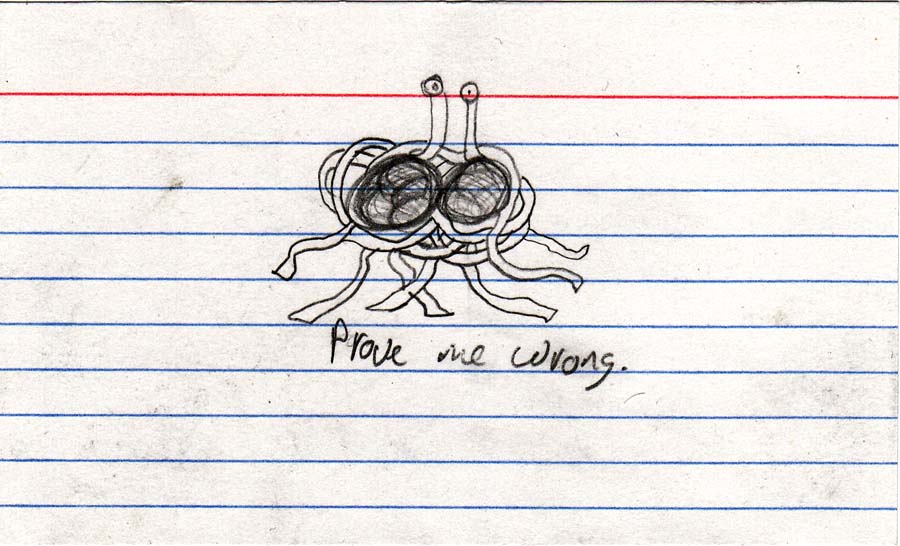
Watch this blog and the Shepherd's Fellowship church blog for analysis and open questions to follow.
Do Not Answer a Fool According to His Folly
 Note: The following is from one "Seiggy", an attendee at last night's debate.
Hi Seiggy,
"You guys did nothing but dance around questions all night."
The above metaphysical and epistemological issues are why we *purposefully* and *strategically* refused to address some of their assertions. Our opponents did exactly what we wanted them to do:
1. They flatly denied that logic was universal, invariant, and absolute.
2. Then, they plainly admitted that they couldn't account for immaterial laws given their materialistic metaphysic.
Thus, unless one can account for the laws of logic by which to disagree with my worldview, they have no right to demand that *I* provide answers to their alleged Bible contradictions when their own worldview can't provide the philosophical cash value needed to account for the very logical laws needed to make their argument in the first place. To say otherwise is mere special pleading.
Also, your assertion that we "danced" around questions "all night" is false. This is why we had an audiovisual recording made for all to see and decide for themselves.
As my post states, most atheists that are formally unschooled in Biblical Studies and/or philosophy try to undermine the Christian faith by making bare-naked assertions and spouting off a list of alleged Bible contradictions. This is unimpressive for the reasons stated here.
We knew this was coming, and (1) because we knew that we would not have the time to do justice to their list of alleged contradictions in the six minute rebuttal period and, (2) because we knew that they wouldn't be able to account for immaterial logical laws given their naturalistic materialism, we took the strategy that we did.
Again, hear me well: we didn't avoid their questions about Bible contradictions because we didn't have the answers; for I had many of them already answered and ready to read in my own study Bible and my prepared notes. As a matter of fact, virtually none of their alleged contradictions needed preparation beforehand since I've heard them so many times that they can be answered off the cuff. We avoided answering them *on purpose* because if they can't account for contradictions in their worldview in the first place, then I'm not obligated to answer their alleged contradictions. The only exception to this was in the Q&A period when I answered one alleged error from Leviticus 11:22-23. The answer I gave resulted in audience cheers.
"I still would like to know how you justify believing in the "Christian God" over Zues, as you have presented nothing that distinguishes the two."
Also, I quoted from Romans 1:18-21 and Colossians chapter 2 in my opening statement. Those passages alone refute the idea of any non-Christian deity since they are inherently defending the Christian God. Romans 1 sufficiently tackles any non-theistic deity (like "Zues"; i.e., polytheism), pantheism (i.e., due to Creator-creation distinction), and leaves the reader to only face the Creator God of Scripture. Colossians 2 and the surrounding context teaches that it is only in Christ (the 2nd person of the Trinity) that the treasures of wisdom and knowledge are hidden. If that doesn't exegetically establish that our position is founded on the Christian God, I don't know what does.
"All of your arguments are cookie-cutter and generic."This is something you've asserted but have yet to prove. Also, what's wrong with this if you can't account for the need to be logical in the first place?
"I could easily plug in Allah, Zues, FSM, or any other imaginary creature and 'win' in your view."
Debate Report: Does the Christian God Exist?
 I, Pastor Dustin and Sye TenBruggencate of Sinner Ministries had the privilege of engaging in our first formally moderated public debate on the campus of the University of North Carolina at Greensboro last night. We appreciate the UNGG Atheists, Agnostics, and Skeptics for inviting us to participate in this debate.
Our goals for the debate were twofold: (1) give a clear gospel presentation, and (2) that God be glorified. In my humble opinion, our goals were met. However, we can always do better by God's grace! As expected, our opponents attacked God's character and God's word. We knew that they would focus on those two things, and so instead of trying to answer their many assertions about alleged contradictions or about God supposedly being an immoral monster, etc., we simply took their feet out from under them by showing that they have no basis for using the laws of logic to begin with in order to create any objection to Christian theism. Then we preached the gospel to them and the crowd.
In the debates I've listened to over the years with atheists that have no formal scholarly training in either Biblical studies or philosophy, I have noticed a disingenuous trend of three things:
1. They tend to amass a list of alleged Biblical contradictions one after another knowing that their Christian opponents will never have time to fairly respond to them in a public debate setting.
2. They tend to ask questions of their opponents that have been successfully answered by Christian theologians for hundreds of years (i.e., Euthyphro's Dilemma).
3. They make bare naked assertions based upon prejudicial conjectures in order to "preach" their unbelief (i.e., "You can't trust the Bible because it's been translated and re-translated, over and over again.")
Regarding # 1, no one is impressed, except the most hardened atheist.
Regarding # 2, the Christians definitely aren't impressed because you are using old worn out arguments that have been refuted for hundreds of years.
Regarding # 3, the uninitiated may be impressed because they don't have the background knowledge in spotting such informal logical fallacies as the bare-naked assertion in the form of a question-begging epithet. Not only that, they also don't have the background knowledge in understanding issues related to textual criticism and the effect that underlying presuppositions have on any field of study.
In conclusion, I will take the time to respond to numbers 1-3 above as they presented themselves in our debate for the benefit of the Christian reader. May God be glorified and may His church be edified!
Thursday, September 02, 2010
God, evil, and Olson
Another salvo from Olson:
http://www.rogereolson.com/2010/09/01/god-and-evil/
“Contrary to the accounts of Calvinism offered here by some, Calvin himself strongly denied that God merely permitted the fall of Adam and Eve. His language against that is quite strong; he scoffs at the idea that God would ever merely permit something. We Arminians are confused and even bemused by contemporary Calvinists’ use of 'permission' when referring to God’s relationship to sin and evil."
I'm not crazy about permissive language myself. However, Helm has carefully explained what he means by that terminology ("Willing Permission," Contemporary Debates in Philosophy of Religion, 233-34), so I assume that Olson is simply ignorant of that analysis.
"But that’s not sufficient to say God is not the author of sin and evil."
Typical of Arminians, he doesn't bother to define what he means by "authorship." This is a traditional term in historical theology, so it has to be defined according to its historical sense. I assume it was used by Calvin and the Westminster Divines in the Latin sense to mean that God is not the actor or doer of evil.
By contrast, Olson seems to be using it in a metaphorical sense. But that introduces an equivocation into his objection. Even if God is the author of sin (whatever that means) in his metaphorical sense, this doesn't mean God is the author of sin in the sense in which Calvin and the Westminster Divines denied that appellation to God.
Moreover, to say that God is the author of sin in a metaphorical sense doesn't show what's wrong with that characterization, even if it were true. So what? Where's the argument that this (i.e. figurative authorship) would be unacceptable?
"Sin and evil, in the Calvinist view, in contrast to the Arminian view, are positively the will of God to glorify himself (by overcoming them)."
What does he mean by "positively willed"? Does that stand in implicit contrast to "negatively willed?" And what would that mean?
I think one of Olson's problems is his failure to distinguish between causes and intentions. God intends sin and evil (though not for their own sake). However, the way that's brought about is a different issue, and a complicated issue. (Just consider different philosophical theories of causation, and the whole determinist/indeterminist debate).
"What I still want to know that, no Calvinist here or anywhere, in my experience, has sufficiently answered, is why anything is considered truly evil in the Calvinist account of God and creation."
I don't see how that's difficult. Something can be evil in its own right, but contribute to something better. Consider Gen 50:20, as well as the preceding events leading up to that summary statement.
When Joseph's brothers wanted to murder him out of envious resentment, their attitude was sinful. But God's motive in decreeing that attitude was quite different from the motive he decreed. It set into motion a series of events which turned out for the best.
Perhaps, though, what Olson means is that something can't be "truly" evil unless it has no redeeming value whatsoever. But in that case, God allows horrendous events for no good reason. No greater purpose.
"If everything is planned and rendered certain by God for his glory, including sin and evil (even as only absences and not substances) why not praise God for sin and evil? "
Why does Olson assume a Calvinist wouldn't (or shouldn't) praise God for sin and evil?
Again, though, he oversimplifies the issue. Sin and evil aren't praiseworthy in their own right. Likewise, the motives of the sinner or evildoer aren't praiseworthy. However, the occurrence of a sinful or evil event can be praiseworthy if God meant it for good. We can praise God for his subtle wisdom in ordaining the Joseph cycle, with all its twists and turns.
Olson’s basic error is that he only sees the problem of evil in terms of God’s involvement in evil. And if we can disassociate God from evil, that’s exculpatory.
But, of course, that doesn’t solve the problem. It simply relocates the problem. For there’s a sense in which God ought to be responsible for whatever happens.
I think one of his problems, and this is a problem with Arminians generally, is that they treat evil as if it were a ritual impurity, like a contaminant or infectious disease, and the way to remain pure is to avoid physical contact. As long as God wears latex gloves, that exonerates him.
And this this is subconsciously reflected in the legalism I sometimes run across among Arminians, where holiness is a matter of avoiding certain physical activities, like drinking or watching R-rated movies.
http://www.rogereolson.com/2010/09/01/god-and-evil/
“Contrary to the accounts of Calvinism offered here by some, Calvin himself strongly denied that God merely permitted the fall of Adam and Eve. His language against that is quite strong; he scoffs at the idea that God would ever merely permit something. We Arminians are confused and even bemused by contemporary Calvinists’ use of 'permission' when referring to God’s relationship to sin and evil."
I'm not crazy about permissive language myself. However, Helm has carefully explained what he means by that terminology ("Willing Permission," Contemporary Debates in Philosophy of Religion, 233-34), so I assume that Olson is simply ignorant of that analysis.
"But that’s not sufficient to say God is not the author of sin and evil."
Typical of Arminians, he doesn't bother to define what he means by "authorship." This is a traditional term in historical theology, so it has to be defined according to its historical sense. I assume it was used by Calvin and the Westminster Divines in the Latin sense to mean that God is not the actor or doer of evil.
By contrast, Olson seems to be using it in a metaphorical sense. But that introduces an equivocation into his objection. Even if God is the author of sin (whatever that means) in his metaphorical sense, this doesn't mean God is the author of sin in the sense in which Calvin and the Westminster Divines denied that appellation to God.
Moreover, to say that God is the author of sin in a metaphorical sense doesn't show what's wrong with that characterization, even if it were true. So what? Where's the argument that this (i.e. figurative authorship) would be unacceptable?
"Sin and evil, in the Calvinist view, in contrast to the Arminian view, are positively the will of God to glorify himself (by overcoming them)."
What does he mean by "positively willed"? Does that stand in implicit contrast to "negatively willed?" And what would that mean?
I think one of Olson's problems is his failure to distinguish between causes and intentions. God intends sin and evil (though not for their own sake). However, the way that's brought about is a different issue, and a complicated issue. (Just consider different philosophical theories of causation, and the whole determinist/indeterminist debate).
"What I still want to know that, no Calvinist here or anywhere, in my experience, has sufficiently answered, is why anything is considered truly evil in the Calvinist account of God and creation."
I don't see how that's difficult. Something can be evil in its own right, but contribute to something better. Consider Gen 50:20, as well as the preceding events leading up to that summary statement.
When Joseph's brothers wanted to murder him out of envious resentment, their attitude was sinful. But God's motive in decreeing that attitude was quite different from the motive he decreed. It set into motion a series of events which turned out for the best.
Perhaps, though, what Olson means is that something can't be "truly" evil unless it has no redeeming value whatsoever. But in that case, God allows horrendous events for no good reason. No greater purpose.
"If everything is planned and rendered certain by God for his glory, including sin and evil (even as only absences and not substances) why not praise God for sin and evil? "
Why does Olson assume a Calvinist wouldn't (or shouldn't) praise God for sin and evil?
Again, though, he oversimplifies the issue. Sin and evil aren't praiseworthy in their own right. Likewise, the motives of the sinner or evildoer aren't praiseworthy. However, the occurrence of a sinful or evil event can be praiseworthy if God meant it for good. We can praise God for his subtle wisdom in ordaining the Joseph cycle, with all its twists and turns.
Olson’s basic error is that he only sees the problem of evil in terms of God’s involvement in evil. And if we can disassociate God from evil, that’s exculpatory.
But, of course, that doesn’t solve the problem. It simply relocates the problem. For there’s a sense in which God ought to be responsible for whatever happens.
I think one of his problems, and this is a problem with Arminians generally, is that they treat evil as if it were a ritual impurity, like a contaminant or infectious disease, and the way to remain pure is to avoid physical contact. As long as God wears latex gloves, that exonerates him.
And this this is subconsciously reflected in the legalism I sometimes run across among Arminians, where holiness is a matter of avoiding certain physical activities, like drinking or watching R-rated movies.
Wednesday, September 01, 2010
J.P. Holding's Response To The Christian Delusion
J.P. Holding just released the first edition of his response to The Christian Delusion. Anybody who has a subscription to his E-Block gets access to it. (It doesn't cost much, and the money supports a good ministry.) You can also get access to it for a one-time donation of $3.
Marian prayers
CRAIGBENNO1 SAID:
Regarding the issue of Mary and the saints... )which btw I'm not defending), A catholic theologian once said to me that the whole issue depends on what you mean by asking someone to pray for you?
In their theology they don't see any difference in asking someone who is alive here to pray for them... and asking someone who is dead in this world to asking them...Its to do with how they perceive the state of the dead..
http://triablogue.blogspot.com/2010/08/idols-idolatry.html#4121282480311067322
Look at this prayer (see below); when you ask a friend to pray for you, is this how you frame your request?
********************************
Heart of Mary, Pray for us. Heart of Mary, according to the heart of God, Pray for us. Heart of Mary, united to the Heart of Jesus, Pray for us. Heart of Mary, organ of the Holy Ghost, Pray for us. Heart of Mary, sanctuary of the Divine Trinity, Pray for us. Heart of Mary, tabernacle of God Incarnate, Pray for us. Heart of Mary, immaculate from thy creation, Pray for us. Heart of Mary, full of grace, Pray for us. Heart of Mary, blessed among all hearts, Pray for us. Heart of Mary, throne of glory, Pray for us. Heart of Mary, most humble, Pray for us. Heart of Mary, holocaust of Divine Love, Pray for us. Heart of Mary, fastened to the Cross with Jesus Crucified, Pray for us. Heart of Mary, comfort of the afflicted, Pray for us. Heart of Mary, refuge of sinners, Pray for us. Heart of Mary, hope of the agonizing, Pray for us. Heart of Mary, seat of mercy, Pray for us.
Immaculate Mary, meek and humble of heart: R. Make our hearts according to the Heart of Jesus.
Let us pray. O most merciful God, Who, for the salvation of sinners and the refuge of the miserable, wast pleased that the Most Pure Heart of Mary should be most like in charity and pity to the Divine Heart of Thy Son, Jesus Christ: grant that we who commemorate this sweet and loving Heart may, by the merits and intercession of the same Blessed Virgin, merit to be found according to the Heart of Jesus. Through the same Christ, Our Lord. R. Amen.
http://www.catholicculture.org/culture/liturgicalyear/prayers/view.cfm?id=1121
Regarding the issue of Mary and the saints... )which btw I'm not defending), A catholic theologian once said to me that the whole issue depends on what you mean by asking someone to pray for you?
In their theology they don't see any difference in asking someone who is alive here to pray for them... and asking someone who is dead in this world to asking them...Its to do with how they perceive the state of the dead..
http://triablogue.blogspot.com/2010/08/idols-idolatry.html#4121282480311067322
Look at this prayer (see below); when you ask a friend to pray for you, is this how you frame your request?
********************************
Heart of Mary, Pray for us. Heart of Mary, according to the heart of God, Pray for us. Heart of Mary, united to the Heart of Jesus, Pray for us. Heart of Mary, organ of the Holy Ghost, Pray for us. Heart of Mary, sanctuary of the Divine Trinity, Pray for us. Heart of Mary, tabernacle of God Incarnate, Pray for us. Heart of Mary, immaculate from thy creation, Pray for us. Heart of Mary, full of grace, Pray for us. Heart of Mary, blessed among all hearts, Pray for us. Heart of Mary, throne of glory, Pray for us. Heart of Mary, most humble, Pray for us. Heart of Mary, holocaust of Divine Love, Pray for us. Heart of Mary, fastened to the Cross with Jesus Crucified, Pray for us. Heart of Mary, comfort of the afflicted, Pray for us. Heart of Mary, refuge of sinners, Pray for us. Heart of Mary, hope of the agonizing, Pray for us. Heart of Mary, seat of mercy, Pray for us.
Immaculate Mary, meek and humble of heart: R. Make our hearts according to the Heart of Jesus.
Let us pray. O most merciful God, Who, for the salvation of sinners and the refuge of the miserable, wast pleased that the Most Pure Heart of Mary should be most like in charity and pity to the Divine Heart of Thy Son, Jesus Christ: grant that we who commemorate this sweet and loving Heart may, by the merits and intercession of the same Blessed Virgin, merit to be found according to the Heart of Jesus. Through the same Christ, Our Lord. R. Amen.
http://www.catholicculture.org/culture/liturgicalyear/prayers/view.cfm?id=1121
Praying To Mary Is Problematic, Even If You Don't Think She's God
Here are some comments I made in a recent thread, which may be helpful to some people:
craigbenno1 wrote:
"A catholic theologian once said to me that the whole issue depends on what you mean by asking someone to pray for you? In their theology they don't see any difference in asking someone who is alive here to pray for them... and asking someone who is dead in this world to asking them...Its to do with how they perceive the state of the dead...The question to ask is whether they actually worship Mary as God or any other statue"
Prayer to the deceased wouldn't have to involve "worship as God" in order to be sinful. There's no reason to expect the deceased to hear our prayers, scripture and early patristic sources condemn attempts to contact the deceased, and the practice is absent in contexts in which we'd expect it to appear if it had been accepted in Biblical and early patristic times.
We've covered this issue in depth in previous threads. See, for example, here, here, here, here, and here. There's a lot more that I haven't linked. Those who pray to Mary frequently do more than "asking Mary to pray for them". See the examples I cited here, and search the web for other examples of Roman Catholic and Eastern Orthodox prayers to Mary. Those prayers are far different than a discussion with a living person, in which you ask that person to pray for you.
Tuesday, August 31, 2010
Que sera sera
According to Arminian epologist Ben Henshaw:
So the future is necessary. God's hands are tied. What will be will be. Sounds pretty fatalistic to me. Indeed, it's more deterministic than Calvinism.
I'm not the only one who sees the dilemma that Ben has created for himself. As a fellow Arminian observes:
Also, if God did foreknow what a person would freely choose and then not create that person based on that knowledge, God would falsify His own foreknowledge by not creating that person. God would essentially make Himself wrong by making something He foreknew happening as not happening, or making a person He foreknew as existing, never to exist. Since God cannot be wrong, He cannot not create someone based on what He knows this 'person' (who will actually never exist) would do or choose. Do you see the problem?
http://arminianperspectives.wordpress.com/2010/08/24/some-quick-comments-regarding-free-agency-and-foreknowledge/
So the future is necessary. God's hands are tied. What will be will be. Sounds pretty fatalistic to me. Indeed, it's more deterministic than Calvinism.
I'm not the only one who sees the dilemma that Ben has created for himself. As a fellow Arminian observes:
Don’t you think God was free to create other people than He has chosen to, or do you think He was constrained in some way to create people He has created?...Well speaking of different ways things could be is simply speaking of different worlds. Possible world lingo simply makes it more convenient, unless this is the only possible world. But then you’d be a determinist.
http://arminianperspectives.wordpress.com/2010/08/24/some-quick-comments-regarding-free-agency-and-foreknowledge/#comment-4969
Subscribe to:
Posts (Atom)