Last year, I wrote an article about how Jesus seems to have structured much of his public ministry around his identity as the light of Isaiah 9:2. His move to Capernaum was part of that process (Matthew 4:12-16), and that move has significant implications for the origins of the infancy narratives, their historicity, the authorship of the gospels, and other important issues. I want to discuss some of those implications in this post.
As I mentioned in my article last year, Matthew apparently worked, and likely lived, in Capernaum or nearby. The same is true of John and some of the other apostles. That put them in a position to have known more about Jesus and to have been in more contact with him accordingly. And that makes men like Matthew and John more plausible candidates for writing biographies of Jesus, which heightens the credibility of the traditional authorship attributions of the gospels. Furthermore, the significant attention given to Capernaum in the gospels of Matthew and John, as discussed in my article linked above, makes more sense under the traditional authorship attributions.
Similar observations can be made about the early Christian accounts of Jesus' childhood in particular. If Matthew and John had so much access to Jesus (and, by implication, his relatives, neighbors, etc.), then they had access to more information about his childhood. (See here concerning the material on Jesus' childhood in the writings of John, which is often underestimated.) It would be natural for people living in or near Capernaum to want to know why Jesus moved there. It's the kind of subject that would easily have come up in conversations. If he had the motive for moving there described in Matthew 4:12-16, as the evidence suggests, then issues related to his ancestry, birth, childhood, and Messiahship (all mentioned in Isaiah 9) would have come to mind and probably would have been discussed. Just as Isaiah 9 is associated with Christmas issues in our day, it was in ancient Israel as well (e.g., John 7:40-8:12). Jesus' move to Capernaum would have been of interest to individuals like Matthew and John, and the reasoning behind the move would have brought up thoughts and discussions related to Jesus' childhood.
People often ask and theorize about the origins of the infancy narratives and other early material on the childhood of Jesus. Bethlehem and Nazareth are important in that context, but Capernaum probably had a large role as well, a role that's been highly neglected.

Sunday, November 29, 2020


Friday, November 27, 2020
Christmas Resources 2020
Last year, I wrote two articles that can be used as a starting point for researching Christmas issues. One of those articles was about how to concisely argue for a traditional Christian view of Jesus' childhood. The other was about how Jesus framed his public ministry around his identity as the figure of Isaiah 9:1-7.
Here are some examples of other Christmas issues we've addressed over the years:
Wednesday, November 25, 2020
Chariots And Horses Of Fire
"Jesus Christ, our most true God, veiled in human form, bows his knee and prays [in John 17], and throws his divine energy into the prayer for the bringing home of his redeemed. This one irresistible, everlastingly almighty prayer carries everything before it. 'Father, I will that they also, whom thou hast given me, be with me where I am,' is the centripetal energy which is drawing all the family of God towards its one home. How shall the chosen get home to the Father? Chariots are provided. Here are the chariots of fire and horses of fire in this prayer. 'I will,' saith Jesus, 'that they be with me;' and with him they must be. There are difficulties in the way — long nights and darkness lie between, and hills of guilt, and forests of trouble, and bands of fierce temptations; yet the pilgrims shall surely reach their journey's end, for the Lord's 'I will' shall be a wall of fire round about them. In this petition I see both sword and shield for the church militant. Here I see the eagles' wings on which they shall be upborne till they enter within the golden gates. Jesus saith, 'I will;' and who is he that shall hinder the home-coming of the chosen? As well hope to arrest the marches of the stars of heaven." (Charles Spurgeon, The C.H. Spurgeon Collection [Albany, Oregon: AGES Software, 1998], Metropolitan Tabernacle Pulpit, Vol. 32, pp. 223-24)
Monday, November 23, 2020
What About Evil? by Scott Christensen
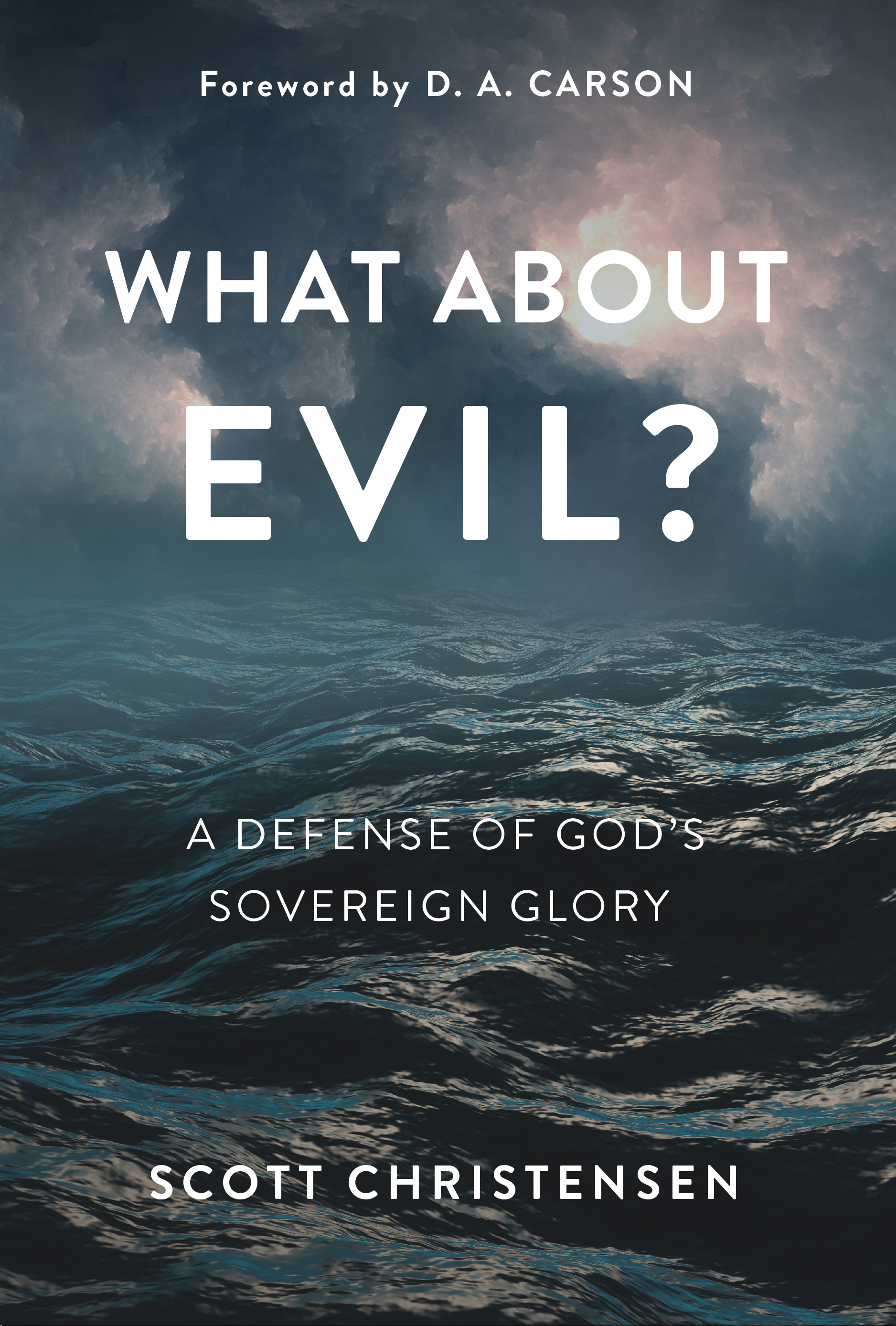
Full disclosure: The following is a review of What About Evil? by Scott Christensen. I am friends with Christensen on Facebook, although I cannot remember precisely the details of how we became Facebook friends. I suspect it’s either because of Triablogue or because of Steve Hays directly. I also received a review copy for free. However, the following views are my own and are an honest assessment of Christensen’s book.
- - -
Christensen’s writing style is one that definitely connected with me. When reading some authors, you can get the sense of overwhelming intellect. They use large words and technical phrases with skill, and you learn a lot from them but it also takes a lot of extra thinking to parse out those sentences. Christensen’s style is the opposite. It’s not that his writing is simplistic—far from it—but rather that he writes in such a manner that it is effortless to take in what he is writing about. In other words, his meaning is plain, not convoluted. His metaphors are obvious, not strained. And the end result is that reading a paragraph from his book is effortless. Unlike reading a massive tome where it is a chore to grind out every sentence, Christensen’s style lends to quick, and enjoyable, reading.
Where this becomes a bit unusual is in instances where Christensen lists examples of what he is referring to. For instance, when giving a list of natural disasters in his introduction (page 2), he includes “...the European Black Death (1347–51), Chilean earthquakes (1647), Krakatoan volcanoes (1883), Spanish flu pandemics (1918), Indonesian tsunamis (2004), Chinese coronavirus pandemics (2020), and endless twisters in Tornado Alley.” Because I am used to reading many technical treatises, my mind immediately asked “why do tornadoes not have any dates listed? And why did he suddenly move from specific examples to the general example of tornados? And why only tornadoes and not, say, hurricanes?”
But of course, Christensen wasn’t trying to make any extra point by including tornadoes there. He’s simply listing some common examples of natural evils, and the “oddity” of having tornados at the end, not fitting the format of the other items in the list, fits into Christensen’s folksy style. This is the sort of list someone would make if they were talking extemporaneously in a conversation.
I hope none of that is taken as a criticism. In fact, I think the style of the book helps make it easier for a lay person to read. And by pointing out the style is “folksy” that in no way means that the arguments Christensen puts forth have no weight. Instead, it means that (in my opinion) more people will be able to benefit from this writing than if Christensen had used a more academic style.
Christensen quickly gets to the point in the book. He is looking into the various theodicies presented to oppose those who question the existence of God based on the existence of evil. He looks at some of the more common theodicies, such as the “Free-Will Defense”, “The Natural-Law Defense”, and the “Greater-Good Theodicy” (among many others), concluding that while there are some good things in most defenses, for a Biblically-minded Christian, the view that is most faithful to Scripture is a version of the “greater-good theodicy” with “the best-of-all-possible-worlds defense.” He dubs his own view the “Greater-glory theodicy”, in his words, “because it seeks to resolve the problem by examining what brings God the greatest glory” (p. 7).
The reason I like Christensen’s method is because he is geared so closely to holding to what the Bible teaches, and using that as the foundation for all else. It places Christ, and His work in defeating evil, at the center of the entire context of evil in the first place. As he writes, “[…]Christ is no conventional hero, and the cross is no conventional weapon. We do not naturally associate a hero’s victory with his death. … Yet surprisingly, in the cross, Jesus defeats evil. Jesus defeats death by dying…. He becomes our hero by being treated as a villain” (pp. 8-9).
If you feel I’m giving away too much of the book, perhaps the low value of those page numbers will assuage you. Christensen fully tells us all of this within the very introduction of his book! This isn’t something he’s trying to hold off for later, to bait you in before revealing where he’s going. As is keeping with Christensen’s “folksy” language, he has no reason to obscure anything with rhetoric and seems almost excited to get through the background information to get to the main point: the glorification of Christ.
Honestly, as someone who’s read a lot of philosophy on theodicies—and many of them quite well reasoned and argued—it’s nice to have one where the focus is so clearly on the majesty of Christ.
This is why I especially enjoyed that while Christensen took several chapters to discuss evil from a historical and philosophical standpoint, including discussing how the term can even be defined, he so quickly delves into what would even constitute a theodicy that honors God, especially in light of how secular the world is in modern days. He examines the strengths and weaknesses of the common arguments in Chapters 5 and 6, (the weaknesses being where they lack Biblical support, and the strengths being where they have sufficient Biblical support), and then spends chapters 7 and 8 discussing the nature of God Himself and how the Bible discusses evil. It is that Biblically-centered focus that I very much appreciated, and that’s not even getting into the section that Christensen himself identifies as the “heart” of his book: Chapters 10 – 13, where the redemptive theme of Scripture is seen as a monomyth—“one universal storyline that evokes a human longing for redemption.” And if you’re looking for shortcuts, first of all I suggest not doing so. But if you really want to get to the main argument, Chapter 12 of the book (specifically, beginning on page 281) presents the “greater-good theodicy” in detail.
Much more could, and should, be said about this work by Christensen. There is a treasure of introductory-level Reformed theology throughout all its pages, and his defense being grounded in Scripture is definitely a breath of fresh air. The Bible is the strength of the Reformed position, and Christensen does a wonderful job pulling together the various threads to support his view: philosophical, historical, and most of all theological. While I am more intellectually driven and love the logic of the Reformed view, Chapters 10 and 11 (where Christensen spends time talking about the entire story of the Bible) was a nice change of pace. As a dabbler in fiction, the purpose and intent of stories also speaks to me, and it’s nice for someone to remind me that God is an Author, just as much as He is an Architect or Mathematician.
My only regret is that when I read the majority of this book, it was during an unexpected foot surgery I had, and as a result the experience was not as physically pleasant as I wish it could have been. I hope in another couple of months to re-read the book, from a new (unmedicated and pain-free) point of view to get another take on it. It will be well worth reading again, and I highly recommend this to anyone who wants to increase their theodicy arsenal. I rate this a solid A+, or 5 stars if we go by the Amazon scale, because it is well written, well researched, well informed, and, most of all, Biblically grounded.
Sunday, November 22, 2020
Buying Christ's Honor With Your Losses
"Blessed are they who would hold the crown on His head, and buy Christ's honour with their own losses." (Samuel Rutherford, Letters Of Samuel Rutherford [Carlisle, Pennsylvania: The Banner of Truth Trust, 2012], 258)
Friday, November 20, 2020
Thursday, November 19, 2020
The High Cost Of Low Living
My post yesterday quoted some comments from J.G. Pilkington on the significance of what are often regarded as little things, including sins that we often underestimate. Adrian Rogers preached a great sermon on Samson, probably the best sermon I've ever heard from him, and it addresses this issue. You can listen to it here. The last several minutes are especially good, starting here, but I recommend listening to the whole thing.
Wednesday, November 18, 2020
The Subtle Power Of Little Things
"Augustin frequently alludes to the subtle power of little things. As when he says,—illustrating (Serm. cclxxviii.) by the plagues of Egypt,—tiny insects, if they be numerous enough, will be as harmful as the bite of great beasts; and (Serm. lvi.) a hill of sand, though composed of tiny grains, will crush a man as surely as the same weight of lead. Little drops (Serm. lviii.) make the river, and little leaks sink the ship; wherefore, he urges, little things must not be despised. 'Men have usually,' says Sedgwick in his Anatomy of Secret Sins, 'been first wading in lesser sins who are now swimming in great transgressions.' It is in the little things of evil that temptation has its greatest strength. The snowflake is little and not to be accounted of, but from its multitudinous accumulation results the dread power of the avalanche. Satan often seems to act as it is said Pompey did, when he could not gain entrance to a city. He persuaded the citizens to admit a few of his weak and wounded soldiers, who, when they had become strong, opened the gates to his whole army. But if little things have such subtlety in temptation, they have likewise higher ministries. The Jews, in their Talmudical writings, have many parables illustrating how God by little things tries and proves men to see if they are fitted for greater things. They say, for example, that He tried David when keeping sheep in the wilderness, to see whether he would be worthy to rule over Israel, the sheep of his inheritance." (J.G. Pilkington, in n. 766 to Augustine's Confessions, 9:8)
Monday, November 16, 2020
The Cause Is The Lord's
"But it is a great part of your glory that the cause is not yours, but your Lord's whom you serve. And I doubt not but Christ will count it His honour to back His weak servant; and it were a shame for Him (with reverence to His holy name) that He should suffer Himself to be in the common of such a poor man as ye are, and that ye should give out for Him and not get in again. Write up your depursments for your Master Christ, and keep the account of what ye give out, whether name, credit, goods, or life, and suspend your reckoning till nigh the evening; and remember that a poor weak servant of Christ wrote it to you, that ye shall have Christ, a King, caution for your incomes and all your losses. Reckon not from the forenoon. Take the Word of God for your warrant; and for Christ's act of cautionary, howbeit body, life, and goods go for Christ your Lord, and though ye should lose the head for Him, yet 'there shall not one hair of your head perish; in patience, therefore, possess your soul.' [Luke 21:18-19]…He who was dead and is alive will plead your cause, and will look attentively upon the process from the beginning to the end, and the Spirit of glory shall rest upon you." (Samuel Rutherford, Letters Of Samuel Rutherford [Carlisle, Pennsylvania: The Banner of Truth Trust, 2012], 133-34)
Friday, November 13, 2020
Shallow Confession Of Sin
"If you forget the costliness of sin, your prayers of confession and repentance will be shallow and trivial. They will neither honor God nor change your life….Stott argued that confessing our sins implies the forsaking of our sins. Confessing and forsaking must not be decoupled, yet most people confess - admit that what they did was wrong - without at the same time disowning the sin and turning their hearts against it in such a way that would weaken their ability to do it again. We must be inwardly grieved and appalled enough by sin - even as we frame the whole process with the knowledge of our acceptance in Christ - that it loses its hold over us." (Tim Keller, Prayer [New York, New York: Dutton, 2014], 212)
Wednesday, November 11, 2020
Prayer Accompanied By Further Action
A good passage to memorize on the subject is Nehemiah 4:9. They prayed, then took up arms.
Tuesday, November 10, 2020
You Have Not, Because You Reason Not
I've been thinking about James 4:2. Sometimes we don't get something because we don't pray for it. The verse is often referred to in a variation of its King James form, "You have not, because you ask not."
The same principle is true of apologetics. We don't get answers we want to questions because we don't think much with the mind God has given us. We don't convince many people of our views, and our culture declines, because we don't reason with people as much as we ought to. That sort of neglect of apologetics, and intellectual matters more broadly, isn't the only factor involved in something like our own unanswered questions or the problems in our culture. But it is one of the factors involved. Similarly, after his comment in James 4:2, James goes on to mention other potential reasons for not getting what we want. But that doesn't change the fact that what he mentions in verse 2 is one of the factors involved.
How often is it suggested that if we want revival, we should pray more, improve our lives in certain moral contexts, study scripture more, attend more church services, evangelize more, and so on? We're often told that we should try to be more like the church in the books of Acts in those contexts. How much is said about doing more in the context of apologetics, which is so prominent in the book of Acts? Or how much is said about maturing intellectually in general, not just in apologetics? We're commanded to be intellectually mature (1 Corinthians 14:20; what Proverbs says about knowledge, discernment, and wisdom; etc.). And that maturity is all the more important when changes in technology and other changes in the world require us to sort through so much more information and to do so more rapidly.
God can act independently of apologetics, just as he can act independently of prayer. The fact that God can convert people and otherwise influence them by non-apologetic means doesn't suggest that we shouldn't try to influence people through apologetics. We have a standing obligation to make the most of what God has entrusted us with, including our minds and the minds of other people. We shouldn't use God's sovereignty as an excuse to neglect prayer or apologetics.
Sunday, November 08, 2020
My thoughts on the 2020 election
Here are my thoughts on the election so far:
1. The media has declared Biden the winner. However, that's not how our system works. The way it works is we vote. All the votes are in. Votes are counted. If there are discrepancies which warrant further investigation (e.g. voter fraud, irregularities that need to be reconciled), then independent investigations will be made. That's how we ensure the integrity of our elections. That's how we ensure future elections remain free and fair. This election isn't any different. We need to wait for the outcome, not accept what the media says - and arguably the media is saying Biden is the winner for malicious reasons (e.g. to foster the notion that Trump stole the election if he does win). In fact, isn't this what essentially happened in 2000 with Gore v. Bush?
2. However, even if Trump doesn't win the presidency, this election is an overall win for the GOP and conservatives in general:
Friday, November 06, 2020
Wednesday, November 04, 2020
The Irony Of Christian Neglect Of Apologetics
The "Christ" in "Christian" comes from Jesus' Messiahship. And that Messiahship is an evidential concept. It involves the historical fulfillment of prophecy by a historical individual. Men like Isaiah and Daniel made much of the apologetic value of their prophecies (Isaiah 43:8-13, 46:9-11, Daniel 2:19-28, 5:8-12), including ones Jesus fulfilled. It's ironic that so many people who call themselves Christians are so apathetic and contemptuous toward apologetics and other intellectual matters. That includes a lot of people who acknowledge in principle that apologetics has some significance, but do little or nothing about it in practice. The problem isn't just with fideists.
Sunday, November 01, 2020
Further Problems With Anita Gregory's Doctoral Thesis On Enfield
A couple of years ago, I wrote a response to the sections of Anita Gregory's doctoral thesis that discuss the Enfield Poltergeist. But I wrote that response before listening to Maurice Grosse and Guy Playfair's Enfield tapes. I've now listened to all of them, and I want to supplement my response to Gregory's thesis with what I've learned since then from the tapes and other sources.
When I make reference to the tapes below, I'll use "MG" to cite Grosse's tapes and "GP" to cite Playfair's. Therefore, MG74B refers to Grosse's tape 74B, and GP15B refers to tape 15B in Playfair's collection, for example.
Saturday, October 31, 2020
Like Light From A Fire
"And, like as the flame burneth the wood without the help of the light, and yet the flame cannot be without the light; so is it assuredly true that faith alone consumeth and burneth away sin, without the help of works, and yet that the same faith cannot be without good works….Whereupon it cometh that the holy Scripture promiseth the Christian everlasting life for his good works; because good works are the fruits and testimonies of lively faith, and proceed of it, as light proceedeth from a flame of fire" (The Benefit Of Christ's Death, 61-62, 64)
Friday, October 30, 2020
Confusing The Author Of Nature With The Editor Of Nature
"…scientists who regard the phenomena investigated by psychical researchers as impossible seem…to confuse the Author of Nature with the Editor of the scientific periodical, Nature; or at any rate they seem to suppose that there can be no productions of the former which would not be accepted for publication by the latter!" (C.J. Ducasse, cited in Stephen Braude, The Limits Of Influence [Lanham, Maryland: University Press of America, Inc., 1997], 20)
Wednesday, October 28, 2020
I stand corrected on convalescent plasma therapy
1. Sorry I haven't been blogging these days. Mainly for personal reasons that have led me to feeling quite burned out over the last year or so. And I'm afraid I don't expect to resume posting any time soon. This is just a one-off post in order to say something that I should say: mea culpa!
In the past, I touted convalescent plasma therapy as a viable "band-aid" to deal with SARS-CoV-2/COVID-19 until a vaccine was ready. However, I stand corrected about this. Convalescent plasma therapy doesn't really work for COVID-19. That's the main take away or bottom line if you don't wish to read further.
2. So please no need to read further if you don't wish, but here are more details in case you do:
My mea culpa is based on the recently published "PLACID trial". Its accompanying editorial is worth a read too. The PLACID trial involved 464 patients in 39 public and private hospitals across India (randomized, but not blinded): 235 patients received the convalescent plasma, while 229 did not (placebo). The study looked at two endpoints - a P/F ratio below 100 or death. All that's necessary to know is P/F ratio indicates low oxygen in the blood aka hypoxemia. (A normal P/F ratio is 400-500. A P/F ratio 100 or less is very impaired, to say the least. P/F stands for PaO2/FiO2, that is, the ratio of arterial oxygen partial pressure to fraction of inspired oxygen. It's also called the Horowitz index.) The study found the 235 patients in the convalescent plasma arm had a 19% chance of reaching a P/F ratio 100 or less or death, while the 229 patients in the placebo arm had an 18% chance of reaching the same endpoints. There's no statistically significant difference between 19% and 18% in this trial.
3. All that said, it's interesting to note the following from the editorial: "convalescent plasma did exactly what the investigators hoped it would do, yet there was no net clinical benefit to patients". It seems the reason may be because, on the one hand, the convalescent plasma is successfully neutralizing the SARS-2 coronavirus (via antibodies), but on the other hand, the convalescent plasma is making the patient's blood more easily able to form blood clots aka thrombi (via clotting factors). And COVID-19 itself is (as the editorial notes) "a life threatening thrombotic disorder".
As such, a potential way forward may be to keep the antibodies, but eliminate the clotting factors. In short: monoclonal antibodies.
4. Finally, a vaccine might be on the way soon - still a surprise to me how fast vaccines are being developed! - which, if so, might diminish the priority to further research other therapies including monoclonal antibodies. In any case, see what pharma companies AstraZeneca and Johnson & Johnson have been saying, for example.
Monday, October 26, 2020
Heaven's Logic In Romans 8:32
The point of Romans 8:32 is that this love of God for his one and only Son was like a massive, Mount Everest obstacle standing between God and our salvation. Here was an obstacle almost insurmountable: Could God - would God - overcome his cherishing, admiring, treasuring, white-hot, infinite, affectionate bond with his Son and hand him over to be lied about and betrayed and denied and abandoned and mocked and flogged and beaten and spit on and nailed to a cross and pierced with a sword, like an animal being butchered and hung up on a rack?...
Would he really do that? If he would, then we could know with full certainty that whatever goal he was pursuing on the other side of that obstacle could never fail. There could be no greater obstacle. So whatever he was pursuing is as good as done….
Therefore, in Paul's a fortiori argument, God has done the hardest thing to give us everlasting happiness. He did not spare his own Son but gave him up for us all. What does this guarantee? Paul puts it in the form of a rhetorical question (that means a question he expects us to immediately answer correctly): "how will he not also with him graciously give us all things?"…
I said that when I was twenty-three, this logic of heaven penetrated so deeply into my soul that it changed the way I think about everything - and that the change was full of hope….
I live my life every day by the promises of God. I owe every one of them to the logic of Romans 8:32….
Behind every one of those battles is the logic of heaven: "I did not spare my own Son; therefore, my promise to you cannot fail. I will help you. Go. Do what I have called you to do."
(John Piper, Why I Love The Apostle Paul [Wheaton, Illinois: Crossway, 2019], 186-89)
Friday, October 23, 2020
Randi's Million Dollar Challenge And The Eisenbud Challenge
James Randi did some good things, and he ought to be getting some positive coverage in the context of his death earlier this week. But the coverage has been far too positive, which is unsurprising in light of the media's biases. You can read our archive of posts on Randi here. While the media give so much attention to Randi's Million Dollar Challenge, keep in mind his failure to meet a challenge in the other direction:
See my post here about how other magicians have misled people about the paranormal.
Nevertheless, with his usual bluster, Randi accepted a $10,000 challenge (a considerable sum in those days) to duplicate the Serios phenomena and make good on his claim.
Of course, confidence is easy to feign, and Randi does it routinely in his role as magician. He also cleverly takes advantage of the occasional high-profile case he successfully exposes as fraudulent, by publicizing those successes and creating the impression that he's a generally reliable guide when it comes to the paranormal. So Randi's dismissal of the Serios case was all it took for those already disposed to believe that Serios was a fake, and it was probably enough even for those sympathetic to parapsychology but unaware of Randi's dishonesty....
What the TV audience never learned was that when the show was over and Randi was pressed to make good on his wager, he simply weaseled out of it. To keep that side of the story under wraps, Randi prohibited publication of his correspondence on the matter. That was undoubtedly a shrewd move, because the letters show clearly how Randi backed down from his empty challenge. However, Randi's original letters now reside in the library at the University of Maryland Baltimore County, and researchers, finally, can easily confirm this for themselves. When Serios's principal investigator, Jule Eisenbud, died, I was assigned the task of going through his papers. I collected all the material relevant to the Serios case and deposited it in the Special Collections section of the UMBC library. (This includes correspondence, the original photos and film, and signed affidavits from witnesses.)...
But there's no documentary evidence of Randi having even attempted to duplicate the Serios phenomena under anything like the conditions in which Serios succeeded, much less evidence of his having actually pulled it off....
In fact, the history of parapsychology chronicles some remarkable examples of dishonest testimony and other reprehensible behavior on the part of skeptics....
Skepticism is just as glib and dishonest now as it was in 1882 when the British SPR [Society for Psychical Research] was founded. In fact, despite sensible and careful dismantling of the traditional skeptical objections, the same tired arguments surface again and again. And those arguments all too easily mislead those who haven't yet heard the other side of the story or examined the evidence for themselves.
(Stephen Braude, The Gold Leaf Lady [Chicago, Illinois: The University of Chicago Press, 2007], 22, 34, 126)
See my post here about how other magicians have misled people about the paranormal.
Thursday, October 22, 2020
Jesus' Temple Cleansings
Lydia McGrew recently posted a series of videos about Jesus' cleansing of the temple, which is recorded late in the Synoptics, but early in the gospel of John. She makes a lot of good points about the likelihood that two events were involved, meaning that John is discussing a different event than the Synoptics. Here are the parts in the series in their chronological order:
Four Different Ways Of Reporting Time
Temple Cleansing (Part 1): Uncanny similarity? Not really.
Temple Cleansing (Part 2): Beware Of A Priori History
Temple Cleansing (Part 3): "Destroy this temple…"
Temple Cleansing (Part 4): "How do we spin this one?"
Temple Cleansing (Part 5): Forty-Six Years
Temple Cleansing (Part 6): Theological Theories
Wednesday, October 21, 2020
Letters Of Gold
"Are ye ashamed to be corrected? This is the vice of the proud. It is, forsooth, a degradation for learned men to pass from the school of Plato to the discipleship of Christ, who by His Spirit taught a fisherman to think and to say, 'In the beginning was the Word, and the Word was with God, and the Word was God. The same was in the beginning with God. All things were made by Him; and without Him was not anything made that was made. In Him was life; and the life was the light of men. And the light shineth in darkness; and the darkness comprehended it not.' The old saint Simplicianus, afterwards bishop of Milan, used to tell me that a certain Platonist was in the habit of saying that this opening passage of the holy gospel, entitled, According to John, should be written in letters of gold, and hung up in all churches in the most conspicuous place. But the proud scorn to take God for their Master, because 'the Word was made flesh and dwelt among us.' So that, with these miserable creatures, it is not enough that they are sick, but they boast of their sickness, and are ashamed of the medicine which could heal them. And, doing so, they secure not elevation, but a more disastrous fall." (Augustine, The City Of God, 10:29)
Monday, October 19, 2020
The Gospels' Agreement About James And Corroboration Of Other Sources
In a post yesterday, I discussed agreements among the early sources regarding the apostles. Some evidence that's often neglected in that context is what the gospels tell us about Jesus' brother James.
I've discussed their material on him elsewhere. Something I don't believe I've discussed here before, though, and it's something that doesn't seem to get much attention in general, is James' position in the lists of Jesus' siblings in Matthew 13:55 and Mark 6:3. Notice that the two lists are different, and there are some differences in the surrounding context, so it's not just a matter of Matthew's copying Mark, Mark's copying Matthew, or both's copying some other source. What I want to focus on here, though is how they list the names of Jesus' brothers in a different order, yet agree in putting James first. As I've mentioned before, the order in which names appear in a list can be determined by a wide variety of factors. James could be listed first because he was the oldest brother of Jesus. Or it could be because he was the most prominent for whatever other reasons. Or it could be both. Maybe James was the most prominent, which was partly because he was the oldest and partly because of one or more other factors. Whatever the cause of his being listed first in both documents, that's consistent with his prominence elsewhere. He's prominent in Acts, much more prominent than the other siblings listed with him in Matthew 13 and Mark 6. He's the only sibling of Jesus mentioned by name in the resurrection appearances discussed in 1 Corinthians 15. He's the only brother of Jesus mentioned in Galatians 1-2 and the only one named anywhere in Paul's letters. Jude identifies himself in connection with James (Jude 1), but James sees no need to appeal to a relationship with any of his brothers in his letter. This sort of greater prominence James had, in comparison to his brothers, is corroborated by the passages in Matthew 13 and Mark 6.
Several years ago, I wrote an article addressing why the gospels don't include any reference to the resurrection appearance to James. I said that the best explanation for their not including the appearance to James is a desire to be consistent with their previous focus on Jesus' earliest followers and a desire to honor those earliest disciples. You can read the article just linked for a further discussion of that subject and others that are related. I want to note here, though, that since one of the gospels that doesn't include the appearance to James is Luke, there's an implication that Luke wanted to honor Jesus' earliest disciples above individuals like James in the manner I just described. That's significant in light of the fact that some people deny that Luke viewed James as an unbeliever during Jesus' public ministry. I've argued that Luke 8:19-21 probably alludes to his unbelieving status. But even if we didn't have that passage, or even if my view of it is wrong, I think the absence of any reference to the resurrection appearance to him is best explained if he was an unbeliever in the relevant timeframe. Even if I'm wrong about both of these matters, the meaning of the Luke 8 passage and the absence of the appearance to James, there has to be some reason why all of the gospels don't mention that appearance. And that's further common ground they have about James.
Sunday, October 18, 2020
How Much The Early Sources Agree About The Apostles
In a recent post on Peter's prominence in the New Testament, I mentioned a significant similarity in how Matthew 14:29 and John 21:7 portray Peter. When people discuss agreements among the gospels and other early Christian sources, agreements about Jesus get the most attention, for good reason. But there are many agreements on other matters as well, including about other individuals. Peter is a good example, and I provide some illustrations in my post linked above (his impulsiveness, his outspokenness, etc.).
But something else should be noted, which doesn't get as much attention, and it's illustrated in the passages in Matthew 14 and John 21 mentioned above. Notice that the passages not only portray Peter behaving so similarly, but also agree about the behavior of the other disciples. They're more reserved, more hesitant to act, or however you'd put it. That's also reflected in another passage I cited in my earlier post, John 20:6. John refrains from entering the tomb, but Peter goes in. There are many examples of agreements like these in the gospels, Acts, Paul's letters, etc. That's a problem for skeptical views that involve less common ground among the early Christian sources, higher levels of carelessness, and so on.
Saturday, October 17, 2020
The Simplest Explanation For Peter's Prominence
There are many places in the New Testament in which Peter is prominent for reasons that are obviously of a non-papal nature. I'll start with some examples in the gospels of Matthew and John that are striking in how similar they are, despite appearing in such different contexts. When Peter leaves the boat he's in and enters the water in Matthew 14:29 and John 21:7, while the other disciples remain in the boat, he does so because of the nature of his personality, not because he's a Pope. Similarly, Peter's entering the tomb, while John remains outside, in John 20:6 is best explained by Peter's personality, not a papal office. And so on. Peter was outspoken, impulsive, rash, and so forth, so that he would often stand out for reasons other than a papacy. There's no reasonable way to deny that Peter's prominence in the early sources is due partly to such personal traits.
And that's a problem for Roman Catholicism. Since Peter's personality explains his prominence so well, no papacy or any other concept of a similar nature is needed to explain that prominence. All other things being equal, we prefer simpler explanations. Simplicity isn't the only criterion we take into account, but it is one of the criteria we consider. Why seek a second explanation for Peter's prominence when the first one is sufficient?
Wednesday, October 14, 2020
Help The Liconas
Mike Licona and Nick Peters have done a lot of good work in apologetics over the years. Here's a GoFundMe page to raise money to help Allie Licona Peters, Mike's daughter and Nick's wife.
The New Testament In The Earliest Centuries
It's common to allege that the twenty-seven-book New Testament canon we have today doesn't first appear in the historical record until around the middle of the fourth century, in Athanasius. But it probably was advocated in multiple locations prior to that time, including in Origen more than a century earlier.
Even if it's recognized that the canon dates earlier than Athanasius' letter, it's commonly suggested that the process leading up to the origination and popularizing of that canon was unusually large and complicated and should motivate us to look for a source like an infallible church to adjudicate the situation for us. However, what stands out about the origins and popularizing of our New Testament canon isn't how unusually difficult the process was, but rather how unusually easy it was. See here for a further discussion of the subject.
And you can go here to find several other articles on issues related to the canon (mostly the New Testament, but also the Old).
Sunday, October 11, 2020
Andrew Before Peter
Several years ago, I wrote a post responding to the popular Roman Catholic claim that Peter is always mentioned first in lists of the apostles. Something that I didn't mention there is that Papias lists several of the apostles in the early second century, and he places Andrew before Peter (in Eusebius, Church History, 3:39:4).
Saturday, October 10, 2020
The Pauline Papacy In Ephesus
Nearly 20 years ago, I wrote a list of 51 proofs of a Pauline papacy and Ephesian primacy. The reasoning Catholics use to argue for a Petrine papacy and Roman primacy can also be used to argue for similarly ridiculous conclusions about Paul and Ephesus. I didn't include any material on 1 Timothy 3:15 in my list, but in light of my recent post discussing the relationship between that passage and Ephesus, my list could have included that passage. Other material could be added as well, like some of Ignatius' comments in his letter to the Ephesians.
Thursday, October 08, 2020
The Pillars Of Roman Catholicism
An easy way to remember some of the problems with Catholic ecclesiolgy is to think of how scripture uses the metaphor of a pillar in a couple of passages.
I recently discussed 1 Timothy 3:15, where the church (whatever concept of the church you think is in view there) is referred to as a pillar and support of the truth. As I mentioned, we normally think of a structure being supported by multiple pillars, not just one, which suggests that the church isn't the only pillar. F.J.A. Hort referred to the absurdity of "a building, standing in the air supported on a single column" (cited in William Mounce, Pastoral Epistles [Nashville, Tennessee: Thomas Nelson Publishers, 2000], 223).
Another relevant passage that uses the pillar metaphor is Galatians 2:9. It's doubtful that people would have been grouping Peter with other apostles as pillars of the church and naming him second, after James, if he was thought of as a Pope. Remember, Catholics are the ones who place so much emphasis on the alleged significance of Peter's being a foundation of the church in Matthew 16, which is similar to the pillar concept in Galatians 2:9. It's highly unlikely that the early Christians believed that Peter was such a unique foundation of the church, the infallible ruler of all Christians, including the other apostles, yet perceived him as described in Galatians 2:9.
Tuesday, October 06, 2020
What To Make Of 1 Timothy 3:15 And Catholic Claims About It
Roman Catholics often cite 1 Timothy 3:15 in support of their view of their denomination. But:
- The context makes it more likely that Paul is referring to the local church than that he's referring to a worldwide denomination, like the Roman Catholic Church. He's writing to Timothy about the latter's work in Ephesus (1:3).
- What we read about the Ephesian church elsewhere, such as in Acts 20:17-38 and Revelation 2:1-7, suggests that there was no assurance that the Ephesian church would remain faithful, have an unbroken succession from the apostles in perpetuity, or any other such thing. In Acts 20, Paul expects wolves to come in among the Ephesian leadership and calls on them to remember the teaching they'd received from Jesus and Paul. He says nothing of an assurance that they'll maintain the faith or how they can look to the infallible church teachings of their day, in addition to remembering the teaching of the past. Even an apostolic church as prominent as Ephesus, one that had the principles of 1 Timothy 3:15 applied so directly to it, could also be addressed in the terms of Acts 20 and Revelation 2.
Sunday, October 04, 2020
The Justification Of The Reformation
Reformation Day is coming up later this month. Here's a collection of resources addressing many topics relevant to the Reformation. Some links have been added to it since last year (a third post on sola scriptura; a post on prooftexts for Catholic Mariology; see the comments section of the thread on the papacy for a couple of links that were added there; a post on ecclesiology; a fourth post on development of doctrine; a third post on the assumption of Mary).
Thursday, October 01, 2020
Enfield Miscellany (Part 4)
(For an explanation of what this series is about, see part 1 here. Parts 2 and 3 can be found here and here. I'll be citing Maurice Grosse and Guy Playfair's Enfield tapes below. I'll use "MG" to designate a tape from Grosse's collection and "GP" to designate one from Playfair's. MG88B refers to tape 88B in Grosse's collection, GP70B refers to 70B in Playfair's, and so on.)
Unknown Precedent
One type of event to look for in paranormal cases is something that has precedent, but only in a context unknown to the people involved in the event. The precedent adds credibility to the claim that the event occurred, and the ignorance of the precedent on the part of those involved in the event undermines the notion that the event was faked based on that precedent. I noticed some incidents in the Enfield case that seem to meet those criteria.
Peggy Hodgson reported experiencing a sensation like a cat sitting on her feet and the bottom of her legs (GP5A, 4:44, especially 5:59). I've come across a similar report, but only briefly and in passing in a summary of a haunting case that occurred in the late eighteenth and early nineteenth centuries (Alan Gauld and A.D. Cornell, Poltergeists [United States: White Crow Books, 2017], approximate Kindle location 3236). Gauld and Cornell refer to how a woman in the case reported "a feeling as if a cat were curling round her feet". In the Enfield case, on the tape cited above, Peggy refers to "a cat sitting on you…on your feet, [unintelligible] your legs". In all the books I've read on paranormal topics, articles I've read, podcasts I've listened to, etc., I don't recall anybody other than the woman cited by Gauld and Cornell and Peggy Hodgson reporting such an incident. And it seems extremely improbable that somebody like Peggy would have come across the obscure incident briefly mentioned by Gauld and Cornell or have been significantly influenced by somebody else who came across it.
Wednesday, September 30, 2020
Christianity And Living Agent Psi
I've posted an Amazon review of Stephen Braude's recent book. The review repeats some of what I've said here, but also adds some comments on other subjects, such as the evidence Christianity provides for life after death.
Tuesday, September 29, 2020
How Replicable Should The Paranormal Be?
Critics of the paranormal often object that paranormal events should be documented in scientific experiments if such phenomena actually occur. It's also common to object to decreases in reported paranormal activity over time or from one region to another, as if we should expect more consistency if the paranormal actually exists.
There are a lot of problems with those objections (e.g., the documentation we already have from scientific experiments), and Stephen Braude discusses some of those problems in his recent book. What I'm quoting below isn't meant to be exhaustive. I doubt that Braude intended to cover all of the ground involved, and I'd include other factors from a Christian perspective:
There are a lot of problems with those objections (e.g., the documentation we already have from scientific experiments), and Stephen Braude discusses some of those problems in his recent book. What I'm quoting below isn't meant to be exhaustive. I doubt that Braude intended to cover all of the ground involved, and I'd include other factors from a Christian perspective:
As time went on, more and more people, both in and out of the field of psychical research, took seriously the possibility that physical mediums might in fact be PK agents and therefore the actual cause of phenomena attributed by others to surviving spirits. And even when the mediums and other spiritists resisted this belief, the fact remains that the belief was increasingly "in the air" and difficult to ignore as growing numbers of secular researchers began to investigate the phenomena for themselves. But this can only have had a chilling effect on the psychology of mediumship generally. Mediums knew that even some sympathetic investigators considered them to be causes of - and not simply vessels for - paranormal physical phenomena. So they now had a concern that quite possibly had never entered their minds before - namely, that they might have powers they couldn't control and that conceivably could do great harm.
It's not surprising, then, to find that Eusapia Palladino's impressive phenomena in the 1890s and first decade of the twentieth century were less impressive than those of Home twenty years earlier. And it's even less surprising to find that many of the mediumistic "superstars" in the next several decades of the twentieth century had increasingly less intimidating repertoires of phenomena. For example, by the time we come to Rudi Schneider in the 1920s and 30s, the most sensational phenomena tended merely to be medium-sized object movements. And more recently, alleged PK superstars such as Nina Kulagina and Felicia Parise produced even smaller-scale phenomena.
Moreover, it's interesting to note how PK superstars in the latter half of the twentieth century seemed to suffer greatly when producing their phenomena. Their spiritistic predecessors typically went into a trance or at least into a state of passive receptivity, and occasionally they were tired afterwards. But more modern PK stars have more thoroughly accepted their role as the originator of their physical manifestations, and they seem quite clearly to be making a conscious effort to achieve those results. But of course, since they acknowledge their own role in the production of the phenomena, it's not surprising that they should have to work hard (say) to make a cigarette or pill bottle move a millimeter or an inch. In fact, consider how convenient effortful PK is psychologically - that is, from the psychic's point of view. If PK subjects feel it's necessary to expend a great deal of energy to produce only a small effect, then (in a careless line of thought characteristic of much self deception) it can easily seem to them as if their life or health would be endangered by trying to produce a phenomenon worth worrying about….
So, practically speaking, investigators may simply have to acknowledge a law of diminishing returns in applying controls. Besides, it would hardly be surprising if at some point (given human psychology), continually tightening controls simply snuffs out the phenomena. And how readily that occurs will undoubtedly vary from one subject to the next, just as our inhibition-thresholds vary widely in many familiar life contexts. I believe that's one reason why laboratory phenomena are so modest compared with phenomena in natural settings, if the phenomena can be duplicated at all in the lab. As I've argued elsewhere, since we really are nowhere close to knowing what psi's natural history is (i.e. its function or purpose - if any - in real-life settings), for all we know it may be similar in crucial respects to familiar phenomena or abilities (e.g., sexual performance, athletic skills) that can only be evaluated in their natural contexts, not in the straitjacketed conditions required for formal experiments.
(Dangerous Pursuits [San Antonio, Texas: Anomalist Books, 2020], 10-11, 69)
Sunday, September 27, 2020
The Dark Side Of The Paranormal
I've often made the point that one of the issues that needs to be addressed more in discussions of the paranormal is the negative nature of much of what's involved. Stephen Braude makes some comments relevant to that subject in his new book:
In fact, over several decades of public lectures, I've had many opportunities to see how much distress I cause when I simply raise the issue [of the potential for using psychic powers for bad purposes] with my audiences. Significantly, that reaction has been especially intense at various New Age conventions where attendees focus exclusively on the potential benefits of psychic influence, apparently refusing to acknowledge the obvious point that no power can be used only for the good. I must confess, I've found it mischievously satisfying on those occasions to play the role of spokesperson for the Dark Side. With gratifying regularity, I've sent some in my audience home in tears….
I'm aware that many people accept the possibility of psychically influencing normal, everyday states of affairs, at least when the effects are salutary - for example, in the realm of healing or meditating for crime reduction. But of course, no force can be used exclusively for the good. So it's both interesting and revealing that few of those who propose beneficial applications of psi consider equally seriously the potential for pernicious uses of the same power.
(Dangerous Pursuits [San Antonio, Texas: Anomalist Books, 2020], 5, 149)
Saturday, September 26, 2020
Stephen Braude's New Book
I recently finished reading his latest book, Dangerous Pursuits (San Antonio, Texas: Anomalist Books, 2020), which consists mostly of updated versions of material he'd previously published. The book is largely about mediumship, but there's also a lot of discussion of philosophical issues related to the paranormal. Some other topics are addressed as well. You can find out more about the issues the book covers on the Amazon page linked above.
There are a couple of chapters on his investigation of the Felix Experimental Group, centering around the mediumship of Kai Mügge. Though Mügge cheats at times (which is common among people with genuine abilities, as we see in academic contexts, sports, etc.), it does seem that he's producing some real paranormal phenomena as well. Some apparently authentic table levitations were caught on video. Braude discusses them and includes some photographs. A video of a particularly impressive levitation is supposed to be included in an upcoming film by Robert Narholz (tentatively titled Finding PK). Judging by the photos and Braude's account of the surrounding context, it seems that the levitation I just referred to is genuine. Go here to watch Braude discussing the subject in an interview, accompanied by a series of photos of the levitation mentioned above. (Watch the remainder of the interview for more photographs and video of levitations not associated with Mügge. For a discussion of other paranormal events caught on video and links to the relevant videos, see here.)
I found Braude's chapter on the mediumship of Carlos Mirabelli highly interesting. I didn't know much about Mirabelli before reading Braude's material. Mirabelli was reported to have "produced full-form materializations in bright daylight, and these were often recognized as deceased relatives, acquaintances, or well-known public figures by those attending the séance. Sitters would watch them form; attending physicians would carefully examine them for up to 30 minutes and report ordinary bodily functions; photographs of the figures would be taken (for example, Fig. 1); and then they would slowly dissolve or fade before everyone's eyes. Moreover, Mirabelli reportedly materialized animals as well." (99) Braude provides some of the relevant photographs, including one apparently showing a woman in the process of materializing. He reports an occasion when one of the medical personnel present touched one of the bodies that was in the process of dematerializing and found it to be "a spongy, flaccid mass of substance and that then he experienced some kind of a shock and fell to the ground" (105). You can read an online version of Braude's chapter on Mirabelli here.
Braude also has a chapter responding to criticisms of the mediumship of D.D. Home. If you don't know much about Home, Braude's chapter is a good introduction.
Much of Braude's material in the book is about issues related to the distinction between psi and super psi. One of the chapters discusses why it might be that disembodied individuals would perceive their surroundings as if having a body (an ability to perceive the physical environment, a range of vision similar to what an embodied person has, etc.). Even the chapter on jazz improvisation includes some comments on paranormal issues. Because of the variety of topics covered, most people interested in paranormal issues should find something worth reading.
Thursday, September 24, 2020
What Would Your Relatives And Coworkers Think?
"For the people is our master and the great mob; a savage master and a severe tyrant: not so much as a command being needed in order to make us listen to him; it is enough that we just know what he wills, and without a command we submit: so great good will do we bear towards him. Again, God threatening and admonishing day by day is not heard; but the common people, full of disorder, made up of all manner of dregs, has no occasion for one word of command; enough for it only to signify with what it is well pleased, and in all things we obey immediately. 'But how,' says some one, 'is a man to flee from these masters?' By getting a mind greater than theirs; by looking into the nature of things; by condemning the voice of the multitude; before all, by training himself in things really disgraceful to fear not men, but the unsleeping Eye; and again, in all good things, to seek the crowns which come from Him." (John Chrysostom, Homilies On First Corinthians, 12:8-9)
Tuesday, September 22, 2020
Daniel The Prophet
I think Steve Hays wrote more about Daniel than any of the other prophets. You can find a collection of links to a lot of Steve's material on Daniel here. The page also links many of his other posts on issues related to prophecy. The collection is far from exhaustive, though. You can search our archives for more.
"The Egyptian or Chaldaean prophets, and the other writers, should have been able accurately to tell, if at least they spoke by a divine and pure spirit, and spoke truth in all that was uttered by them; and they should have announced not only things past or present, but also those that were to come upon the world. And therefore it is proved that all others have been in error; and that we Christians alone have possessed the truth, in as much as we are taught by the Holy Spirit, who spoke in the holy prophets, and foretold all things. And, for the rest, would that in a kindly spirit you would investigate divine things - I mean the things that are spoken by the prophets - in order that, by comparing what is said by us with the utterances of the others, you may be able to discover the truth." (Theophilus of Antioch, To Autolycus, 2:33-34)
"Let [Porphyry] explain the meaning of that rock which was hewn from the mountain without hands, and which grew to be a great mountain and filled the earth, and which smashed to pieces the fourfold image. And let him say who that Son of man is who is going to come with clouds and stand before the Ancient of Days and have bestowed upon him a kingdom which shall never come to an end, and who is going to be served by all nations, tribes, and language-groups. Porphyry ignores these things which are so very clear and maintains that the prophecy refers to the Jews, although we are well aware that they are to this very day in a state of bondage." (Jerome, Commentary On Daniel, Chapter Eleven, vv. 44-45)
Monday, September 21, 2020
The Perennial Jewish Corroboration Of Christianity
What's below are some comments from Augustine on Jewish corroboration of Christianity. Notice that he was writing about 1600 years ago and that his comments are applicable to every century of the church's history. We're sometimes told that people didn't have much evidence for Christianity during most of church history, as if people had little evidence for the religion between the earliest years of the history of the church and the modern era. Supposedly, recent developments in fields like archeology and historical scholarship have brought about a major change. Those who lived in the medieval era, for example, allegedly didn't have much evidence to go by. It's true that they had significantly less evidence than we have, but they had more than is often suggested. Augustine is addressing a significant line of evidence for Christianity that's existed throughout church history:
"Indeed, it is a great confirmation of our faith that such important testimony is borne by enemies. The believing Gentiles cannot suppose these testimonies to Christ to be recent forgeries; for they find them in books held sacred for so many ages by those who crucified Christ, and still regarded with the highest veneration by those who every day blaspheme Christ. If the prophecies of Christ were the production of the preachers of Christ, we might suspect their genuineness. But now the preacher expounds the text of the blasphemer. In this way the Most High God orders the blindness of the ungodly for the profit of the saint, in His righteous government bringing good out of evil, that those who by their own choice live wickedly may be, in His just judgment, made the instruments of His will. So, lest those that were to preach Christ to the world should be thought to have forged the prophecies which speak of Christ as to be born, to work miracles, to suffer unjustly, to die, to rise again, to ascend to heaven, to publish the gospel of eternal life among all nations, the unbelief of the Jews has been made of signal benefit to us; so that those who do not receive in their heart for their own good these truths, carry, in their hands for our benefit the writings in which these truths are contained. And the unbelief of the Jews increases rather than lessens the authority of the books, for this blindness is itself foretold. They testify to the truth by their not understanding it. By not understanding the books which predict that they would not understand, they prove these books to be true." (Reply To Faustus The Manichaean, 16:21)
Saturday, September 19, 2020
Non-Christian Fulfillment And Corroboration Of Christian Prophecies
I've been discussing different approaches we can take toward arguing for Christianity from prophecy. I want to expand on an approach that was mentioned in the post just linked. We can focus on prophecies fulfilled or corroborated by non-Christians. For example:
- Jesus' Bethlehem birthplace (Micah 5:2). (Also see the closing paragraphs here.)
- His close association with Galilee (Isaiah 9:1-2).
- His close association with Nazareth in the region of Zebulun (Isaiah 9:1-2).
- The arrival during the time of the Roman empire of a kingdom of God that would gradually grow over time (Daniel 2:34-35).
- The initial Jewish rejection of Jesus (Isaiah 49:7, 53:1-8, Zechariah 12:10).
- The scourging by the Romans (Isaiah 50:6).
- The crucifixion by the Romans (Psalm 22, Daniel 9:26, Isaiah 53:4-9).
- The empty tomb (Isaiah 53:9-11).
- The resurrection appearance to James (Isaiah 53:10-11).
- The resurrection appearance to Saul of Tarsus (Isaiah 53:10-11).
- The Romans' destruction of Jerusalem and the temple (Daniel 9:26).
- Jesus' popularity among the Gentiles (Isaiah 9:1, 42:6, 49:6, Daniel 2:35).
- His popularity among Gentile rulers (Isaiah 49:7, 52:15).
- Ongoing Jewish rejection (Zechariah 12:10, Romans 11:25-32).
- The prominence of Jerusalem (Zechariah 12:2-3).
Wednesday, September 16, 2020
How To Argue For Prophecy Fulfillment
In a post last year, I outlined how I think we should address issues of prophecy fulfillment by starting with the common ground we have with skeptics. Begin with fulfillments that are accepted by both sides. You could also grant much of what critics say about a prophecy for the sake of argument, such as that the passage isn't Messianic in its original context, but argue that Jesus' alignment with the passage in a typological or secondary manner is evidentially significant. And much of Jesus' alignment with the relevant passages comes from facts widely accepted even among non-Christians. I cited Isaiah's Servant Songs as an example of a good place to start. What I want to do here is discuss another approach that can be taken within the same framework.
Instead of using passages, like the Servant Songs, organize your material around topics. That allows you to appeal to material from more than one passage or series of passages. It's also easier in some ways for people to understand and remember the material involved if you take a topical approach. Here are some examples of the topics that could be used:
Monday, September 14, 2020
The Errors Of People Finding Errors In Scripture
Often, some of the best material in a book is found in its notes. Martin Hengel has a great line in a note in a book he wrote about the gospel of Mark. He's addressing modern critics who are overly dismissive of the author of the gospel of Mark because of alleged errors he made on matters like geography and Jewish customs:
"As many and as few mistakes are made in the Gospels as in monographs on the New Testament." (Studies In The Gospel Of Mark [Eugene, Oregon: Wipf and Stock Publishers, 2003], n. 51 on p. 148)
In the same note, he gives an example of a fellow New Testament scholar, apparently, who made a geographical error similar to the ones that are supposed to be in Mark:
"When I visited my distinguished colleague A. Kuschke (to whom I had dedicated the above article on his seventieth birthday) in Kusterdingen, south-east of Tübingen, we were able to admire Pfrondorf to the north, beyond the Neckar. A colleague who had lived for many years in Tübingen asked me, 'Is that beyond Wankheim?' 'No,' I had to tell him, 'it's in the opposite direction.'"
The house my mother is currently living in is the one where I spent most of my childhood. I lived there for a double-digit number of years, and I frequently go back there to visit. I can't name some of the streets closest to the house. There are many aspects of the topography, names of certain neighbors, etc. that I wouldn't be able to provide if asked. But critics often expect Mark to have a much higher level of knowledge about regions of Israel, like Galilee, where we have no reason to think he ever lived. As Hengel comments elsewhere in his book, "His 'deficient knowledge' of the geography of Galilee, which contemporary exegetes like to criticize, in fact simply shows up the [latter's] historical incomprehension: without a map it would be difficult even for a man of antiquity like Mark to establish his bearings in a strange area a good seventy miles from his home city" (46).
Hengel wasn't a conservative, and he wasn't an inerrantist, but he often agreed with conservatives and inerrantists on significant issues. And what he says above about the gospels is also relevant to criticisms that are often brought against the church fathers and other ancient sources. The evidence supports the inerrancy of scripture, and the supposed errors in Mark are often not seen as errors even by people who aren't inerrantists. But the points Hengel makes above should be kept in mind. Since inerrantists often argue for inerrancy by appealing to the general trustworthiness of the relevant documents, without yet appealing to their inerrancy, Hengel's points are relevant accordingly even for those wanting to persuade people to accept the inerrancy of scripture.
Saturday, September 12, 2020
The Greatness Of The Gospel
How we view the gospel affects our relationship with God, our relationships with other people, our priorities, our objectives, the sense of urgency we have, and many other aspects of life. It should be a foundational motivating factor every day of our lives. It's important that we have a high view of the gospel and think about it often, deeply, and in a multifaceted way. Here are some examples of authors down through the centuries commenting on certain portions of the gospel:
Faith Alone
He Gives Himself
The Incarnation
Gethsemane
Put On Trial
The Cross
The Tomb
The Resurrection
The Defeat Of Satan
Imputed Righteousness
The Benefits Of The Gospel
"An idea has long possessed the public mind, that a religious man can scarcely be a wise man. It has been the custom to talk of infidels, atheists, and deists, as men of deep thought and comprehensive intellect; and to tremble for the Christian controversialist, as if he must surely fall by the hand of his enemy. But this is purely a mistake; for the gospel is the sum of wisdom; an epitome of knowledge; a treasure-house of truth; and a revelation of mysterious secrets. In it we see how justice and mercy may be married; here we behold inexorable law entirely satisfied, and sovereign love bearing away the sinner in triumph. Our meditation upon it enlarges the mind; and as it opens to our soul in successive flashes of glory, we stand astonished at the profound wisdom manifest in it. Ah, dear friends! if ye seek wisdom, ye shall see it displayed in all its greatness; not in the balancing of the clouds, nor the firmness of earth's foundations; not in the measured march of the armies of the sky, nor in the perpetual motions of the waves of the sea; not in vegetation with all its fairy forms of beauty; nor in the animal with its marvellous tissue of nerve, and vein, and sinew: nor even in man, that last and loftiest work of the Creator. But turn aside and see this great sight!—an incarnate God upon the cross; a substitute atoning for mortal guilt; a sacrifice satisfying the vengeance of Heaven, and delivering the rebellious sinner. Here is essential wisdom; enthroned, crowned, glorified. Admire, ye men of earth, if ye be not blind; and ye who glory in your learning bend your heads in reverence, and own that all your skill could not have devised a gospel at once so just to God, so safe to man." (Charles Spurgeon, The C.H. Spurgeon Collection [Albany, Oregon: AGES Software, 1998], The Park Street Pulpit, Vol. 1, pp. 113-14)
Thursday, September 10, 2020
What Christians and atheists both get wrong about Intelligent Design
I recently had a conversation with a friend who brought up Intelligent Design (ID), and it reminded me of something I’ve mentioned several years ago. Given how much time has passed, I thought it was worth reiterating it now. And that is the strange fact that both atheists and Christians, especially Young Earth Creationists (YEC), both fall into the same error in thinking that ID requires the existence of God. Atheists use this claim to argue that ID should not be taught in schools. Christians tend to use ID as an apologetic to defend Creationism against Darwinism.
The problem is that when we see what ID claims, it’s nowhere near requiring a deity. Put simply, ID states that the evidence we have for evolution does not make any sense if we hold to random processes causing it all. Rather, the evidence that we see indicates that the way that organisms exist now makes sense only if they were designed to be specific ways. That is, evolution only makes sense if it is teleological, not random. (Teleological just means that it has an end or a goal in mind, something which Darwin specifically rejected.)
Now the temptation is that the intelligent designer of ID must be God, but that’s not actually what ID is saying. ID is only saying that the evidence of what we see indicates that life on Earth has been designed by some form of intelligence. Given that ID does not require a YEC view of time, this means that it is perfectly consistent with ID to limit the claims of ID strictly to something along the lines of, “The evolution of life on Earth over the past 4.5 billion years came about from an intelligent designer intending a specific outcome.”
Such a designer need not be any more intelligent than human beings already are. In theory, if we wanted to do so, we could set up labs on Mars and grow some microscopic organisms, guiding their evolution in the lab by selecting certain breeds of organisms over others (the same as people already do for dogs and other animals), genetically modifying those that don’t have the required genetic sequences already in place to form new organisms, and we could release those organisms into the Martian wilderness. We wouldn’t even really need a few billion years to tinker around with the life forms we’ve introduced there. If we were to build up a sufficiently advanced life form that was able to be self-aware, and it surveyed its historical settings, looking at fossils left behind and so forth, our intelligent design of those life forms would look indistinguishable from how life forms came about on Earth, in this scenario.
Really, the only thing that is keeping humans from doing this right now is the fact that it takes a lot of time and money to get to Mars, and this isn’t something that very many people would want to spend those resources on. But it’s easy to imagine an alien race very similar to human beings who might wish to tinker around on some planet. They discover Earth and set up their labs on Earth, terraforming the planet and guiding the evolution of life until one day humans are on the planet. Those aliens do not need to have any divine characteristics at all. In fact, they could even by slightly stupider (on average) than human beings are, and still have a statistical chance of having enough smart aliens to pull off such a scenario.
And since ID is limited solely to the evolution of life on Earth, the fact that the evolution of life on Earth makes more sense from a teleological perspective than from a random perspective does not even imply the existence of God for the rest of the universe, because the aliens who created us may have come about from completely different methods. Our evolution appears guided. Perhaps if we saw the evidence of this hypothetical race’s origins, a completely different theory might be proposed that would not require God.
That is why ID is neither proof of the existence of God, nor should it be disbarred from being taught in schools. It is also why Christian theists need to have better arguments against atheism (and the good news is, we do!). Sure, ID can disprove Darwinism, but that doesn’t prove God when someone even slightly less intelligent than we are could replicate the results we see on Earth. So while ID isn’t bad by any means, especially since it does help show how ludicrous Darwinism is, Christians need to be very wary about relying on ID as an apologetic silver bullet against materialistic Darwinists.
More Evidence Of The Evangelical Lack Of Urgency
I discussed the subject of urgency in a recent thread. It wasn't just about Evangelicals, but the lack of urgency among Evangelicals in particular came up. I cited a lot of evidence relevant to issues of urgency, such as polling data, but that can be supplemented by other evidence that's not as extensive as something like a poll.
I've done a lot of work in apologetics over the years, so I have more familiarity with that field than others. I've often written about the negligence of Evangelicals in apologetic contexts (and theological contexts, moral contexts, etc.), including a lack of appropriate urgency. See here regarding same-sex marriage. And here regarding Christmas issues. Here regarding the paranormal. Those are just a few of many examples that could be cited.
Something that people often do in a context like this is cite the work of William Lane Craig, James White, Michael Brown, and other individuals who are doing a lot of good in apologetics and other fields, as if the work of such individuals suggests that Evangelicals in general are doing well. It does no such thing. Rather, Evangelicals are overly dependent on a tiny minority of individuals who are expected to carry an inordinately large burden.
What are you doing? What specific plans do you have in place to accomplish significant things, in apologetics and elsewhere? How often do you speak up? How often do you do little or nothing more than sit back and wait for other people to do the work?
"Strange were it that the physician, or the shoemaker, or the weaver, in short all artists, should be able each to contend correctly for his own art, but that one calling himself Christian should not be able to give a reason for his own faith; yet those things if overlooked bring only loss to men's property, these if neglected destroy our very souls. Yet such is our wretched disposition, that we give all our care to the former, and the things which are necessary, and which are the groundwork of our salvation, as though of little worth, we despise. That it is which prevents the heathen from quickly deriding his own error. For when they, though established in a lie, use every means to conceal the shamefulness of their opinions, while we, the servants of the truth, cannot even open our mouths, how can they help condemning the great weakness of our doctrine? how can they help suspecting our religion to be fraud and folly? how shall they not blaspheme Christ as a deceiver, and a cheat, who used the folly of the many to further his fraud? And we are to blame for this blasphemy, because we will not be wakeful in arguments for godliness, but deem these things superfluous, and care only for the things of earth." (John Chrysostom, Homilies On John, 17:3-4)
Tuesday, September 08, 2020
Dying Well As A Christian
One of the many things to be grateful to God for in the life of Steve Hays is how well his life ended. I've written about how he was active in doing apologetics and other important work until the end and how well his life concluded in other ways. As his obituary said, "What he lived by, he died by."
A few years ago, I wrote about some similar themes in the life of T.S. Mooney. You can read those posts here and here.
All of us should periodically review our lives and ask how well we're preparing for death.
Sunday, September 06, 2020
The Missing Urgency
Scripture says a lot about the urgency we should have in religious contexts. Our culture doesn't. Most likely, your closest relatives, friends, and acquaintances don't either.
They're too occupied with the "worries and riches and pleasures of this life" (Luke 8:14). The need for urgency is still there (Nehemiah 6:3, Psalm 39:4, 90:12, Hosea 5:15, Matthew 9:37-38, 24:42, Luke 12:20-21, John 4:35-38, 12:35, Romans 13:11-14, 1 Corinthians 7:29-31, 2 Corinthians 6:1-2, Ephesians 5:16, Colossians 4:5, Hebrews 10:25, James 4:13-15, Revelation 2:16, 3:11, etc.).
"You wicked, lazy slave, you knew that I reap where I did not sow and gather where I scattered no seed." (Matthew 25:26)
Friday, September 04, 2020
Craig and Rasmussen on divine aseity and abstract objects
Some might be interested in the following discussion between William Lane Craig and Josh Rasmussen on divine aseity and abstract objects. I haven't watched it yet, and I doubt I'd entirely agree with either Craig or Rasmussen on the topics at hand, but I post it because it might be a thought-provoking discussion on subjects important in philosophical theology.
Asians coming to America to benefit from slavery?
Pastor Jim responds to another Asian-American pastor who made the highly tendentious claim:
What many Asian Americans fail to realize is that our success is largely built on the backs of African Americans themselves. After all, if African American slavery did not exist, the United States may not have been such a desirable country to immigrate to. It was through the enslavement of African Americans that American prosperity was built in the first place.
As an aside, it's interesting there has been an Asian presence in the US since at least the antebellum period. Mainly in California, but some arrived and settled in Hawaii in the early 1800s, though of course this was well before Hawaii became a US state. Many early Asian immigrants were contract workers on plantations and manual labor for railroads.
Thursday, September 03, 2020
"Former Psychopath Dr. David Wood Shares His Astounding Transformation Into Christian Apologist"
Just my own summary:
1. David Wood goes into some depth about his testimony or conversion with Eric Metaxas. It starts at approximately 32:30 with Wood meeting another inmate named Randy who was a Christian. Wood saw Randy always sitting in his bunk reading his Bible. Randy wouldn't do anything the other inmates were doing.
2. One day Wood told Randy he was only reading the Bible because Randy was born in the US. If Randy had been born in China, then he'd be Buddhist. If India, Hindu. If Saudi Arabia, Muslim. Wood also told Randy "people like you believe whatever you're told to believe". Wood had the same idea of Christianity that he had of objective morality - that it's just a false belief that people are told by others, which they accept, because they don't know how to think for themselves. I guess Wood's idea is that Randy is a sheep. Like everyone else. Except for Wood himself.
3. However, Randy was the first Christian to put up a fight against Wood and argue back against Wood. Randy challenged Wood. The most "annoying" thing for Wood was that Randy would constantly question everything Wood himself believed: "Where did you get your idea then?" And Wood couldn't respond to Randy. Other than with silence.
Wednesday, September 02, 2020
"Is David Wood's mockery Christ-like?"
1. David Wood defends his satire of Muhammad and Islam (it looks like this was filmed before Wood's most recent "mockery" which involved the "desecration" of the Quran):
The above is an excerpt, but the complete video is here:
2. I left my own comments regarding Wood's latest "mockery" in Peter's previous post.
JIP and WCF
Paul Helm on J.I. Packer and the Westminster Confession of Faith. (There seem to be more than a few spelling and punctuation errors.)
Answering some questions on the theological foundations of modern science
"Answering Some Questions on the Theological Foundations of Modern Science" (James Anderson).
Chris Bolt's book is based on his doctoral dissertation "The World in His Hands: A Christian Account of Scientific Law and Its Antithetical Competitors" which is currently available to download for free via SBTS.
James Gibson
James Gibson, a Reformed Christian and former graduate student in philosophy, has a couple of interesting papers on his website.
Memento mori
Christina Shenvi recounts her husband Neil Shenvi's seizure, which led to the discovery of his brain tumor, which led to surgery, which led to timely reflection:
"Is daddy going to die?" My 10-year-old son looks up at me. Tears well up in his eyes. He looks anxiously back and forth from me to my husband. He's the spit and image of his dad, with dark brown hair, tan, quarter-Indian skin, and hazel eyes. We've just broken the news that the brain tumor, which has lain dormant for 8 years, is starting to grow again. The younger three kids look to their big brother and to us for their cues.
Tuesday, September 01, 2020
A Tribute To John Burcombe

(This post will make some references to Maurice Grosse and Guy Playfair's Enfield tapes. I'll use "MG" to refer to tapes from Grosse's collection, and "GP" will refer to those from Playfair's. So, MG63B is Grosse's tape 63B, and GP40A is tape 40A in Playfair's collection.)
When the Hodgson family first realized that something paranormal was occurring in their home, they headed for the Burcombes' house. It was only after they noticed the lights on at the Nottinghams' house next door that they decided to go there instead. Though none of the Burcombes were present at the Hodgsons' house on the opening night of the case, the first people the Hodgsons thought to go to for help were John Burcombe and his family. They would often be a source of refuge for the Hodgsons as the poltergeist developed.
John Burcombe was the brother of Peggy Hodgson, and he had a reputation similar to his sister's:
Monday, August 31, 2020
Respecting the Unrespectable
My previous post about David Wood eating a portion of the Quran brought up some good discussion in the comments, and I wanted to bring out some of the key points here since I know there are some people who don’t read comments, and because this will help focus comments made on this post. Thus far, the main Biblical passage being used against Wood’s tactics has been 1 Peter 3:15, with the focus being on the word “respect.” So let’s examine the verse.
The first thing that should be noted is that 1 Peter 3:15 isn’t even a complete sentence. It’s a portion of a sentence that, in the ESV, begins in the middle of verse 14 and goes to the end of verse 16. The immediate context of the passage is Peter’s argument that if we are to suffer we should suffer for doing good, not for doing evil. In establishing that context, Peter first asks: “Now who is there to harm you if you are zealous for what is good?” (1 Peter 3:13). I have to take this as a rhetorical question since Peter knew Jesus suffered harm for being zealous for what is good, and he had suffered plenty at the hands of evil men. That is why in the next verse he says, “But even if you should suffer for righteousness’ sake, you will be blessed” (1 Peter 3:14a). So Peter basically begins by showing that it is less likely for us to suffer if we are doing good than if we are doing evil, but if we do suffer for doing good then we are blessed.
It is in this context that he then says, “Have no fear of them, nor be troubled, but in your hearts honor Christ the Lord as holy, always being prepared to make a defense to anyone who asks you for a reason for the hope that is in you; yet do it with gentleness and respect, having a good conscience, so that, when you are slandered, those who revile your good behavior in Christ may be put to shame.” (1 Peter 3:14b-16). We will look at this sentence in more detail shortly below, but to confirm the context, immediately after this Peter writes: “For it is better to suffer for doing good, if that should be God’s will, than for doing evil.” (1 Peter 3:17).
So the context of the passage is the same throughout. The sentence we are interested in is sandwiched between two statements about being persecuted for doing good. Thus, 1 Peter 3:15, far from being a text telling you how you should approach every apologetic encounter, is actually focused on what a Christian should do when he is being persecuted. In addition to the context being related to persecution, the exact wording of the text is saying only that we should always be “prepared to make a defense to anyone who asks you for a reason for the hope that is in you.” This verse is not prescribing the way that you introduce the Gospel to another person, nor is it telling you how you should behave in your day to day life. It is telling you how to behave when someone asks you for the reason why you have hope, in the context of persecution. And that makes sense, since without persecution, most people wouldn’t be curious as to why you have hope. Hope in the face of persecution, on the other hand, is powerful.
Does this mean that we cannot expand from the immediate context and apply this to other contexts? No, but it does mean that if you wish to apply this to other contexts then the onus is on you to provide a reason why the verse would apply to other arenas that it does not talk about in its own context. In other words, 1 Peter 3:15 only says that we are to answer questioners—questioners who, in context, are persecuting us—with “gentleness and respect”. The verse itself does not say that we are to treat every single person we come into contact with gentleness and respect—that needs to be argued for, not assumed.
Since people tend to miss things on controversial topics, let me be clear. I am not saying that this verse doesn’t apply to other contexts—I’m saying that if you wish to show that it applies to other contexts, you need to supply a reasonable argument making that case. Simply saying, “1 Peter 3:15!” isn’t an argument.
Sunday, August 30, 2020
The Dark Side of Political Philosophy, and How it Led to the Growth and Development of Today’s “Political Left” Movement
(Updated August 30, 2020): On the topic of why I think that the Roman Catholic Church is a problem with respect to the “wokism” situation we see today, it is not simply that I think things like “the Mass”, the priesthood, the saints, had anything (or much) to do with it. Roman Catholicism is NOT just its religious trappings. It is not just its history. It is not just “the evils that it has done in history”. It is also a thought system of its own. It has adopted “philosophies” over time. It is in fact a collection of these things. More, as well, it was a “cause” against certain “effects” reacted. Today we see some “effects” in the form of the so-called “academic subject” called “intersectionalism” that reacts against “White European Males”. There is so much more.
In this article, originally dated February 2019, I began to make the philosophical connection.
I’ve been asked many times, “why do you think it’s the intellectuals who convert to Roman Catholicism, while many of those who don’t approach the topic from a so-called intellectual viewpoint tend in large measure to convert the other way, from Roman Catholicism to evangelicalism?”
It seems to me that the “intellectuals” (or those who would think of themselves in that way) are more philosophically savvy, and they tend toward logical and ordered systems such as Aristotelianism (and derivatively, Thomism). That is a definite draw.
However, I think that is wrong-headed in several important ways. To take just one example, in his “Scholastic Metaphysics: A Contemporary Introduction”, Edward Feser outlines Kant’s “naturalist” assumptions and decides simply to ignore all of Kant (and what followed). He says (and I’ve added paragraph breaks to enhance readability):
Subscribe to:
Posts (Atom)