
Showing posts with label facebook. Show all posts
Showing posts with label facebook. Show all posts
Tuesday, November 04, 2025
What should Christians do with things like the internet and social media platforms?
More than 1500 years ago, Augustine expressed some of his reasons for preferring a written debate over an oral one:


Thursday, July 03, 2025
Skeptical Myths About The Enfield Poltergeist
There's a constant stream of new videos, podcasts, articles, and other material coming out about the Enfield case. There are certain skeptical misrepresentations that are recurring themes. I've addressed many objections to the case here and elsewhere over the years, but my material has been scattered across a lot of locations. I want to gather in one place some concise responses to particular objections, including some of the most common ones, with links to lengthier responses for those who are interested.
The objections vary a lot in their quality, but they're ones I think are worth responding to because of their popularity or for whatever other reason. Sometimes an objection is inaccurate because it's assigned too much significance to one degree or another, even though it would be accurate if kept in proportion. Since some otherwise valid objections seem to often be taken out of proportion, that's one of the problems I want to address here.
This post is meant to give people a better understanding of the case, whether as a cure for the myths after encountering them or as an inoculation before encountering them in the future. I'm not trying to resolve every issue here. You can read my other posts on Enfield, like the ones linked above, for more.
Each myth will be summarized in bold print, followed by a response. I'll probably add responses to more myths as time goes on. Below is a list of each one, with a link that will take you to the relevant section of the post.
The objections vary a lot in their quality, but they're ones I think are worth responding to because of their popularity or for whatever other reason. Sometimes an objection is inaccurate because it's assigned too much significance to one degree or another, even though it would be accurate if kept in proportion. Since some otherwise valid objections seem to often be taken out of proportion, that's one of the problems I want to address here.
This post is meant to give people a better understanding of the case, whether as a cure for the myths after encountering them or as an inoculation before encountering them in the future. I'm not trying to resolve every issue here. You can read my other posts on Enfield, like the ones linked above, for more.
Each myth will be summarized in bold print, followed by a response. I'll probably add responses to more myths as time goes on. Below is a list of each one, with a link that will take you to the relevant section of the post.
Saturday, March 28, 2020
Staying Connected While Staying In
For the second time I got this Facebook notification:
Staying Connected While Staying In
People on Facebook are showing how they're helping to slow the spread of coronavirus (COVID-19). Add a frame to your profile picture to increase awareness.
As a nonconformist who rejects the policy, the propaganda, and the social coercion, I decline.
Tuesday, May 29, 2018
Mafia loansharks
I’ve become super convicted about the large-scale ills of Facebook and Google.
I fully realize that a major reason the Bee (and my webcomic, for that matter) was able to blow up like it did was because of social media — Facebook in particular. This is just how it goes when you make things for the internet: you create, you post to social media, you hope people like it and it spreads. But the power that Facebook held over me as a content creator began to make me very uneasy.
True crime fascinates me, and this is a comparison that often comes to mind: to become a successful content creator you have to use Facebook, and using Facebook, especially if you’re a Christian and/or a conservative, is sort of like going to a mafia loan shark for $10,000. They’re happy to give it to you, just like Facebook will gladly give you the opportunity for your content to go viral on their massive platform. But then, if it does, they own you. You have to conform to their rules and their worldview, and jump through every hoop they put in front of you, if you want to remain a successful content creator. It’s just like a loan from a local mob guy: sure, now you’ve got $10,000 in your hand, but you’re going to pay a high price in return. You’re going to have to alter whatever needs to be altered — even your worldview — to accommodate Facebook. If you miss a payment or step out of line, you’re going to get a beating. And if they ever decide you’re too much trouble, they’ll just shoot you. Facebook has the power to kill publishers, and they do, not only based on publishing techniques, but based on worldview. Just think about that.
This takes us into the bigger and scarier picture, which is that Facebook and Google have a practical duopoly on information. The web is where everyone gets information about everything, and they literally control what information the world sees. I could write a million words on this topic, but I won’t. I cover it regularly on CDR, and the CDR Manifesto speaks on it. Suffice it to say, my worldview combined with my job description gives me a unique vantage point from which to view the current state of things. As a follower of Christ, I am primarily concerned with glorifying God, loving my neighbor, and spreading the gospel. I’ve thought about this deeply and carefully, and I think the centralization of the internet is one of the greatest threats to the spread of the gospel, and the well-being of mankind, that we face today. Maybe the single biggest threat. It is tyranny over information. It’s a handful of people who are hostile to the Christian message and the plight of the individual deciding what’s good and bad, true and false. It’s never been seen before on this scale. I am no conspiracy theorist; never have been. From where I sit, this danger is as clear as day.
All of this is to say nothing about the long-term ramifications of the massive collection of personal data, or the incalculable intrapersonal effects social media is having on us.
Because of all of this, I have founded the Christian Daily Reporter to be a daily source of news and information that lives outside the centralized tech-giant choke-hold, and I am in the process of becoming something of a conscientious objector to Facebook and Google (I’m sure I’ll have more updates on this process in the future). I have come to a place where I no longer feel morally OK being a part of the Facebook and Google machine, and because of their surveillance-capitalism business models, just existing on their platforms makes me a paying customer. How does CDR grow without social media? Not sure; I’m just focusing on making it so good that people want to come back every day.
(By the way, if you follow the news and have seen what’s been happening with Facebook and Google in the months since I launched CDR, hoo boy, you can imagine how justified I am feeling these days.)
Saturday, October 01, 2016
IMPORTANT: International Declaration of Fidelity to the Church's Unchangeable Doctrine and Uninterrupted Discipline on Marriage
There is a "Catholic-Protestant Debate Group" on Facebook. It is a closed group, but you can apply for membership there.
Not long ago, one of the moderators, Seth Murray, blocked me (I'm still a member of the group, he just can't see what I write) -- because I insisted that Amoris Laetitia actually was a big deal in the history of the Roman Catholic Church. Well, now there is an IMPORTANT: International Declaration of Fidelity to the Church's Unchangeable Doctrine and Uninterrupted Discipline on Marriage attesting the very thing I was saying.
I like to razz them, so I posted this:
This is important enough, by the way, that the New York Times has been writing about it:
http://www.nytimes.com/2016/09/28/opinion/has-pope-francis-failed.html?_r=0
http://www.nytimes.com/2016/09/18/opinion/sunday/dilution-of-doctrine.html
More instances where Roman Catholicism opens up the name of Christ to mockery.
Not long ago, one of the moderators, Seth Murray, blocked me (I'm still a member of the group, he just can't see what I write) -- because I insisted that Amoris Laetitia actually was a big deal in the history of the Roman Catholic Church. Well, now there is an IMPORTANT: International Declaration of Fidelity to the Church's Unchangeable Doctrine and Uninterrupted Discipline on Marriage attesting the very thing I was saying.
I like to razz them, so I posted this:
These guys are just way too uptight, right? I mean, TECHNICALLY no TRULY INFALLIBLE dogmas have been changed. THE TEACHING (whatever that is -- where's the "infallible table of contents", to use Scott Hahn's word, but that's another question) is UNSCATHED. These guys should just chill. So what if a brilliantly "merciful" pope has found a way around the letter of the "unchangeable law", handed down, uninterrupted, as received from the Apostles? Why change "the letter" of the law, when "the spirit" is so malleable? They should just get with the times. Be like the Easterners. Go with the flow. After all, annulments are just so easy and inexpensive to get these days. This issue never needs come up in real life. We should go with Seth Murray on this one, right? Seth is studying this stuff, and he says, "no harm, no foul." Move along. No need to make a big deal about this, much less have an IMPORTANT INTERNATIONAL DECLARATION. These guys should just get a life, right?
This is important enough, by the way, that the New York Times has been writing about it:
http://www.nytimes.com/2016/09/28/opinion/has-pope-francis-failed.html?_r=0
http://www.nytimes.com/2016/09/18/opinion/sunday/dilution-of-doctrine.html
More instances where Roman Catholicism opens up the name of Christ to mockery.
Friday, September 25, 2015
Popular “Pope Francis” Meme Trashes the God of the Bible
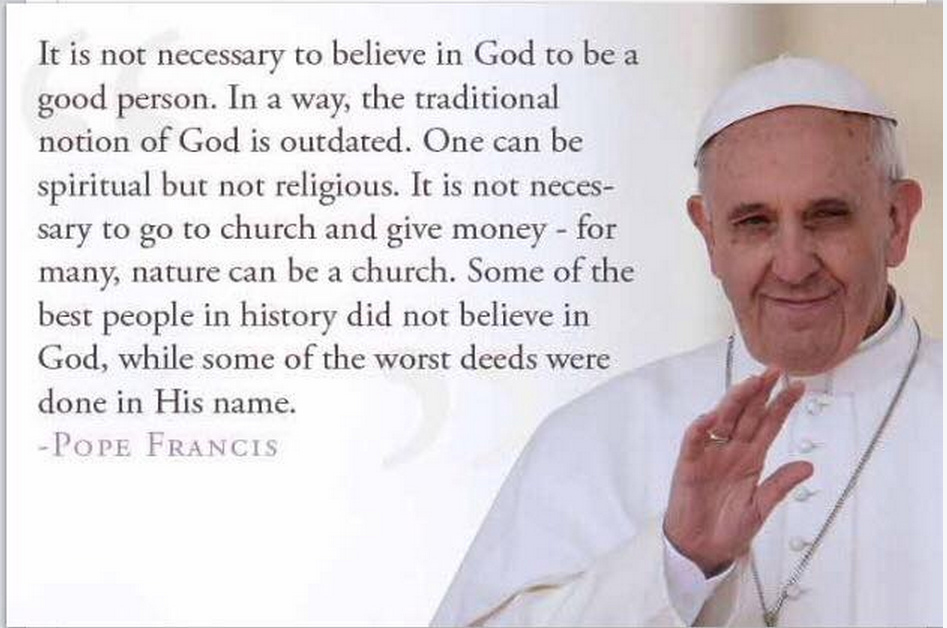
Here is the source on Facebook. And here is the Snopes comment on it, which I found in the comments thread:
"The Lord has redeemed all of us, all of us, with the Blood of Christ: all of us, not just Catholics. Everyone! 'Father, the atheists?' Even the atheists. Everyone! And this Blood makes us children of God of the first class. We are created children in the likeness of God and the Blood of Christ has redeemed us all. And we all have a duty to do good. And this commandment for everyone to do good, I think, is a beautiful path towards peace. If we, each doing our own part, if we do good to others, if we meet there, doing good, and we go slowly, gently, little by little, we will make that culture of encounter: We need that so much. We must meet one another doing good. 'But I don't believe, Father, I am an atheist!' But do good: We will meet one another there."
It appears to be a transmogrification of this quote. However, when Rome habitually puts out statements where both sides can take away their own meaning, (see also here for documentation of that phenomenon) then you would expect something like this to happen.
But I found it because it had been shared by a neighbor, just yesterday, with the one-word qualification, “Profound”.
Wednesday, August 19, 2015
Christians Evangelizing For Secularism
There's a growing list of contexts in which many people think we should say little or nothing about God. Think of the radical redefining of separation of church and state and religious liberty in recent decades and the reaction to the intelligent design movement, for example. It's often considered too divisive, embarrassing, or whatever to bring up religious matters in school, in the workplace, in the media, or at family gatherings. The more that mindset is adopted in some settings, the more it tends to grow in others.
I recently heard somebody commenting on how Christians often use Facebook, Twitter, and other media to do things like post photographs of their children and discuss sporting events, yet say nothing about subjects like God and the Bible. I've been astonished by how many people's Facebook accounts are a form of evangelization for secularism. And that occurs even in nations where the large majority of people claim to be Christian. They have so much to say about their children and grandchildren, friends, music, movies, television, sports, their jobs, politics, travel, food, etc., but so little to say, if anything, about matters like God, theology, and apologetics. When people see something like your Facebook account, blog, or Twitter page, do they see a secular, or nearly secular, lifestyle?
You don't always know who your audience is or how much you're influencing people. If you live well, such as by speaking up about issues you ought to be speaking up about, that will influence other people to do the same. You don't know how much joy or encouragement you might bring some relative, former coworker, or somebody else who comes across your Facebook account or blog and sees you identifying yourself as a Christian or giving some indication of how much you've matured as a Christian. There are people who are looking for that sort of evidence where they want to find it, but aren't seeing it. I doubt that most people realize how damaging it is when so much of their life, including their online presence, is so secular.
"I am constantly astonished at people who say they believe in God but live as though happiness were to be found by giving him 2 percent of their attention." (John Piper, Desiring God [Sisters, Oregon: Multnomah Books, 1996], 268)
I recently heard somebody commenting on how Christians often use Facebook, Twitter, and other media to do things like post photographs of their children and discuss sporting events, yet say nothing about subjects like God and the Bible. I've been astonished by how many people's Facebook accounts are a form of evangelization for secularism. And that occurs even in nations where the large majority of people claim to be Christian. They have so much to say about their children and grandchildren, friends, music, movies, television, sports, their jobs, politics, travel, food, etc., but so little to say, if anything, about matters like God, theology, and apologetics. When people see something like your Facebook account, blog, or Twitter page, do they see a secular, or nearly secular, lifestyle?
You don't always know who your audience is or how much you're influencing people. If you live well, such as by speaking up about issues you ought to be speaking up about, that will influence other people to do the same. You don't know how much joy or encouragement you might bring some relative, former coworker, or somebody else who comes across your Facebook account or blog and sees you identifying yourself as a Christian or giving some indication of how much you've matured as a Christian. There are people who are looking for that sort of evidence where they want to find it, but aren't seeing it. I doubt that most people realize how damaging it is when so much of their life, including their online presence, is so secular.
"I am constantly astonished at people who say they believe in God but live as though happiness were to be found by giving him 2 percent of their attention." (John Piper, Desiring God [Sisters, Oregon: Multnomah Books, 1996], 268)
Sunday, July 26, 2015
“Be Weird. Be Random.”
I’ve been spending an inordinate amount of time on Facebook these days.
When I set my wife up with a Facebook account, after she came home from the hospital following her bone marrow transplant, I had connected her with maybe 100 of my friends from church and work. She took a liking to it. By adding her work friends, her old military friends, and friends from a Stephen King fan club group, she built her network of friends to more than 500. (She’s down to only 300 friends now. That could be my influence, or the influence of her death, or maybe both. How would we test something like that?)
A handwritten note that I found showed what she liked about Facebook: she could contact anyone, any time.
I’ve been posting frequently to her Facebook timeline. Facebook enables you to “memorialize” an account; so her account now is “Remembering Bethany Bugay” (and I would encourage you to visit there and look around to see what I’m talking about).
She was a remarkable woman in many ways. She kept journals throughout her life, and I’ve been finding and working my way through some of them. I’ve thought about writing more about her life, and a number of her Facebook friends have asked me to continue writing about her.
I may or may not continue to do that. Some of the things I’m finding have not been flattering, in a way that I’ll try to describe below.
Elsewhere, where Facebooks suggests friends, one of them was a person named “Gifted Dreamdancer”, a friend of one of my wife’s friends whose profile photo appeared to be a meme that featured someone nearing the edge of a cliff, and this saying:
My thought was, if this person were truly “gifted”, he or she would understand that “weird” and “random” are not commensurate with being gifted. If you are hiding “weirdness” or “randomness”, what would make this person think that that is what you truly are? Certainly, it is a lack of a Christian viewpoint, which would hold that “what you truly are” is “created in the image of God”. And that a true gift is a kindness; it is not something that should seek to distort or to be harmful in any way.
And yet this type of attitude – wrongheaded as we would see it – is actually quite widespread in our culture. It brought to mind an Avril Lavigne song that featured this “lost-and-wandering” message:
More straightforwardly, this kind of confusion was described in a song about Marilyn Monroe:
I say these things to note that, before we met, my wife had this kind of characteristic in her life. She had been sexually abused as a child, and not only as a small child, but on a continuing basis. She ran away from this, but the very act of running away set off a chain of events that got her into even more trouble, which I would say, shaped the rest of her entire life.
Beth not only kept journals, but cards and letters and other memorabilia as well. When we were married, I actively stayed away from these people (and I certainly didn’t want Beth to contact them – old boyfriends included).
But now that she is gone, I’m finding that I have a kind of curiosity to “fill in the gaps”, to add pieces to the puzzle that I had not found before. Really, to understand what made her tick. I’ve contacted several of the individuals who played a role in her earlier life, and virtually all of them have said, in one way or another, “we were young”, as a way of explaining away some of the really stupid and harmful things that they did. One person said that she was “spontaneous”.
When you’re young, that’s decidedly NOT the time to “be weird” or “be random”. In your youth is precisely time to “Remember also your Creator in the days of your youth”. The reason for this, according to the writer of Ecclesiastes, is because “the evil days [will] come” and “the years [will] draw near of which you will say, ‘I have no pleasure in them’”.
In your youth is the time to understand that you are capable of making very bad decisions that can affect the rest of your life. Since, as young people, you have most of your life yet to live, for that reason, you have the very most to lose as well.
Beth was abused, and that led her to get herself into a position to make decisions that affected her life for the rest of her life. One thing led to another, setting off a chain of events that led her to the military in 1980, to the military again in 2002, got her deployed to Iraq, exposed to Benzene, which caused her leukemia, and led to her eventual early death.
She made bad decisions, but others, instead of legitimately caring for her, took advantage of her, and took what they could for themselves of her bad decisions. The results, I find, were devastating, in more ways than one.
When I set my wife up with a Facebook account, after she came home from the hospital following her bone marrow transplant, I had connected her with maybe 100 of my friends from church and work. She took a liking to it. By adding her work friends, her old military friends, and friends from a Stephen King fan club group, she built her network of friends to more than 500. (She’s down to only 300 friends now. That could be my influence, or the influence of her death, or maybe both. How would we test something like that?)
A handwritten note that I found showed what she liked about Facebook: she could contact anyone, any time.
I’ve been posting frequently to her Facebook timeline. Facebook enables you to “memorialize” an account; so her account now is “Remembering Bethany Bugay” (and I would encourage you to visit there and look around to see what I’m talking about).
She was a remarkable woman in many ways. She kept journals throughout her life, and I’ve been finding and working my way through some of them. I’ve thought about writing more about her life, and a number of her Facebook friends have asked me to continue writing about her.
I may or may not continue to do that. Some of the things I’m finding have not been flattering, in a way that I’ll try to describe below.
Elsewhere, where Facebooks suggests friends, one of them was a person named “Gifted Dreamdancer”, a friend of one of my wife’s friends whose profile photo appeared to be a meme that featured someone nearing the edge of a cliff, and this saying:
“Be Weird. Be Random. Be Who You Are. Because You Never Know Who Would Love The Person You Hide”.
My thought was, if this person were truly “gifted”, he or she would understand that “weird” and “random” are not commensurate with being gifted. If you are hiding “weirdness” or “randomness”, what would make this person think that that is what you truly are? Certainly, it is a lack of a Christian viewpoint, which would hold that “what you truly are” is “created in the image of God”. And that a true gift is a kindness; it is not something that should seek to distort or to be harmful in any way.
And yet this type of attitude – wrongheaded as we would see it – is actually quite widespread in our culture. It brought to mind an Avril Lavigne song that featured this “lost-and-wandering” message:
Isn't anyone trying to find me?
Won't somebody come take me home?
It's a damn cold night
Trying to figure out this life
Won't you take me by the hand?
Take me somewhere new
I don't know who you are
But I... I'm with you
I'm with you
More straightforwardly, this kind of confusion was described in a song about Marilyn Monroe:
And it seems to me you lived your life
Like a candle in the wind
Never knowing who to cling to
When the rain set in …
I say these things to note that, before we met, my wife had this kind of characteristic in her life. She had been sexually abused as a child, and not only as a small child, but on a continuing basis. She ran away from this, but the very act of running away set off a chain of events that got her into even more trouble, which I would say, shaped the rest of her entire life.
Beth not only kept journals, but cards and letters and other memorabilia as well. When we were married, I actively stayed away from these people (and I certainly didn’t want Beth to contact them – old boyfriends included).
But now that she is gone, I’m finding that I have a kind of curiosity to “fill in the gaps”, to add pieces to the puzzle that I had not found before. Really, to understand what made her tick. I’ve contacted several of the individuals who played a role in her earlier life, and virtually all of them have said, in one way or another, “we were young”, as a way of explaining away some of the really stupid and harmful things that they did. One person said that she was “spontaneous”.
When you’re young, that’s decidedly NOT the time to “be weird” or “be random”. In your youth is precisely time to “Remember also your Creator in the days of your youth”. The reason for this, according to the writer of Ecclesiastes, is because “the evil days [will] come” and “the years [will] draw near of which you will say, ‘I have no pleasure in them’”.
In your youth is the time to understand that you are capable of making very bad decisions that can affect the rest of your life. Since, as young people, you have most of your life yet to live, for that reason, you have the very most to lose as well.
Beth was abused, and that led her to get herself into a position to make decisions that affected her life for the rest of her life. One thing led to another, setting off a chain of events that led her to the military in 1980, to the military again in 2002, got her deployed to Iraq, exposed to Benzene, which caused her leukemia, and led to her eventual early death.
She made bad decisions, but others, instead of legitimately caring for her, took advantage of her, and took what they could for themselves of her bad decisions. The results, I find, were devastating, in more ways than one.
Sunday, January 02, 2011


Thursday, May 13, 2010
Reasons Why Not to Have a Facebook Account
Update: Here are a few other related articles that have been brought to my attention.
Top Ten Reasons You Should Quit Facebook
How to Quit Facebook Without Actually Quitting Facebook
Fed Up With Facebook? Delete it, and Here's How
Reclaiming Privacy
Kent Brandenburg is someone that I rarely agree with. I once was a fundamentalist as he is. But I still share some concerns that they have about worldliness. I don't always agree on their specifics of what constitutes worldliness. But here he gives good reasons why not to have a Facebook account. Certainly, some of these reasons can be applied to other orbits of the Internet (I don't even believe in Powerpoint Preaching).
Facebook (and addiction to it) is pervasive in the Evangelical church. My first concern about it happened when I attended seminary. Yes, I said seminary. I noticed that scores of seminarians were addicted to it -- spending 2–5 hours a day on it. I have no idea how they managed their studies by being consumed by this social network. I never asked. But maybe I should have. That was over three years ago. I cannot imagine how more prevalent it is today. Should seminaries crack down on facebook addiction with students? Should God's people finance tens of thousands of dollars to send their young men to seminary so they can play on facebook all day and night?
I think we can have a beneficial discussion on this topic. What are your thoughts after you have read all of Kent's reasons.
Top Ten Reasons You Should Quit Facebook
How to Quit Facebook Without Actually Quitting Facebook
Fed Up With Facebook? Delete it, and Here's How
Reclaiming Privacy
Kent Brandenburg is someone that I rarely agree with. I once was a fundamentalist as he is. But I still share some concerns that they have about worldliness. I don't always agree on their specifics of what constitutes worldliness. But here he gives good reasons why not to have a Facebook account. Certainly, some of these reasons can be applied to other orbits of the Internet (I don't even believe in Powerpoint Preaching).
Facebook (and addiction to it) is pervasive in the Evangelical church. My first concern about it happened when I attended seminary. Yes, I said seminary. I noticed that scores of seminarians were addicted to it -- spending 2–5 hours a day on it. I have no idea how they managed their studies by being consumed by this social network. I never asked. But maybe I should have. That was over three years ago. I cannot imagine how more prevalent it is today. Should seminaries crack down on facebook addiction with students? Should God's people finance tens of thousands of dollars to send their young men to seminary so they can play on facebook all day and night?
I think we can have a beneficial discussion on this topic. What are your thoughts after you have read all of Kent's reasons.
Subscribe to:
Posts (Atom)