Thursday, February 06, 2014

Rapid speciation


Jonathan Sarfati, Ph.D. says:
Pretty good review ^^^^.
CMI’s review is titled Clash over worldviews. Among other things, it documents that leading evolutionists E.O. Wilson and the late Ernst Mayr agreed with a distinction between observational and historical science. It also deals with Nye’s ‘evidences’ that Ham had no chance to rebut in the short time available.
It was an unconscionable bait-and-switch for Nye to compare the number of kinds on the Ark, only vertebrate animals, with the number of so-called species today. The vast majority of those species are non-vertebrate, and no creationist believes that they evolved from the Ark vertebrates. See for example Refuting Noah’s ark critics.
The Ark landed in the mountains of Ararat, and it’s well known that mountains are good for rapidly producing new varieties and even speciation. That’s because they readily provide the geographic barriers needed for allopatric speciation. With the small populations off the Ark, it’s even easier because of genetic drift.
Actually, even before Darwin, creationists understood that a wide variety of animals descended from a relatively small number of kinds on the Ark. Thus they realized that there was a lot of post-Flood variation, and even what we would now call speciation. For example, Anglican Bishop John Wilkins (1614–1672), the founder of the metric system and the first secretary of the Royal Society; and German Jesuit scholar Athanasius Kircher (1602–1680), renowned in his day as “master of a hundred arts”.
Even now, we could call it a creationist prediction that rapid speciation would be more common than evolutionists expect.


http://blog.drwile.com/?p=12141&cpage=2#comment-83683

Lord of the flies


While the doctrine of “original sin” gets a hard time (I prefer talking about original “guilt” and original “death”), G.K. Chesteron famously said, original sin is the only Christian doctrine that is empirically verifiable. All people sin. All people imitate sin. All people have a propensity to sin. All people are guilty of sin. That human beings sin, transgress, break laws, violate rights, and commit immoral deeds is self-evident to everyone. I have to confess that one of the things that amazed me as a parent was that I never had to teach my children how to lie. They picked it up quite naturally. The mess that one child makes he or she will instinctively blame on another child, preferably the younger one, who cannot yet speak for themselves. Greed, violence, and selfishness seem like the default setting that they are born with. I sincerely believe that crying babies would throw their own mothers under a truck if it would get them what they want. Experience has also taught me that raising toddlers is like working for Caligula and Charlie Sheen combined. A house run by teenage boys has about the same degree of law and order as lunatics running an asylum. A colony of minors stranded on an island would not resemble Peter Pan’s paradisiac Never Never Land, but would descend immediately into violence and terror more akin to William Golding’s novel Lord of the Flies where the strongest ruled the weakest with merciless spite. If you ever want to see what people are like, what they are truly like, see what they do when they think no one is watching them. Whether it is under a hoody, in a dark alley, or anonymously on the internet, that is when you see what evil desires and what dark proclivities lurk within the hearts of men and women. I’m sure psychologists, sociologists, and anthropologists have their own models and explanation for this sort of innately inhumane behavior, but just as equally important is the theological one: human beings are born into the world with an inherent propensity to sin because they are born into the world separated from God. The whole condition of guilt, sinful behavior, and death is all traceable to the one act of disobedience in our primeval parents, Adam and Eve. 
http://www.patheos.com/blogs/euangelion/2014/02/paul-on-sin-in-romans-5-6/

Throwing Ham under the bus


Here are some comments I've run across regarding the Ham/Nye debate:

"I still respect Ken Ham a lot. I think he's doing tremendous work for the Kingdom and am not pleased at all by professing Christians who seem all to eager to throw him under the bus." 
"Give me a break! Like I said to disgruntled Christians, how about praying for Ken Ham instead of criticizing him? Is it Ham's fault that they promoted the debate better than Dr. Craig? Does the average Christian need 2 doctorates, etc. to do apologetics? Man...some Christians never have enough to complain about." 
"I had families from church over to watch the debate and there were 7 kids. Most of those kids got was Ham was saying. Now, had this debate featured a "higher level" Apologist who used more technical terms, those kids probably would not have followed."

i) I'm going to begin by saying some positive things about Ham. I appreciate the fact that he's been an outspoken critic of Peter Enns. That's more than I can say for the grand muftis in the PCA. Why is Enns still an elder in good standing in the PCA? He's been a ripe candidate for a heresy trial for some time.

Likewise, I appreciate the fact that Ham founded AiG. That's a very useful resource.

In interviews, Ham said he challenged Nye to a debate because the scientific establishment has silenced public debate over evolution in primary and secondary education, so this is a way of bypassing official censorship. Going over their heads to directly address the general public. That's why he also does the talk show circuit (The O’Reilly Factor and Fox and Friends in the Morning; CNN’s The Situation Room with Wolf Blitzer, ABC’s Good Morning America, the BBC). I think that's a commendable strategy.

ii) There's a right way and wrong way to score the Ham/Nye debate. For instance, you had old-earth creationists who said he lost because he defended young-earth creationism, and you had theistic evolutionists who said he lost because he defended young-earth creationism. But that's the wrong way to score the debate. Since he is a young-earth creationist, that's going to be his frame of reference. The proper standard of comparison would be the most sophisticated exponents of young-earth creationism. Did he bring to the debate the best that young-earth creationism has to offer? 

Now for the other side of the argument:

iii) Ham doesn't know his limitations. And that's not admirable. That's prideful. Given that he's recruited a number of contributors to AiG who have the expertise he lacks, why didn't he tap his own talent pool? Instead of presuming to spearhead the debate himself, why not volunteer one of his AiG contributors? Why not challenge Nye to debate one of them?

It's possible that Nye would have declined that challenge. However, since Nye is very self-confident, it wouldn't surprise me if he'd accepted the challenge. That would have given Nye a much stronger opponent. Consider Jerry Coyne's damning admission:

I hope that, in the future, Nye is not so emboldened by his success in this debate that he starts debating creationists. Eventually he will run into one that is not as Ham-handed as Ham, and he’ll lose badly.  
http://whyevolutionistrue.wordpress.com/2014/02/05/who-won-the-big-evolutioncreation-debate/

iv) The debate question (“Is creation a viable model of origins?”) was so broad that it was practically impossible for a creationist to win. Nye can hurl too many objections at his opponent. There's not enough time to respond to the objections. So the debate question needed to be very narrow.

Sure, Nye could still go off-message, but in that event his opponent could the remind the audience that Nye was tacitly conceded that he lost the argument whenever he felt the need to change the subject.

v) Some Christians think we should go easy on Ham. Do they think your kid's high school biology teacher will go easy on Ham style arguments? Do they think your kid's college astronomy or geology prof. will go easy on Ham style arguments? If you send your kids into battle with light armor, they will return in bodybags. 

vi) No, the average Christian doesn't need two doctorates to do apologetics. But that misses the point. If you're going to defend Christianity on a national stage, then that raises the bar. Likewise, science is very specialized. You can't just bluff your way through a scientific debate if you lack scientific expertise.

vii) There's more to Christian faith than arguments. Some Christians don't need arguments. They've experienced God in unmistakable ways.

But if you are going to argue for the faith, then your argument should be able to withstand hostile scrutiny. It's pointless to argue for your position in the first place unless you have good arguments. A bad argument is worse than no argument. 

viii) I'm not clear on how Ken Ham relates creation science to biblical authority. To judge by the debate reviews, he seems to use the Bible to defend creation science rather than using creation science to defend the Bible. If so, that's backwards. Isn't the point of creation science to give scientific reasons for believing Gen 1-11? So Ham needs to defend creation science on scientific grounds. Creation science is supposed to provide supporting arguments for Gen 1-11, as well as scientific objections to Darwinism, &c. 

Moreover, to judge by the debate reviews, he appealed to biblical authority without giving the audience reasons for believing the Bible. But in a national debate, where many members of the TV audience are unbelievers, that's not something they will take for granted. 

The geological column

http://creationwiki.org/Geological_column

Al Capone, a “Catholic murderer” and a “Pop Tart Catholic”

Al Capone, a faithful “son of the Church” 
Did you know that Al Capone considered himself to be a good Roman Catholic until the end? He received last rites from a priest and a Catholic burial.

In his search to demonstrate that those “Callers” who call Protestants to communion with Rome, Darryl Hart has uncovered a Roman Catholic writer, John Zmirak, who is confirming the kinds of things that we have always known: That if you take away all the “Cafeteria Catholics” who break all the rules (most notably the rule on contraception), then you end up with 1.2 million of “the right kind of Roman Catholics” – those who diligently seek to keep all the rules in the proper, nanny-enforced way.

But let’s use language a good deal more precisely, in a doctrinally rigorous sense. How many people in America actually believe all the central truths of the Catholic Catechism? Public opinion surveys have revealed that high percentages of Sunday Mass-goers do not hold, or perhaps never learned about, transubstantiation (the change of bread and wine into Christ’s body and blood in the Eucharist). Depending on which faction of the Catholic fragment you belong to, you can chalk up that ignorance to either the collapse of Catholic schooling, the dumbing down of the liturgy, or even to the suppression during the 1970s of the “unconscious catechesis” that used to occur every time the most unlettered peasant knelt for the Host and reverently took it on his tongue from the blessed hands of a priest.

I don’t know that public opinion surveys have asked “Sunday Catholics” what they believe about the physical resurrection of Christ, or the Immaculate Conception, but if average Catholics believe what I was taught in my Catholic high school, then they are heretics – and probably don’t even know or care.

Wednesday, February 05, 2014

Bill Nye's science lies

http://www.uncommondescent.com/geology/nye-ham-and-how-darwinism-possibly-poisons-science-in-lab-field-and-theory/

Spontaneous abortion

I've noticed some people arguing the fact that a woman's body "naturally rejects hundreds of fertilized eggs in her lifetime" (source) is meant to imply pro-life proponents are inconsistent in defending life at conception. This, in turn, is meant to imply abortion is morally licit.

On the one hand, most pro-life proponents believe life begins at conception. But on the other hand, if so, then why do pro-lifers not mourn the loss of these "hundreds of fertilized eggs"?

I'd like to make some preliminary notes on the topic, and perhaps come back to more specific details at a later date if I can find the time:

On worldviews

Check out Prof. James Anderson's five-part series on worldviews.

Also, here is his book.

Necessity and determinism

http://analytictheologye4c5.wordpress.com/2014/02/05/getting-clearer-on-reformed-theology-determinism-and-necessity/

Ostrich apologetics


Do you have what it takes to take on Bill Nye The Science Guy? Do you have to know everything, about every branch of science? 
You would think if the Bible is true, and every Christian is called to defend it, then every Christian should be able to defend it. 

I don't believe it is possible to be any more ivory tower than this blog post. Sure, I think there are better people who can take on Bill Nye, cough Sye, cough, but it's not because of their education, or college degrees. It's not because of the height of their ivory tower. 

Unfortunately, this ostrich posture is representative of some Christians. They operate with a fatalistic outlook, as if qualifications don't matter. But if you're going to make a scientific case for creation science, or make a scientific case against evolution, then your scientific competence, or lack thereof, is directly germane to the success or failure of your performance. There's no magical efficacy that attaches to a well-meaning, but ignorant performance.

Every Christian isn't called to defend specialized issues which he has no technical competence to defend. To the contrary, he ends up harming the cause. Every Christian doesn't have a duty to get into a national televised debate with Bart Ehrman on the reliability of the NT text. Don't do that if you lack the requisite expertise in textual criticism. Every Christian doesn't have a duty to get into a national televised debate with Israel Finkelstein on the historicity of the OT. Don't do that if you lack the requisite expertise in Biblical archeology. 

There's a very common narrative of boys who get their information from someone like Ken Ham, go off to college fired up about how they are going to trounce the Darwinians, only to lose their faith in Biology 101, Geology 101, or Astronomy 101. Enthusiasm is no substitute for know-how.

That's one reason we need to distinguish creationist popularizers like Ken Ham from creation scientists who have real expertise.

Textual stability

http://larryhurtado.wordpress.com/2014/02/05/originals-for-nt-gospels/

Presenting the Gospel


A number of commentators have commended Ken Ham for presenting the gospel several times during his debate with Bill Nye. However, a problem with that commendation is that, in the context of a debate over creation science, the credibility of the gospel is tied to Ham's ability to make a credible case for creation science.

I think some commentators are acting as if the gospel is somehow a stand-alone presentation, independent of the context in which it's given. It's easy for me to imagine some listeners saying to themselves, "That's a beautiful story, Mr. Ham. A beautiful fictional story. Pity the Bible isn't believable." 

This is not like a debate over evidence for the Bible, which would, in turn, lay a foundation for a gospel presentation. 

Creation debate


I going to do two things in this post: begin with some links to post-debate analysis, then include some comments from the Uncommon Descent blog. 

There were two related events last night: the formal debate between Ham and Nye, then a joint interview with Piers Morgan. I didn't watch either one. I don't think Ham and Nye are terribly competent spokesmen for their representative positions.

Post-debate analysis tends to focus on lost opportunities. Post-debate analysis can be more useful than the actual debate because it gives the commentator the opportunity to shore up deficits in the actual debate:


--------------------------------------------------------------------------------------------------


  1. As a card carrying YEC ( paid about $35 for my membership in Creation Research Society), I thought NYE won the debate but not hands down.
    He posed the question, “Is Ken Ham’s model viable?” the answer imho, is “not yet” which is as good as “no”. It was clear in the Q&A not even some YECs would agree with the model Ham had in mind, and in fact Ham waffled. “The Bible said it” is not a model.
    Ham however probably elevated the dignity of creationists by showing the media is distorting evidence and that creationists can do good operational science and that secularists are hijacking the definition of science.
    Nye made some mis-steps most notable claiming the adequacy of natural selection, and he fumbled over the 2nd law (and I could have given a better answer than the confused answer he gave), simply by saying “the 2nd law states…” “creationists mistake organization with entropy, entropy helps you estimate energy available to do useful work, you need entropy to be alive, if you remove all the entropy in your body (say by freezing to absolute zero) you die. Duane Gish was horribly wrong and that’s an example of creationism teaching bad science.”
    Some scientists who aren’t creationists don’t think the universe is expanding nor that the Big Bang is correct. Another forgivable misstep.
    Ham, when asked about the dinosaurs and carbon dating didn’t use the opening! He could have said “we find carbon 14 in dinos, ambers, and the entire carboniferous era of supposedly 300 million years ago, and then this casts doubt on the interpretation of other radiometric methods, and by the way other clocks indicate youth. Distant starlight would be a problem if the transmission of light over time and space is constant, and if one or both vary the speed of light, then it’s not a problem and that is a testable prediction” But he waffled and just waxed philosophical and theological.
    As both Dr. Sheldon and myself point out, we are skeptical of the existence of Dark Energy and Nye laid out the claim of dark energy as being real.
    Ham did a good job of using the notion of “the orchard” of life vs. trees. I’m not comfortable saying there is no increase of information, there is no significant increase in information, but I’m glad he had Fabich speak for him. And I was really glad Distinguished professor of astronomy Danny Faulkner spoke and advocated young universe.
    But is the model viable. “Not yet” in my opinion, and that is as good as “no” for the sake of science. But that’s not complete fair because we should also ask is the Darwinian model viable, “NO WAY, and never”, not even based on the terms of science Nye laid out.
    Both performed well, and it wasn’t the blowout of Ham destroying Nye, Nye won the fundamental question even if he had to use some falsehoods to win the debate. His criticism of Noah’s ark was powerful.
    What’s an example of a rout aside from the Seatle Seahawks crushing the Denver Broncos in the superbowl? Stephen Meyer vs. Peter Ward. That’s where the ID side completely obliterated the Darwinian side.
    Credit Ham for mentioning the Lord Jesus Christ and pointing out that we may have joy now to discover, but what will it mean for us when we are dead.
  2. I think Ham was far better prepared in his presentation, but wobbled in rebuttal and the little Q&A that I could tolerate. Nye was as methodical as a sand flea with a flurry of attacks against YEC from every known science in random order. Ham would have needed “millions of years” to rebut every point. Good tactic by Nye.
    Nye did make good points about the reasonableness of some of the mathematics of Genesis, although he was apparently unable to grasp Ham’s presentation of the “orchard” model, and the profoundly expanded genetic variability in earlier organisms such as is apparently preserved in dogs was lost on Nye. The genetic variability dogs would enable them to easily form hundreds of “species” in a short amount of time.
    That Nye presented the inflationary model in one breath, and the fixed distance of stars in the next was as remarkable as Ham’s ignorance of the currently accepted understanding that the universe inflated faster than the speed of light, which means that a star that’s 6,000 light years distant could have been 1 light year distant a few seconds ago, as is thought to have happened at some point.
    Particularly appalling was Ham’s inability to come up with a single prediction based on YEC, or a reason why anyone could possibly be interested in Cosmology when the Bible already tells you that “In the beginning, God created the heavens and the Earth.” Apparently, Ham’s curiosity is very easily sated. Nye’s attempt to enforce the imaginary separation between “scientists and engineers” from Christians pretty much failed in light of Ham’s presentation.
    Overall, Ham did a better job, but not by much, and I’m sorry to say that the encounter was reminiscent of a battle between a blind cobra (Nye) and a crippled mongoose (Ham).
    -Q
  3. Scordova.
    NO!! Ham was way ahead in argument, articulation, and summing things up.
    Nye lost everywhere he roamed.
    Ham did point out the racism in early textbooks based on Darwin, I forgot to mention that. That was a good jab.
    Nye stated a falsehood, but one he obviously believes, that about Natrual Selection.
    Maybe I just found Nye more charming. Ham began to resort to implicit circular reasoning without justifying his reverence for the Bible, he just accepts it.
    It’s commendable that someone accepts the Bible, but with an audience watching to hear why you accept it and no answer is given except, “I believe it”, I find that off putting. Not once did Ham say why he believes it, he just states it without any support, which doesn’t look much better than saying “the book of the flying spaghetti monster answers all your questions….it answers the questions of …..” It comes across as closed-minded and out of touch and perhaps gullible. Exactly the qualities you don’t really want to see in someone, especially a scientist.
    Nye was being extremely diplomatic in not directly attacking the Bible, so he let up when he could have really abused Ken Ham. Nye could have said, “In the Bible, God commanded the children of Israel to kill women and children like the Amalekites. Do you agree that this was a good thing to do. If God asked you to do that, Ken, would you have done it?” Thankfully the debate didn’t get to such mud slinging…
    But personally I don’t care what individual has won the debate. The facts have decided, and the facts are the judge in the end (well, God is the judge in the end). So the facts win the debate.
    ID is true, and whether the case of YEC will ever be convincing from the data remains to be seen, but for now, I can only merely accept it personally, on faith, but I will admit, not all the available observations are friendly to YEC, there are unresolved serious problems. I know that, the best YEC scientists that I meet in conferences know that.
    Darwinism is dead, ID is alive, and YEC is still in the hospital bed.
  4. Ham answered a question that went something like, “if you had evidence that the world was old, would you still believe in God and Jesus Christ?”
    Ham basically answered that would be impossible since God’s word is true, which is nothing more than an assertion, and shows he will not follow physical evidence where it leads.
    I would have said, “Yes I would still believe in God and Jesus Christ. I’d believe in God because of the evidence of design even in an Old Universe, and I believe in Jesus Christ because of the blood of the martyrs and the changed lives, not the least of which is mine. If you can provide convincing proof that life can arise without intelligence, that would make me doubt, if you can provide proof that Jesus was not a historical person as well overturning the well-attested martyrdoms of the early Christians, I might have even more doubt, but you can’t say He hasn’t changed lives nor hasn’t answered prayers. But one thing is clear, there is no salvation in Charles Darwin nor eternal hope for a soul after death through science.”
    Why do I believe world is young? Half the scientific clocks say it is, half don’t. So it is inconclusive on evidential grounds. A natural reading of the Bible suggests it, so that makes it promising enough for me to believe it. If ALL the clocks said the world is old, then I don’t think I could accept YEC.

“Reformed Aesthetics”: bringing the “poetics of everyday life” back into focus

My online profile for years has begun with the following statement: “‘We are His workmanship,’ His ποίημα (poiema), His ‘poetry.’ If you’ve ever studied poetry, or struggled to write a poem, you understand the care God takes to ‘work all things together for good’ in our lives. For this reason, and many others, I believe in the Sovereignty of God.” The beauty of the world around is not something I take for granted.

Stephen Wolfe has published his first blog article at Reformation500.wordpress.com, entitled simply “Reformed Aesthetics – Introduction” . He explains:

My contributions to this site will be an attempt to formulate a Reformed view of aesthetics. Though Anglicans, Roman Catholics, and Eastern Orthodox think on these things regularly, Reformed Christians rarely discuss issues in art, poetics, music, and other things with the form and felt qualities of meaning. One would struggle to find any detailed discussion of these topics in most systematic theologies. This is a mistake. The aesthetic dimension of life is vital to worship and life….

I’m not advocating for the use of icons, images of God the Father, and statues in churches. Nor am I arguing that we satisfy the latest craving for a “sacramental worldview” found in the neo-platonism of the medieval period and in the Radical Orthodox movement…. With most of the Reformers, I deny this. Beautiful things are not beautiful because they “participate” in the divine. While creaturely beauty is an analogy to the beauty of God, it is not an analogy by virtue of some added divinity. There is no nature/grace dualism. Just as God’s moral character has been created or brought into creation as the moral law, God’s beauty has been analogized into creation as the creaturely standard of beauty. The standard of beauty is purely creaturely, not something creaturely with some supra-creaturely or divine addition.

Tuesday, February 04, 2014

Bible secrets revealed

http://michaeljkruger.com/bible-secrets-revealed-the-complete-series/

Unapologetic

"Unapologetic: Theological Reflections on Romans 1-2" by Evan May.

The cosmic crap-shooter


God’s middle knowledge is His knowledge of all contingently true conditional propositions in the subjunctive mood, including propositions about creaturely free actions. For example, logically prior to His creative decree, God knew that if Peter were in circumstances C, he would freely deny Christ three times. Such subjunctive conditionals are often called counterfactuals. These counterfactuals serve to delimit the range of possible worlds to worlds which are feasible for God to actualize. For example, there is an intrinsically possible world in which Peter freely affirms Christ in precisely the same circumstances in which he in fact denied him; but given the counterfactual truth that if Peter were in precisely those circumstances he would freely deny Christ, then the possible world in which Peter freely affirms Christ in those circumstances is not feasible for God. 
So there are worlds which are intrinsically possible but which God, given the counterfactuals that happen to be true, is not capable of actualizing and which are therefore, in Flint’s terminology, infeasible for God. Notice that because counterfactuals of creaturely freedom are contingently true, which worlds are feasible for God and which are infeasible is also a contingent matter. It all depends on how creatures would freely behave in various circumstances, which is beyond God’s control. 
http://www.reasonablefaith.org/the-difference-between-possible-and-feasible-worlds

I don't see that Craig's conclusion follows from his set-up. Human agents are like fair dice. God can actualize circumstances, and God can actualize possible agents. By actualizing an agent, God indirectly actualizes the agent's choice–whatever choice that happens to be. 

However, God can't guarantee which choice the agent will make. Since Peter has libertarian freedom, he could do the same thing given the same antecedent conditions, or something different given the same antecedent conditions. If God rewound the tape, he might get the same result or a different result. 

Suppose God wants Peter to deny Christ. God might get lucky. He might get Peter to deny Christ on the first throw. But the outcome is beyond God's control. If God threw the dice 10 times, Peter might deny Christ three times in a row, or affirm Christ twice in a row, or alternately affirm and deny Christ. 

In principle, God could get the desired result by rewinding the tape (i.e. annihilating each failed outcome) until he hits on the desired result. God could serially ensure the outcome by instantiating and annihilating actualized possible worlds until the odds align with God's desired result. 

Libertarian Free Will and the Atonement

http://analytictheologye4c5.wordpress.com/2014/02/01/libertarian-free-will-and-the-atonement/

Superbowl theology


There have always been critics of penal substitution, original sin, imputed righteousness, vicarious atonement, and federal theology in general. Some critics are professing Christians while others are outright unbelievers. Critics regard this framework as unfair or legally fictitious.

It's striking to compare their attitude with sports fans. Fans are very invested in "their" team. They are proud when their team wins, but disappointed, embarrassed, or even ashamed, when their team loses (depending on how their team lost). 

Even though a fan is not a teammate, the fan identifies with the home team, as if a win for the player is a win for the fan, a loss for the player is a loss for the fan. 

When fans relocate from one state to another, it's not usual for them to switch their allegiance to the teams of their adopted state. 

It's striking that many people who reject the vicarious principle in theology accept the vicarious principle in sports.

Monday, February 03, 2014

The sustainability paradox

http://bnonn.thinkingmatters.org.nz/thorny-problems-with-karma-5/

The ethics of contraception

http://www.etsjets.org/files/JETS-PDFs/56/56-4/JETS_56-4_683-96_Hollinger.pdf

God's android army


[James Anderson] “Indeed, it’s a strange model of divine infallibility that hangs on the divine decree counterfactually tracking the libertarian-free choices of human agents. You might as well say that a train infallibly decrees its destination because it necessarily follows its tracks. If a junction gets switched, no problem, because that only means the train decreed a different station!” 
[Greg Welty] This would be a good analogy, if the agents were actual the way the tracks and junction are actual. As you know, nothing creaturely is actual when God makes his decree. God isn’t ‘tracking’ any *actual* creaturely choices. If you want to talk about a Molinist train, the fact that there are any tracks or junction switches at all is due to the choice of the train at the outset. The train doesn’t ‘necessarily follow’ anything. As you can see, such a Molinist train isn’t much of an analogy to a real train.

I have two problems with Greg's response:

i) I don't see how the distinction between possible and actual agents is germane here. Although, at this (divinely) prevolitional stage, we're talking about possible agents, they are like actual agents insofar as their hypothetical choices are autonomous in relation to God. What they would do if put in a given situation is beyond God's control. So that places an actual constraint on God's field of action. In that respect, they might as well be real. At the salient level of comparison, I think your analogy holds. 

ii) Let's shift metaphors. It's as if God inherited an army of androids. Each android has its own autonomous program. Each android has a different program. 

God didn't program the androids. God has no control over their programming. God can't reprogram them. 

But God has indirect control over the outcome. At this stage, all the androids are offline. God can decide which android to turn on. If God doesn't want what a particular android would do, he can prevent that by not flipping the on-switch. 

Likewise, if God desires a particular outcome, and there's an android whose stochastic programming, if put in that situation, will facilitate that outcome, then God can control the outcome by choosing an android which will, of its own volition, do what God wants in that situation. 

But God is limited to what the androids are preset to do. There are outcomes God can't bring about unless there happens to be an android with a program that's matches the desired outcome. No such android may be available, in which case God can't bring about that outcome. The individual programs of the individual androids dictates what God is able to do with them. 

(A Molinist might object that a preset android lacks libertarian freedom. That's why I say their programming is stochastic. But in any case, the objection misses the point of my analogy. I'm simply using that metaphor to illustrate how the agent is independent of God. Free in relation to God.) 

iii) The Molinist God is not omnipotent. There are fundamental factors beyond his control. He's not the source of the possibilities from which he makes his selection. He can't even instantiate some possibilities. He's a downsized God. Greater than Zeus but less than Yahweh. A middling God. 

iv) For the sake of argument, I'm granting Molinist postulates. But, of course, Molinism suffers from internal tensions. As one philosopher notes:

I suppose that in some sense Freddoso’s contention is correct, since Molinism—in particular, the theory of middle knowledge—provides a picture or story in which the two claims could be true, if the sceptical worry can be answered. But the theory of middle knowledge in itself provides no answer to the sceptic; that is, it does not even seek to explain how the can- claim is compatible with the backtracker. Rather, it takes the compatibility of these claims for granted. It is thus at best ancillary to an answer to the incompatibilist, and it piggybacks on such an answer. Thus, the theory of middle knowledge is not in itself an answer to the basic thrust of the incompatibilst’s argument. 
To explain. On the theory of middle knowledge, God has prevolitional knowledge of a large set of conditionals specifying how individuals would freely behave in various circumstances: ‘If in circumstance C1, agent A would freely do X ’ ‘If in circumstance C 2, agent A would freely do Y ’, and so forth. These conditionals are supposed to be simply ‘given’ in the sense that they are true prior to any decree by God as to which possible world will be actualized. But note that it is an assumption shared by Molina and Freddoso that acting freely implies freedom to do otherwise. So, on the theory of middle knowledge, conditional truths of the form, ‘If agent A were in circumstance C1, he would be free to do other than he actually does (X), or ‘If agent A were in circumstance C2, he would be free to do other than what he actually does (Y )’ are simply assumed to be knowable by God prior to the relevant times (the times of the actions). Thus, it at least appears that the theory of middle knowledge simply presupposes that God’s foreknowledge is compatible with human freedom to do otherwise! 
The theory of middle knowledge does not answer the incompatibilist’s sceptical argument from the fixity of the past. The theory of middle knowledge does not even attempt to explain how the pertinent can-claims can be consistent with their paired backtracking counditionals. In assuming that God can know the conditionals in question, the theory of middle knowledge appears to be taking for granted the very question at issue in the debate between the compatibilist and the incompatibilist: it appears to be assuming that human agents can so act that the past would have been different from what it actually was. 
http://www.andrewmbailey.com/jmf/Molinism.pdf

v) In addition to the classic tension between divine omniscience and libertarian freedom, Molinism aggravates that tension inasmuch as the human agents in question don't even exist! Yet God supposedly knows what these nonentities would do. As Arminian philosopher Jerry Walls opines, "how God could know the actual free choices of possible creatures who will never exist?"

(That's not a problem for Calvinism, for what they would do is the result of what God would predestine them to do.) 

So Molinism is a type of finite theism. A God who's limited in knowledge and power. 

Legends of the flood


I'm going to comment on this article:


We have known for well over a century that there are flood stories from the ancient Near East that long predate the biblical account
Actually, Josephus and some church fathers knew about Mesopotamian flood traditions from Berossus. So this is hardly revolutionary. 
(even the most conservative biblical scholars wouldn’t date any earlier than the ninth century B.C).
i) Actually, the most conservative biblical scholars date the Genesis flood account to the time of Moses in the 2nd millennium BC. They differ on whether the early date or the late date for the Exodus is correct. But on either reckoning, that's well before the 9C BC.
ii) Baden fails to distinguish between the date for Genesis and the date of the source material which the narrator may have used.
The people who wrote down the Flood narrative, in any of its manifestations, weren’t reporting on a historical event for which they had to get their facts straight (like what shape the ark was).Everyone reshapes the Flood story, and the ark itself, according to the norms of their own time and place.Neither version is right or wrong; they are, rather, both appropriate to the culture that produced them. Neither is history; both are theology.
That's sloppy reasoning on several grounds:
i) To begin with, the fact that you may have multiple accounts of an event doesn't cast doubt on the historicity of the underlying event. Suppose a reporter collected oral histories of the Johnstown Flood (1889). Survivors would give personal accounts of the ordeal. Details would vary. But that wouldn't mean it never happened.
ii) We need to distinguish between fiction and legend. The Mesopotamian traditions are legends of the flood. But legends aren't necessarily fictitious. To the contrary, legends can have a basis in fact.
Legends can have a historical core, but be inaccurate in varying degrees if this was passed down for several generations. It's not an eyewitness account by a survivor, but a thirdhand account. By the time it's written down, inaccuracies may creep into the account. For the writer can't check his materials against the event. He wasn't on the scene when it happened. 
In addition, you sometimes have deliberate legendary embellishment. Mesopotamian accounts have a political and/or theological agenda. It may be to promote the state religion, or promote a rival religious faction.
Take the Gunfight at the O.K. Corral. That's legendary rather than fictional. It's a real event, but the details are fuzzy because we don't have enough firsthand accounts to determine exactly what happened. 
In ancient Mesopotamia, a round vessel would have been perfectly reasonable – in fact, we know that this type of boat was in use, though perhaps not to such a gigantic scale, on the Mesopotamian rivers.The ancient Israelites, on the other hand, would naturally have pictured a boat like those they were familiar with: which is to say, the boats that navigated not the rivers of Mesopotamia but the Mediterranean Sea.
Since liberals typically think the Pentateuch was composed or finalized during the Babylonian Exile, the difference between the two accounts runs counter to the Babylonian provenance which liberals attribute to the Pentateuch.
What, then, of the most striking parallel between this newly discovered text and Genesis: the phrase “two by two”? Here, it would seem, we have an identical conception of the animals entering the ark. 
I don't find anything striking about that. It does't reflect literary dependence. Rather, "two by two" is a natural breeding pair. That's the bare minimum needed to repopulated the devastated area. That's realistic. Indeed, Baden even admits that lower down when he says:
If the goal of the ark is the preservation of the animals, then having a male and female of each is just common sense. And, of course, it’s a quite reasonable space-saving measure.
Moving along:
More accurately, it’s one thing that the Bible says – but a few verses later, Noah is instructed to bring not one pair of each species, but seven pairs of all the “clean” animals and the birds, and one pair of the “unclean” animals.(This is important because at the end of the story, Noah offers sacrifices – which, if he only brought one pair of each animal, would mean that, after saving them all from the Flood, he then proceeded to relegate some of those species to extinction immediately thereafter.)This isn’t news – already in the 17th century scholars recognized that there must be two versions of the Flood intertwined in the canonical Bible.
But even on his own explanation, that's not a discrepancy. There were more clean pairs than unclear pairs because clean animals were sacrificial animals (as well as edible animals for human consumption). So you needed extra clean animals to spare. 
Moreover, it's standard compositional technique for the narrator to make a general statement, then follow-up with specific details. 
One version says the Flood lasted 40 days; the other says 150.
That confuses the duration of rainfall with the duration of the flood.
One says the waters came from rain. Another says it came from the opening of primordial floodgates both above and below the Earth. 
As if the flood could only have one source of water. Keep in mind, too, that these are linked. For instance, torrential rain causes rivers to flood their banks. So that's realistic. 
One version says Noah sent out a dove, three times. The other says he sent out a raven, once.
The birds have different functions. Doves are used as homing pigeons to find your way back. Ravens are used to find new land when you travel by sea to a new destination. Once again, that's realistic. 

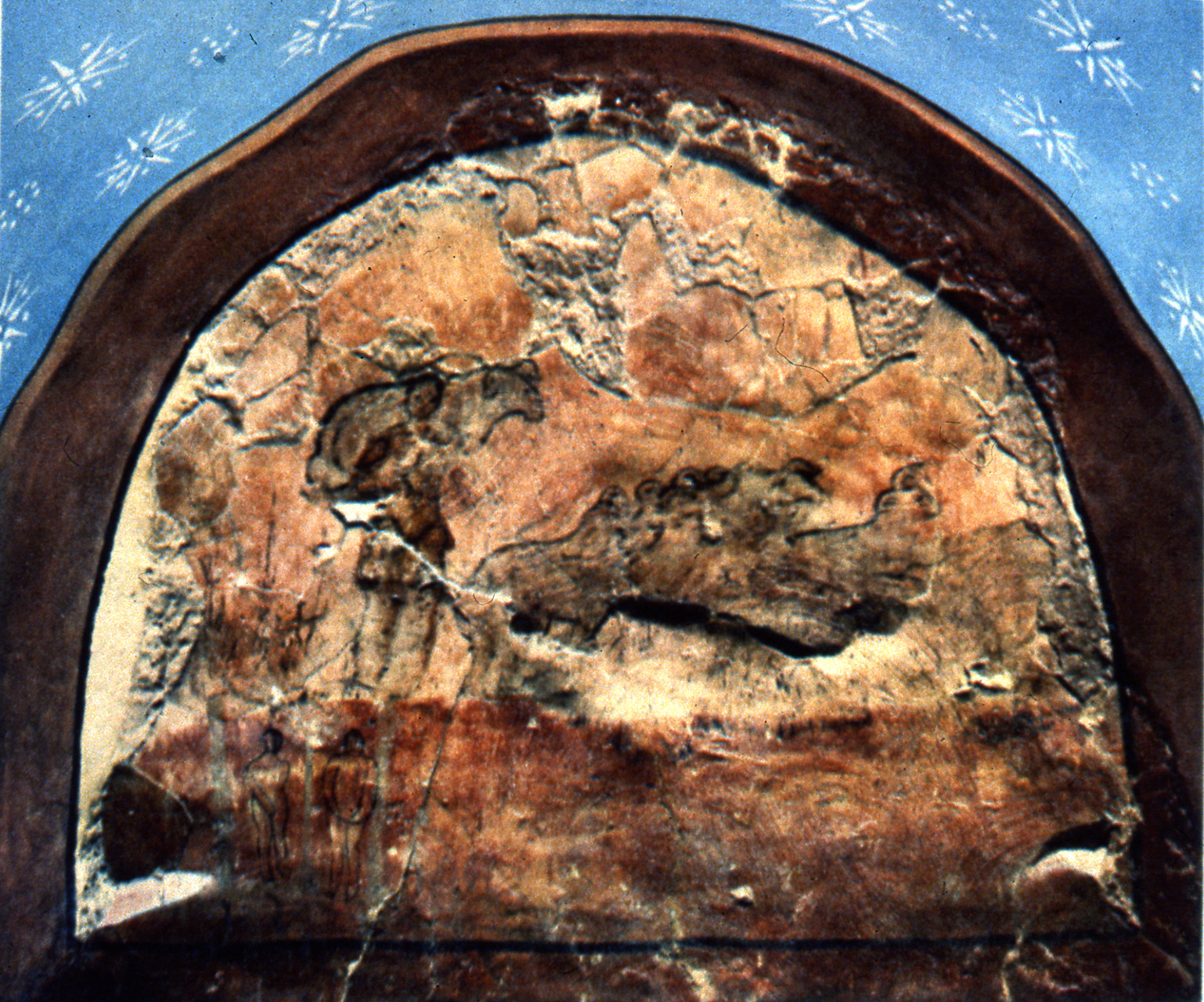
The earliest church building ever found: Dura-Europus in modern-day Syria

This image of the Good Shepherd is still visible above the
baptistry. More images are available here.
While doing some reading on another topic, I came across the account that Samuel Hugh Moffett relates of the story of the oldest church building ever found, at Dura-Europus, along the banks of the Euphrates River in what is now western Syria, near the border with Turkey. It was located at the site of what had been a Roman garrison, as the Romans pushed eastward into the Persian Empire, before a Persian army expelled them, around the middle of the third century.

It is interesting to note that there was not an “altar” at the front, (as most Roman Catholics would have us believe that “the Mass” was the most ancient form of Christian worship), but the church did feature an almost-immersion-sized baptistery.

Northwest about eight hundred miles from the great rock figures at Bishapur, a small Roman garrison town once stood on the west bank of the Euphrates River, Dura-Europos. About 250 as the legions fell back before Shapur’s advancing Persians, Rome abandoned the fort and the Persians destroyed it. For seventeen centuries its crumbling ruins lay open to the sun and the wandering Bedouins. Then in 1920 a British military detachment digging trenches uncovered a part of the ancient city wall that had collapsed, burying and preserving a narrow strip of the town much as the ashes of Vesuvius had in a much larger way covered Pompeii. Archaeologists carefully removed the fallen wall.

Sunday, February 02, 2014

Responding to a Lutheran considering converting to Rome, Jonathan Fisk calls Roman Catholic Church the “Abomination of Desolation”

He’s kind of hard to listen to sometimes, but thanks to the magic of editing, he moves quickly, and he has some great one-liners. Here, Jonathan Fisk responds to a Lutheran who says he is considering a move to Rome:


Here are some great one-liners:

“Grace, of course, is the super-juju to help you get there [to Heaven], but if you don’t get there [on your grace-assisted own strength], you don’t get there”.

Did you ever notice that Purgatory and the Sarlacc [pit from Star Wars] are like, one [and the same – in the sense that they’ll slowly digest you over a thousand years].

Lutheranism exists because the teaching of the Roman Catholic Church is so abhorrent, so connected to the Abomination of Desecration mentioned in the book of Daniel and the Gospels, that the entire northern half of a continent was forced to leave it, actually was kicked out from it, because they said, “no, Jesus is our Savior, we don’t have to submit to the pope to be saved”, and they were told, “Oh yes you do, and since you don’t, you’re going to hell, see you later, and oh by the way, wherever we find you with our armies, we’re going to kill you.” That’s the tradition that you’re buying into. Granted, most American Roman Catholics don't know the first thing about this ...

That last one is as succinct and accurate a summary of the Lutheran Reformation that you’ll find.

For those of you who won’t be watching the Super Bowl today, this is a truthful and entertaining 20 minutes.