Monday, September 28, 2015

Dispatch from Philadelphia: Street Witness to Roman Catholics

I had the privilege to work with Geoff Robinson and some of the team who were reaching out to Roman Catholics last week. Because of my personal situation this summer, I wasn’t able to do as much as I had liked. However, there were a few over-runs on the expenses, and Geoff provides links below and it would be great if someone could help out with these a bit.                                                                                                      

Meanwhile, here is Geoff’s recap of the week: 
.. after our daily witness to the World Meeting of Families, we headed to the suburban transportation centers. We decided it would be next to near impossible to get everyone coordinated in the city. We don't need to see the pope. We just wanted to get to the people.

Well, as far as I can tell we were the only ones with that idea, at least on the South Jersey side of things. [Several of us]  had a successful witness in some of the SEPTA stations....

I estimate we gave out about 4,000-5,000 broadsides this weekend. People were in a rush so we didn't have a ton of conversations, but there were a few.

Again, the consistent thing I'm hearing from Catholics is that they are deceived by both Catholic and Protestant leaders into thinking that there is no difference between Catholic and Protestant teaching on justification.
[JB note: My blog posts on the “Joint Declaration” were a result of some quick research I did in response to questions on this question].
I tried to cut through that by emphasizing what Paul tells us about adding works to justification: if you rely on works of the law you are under a curse, because they have to be perfect.

I ran into the folks at Jeremiah Cry ministries heading into the city. They are a Reformed street preaching ministry. They were sharing the gospel in the city. God bless those guys they were such an encouragement to just run into them.

So, besides praying for everyone who read or heard the message of God's free grace in Christ, the main takeaway I would give to all of you is that our team and others proclaimed the gospel to a lot of Catholics who didn't even know there was a difference between us. (Some did know and would just say something like "James" while walking by.)

Many thousands in our home area of Philadelphia and beyond now know there is a difference. And this difference isn't an inconsequential difference. If that is the bare minimum of how the Lord used this, this opens up opportunities. And it should remind us that there are many who are essentially "unreached" in my opinion in our own back yard.

We had 4 law/gospel broadsides. All were written with Roman Catholics in mind. 2 specifically mentioned that we have disagreements with Rome (we mentioned and quoted Trent). We got reactions and conversations mostly from the two that respectfully mentioned our disagreements. So another lesson: don't hide your difference for fear of offending. Pointing out disagreements leads to clarity and can give opportunities for making the gospel message more clear for people.

One item of business before I leave you. Ammi Ministry graciously bought $180 worth of SEPTA tokens for our campaigners. We also need some extra money for incidental expenses and I wanted to give the church that housed us during the week a donation for being gracious hosts to us.

If the Lord leads you to give, please help defray some of these costs.


In Him,
Geoff Robinson

The Pope's Failed Visit To America And His Failed Leadership

Here's a New York Times story that unintentionally illustrates how corrupt the Catholic Church is and how bad of a leader Pope Francis is. For example:

But mostly Francis demonstrated a nuanced political dexterity, effectively sidestepping the familiar framework of American debate while charting his own broader path. He advocated “life” but emphasized opposition to the death penalty, not abortion. He made strong stands for religious freedom — a major issue for American bishops — but refocused the concept on interfaith tolerance and harmony….

Francis responded on this trip by advising the bishops to use less harsh language, be less critical and offer a more welcoming approach in the church and in society. “Our common house can no longer tolerate sterile divisions,” he said Sunday during his final Mass, on the Benjamin Franklin Parkway.

He never mentioned same-sex marriage — and is opposed to it — but analysts say his message was that bishops should focus less on such issues and more on pastoring to Catholic families over all….

While Francis needed to be careful wading into politics, “complete silence on these issues demoralizes those who are on the front lines of these battles,” wrote R. R. Reno, the editor of First Things, a conservative journal on religion in public life. “The only specific issues Francis mentioned before Congress are associated with progressive politics.”…

“I love the inclusiveness of this pope,” she said. “He stepped outside the borders of what’s been acceptable before in the Catholic Church.”

While everyone in the church if not the country was parsing what Francis said during his visit, the faithful, including Ms. Giovinco, heard unmitigated tolerance. “He’s following the original precepts of the church: Love one another.”

Contrast the Pope's behavior with Jesus' calls for repentance, confrontations, and rebuking of his contemporaries in the gospels, the behavior of the apostles in Acts, and how early church leaders like Polycarp and Athanasius conducted themselves. For documentation of the contrast between the ecumenism of modern Catholicism and the beliefs and practice of patristic Christianity, see the fourth post in the comments section of the thread here.

Sunday, September 27, 2015

Carson kerfuffle

Ben Carson is hardly my first pick for prez. However, the typical reaction to his Muslim president comment reflects a characteristic chasm between the political elite and the rank-and-file. I seriously doubt most conservative voters had any problem with his answer.


Blood moon


Blood moons have occurred many times throughout history. But the eschatological events that mark the Day of the Lord will be unmistakably unique. Those biblical passages also talk about the sun being darkened, and about other cosmic phenomena taking place (such as the stars falling from the sky in Rev. 6:13). Again, the language of Scripture depicts something far more dramatic than a normal lunar eclipse. 
http://www.tms.edu/preachersandpreaching/blood-moons-and-biblical-discernment/

I disagree:

i) To begin with, this may be stock figurative eschatological imagery.

ii) Even assuming it's literal (and I'm open to that), the fact that any one celestial sign is fairly commonplace doesn't mean the combination is commonplace. Ancient observers were impressed by rare astronomical conjunctions. For certain astronomical events to cluster in time and/or place is what makes it a portent or prodigy. 

iii) Another problem with the interpretation is that it uses modern astronomical knowledge as a frame of reference, regarding the frequency of lunar and solar eclipses, but the original audience wasn't privy to that information. So solar and lunar eclipses, as well as meteor showers, would be much rarer for the original audience. 

To witness a solar or lunar eclipse, you must be alive at a particular place and time. You must be facing the sun or moon. If you're on the side of the earth facing away from the sun, you can't see a solar eclipse. And it only lasts a few minutes. So it's not as if there's time for it to circle around. Likewise, the visibility of a lunar eclipse may depend on what hemisphere you're in.  

Astronomers keep records of how many solar and lunar eclipses there've been, but even in modern times, the man on the street doesn't have that figure in his head. 

iv) If, however, it is necessary to make the sign more impressive, there are miraculous ways God could do it. It is physically impossible to have a simultaneous solar and lunar eclipse. A solar eclipse requires sun and moon to be in conjunction whereas a lunar eclipse requires sun and moon to be in opposition. The same object can't be in two different places at the same time (although that might be disputed at Plank scales).

But God could create an optical illusion of a simultaneous solar and lunar eclipse. 

In theory he could create temporary duplicates of sun and moon (although that would require other adjustments to shield the earth from the additional solar radiation and gravitational effects.

Likewise, God could miraculously cause a solar and lunar eclipse in rapid succession. An interval that's naturally impossible.  

Catechizing sodomy and lesbianism

How would we ever survive without the moral guidance of the Roman Magisterium?


Former “Spiritual Friendship” contributor Chris Roberts, who also gave a presentation at the November 2014 “Gay in Christ” conference, was selected as the editor of the official preparatory catechesis for the September 2015 World Meeting of Families in Philadelphia, a Vatican-sponsored event. 
https://stream.org/the-dangers-of-a-homosexuality-of-the-heart/

Transgender illegals

It's revealing to see the priorities of ICE:

https://stream.org/the-dangers-of-a-homosexuality-of-the-heart/

Dispatches from Philadelphia: “Pope Francis” Schedule for Sunday. Please pray for Papal Outreach Street Evangelization

Sunday, Sept. 27
9:15 a.m. - The pope is scheduled to begin his day by meeting bishops at St. Martin’s Chapel in St. Charles Borromeo Seminary in an event that is closed to public.

11:00 a.m. - Francis is expected to visit the Curran-Fromhold Correctional Facility. While at the Philadelphia facility he is due to meet with a group of prisoners, their families, and prison staff members.

4:00 p.m. - The pope is expected to celebrate Mass Sunday to bring a conclusion to the World Meeting of Families, the congress held to promote family life, at the Benjamin Franklin Parkway. Francis is expected to parade along the parkway leading up to the event. Hundreds of thousands of people are expected to attend the Mass, which is a ticketed event, while more than 1 million could attend in the general area of the parkway.

7:00 p.m. - Francis is scheduled to meet with organizers, volunteers and benefactors involved with the World Meeting of Families at the Atlantic Aviation hangar.

8:00 p.m. - Francis is expected to depart for Rome, bringing to a close his first visit to the United States.

Separating the boys from the men


There's a Facebook group in support of resurrecting W. L. Craig's fabled beard. There are reported sightings of Craig's beard from the past. 

However, I think the explanation for Craig's disappearing beard is straightforward. As a man of honor and integrity, he came to the realization that his theology belied his beard. You see, Calvinism is a manly bearded tradition whereas freewill theism is a callow peach fuzzy tradition. Consistent Calvinists look like this:


and this:


and this:


and this


and this


whereas consistent freewill theists look like this


and this


and this 


Saturday, September 26, 2015

Coming to a neighborhood near you

http://www.dailymail.co.uk/news/article-3249667/

Federalism and SSM

i) The Constitution is silent on marriage. There's no enumerated Constitutional right to homosexual marriage. After all, the Constitutional doesn't even say heterosexual marriage is a Constitutional right.

According to the 9th and 10th amendments, that means any legal or civil right to marriage must be enacted at the state level:

Amendment IX
The enumeration in the Constitution, of certain rights, shall not be construed to deny or disparage others retained by the people.

Amendment X
The powers not delegated to the United States by the Constitution, nor prohibited by it to the states, are reserved to the states respectively, or to the people.

For the Supreme Court to decree a Constitutional right to homosexual marriage violates Federalism. That falls outside the jurisdiction of the Supreme Court. That's a state issue.

ii) At best, the Supreme Court might strike down anti-miscegenation laws based on the 14th amendment. At least in that instance there's a general Constitutional principle in play: the 14th amendment was designed to overrule state laws discriminating against blacks.

iii) Furthermore, even if a given state passed a statue legalizing homosexual marriage, it would have to include religious exemptions. For state and federal laws don't nullify the first amendment. State and federal laws cannot violate the civil liberties accorded citizens in the first amendment. In case of conflict, the Bill of Rights takes precedence.

iv) That's true for private citizens and public employees alike. Surrending your Constitutional rights is not a condition of gov't employment.

Pope Francis for president!


L'Osservatore Romano

Democrat operatives have been biting their nails in search of an acceptable candidate. This week, Pope Francis solved that problem by giving his nomination speech to a joint session of Congress. He ran on a solid Democrat platform, stressing the threat of global warming, an open borders policy, socialism, and opposition to the death penalty.

On the heels of its queer marriage and Obamacare rulings, the Supreme Court, in a 5/4 decision, reinterpreted the Constitution to waive the traditional eligibility requirement (natural born citizen) for presidential aspirants, clearly the way for the pope's candidacy. 

Boys will be boys


I'd like to highlight a recent incident that nicely illustrates an issue in the current dustup over complementarianism. 

This week a video went viral depicting a fistfight at Huntington Beach High. According to reports, two students got into an argument. One student (Noah) began to assault the other student (Austin) who's visually impaired (blind in one eye). At that point a third student (Cody) jumped in to protect Austin. He flattened the attacker with one punch in the face. 

That's a classic male reaction. Cody saw a situation which required immediate physical intervention. He instinctively did exactly what a boy should do.

That didn't happen at home or at church. 

Judicial hegemony


I'll comment on this post:


Departmentalism is a pipe dream. It's not the way America actually works. In practice, in America, the Supreme Court has a final say. 

Several problems with a that objection:

i) As I already noted, TFan careens between opposing principles. His initial post appealed to the English common law tradition. He said the founding fathers accepted the principle that judicial precedent can have the force of law.

a) Now that appeal is problematic on its own grounds, for as I pointed out, having a written constitution represents a significant modification of the common law tradition. A written constitution restricts judicial discretion compared to common law jurisprudence.

b) But in addition, TFan's argument is an appeal to what he takes to be the original vision of the founding fathers. They (allegedly) intended judicial precedent to be the rule of law. 

But then he reverses himself by appealing to the modern status quo as determinative. All that matters is not what the founders intended, but how the current system works. If so, then he's withdrawn his initial argument, and replaced it with another argument that appeals to a principle diametrically opposed to the initial argument.

In other words, Whelan's position is a minority position that reflects the way he thinks the system should be not the way the system actually is.

i) Unfortunately for him, TFan's objection is self-refuting. TFan isn't simply describing the status quo. Rather, he's treating the status quo as normative. For instance, he says:

They are free to think the Court decided wrongly. However, even if they disagree with the ruling, they have to obey the ruling until it is overturned. 
One doesn't have to agree with the Court, but one does have to obey the Court.

Notice the implication: we are supposed to comply with the status quo–because it's the status quo. He's not merely describing how things are, but saying we (whether private citizens, or the president, or Congress) ought to defer to the status quo. He confers normative force to the status quo. After all, if he doesn't think that's the case, then why not challenge the status quo?

ii) In addition, TFan's attempted critique of Whelan is vitiated by equivocation. Whelan is exegeting Marbury v. Madison. Whelan is discussing the original scope of that ruling. What did Marshall mean? 

By contrast, TFan appeals to how the Supreme Court has been behaving at later stages of American history. But that changes the subject from what Whelan is talking about. 

As I read it, Marbury isn't asserting that the judiciary has the authority to dictate to Congress or the Executive; rather, it's claiming that Congress and the Executive lacks the authority to dictate to the judiciary. It's an argument for judicial independence. But that doesn't entail that the other two branches of gov't are subordinate to the judiciary. Rather, we have three independent power centers. Each one is authoritative within its proper sphere of governance.

Of course, they are meant to work together. The system falls apart if they fail to cooperate. But that doesn't mean one branch has the right to impose itself on the other two branches by threatening to go on strike unless it always gets its way. 

iii) Furthermore, even if Marbury taught judicial supremacy, why should anyone take that claim seriously? When the Supreme Court makes a self-serving claim, that hardly makes the claim true. The appeal is viciously circular. The Supreme Court must have the authority it claims for its claim to be authoritative. Unless it had that authority in the first place, its claim to authority...lacks authority. 

It's like Catholic apologists who quote early bishops of Rome on Roman primacy. Well, we'd expect bishops of Rome to magnify their authority. 

The fact that the Supreme Court makes self-aggrandizing statements hardly proves it to be what it claims to be. The authority of the judiciary is something to be determined by the Constitution, founding fathers, and ratification debates. 

iv) Then there's TFan's persistent failure to distinguish between judicial review and judicial supremacy. The question at issue is not whether the judiciary has the authority to disregard laws it considers unconstitutional, but whether the other two branches of gov't are subordinate to judicial rulings. 

What would be the point of having a judiciary that no one had to obey? The idea that the Supreme Court's decisions on constitutional matters are just advisory is just nuts.

i) What's funny about this objection is TFan's blindspot to the obvious counterexample:

What's the point of having elective branches of gov't if no judge has to disobey them? The idea that the executive and legislative interpretations of the Constitution are just advisory is just nuts. 

Why is TFan unable to see the nuttiness of his alternative? If it all comes down to to judicial hegemony, then the people's elected representatives are merely figureheads. 

ii) In addition, the way he frames the argument is very slack:

Who said "no one" has to obey the judiciary? Private citizens are in a different position than, say, governors. Keep in mind that even at the state level, there is such a thing as states rights (9th-10th amendments). 

In addition, both private citizens and state officials are in a different position than the US president or members of Congress.  

Why is it "nutty" to say the judiciary lacks the authority to command the people's elected representatives? 

vi) Finally, there's TFan's circular appeal to the status quo. But that's just a tautology. How does the status quo obligate anyone to maintain the status quo?  The status quo is simply how things currently operate. But that's no reason to think the status quo cannot or should not change. The way things are as of now is descriptive, not prescriptive. 

Dispatch from the Papal Outreach in Philadelphia, 6:00 am 9-26-2015

Geoff Robinson, who is coordinating a street-evangelism ministry to the Roman Catholics who will be thronging to see “Pope Francis” in Philadelphia, provides this update:

We have completed the first phase of our campaign.

The Lord blessed our outreach to the World Meeting of Families. Due to several factors under God's providence, it seemed we were everywhere. We had t-shirts designed and donated to us that, without our knowledge, matched the color scheme of the t-shirts given out at the conference. And the Convention Center had only so many access points so we were able to cover the area quite well with a minimal amount of people. Our bilingual tracts made it easy to give out the gospel message to people we couldn't communicate with.

We engaged in many conversations. Most of the people we talked to believe there is no difference between Rome and for lack of a better term the Reformation. Others would just shout out a quip about James 2 to us, but the vast majority of those folks didn't engage in a meaningful conversation.

If I can give one example, I was engaged in conversation with a priest. He was claiming that we believe the same thing regarding grace, etc. If surface-level language is to be believed, he even supported imputed righteousness. It took several minutes to get to the point of agreement that Rome believes in faith + works produces justification and how we disagree on that point.

At that point, the priest gave me a similar objection as the one Paul anticipated in Romans 6:1. At which point I tried to drive the point home: "You are this close! Don't you see!?! You gave me the same objection as Romans 6:1. That means I explained Romans 1-5 correctly!"

I relate this story for one purpose: It's easy to dialogue with someone who has everything clear in their head about where our differences lie. It's not so easy to communicate on the street or with friends, etc. We talked to Catholics who ranged everywhere from crass Pelagianists to people who were confused to people who understood the gospel of free grace and believed it but were still in Rome.

If you run into someone who believes that Reformation was a waste of time, be patient with them and take the time to talk with them. That's a good sign they are confused. And, frankly, that's people in our congregations as well.

Make sure you invest the time with your friends and neighbors to really make sure they understand the differences and understand that those who add works to be justified "are under a curse; for it is written 'cursed is everyone who does not abide by all things written in the Book of the Law, and do them."

As of this morning, campaigners will be going to various SEPTA and PATCO stations. Please pray for the campaigners and that God will bless the gospel message.

In Him,
Geoff

Friday, September 25, 2015

Upon This Sand They Built A Church

I want to gather a collection of links to some posts I've written on the papacy over the years.

Here's an overview of the Biblical evidence pertaining to the papacy. And here's a post addressing the earliest extrabiblical sources. In another post, I addressed the absence of a papacy in early responses to Christianity by non-Christian sources. Regarding how we should expect to see the papacy referred to in the early sources if such an office existed, see here.

I wrote a series on apostolic succession, and that series discusses many subjects relevant to the papacy. There's a lot of material on how Hegesippus, Irenaeus, and other early sources viewed Peter, the nature of succession, and other pertinent issues. And here's a post on the episcopate in the early church.

Timely Slogans for Every Candidate

http://christthetao.blogspot.com/2015/09/timely-slogans-for-every-candidate.html

Parsing manhood and womanhood


There's been a cold war going on between Doug Wilson and the Mortification of Spin over the nature of complementarianism. Denny Burk is another participant in this debate. The flashpoint of the debate was an answer that John Piper gave to a question about policewomen. 

Todd Pruitt made the mistake of using Doug Wilson as a bad example. I generally like Pruitt. He's usually a good culture warrior. He stays informed. But he's no match for Wilson's wit and rhetorical prowess. That exchange went badly for Pruitt.

A better match-up is between Wilson and Trueman, both of whom are witty and rhetorically nimble. But that's not the level at which we need to conduct the debate. This isn't a test of literary panache. There are very serious issues at stake, which require serious analysis. Not just clever repartee. 

One of the tragedies of the slavery/segregation debate is that the right people were wrong and the wrong people were right. By that I mean many of the more orthodox spokesmen were on the wrong side of the issue while many of the less orthodox people were on the right side of the issue.

Problem is, when the most orthodox people are derelict in addressing a social issue, they allow that issue to be defined, by default, by the wrong people. By people with the wrong frame of reference. They will fill the vacuum, and they will misdefine the issue. 

Trueman, for one, suffers from intellectual impatience on this issue. He doesn't want to be bothered with it, beyond a very sketchy position on marriage and church office. But that effectively delegates to secular social engineers all the detailed answered when it comes to society at large. If conservative Christians don't make the intellectual effort, then masculinity and femininity will be defined by feminism, the manosphere, transgender movement, &c. The secular extremists, at various ends of the secular spectrum, will dominate the debate. Extremists (e.g. feminism, transgenderism) and reactionaries (e.g. manosphere). 

In fairness, Trueman is right to be critical of an approach that makes men and women painfully self-conscious about when they are doing, constantly second-guessing their actions, "Is this the manly thing to do?" It's not about making a long list of rules, of do's and don't's. 

Men and women have many overlapping physical and psychological abilities. The question is where the distinctives come into play.

But complementarians of the MOS variety can't successfully oppose the excesses of the patriarchy movement if they are too intellectually negligent to present a concrete alternative. It's incoherent to say "Don't do that!" unless you can say "Do this instead." You can't beat something with nothing. 

Now that may not be Trueman's skill set. But if so, he should recognize his own limitations rather than making his limitations the yardstick.  

However, the approach of Trueman trivializes the issue, as if Christians don't need to give serious consideration to the sociopolitical implications of gender essentialism. Let's block out some of the issues:

i) In defining manhood and womanhood, what's the frame of reference? In complementarianism, manhood and womanhood are to some degree mutually defining. Men have some distinctive masculine virtues, women have some distinctive feminine virtues, and these were meant to supplement each other. Without the moderating influence of each sex, a nature virtue, carried to an extreme, becomes a vice.

By contrast, it's my impression that feminism tries to define womanhood autonomously, without reference to men. The very concept of womanhood is independent of the other sex. 

That's a very different approach, with very different consequences. And, of course, you have vicious internecine wars within feminism regarding the true definition of womanhood.

ii) Another issue is what Robert Bork dubs "coercive equality." This involves the twin notions that women can do whatever men do (or vice versa) and, what is more, women should be doing it at the same rate as men. If not, then this must be due to sexism and discrimination. 

It's not enough to have equality of opportunity, you must have equality of outcome. And if disparity remains despite equality of opportunity, then we must even that out by any means necessary. Demoting qualified men. Promoting unqualified women. Lowering standards. Having quotas. 

iii) Apropos (ii), suppose more men have a natural aptitude, or take a natural interest, in math and science, than women. But, of course, you have exceptions on both sides of the equation. Women who are good at math and science, men who are bad at math and science.

One policy is to give people the freedom to pursue what they are good at, pursue what they find interesting or personally self-fulfilling. 

But that won't satisfy the radical egalitarians. You have feminists who can't grant the possibility that if women are "underrepresented" in certain positions or majors, that's by choice. They refuse to honor the spontaneous preferences of women.  

iv) More controversial is whether some occupations are inherently more suitable for men than women, or vice versa, due to physical differences, psychological differences, or both. 

Christians who believe in gender realism (as Christians should) will draw some lines in that regard, at least in principle. Stock examples include the coed military. 

v) Another example is official hostility towards stereotypical male behavior. From what I've read, the NEA imposes a feminist ideology on education. This results in persecuting boys for thinking and doing what comes naturally to boys. And, more subtly, this stigmatizes girls for thinking and doing what comes naturally to girls. 

vi) On a related note is the question of whether we should have coed team sports and coed contact sports. Likewise, games are typically competitive, which is a stereotypically masculine trait. Not surprisingly, educators who operate with a feminist ideology are opposed to competitive games. In its place they substitute the stereotypically feminine trait of cooperation. Conflict resolution. 

Should Christians op-out of that public policy debate? Retreat into the home and the church? 

vii) It is, moreover, naive to think radical egalitarians will allow Christians to privatize their faith. The social engineers will invade the home and the church. Dictate to parents how they are allowed to raise their kids. 

viii) Although the debate tends to focus on the role of women, what should be the priorities of a man? For instance, many men are very career-minded. How should that be prioritized in relation to their duties as a husband or father? 

ix) Another issue is whether feminism results in a permissive justice system. Consider CA Chief Justice Rose Bird's refusal to uphold capital punishment. Is that an isolated case? Or take jurors. Consider the Menendez trial:

All six women jurors in the Erik Menendez trial voted to acquit him of the murder of his father (all six males voted guilty of murder). A virtually identical breakdown by sex took place in the Lyle Menendez trial for the murder of their mother. The women all had compassion for the brothers despite their confessions to the shotgun murders of their parents. 
To say that the human race needs masculine and feminine characteristics is to state the obvious. But each sex comes with prices. Men can too easily lack compassion, reduce sex to animal behavior and become violent. And women’s emotionality, when unchecked, can wreak havoc on those closest to these women and on society as a whole — when emotions and compassion dominate in making public policy. 
http://www.dennisprager.com/the-feminization-of-society-judeo-christian-values-part-xxii/

Early Pope Fiction

Awareness of the Christian past of Rome and the spiritual resources that lay almost untapped within it and especially underneath it had been growing since the time of Paul I (757-767). He and his successors over the next hundred years moved bodies of Christians buried in the catacombs outside the walls into the city for re-interment in its growing number of churches.

The belief that those buried in the catacombs were all victims of the persecutions of the second and third centuries grew as the veneration of the relics of martyrs became increasingly popular. As we have seen, the number of early popes believed to have been martyred expanded significantly between the fourth and sixth centuries. In many cases, no record existed of the life and heroic death of the presumed saint, and legends had to be invented to provide these bones with an appropriate past.

Roger Collins, “Keepers of the Keys of Heaven: A History of the Papacy” (p. 156). Basic Books. Kindle Edition.

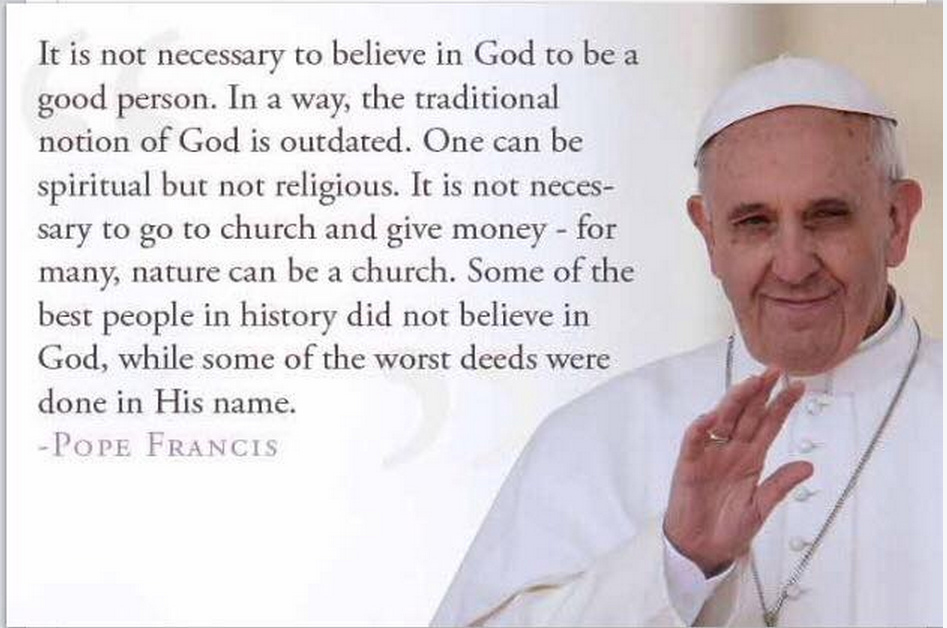
Popular “Pope Francis” Meme Trashes the God of the Bible

I’m not sure what is the source for either this quote or this meme, but it was dated December 21, 2014, and the last time I looked, it has more than 683,000 “shares” on Facebook.

Here is the source on Facebook. And here is the Snopes comment on it, which I found in the comments thread:

"The Lord has redeemed all of us, all of us, with the Blood of Christ: all of us, not just Catholics. Everyone! 'Father, the atheists?' Even the atheists. Everyone! And this Blood makes us children of God of the first class. We are created children in the likeness of God and the Blood of Christ has redeemed us all. And we all have a duty to do good. And this commandment for everyone to do good, I think, is a beautiful path towards peace. If we, each doing our own part, if we do good to others, if we meet there, doing good, and we go slowly, gently, little by little, we will make that culture of encounter: We need that so much. We must meet one another doing good. 'But I don't believe, Father, I am an atheist!' But do good: We will meet one another there."

It appears to be a transmogrification of this quote. However, when Rome habitually puts out statements where both sides can take away their own meaning, (see also here for documentation of that phenomenon) then you would expect something like this to happen.

But I found it because it had been shared by a neighbor, just yesterday, with the one-word qualification, “Profound”.

What Darwin Got Wrong


Not So Natural Selection
Richard C. Lewontin

The modern skeletal formulation of evolution by natural selection consists of three principles that provide a purely mechanical basis for evolutionary change, stripped of its metaphorical elements:

(1) The principle of variation: among individuals in a population there is variation in form, physiology, and behavior.

(2) The principle of heredity: offspring resemble their parents more than they resemble unrelated individuals.

(3) The principle of differential reproduction: in a given environment, some forms are more likely to survive and produce more offspring than other forms.

Evolutionary change is then the mechanical consequence of variation in heritable differences between individuals whenever those differences are accompanied by differences in survival and reproduction. The evolution that can occur is limited by the available genetic variation, so in order to explain long-term continued evolution of quite new forms we must also add a fourth principle:

(4) The principle of mutation: new heritable variation is constantly occurring.

The trouble with this outline is that it does not explain the actual forms of life that have evolved. There is an immense amount of biology that is missing. It says nothing about why organisms with the evolved characteristic were more likely to survive or reproduce than those with the original one. Why, when vertebrates evolved wings, did they have to give up their front legs to do it? After all, insects can have two pairs of wings and six legs, so there cannot be any deep general biological constraint on development. Why don’t birds that live in trees make a living by eating the leaves as countless forms of insects do instead of spending so much of their energy looking for seeds or worms? 

It is by no means an anomaly that one of the authors of What Darwin Got Wrong comes to the subject from cognitive studies and linguistics. We have evolutionary schemes for history, psychology, culture, economics, political structures, and languages. The result has been that the telling of a plausible evolutionary story without any possibility of critical and empirical verification has become an accepted mode of intellectual work even in natural science.

The other source of anxiety and anger is that the argument made by Fodor and Piattelli-Palmarini strikes at the way in which evolutionary biologists provide adaptive natural historical explanations for a vast array of phenomena, as well as the use by a wider scholarly community of the metaphor of natural selection to provide theories of history, social structure, human psychological phenomena, and culture. If you make a living by inventing scenarios of how natural selection produced, say, xenophobia and racism or the love of music, you will not take kindly to the book.

Even biologists who have made fundamental contributions to our understanding of what the actual genetic changes are in the evolution of species cannot resist the temptation to defend evolution against its know-nothing enemies by appealing to the fact that biologists are always able to provide plausible scenarios for evolution by natural selection. But plausibility is not science. True and sufficient explanations of particular examples of evolution are extremely hard to arrive at because we do not have world enough and time.