Thursday, April 02, 2020

Spinning in the dark

I'm going to comment on this exposition of the evidential problem of evil:


The entry was written by a philosopher who specializes in the problem of evil (Nick Trakakis).

The evidential problem of evil is the problem of determining whether and, if so, to what extent the existence of evil (or certain instances, kinds, quantities, or distributions of evil) constitutes evidence against the existence of God, that is to say, a being perfect in power, knowledge and goodness. Evidential arguments from evil attempt to show that, once we put aside any evidence there might be in support of the existence of God, it becomes unlikely, if not highly unlikely, that the world was created and is governed by an omnipotent, omniscient, and wholly good being. Such arguments are not to be confused with logical arguments from evil, which have the more ambitious aim of showing that, in a world in which there is evil, it is logically impossible—and not just unlikely—that God exists.

i) If that's a requirement for the evidential problem of evil, then I reject how the issue is framed. How is it reasonable set aside evidence in support of God's existence when considering whether the world was made and governed by an omnipotent, omniscient, and benevolent God? For instance, what if the evidence for God's existence includes evidence of divine benevolence? Surely evidence of divine benevolence is directly germane to whether the existence of evil counts as evidence against the existence of God? At the very least, those have to be weighed against each other. 

ii) Moreover, it's unreasonable to consider the likelihood or not of God's existence in insolation to all the available evidence. Perhaps, though, Trakakis has in mind a kind of cumulative case against God's existence, where you assess each type of evidence individually, then combine them. Even so, that has to be counterbalanced by considering the positive evidence, if any, for God's existence. 

iii) Likewise, if there's evidence for God's omniscience and omnipotence, then that's directly germane to whether God might have a good reason not to prevent evil, even if the reason is inscrutable to humans. 

iv) I agree that more than sheer consistently is demanded, since an ad hoc explanation might be logically consistent. Rather, it should be consistent with the nature of God and his modus operandi. Not out of character. Not detached from theology. 

A theodicy may be thought of as a story told by the theist explaining why God permits evil. Such a story, however, must be plausible or reasonable in the sense that it conforms to all of the following:

a. commonsensical views about the world (for example, that there exist other people, that there exists a mind-independent world, that much evil exists);
b. widely accepted scientific and historical views (for example, evolutionary theory), and
c. intuitively plausible moral principles (for example, generally, punishment should not be significantly disproportional to the offence committed).

Judged by these criteria, the story of the Fall (understood in a literalist fashion) could not be offered as a theodicy. For given the doubtful historicity of Adam and Eve, and given the problem of harmonizing the Fall with evolutionary theory, such an account of the origin of evil cannot reasonably held to be plausible. 

i) From a secular standpoint, it's not a given that evil exists. If that reflects the viewpoint of the atheist, then he needs to justify moral realism on secular grounds. In principle, it's possible for him to address the problem of evil for the sake of argument, by attempting to show that Christian theism is self-contradictory in the regard. But those two approaches need to be disambiguated. 

ii) Ironically, metaphysical idealism is becoming an academic fad.

iii) A Christian may well disagree with the moral intuitions of an atheist. 

iv) Unless we're dealing with the evolutionary argument from animal suffering, or the Fall, I don't see that the status of evolution is generally relevant to the evidential argument from evil. 

v) The Fall, whether human or angelic, can't be an ultimate explanation for evil since that only pushes the question back a step to the origin of their moral defection. 

A similar point could be made about stories that attempt to explain evil as the work of Satan and his cohorts.

i) But demonic and diabolical evil are fixtures of Christian supernaturalism. So that can't be eliminated from a Christian theodicy. Although that falls short of an ultimate explanation for the origin of evil, yet given the existence of fallen angels, many particular evils are the result of demoniacal and diabolical agency. 

ii) Admittedly, Christian theism isn't the explicit target of the argument as formulated by Trakakis, but for a Christian, the evidential argument from evil must engage Christian theism. In that context, you can't just strip away angelic evil, as if that's piece of tape to peel off. That's part of the deep structure of Christian theology. 

iii) And besides the witness of biblical revelation, there's a lot of empirical evidence for demonic agency. It's just anti-intellectual prejudice and ignorance that brushes that aside. 

That may not plausible or reasonable to the atheist, but it begs the question to make his plausibility structure the benchmark. Here we may rapidly reach an impasse because both sides don't share the same plausibility structure. That doesn't mean no further progress is possible–inasmuch as each side can attempt to defend its own plausibility structure and critique the plausibility structure of the opposing side, but that will require a digression from the immediate bone of contention since both sides will have to take step back several paces and hash out some preliminary issues. And that, too, may lead to stalemate–so that they never return to the immediate bone of contention. An atheist is not entitled to simulate his plausibility structure as the privileged frame of reference. 

An important distinction is often made between a defence and a theodicy. A theodicy is intended to be a plausible or reasonable explanation as to why God permits evil. A defence, by contrast, is only intended as a possible explanation as to why God permits evil. A theodicy, moreover, is offered as a solution to the evidential problem of evil, whereas a defence is offered as a solution to the logical problem of evil. 

The basic problem I have with this approach is that once we bracket God , I no longer have a framework for what's plausible or reasonable. I'm at sea. I have no compass points. I'm intellectually lost. 

So I find the argument from evil tp be quite artificial and self-defeating. It's atheism, not Christianity, that must resort to ad hoc postulates. Without God I have nothing to work with. I can't get the argument started. Nothing is a given. There are no criteria. Nothing to lend the argument from evil any traction or foothold. You can't evaluate anything if you have no norms. The argument from evil has what little plausibility it enjoys by taking for granted many key assumptions that fade away once God removed from consideration. We left spinning in the dark. 

Wednesday, April 01, 2020

Can salvation be lost?

In response to a Facebook question:

Salvation can't be lost because:

i) It's not a matter of chance who will or won't be saved. The Father made that decision (election). Salvation is too important to be left to chance.

ii) The Son atoned for the sins of those on whose behalf he died. The Son didn't die for them in vain. He went on a mission to save them. He didn't come up short. He got exactly what he died for. He got exactly what he went for (John 17).

iii) The Spirit renews and preserves the saints. 

iv) The Father, Son, and Spirit complete the work they began. They don't leave the job half-finished.

v) Put another way, sinners were lost before they were saved. So they can't be lost again. What's the point of saving the lost if they end up right where they began? If it comes full circle, why not leave them where God found them? 

Who is God?

God is the ultimate reality. An omniscient, omnipotent, wise, just, good, merciful, and self-existent agent subsisting outside of time and space. God is the source of all possibilities, actualities, and necessities. Source of the good, the true, and the beautiful. The Creator of the world, redeemer of the fallen world, and judge of saints, angels, and the wicked.

Rounding Off My Response to Richard Carrier On Undesigned Coincidences (Part 6)

http://www.answeringmuslims.com/2020/04/rounding-off-my-response-to-richard.html

The meaningless Covid-19 models

https://thecritic.co.uk/the-meaningless-of-the-covid-19-models/

Why it's hard to make a good coronavirus model

"Why It’s So Freaking Hard To Make A Good COVID-19 Model"

The existence of the soul

Currently J. P. Moreland's series on the existence of the soul is available for free here.

Welty on evil

"The Problem of Evil" (Greg Welty)

Breaking the spell

Because freewill theists often confuse Calvinism with fatalism, I've discussed the difference on a number of occasions. In Classical literature, Creon and Oedipus are paradigm examples. Although it's a bit cheesy, Final Destination 1 (2000) is a convenient illustration. 

But is fatalism real, and is there a way to successfully cheat fate? Cosmic fatalism is incompatible with the sovereignty of God. However, witchcraft has a fatalistic streak. By that I mean, hexing somebody. Suppose you come under a curse. Can you cheat fate?

I don't think that's a hypothetical or isolated case. For instance, witchcraft is common in cultures that practice animism, polytheism, and ancestor worship. 

I'm not talking about folks who merely practice occult rituals, but those who gain actual occult power through the practice of sorcery. 

Within the realm of witchcraft, fatalism may be a real phenomenon. If you've been hexed, you may be doomed.

There is, however, a way to break the spell. Christian missionaries have always engaged in "power evangelism". If a pagan converts to Christianity, then he's not doomed. That's a way to cheat fate. That liberates the convert from occult bondage, although there may be some lingering, residual effects. You've transferred allegiance from a lesser, malevolent power to a greater, benevolent power. 

Coronavirus19 – What’s It for?

http://paulhelmsdeep.blogspot.com/2020/04/coronavirus19-whats-it-for.html

Tuesday, March 31, 2020

Can We Measure the Value of Saving Human Lives in Dollars?

https://www.thepublicdiscourse.com/2020/03/61900/

Bishop Barron Q/A

This month, Bishop Barron did another Q/A, this time from non-Catholics:


1. I didn't watch the whole thing since not all of the questions interest me. He did a pretty good job of fielding the question about alleged pagan parallels because Jesus and mythic heroes. 

2. He also gave an adroit answer to how a loving God can send people to hell: 

It's like someone at a party, everyone is having a great time, but you've decided, because you're in a kind of a funk, to sit sullenly in the corner and refuse to participate. Not only are you happy in yourself but the party around you is making you more unhappy. If you're in a really bad frame of mind, who are the most annoying people? Those who are in a good mood.

We're often our own worst enemies. Drug addicts. Choosing contrary to self-interest. 

There's a grain of truth to those explanations. They're useful up to a point.

But what was glaringly absent from his justification is any reference to the punitive function of hell, even though that's fundamental to the biblical concept. 

In Scripture, damnation isn't primarily about rejecting God's love but retributive punishment from wrongdoing. The theme of eschatological justice, which is hell's primary rationale in Scripture, has disappeared from Barron's concept of damnation.

That may be because Barron is a hopeful universalist, so he believes in remediation rather than retribution. 

In contemporary Catholicism as well as contemporary freewill theism, the concept of damnation and warrant for damnation has been recast in terms of love rather than justice. It's all about rejecting God's love, not about just deserts.  

External Coincidences and Acts of the Apostles: Responding to Richard Carrier (Part 5)

http://www.answeringmuslims.com/2020/03/external-coincidences-and-acts-of.html

Is public worship a nonessential service?

Robert A. J. Gagnon

The very first line of the very first amendment of the Constitution contains the words that "Congress shall make no law . . . prohibiting the free exercise" of "religion." How prohibiting people from meeting and praying in person and arresting pastors who hold such a meeting, even when practicing a 6-foot-distant rule, distributing a hand sanitizer to everyone who comes, and installing a $100,000 hospital-grade air purification system is not a restraint on the "free exercise of religion" I know not.

When the state can prohibit people from meeting to worship in person, for any length of time that the state deems appropriate, and even arrest pastors who violate such a prohibition, that's quite a restraint on the free exercise of religion, isn't it?

Especially when the ruling in question permits any business to continue running where a 6-foot distant policy is implemented. Or when "shelters" are still permitted. Or when people continue to congregate in mass supermarkets, Walmarts, liquor stores, shelters, and gas stations. Or when abortion clinics are still open for business, killing babies and not practicing a 6-foot-distant policy.

Or when, as NYC ICU doctor, David Price notes, if you stop touching your face before washing your hands, you will not get the virus; and you would need prolonged (15-30 minutes) exposure to someone aspirating the virus within 3-6 feet in order to get it that way.

Or when according to an infectious disease expert, a mandatory national lockdown is no cure and ultimately more dangerous to the country than the disease itself.


The State has no right to determine whether religious assemblies constitute an "essential service" in the midst of a pandemic, much less the right to arrest pastors for gathering their flock. The first line of the First Amendment makes that absolutely clear. This is all the more obvious when the State declares abortion an "essential service." The State can issue a strong advisory for churches not to assemble regularly. Churches that assemble can be subject to criticism by the State, the general public, and other churches. But the State cannot order churches to stop assembling, much less arrest pastors for assembling, without violating the First Amendment right to "free exercise" of religion. If you don't know that, then our major problem is not the virus. I'm shocked that so many Evangelical leaders seem not to know this.


Are churches prepared not to meet in person for the next year-and-a-half that it will take to develop a vaccine and distribute it widely when parishioners can protect themselves by not touching their faces with unwashed hands and not being within 3-6 feet of the same infected person for 15-30m or more? Is that really a workable option? When 50,000 people die every year from seasonal flu and 443,000 from diseases related to smoking? When other outbreaks of severe virus are possible in the future? Are they going to condone the state arresting pastors who meet with their congregations during that interval? Do they value so little the scriptural injunction not to forsake meeting, much less the First Amendment that absolutely prohibits any restraint on the free exercise of religion? Do they have any idea what the long-term ramifications for religious liberty are from surrendering their rights to the state? Are they sheeple?

Plague and providence

1. Thus far I haven't commented on the pandemic from a theodical standpoint. One reason is that I've written so much about theodicy in general that anything I have to say about the pandemic is apt to be repetitious to some degree, and repetition is boring.

2. In addition, there are atheists who act like every time there's some new natural disaster, such as the Christmas Day tsunami (2004) or the Japanese tsunami (2011), this is supposed to shake the faith of Christians. That every natural disaster ought to send us back to the drawing board. But in Christian theology, moral and natural evils are to be expected. And we have a number of preexisting theodical strategies to deal with these events. Natural and moral evil aren't something new, and theodicies aren't generally new, although they undergo refinement.

3. There's a sense in which I agree with unbelievers that evil can call into question God's existence. By that I mean, many people labor under a faulty concept of God, and evil may expose their faulty concept of God. In that regard, evil can have a winnowing effect on theology.

4. It's common to ask why God allows evil. When a Calvinist uses that terminology, some freewill theists object that it's deceptive for a Calvinist to characterize evil in terms of divine permission. According to Calvinism, God predestined evil.

That's true, but when I say God allows evil, I simply mean that God did not prevent a particular evil. You allow something you were in a position to prevent. That's a coherent concept. To say "allow"/"didn't prevent" are stylistic variations on the same idea.

5. Moral and natural evils are not unplanned events. They happen for a purpose. I'd add that even according to influential models of freewill theism like Molinism and simple foreknowledge, these aren't unplanned events.

In open theism, God doesn't have a master plan for the world, but a set of contingency plans.

6. A basic function of theodicy is not to explain why God allowed a particular evil, but to show how that's consistent with God's existence. There may be different reasons God had for allowing the evil in question. Even if we lack the information to narrow it down to one "correct" explanation, we can offer a number of potential reasons showing that the evil is consistent with God's existence.

7. Some Christians deny that natural evils or natural disasters preexisted the Fall. I disagree. I think they serve a necessary purpose to maintain the balance of nature.

I think one effect of the fall is to expose humans to natural dangers that always existed, from the time of creation. In an unfallen world, humans would be divinely shielded from certain natural hazards, but due to the fall, God withdrew his providential protection.

8. This doesn't mean God directly created a pathogen like the coronavirus. God created a world in which natural organisms adapt and mutate.

9. Although Christian theologians tend to focus on the punitive aspect of death, as divine punishment for original or personal sin, that's one-sided. Human mortality has other spiritual purposes. Nothing exposes human vulnerability and helplessness like death. So death provides an opportunity for humans to renounce their feigned autonomy and admit their total dependence on God's mercy and provision.

10. We like to be in control. An unnerving aspect of the coronavirus is the element of uncertainty in terms of scale, lethality, and distribution. It's so unpredictable. Who will it strike next? For unbelievers and nominal believers who live in denial regarding the inevitability of death, who shove the prospect of death into the back of their minds or only think of death in abstract terms, the coronavirus forces them to confront their mortality and lack of control.

11. It exposes the ineptitude of many public officials. It chastens blind faith in the cult of expertise. It's a test of moral character, revealing what people are really like when altruism is costly. Does ruthless self-interest dominate?

12. It raises questions about the importance and relevance, or unimportance and irrelevance, of public worship. By the same token, it raises questions about how we prioritize risk assessment. Is a supermarket an essential business but a church service is inessential?

13. Several standard theodicies are germane to the pandemic. For instance:

i) The soul-building theodicy, where suffering is an opportunity to tap into compassion and cultivate sacrificial virtues.

ii) Second-order goods. There are certain kinds of goods whose existence is contingent on the existence of evil. If you eliminate the evil, you eliminate the resultant or compensatory good. So there are tradeoffs. Some evils a necessary evils, in the sense of conditional necessity. They don't have to exist, but they're a necessary source of certain otherwise unobtainable goods.

In that respect, there are tradeoffs. It's easy to imagine ways the world might be a better place, yet that mental exercise involves freezing the goods in place while changing some variables to eliminate the evils. Yet in a cause/effect world, that's artificially compartmentalized.

iii) Events in a cause/effect world have a domino effect. Like time-travel stories, changing a variable in the past changes the future. And the change is more far-reaching the farther it extends into the future. When we think about improving the world, we artificially isolate or insulate causes and effects. But it's not possible to strike an optimal balance where a single world history or timeline contains all the distinctive goods, devoid of evil.

iv) Apropos (ii-iii), housebound couples will result in a baby boom a few months from now. Although many people will die as a result of the pandemic, many new lives will come into being as a result of the pandemic. Individuals who'd never experience the gift of life had it not been for the pandemic. The dying already had an opportunity to live. The tragic death of some creates a situation where others will now have the same opportunity.

v) Human life is brief. What ultimately matters is the world to come (i.e. the New Eden). But you can't participate in the world to come unless you participate in the lifecycle. You must be brought into existence, and you must die, before you can step into eternity. Of course, many humans fail to take advantage of that. They live for what this world has to offer, so the world lets them down. They lose what they had while missing out on what they might have had by squandering their opportunities.

Bishop Wright's response to the pandemic

No doubt the usual silly suspects will tell us why God is doing this to us. A punishment? A warning? A sign? These are knee-jerk would-be Christian reactions in a culture which, generations back, embraced rationalism: everything must have an explanation. But supposing it doesn’t? 

The point of lament, woven thus into the fabric of the biblical tradition, is not just that it’s an outlet for our frustration, sorrow, loneliness and sheer inability to understand what is happening or why. The mystery of the biblical story is that God also laments. Some Christians like to think of God as above all that, knowing everything, in charge of everything, calm and unaffected by the troubles in his world. That’s not the picture we get in the Bible.

God was grieved to his heart, Genesis declares, over the violent wickedness of his human creatures. He was devastated when his own bride, the people of Israel, turned away from him. And when God came back to his people in person—the story of Jesus is meaningless unless that’s what it’s about—he wept at the tomb of his friend. St. Paul speaks of the Holy Spirit “groaning” within us, as we ourselves groan within the pain of the whole creation. The ancient doctrine of the Trinity teaches us to recognize the One God in the tears of Jesus and the anguish of the Spirit.

It is no part of the Christian vocation, then, to be able to explain what’s happening and why. In fact, it is part of the Christian vocation not to be able to explain—and to lament instead.


1. N. T. Wright has always been a mixed bag. As I recall, he developed a conservative reputation by debating Jesus Seminar types, and he was pretty good on his side of the debate. He also wrote a classic defense of the Resurrection. But in addition he churns out hasty, forgettable potboilers. He spreads himself way too thin. He's overrated and overexposed. He's become an oracle who's expected to have something wise to say about everything.

Monday, March 30, 2020

Joe Rogan's biblical illiteracy

https://www.youtube.com/watch?v=fownDeTsw0Y

Crackdown on churches and synogogues

Tampa megachurch pastor Rev. Rodney Howard-Browne was arrested for holding voluntary services and "faces a punishment of up to 60 days in jail and fines totaling up to $500." This raises an important church-state concern, as does New York City Mayor Bill de Blasio's outrageous threat "to permanently close churches and synagogues [mosques?] that hold services during the coronavirus pandemic." He doesn't have the constitutional authority to "permanently close" any church, though he apparently thinks he does.
Getting an abortion is an "essential" service according to Democrat-governed areas (and the wicked NYT). In many places keeping liquor stores open is also an "essential" service. We go to grocery stories in close contact with tens or hundreds of people. If you don't touch your face with unwashed hands, you are very unlikely to get COVID-19, particularly if not standing within 3-6 feet of the same person for 15-30 minutes or more. Many church buildings have enough space to make such a seating arrangement possible.
How long should churches allow the state to close their doors? Are churches not going to meet for Easter celebration? What if the restrictions persist over many months, even over a year? In ancient Israel a disease or plague would have prompted people to hold a national convocation of repentance, not to disperse. Democrats are already inclined to act with impunity against the church, as Beto's remark about removing the tax-exempt status of any church that does not kowtow to the LGBTQ agenda. These recent events will only make matters worse, with long-term ramifications well beyond the time that it takes COVID-19 to run its course.

Is atheism the religion of the godless?

@SecularOutpost
I’ve never understood the motivation of some / many / most Christians to define religion in a way that makes some / many / most atheists religious. (I agree that an atheist can be religious, FTR.) Especially when combined with the idea that Christianity is not a religion.


The reason is the way in which atheism so often becomes the functional equivalent of religion. In practice it's not just nonbelief in a God or gods. They feel they need to fill the void with substitutes that take the place of God and play the explanatory role of God. A cause or ideal to live for and center their lives on. 

Just like we might say football is Joe's religion or becoming a senior partner in the law firm is Jerry's religion. And all-consuming passion that mimics religious devotion. 

BTW, Jeff Lowder is an apostate, so his question reveals the fact that he never really understood atheism or religion. 

Is church attendance a pact with the devil?

It's revealing to compare these two positions by David French: On the one hand, voting for Trump in the 2016 general election was a betrayal of Christian faith. Caving into worldly fear. Diametrically opposed to 2 Tim 1:7. 

Instead, the evangelical church is called to be a source of light in a darkening world. It is not given the luxury of fear-based decisionmaking. Indeed, of all the groups in American life who believe they have the least to fear from American politics, Christians should top the list. The faithful should reject fear.

This is made plain to young Christians from the early days of Sunday school. There, many millions of young believers are taught the biblical verse: “For God gave us not a spirit of fear but of power and love and self-control.”

But in 2016, something snapped. I saw Christian men and women whom I’ve known and respected for years respond with raw fear at the very idea of a Hillary Clinton presidency. 


On the other hand, when Christians appeal to the same verse to justify church attendance during the pandemic, that's succumbing to the diabolical temptation, when Satan tried to strike a bargain with Jesus in the wilderness: 

Even within those churches that have chosen to comply with public health warnings and temporarily cancel services, there are rumblings of dissent and discontent. You see it all over social media. And whether sophisticated or simple, these impulses toward defiance are virtually all grounded in a similar question: Why should Christians surrender to fear? People of faith should reject the guidance of public officials. Our gatherings are different. After all, isn’t it true that “God gave us a spirit not of fear but of power and love and self-control”? 

Then the devil took him to the holy city and set him on the pinnacle of the temple and said to him, “If you are the Son of God, throw yourself down, for it is written, “‘He will command his angels concerning you,’ and “‘On their hands they will bear you up, lest you strike your foot against a stone.’” Jesus said to him, “Again it is written, ‘You shall not put the Lord your God to the test’” (Matthew 4:5-7).

The first set of verses represents the second of the three great temptations of Jesus as outlined in the book of Matthew. Satan demanded that Christ perform an ostentatious display of power and faith—that he throw himself from a great height to demonstrate his invulnerability. Yet Christ refused, declaring that such a ridiculous and ostentatious act would put God to the test.


Now, I agree with French that going to church is a not a talisman that will safeguard parishioners from contacting the virus. Some of them might even contract it by going to church. Mind you, there are so many ways to contract the virus that I think the vector of transmission is often untraceable. But it's a malicious caricature to attribute that motive to every churchgoer or would-be churchgoer during the pandemic. 

What's striking, though, is French's priorities. Voting for Trump was (and still is, by his lights) a cowardly, faithless action. But keeping church services available during the pandemic is tantamount to making a pact with the devil. French's theological priorities and elastic use of Scripture are so inverted that it's hard to know what more to say.  

Monsters in my closet, monsters under my bed

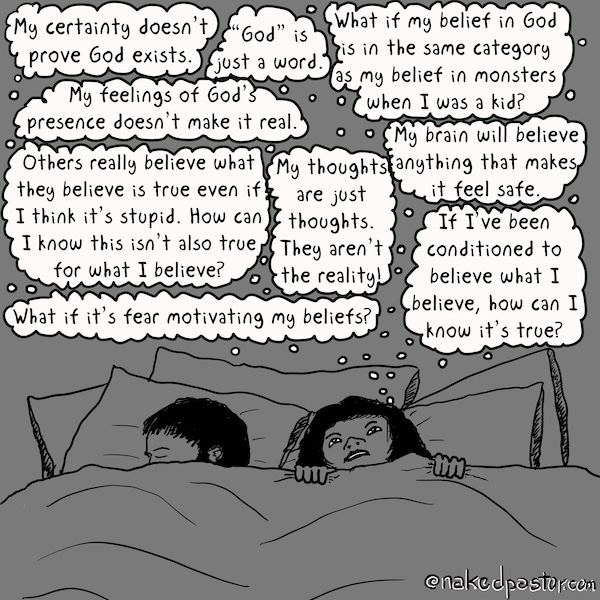
No, I've never had thoughts in bed like the woman in the cartoon:


But as far as that goes, what if your belief in God is in the same category as the monsters you believed in as a kid? It can be a mistake to outgrow belief in monsters. Sure, monsters in comic books and Hollywood horror flicks are fictional characters, but the world contains real monsters, both natural and supernatural. 

Image

Time's arrow

Astronomers on earth inferred a hospitable, earth-like planet in a parallel universe. So they mounted an expedition through the wormhole to explore the planet. 

The planet turned out to be a natural wilderness with settlements of Stone Age humanoids. At first, everything seemed normal. But on closer inspection, something was off. Take the cherry trees. When the astronauts landed, the trees had ripe cherries. But after a few weeks the cherries became cherry blossoms, then buds. 

When an astronaut accidentally cut himself, the wound healed up in a matter of minutes. And their hair began growing shorter rather than longer. When an astronaut dropped a glass, the shattered glass reassembled in moments. 

It's as if time's arrow was reversed. The next day was the day before. They went from March 15 to March 14. They remembered March 15 but had no recollection of March 14 because they hadn't experienced it yet. They remembered the future but not the past. 

Then they befriended the natives. The natives were highly intelligent but initially cautious about the astronauts. Yet the astronauts were eventually able to question the natives. Didn't they find it disconcerting to be living backwards?

But the natives has no other basis of comparison. For them, it was natural for dead things to come back to life. Indeed, for them, life began as adults, when their aging corpses came to life. That's when they became conscious. That's when their experience began. That's when their memories began. 

For them it was natural to see a melted snowman reconstitute. That was their only frame of reference. 

So they didn't view themselves as living backwards. It felt like they were living forwards. They couldn't tell the difference between moving from the past into the future or moving from the future into the past. For them there was a day behind and a day ahead. There was a certain predictability, even uniformity to nature, as things aged down. 

They found the descriptions of time's passage by the astronauts puzzling. It would be very disorienting to live in a world where dead things stayed dead. Where a campfire burned out, reducing the wood to ashes. In their experience, the wood was not consumed. The fire died out when the embers recombined as branches. At the end of the process was a pile of fresh firewood. It took a lot of imagination on their part to conceive the kind of world the astronauts came from. A world where meteors were falling stars. The natives were used to watching meteor showers rain upwards. So there didn't seem to be one right way to experience time's passage. Each world had its own now and then. 

When the astronauts tried to return to their home planet, they were unable to. In a sense, they'd done it already, but that lay in the past. At present, their "future" was in the parallel world–because that's where they were. So they couldn't get back. They had been back, but yesterday was like March 15 while today was like March 14 and tomorrow was like March 13. They could make plans and carry out their plans, but that was always a thing of the past, over and done with. The only way forward was backward. 

Is the coronavirus a bioweapon?

There's a conspiracy theory floating around that claims the coronavirus (SARS-CoV-2/COVID-19) was a bioweapon engineered by China.

I don't know how or when it started. Tom Cotton broached the theory back in January:

I would add: BSL-4 labs represent the highest level of containment for deadly pathogens. There are only about 50 BSL-4 labs in the world.

My thoughts:

Dividing Up Early Christianity Is More Difficult Than Often Suggested

It's common for people commenting on Easter issues, as well as issues in other contexts, to put one strand of early Christianity against another. They'll claim that a particular belief is found in one gospel, but not another. The Pauline letters have one view of a subject, but a contrary view is found in the gospels. And so on. In the context of Easter, we'll be told that Paul had no concept of the empty tomb or that some portions of early Christianity believed in a form of resurrection that didn't involve the transformation of the body that died, for example.

One of the points that ought to be made in these contexts is that the alleged differing strands of early Christianity often express agreement with one another. On the resurrection, Paul refers to how he and the rest of the apostles were in agreement (1 Corinthians 15:11). To cite another example, see here regarding the likely reference to Luke's gospel as scripture in 1 Timothy 5:18. Paul's letters are referred to as scripture in 2 Peter 3:15-16. An example cited less often, but which has a lot of significance, is the early patristic attestation of how highly John viewed the Synoptic gospels. See here concerning what Papias tells us about John's view of the gospel of Mark. (And for more about Papias and his relationship with the apostle John, see here.) Clement of Alexandria cited some elders who commented on John's view of the Synoptics. See here for more about that passage.

Notice, too, that much of what I'm saying here holds up even if the traditional authorship attributions of the New Testament documents are rejected. I explain some of the reasons why in my article on 1 Timothy 5:18 linked above, and those principles apply to other documents as well, not just 1 Timothy. Similarly, even if you think the elder Papias referred to was somebody other than the apostle John, the fact would remain that Papias was highly influenced by the Johannine documents (as I argue in my material linked above), and he held a high view of the Synoptics. Furthermore, saying that the elder Papias refers to wasn't the apostle John doesn't change the fact that he was some sort of prominent early church leader who didn't write the gospel of Mark and seems to have operated largely outside of the circles that gospel's author is usually associated with, yet he held a high view of that gospel. Rejecting something like Pauline authorship of 1 Timothy or the identification of Papias' elder as the apostle John would weaken my argument, but the argument would still carry some weight.

Drugs against coronavirus

I see a lot of people strongly urging doctors to use the drug hydroxychloroquine/azithromycin as a remedy against the coronavirus or Covid-19. I guess that's in large part because Pres. Trump has been pushing the same drug quite a bit. However:

1. The evidence for the drug in human beings - not in vitro ("test tubes"), nor in vivo in animals (e.g. mice), but in human beings - is still predominantly anecdotal or low quality studies (e.g. here).

Sure, there may seem to be hundreds of coronavirus sufferers who have dramatically improved thanks to this drug combination, but one could say similar things for homeopathy, Chinese medicines, chiropractic manipulation, and so on.

At best, at this point, hydroxychloroquine/azithromycin may indeed be promising, and perhaps it will be proven to be safe and effective in treating Covid-19 in the near future, but there remains much work to be done in order to demonstrate these hypotheses.

2. I realize people are demanding a fix stat. It looks like governments have fast-tracked a lot of the trials. Indeed, it seems to me like we're moving about as fast as we can. However, there are limits to how fast trials can move. We can't time travel.

3. Suppose we have several friends who are badly injured and need to go to the emergency department. So we get them into a car and drive them to the ED as quickly as we can. Suppose we speed, run red lights, and zigzag through traffic to do all we can to get our friends to the ED as soon as possible.

Nevertheless if we're decent people then I presume we wouldn't attempt to run over pedestrians or drive through stores with people shopping or anything like that. As much as we wish to save our friends, all things equal, we wouldn't necessarily want to endanger other people's lives in order to do so.

I realize the analogy is not entirely analogous, but dropping the analogy my point is simply that we may believe this drug will save our friends and family. However, in this case, we wouldn't (or shouldn't) wish to endanger the lives of others in case it doesn't work in other coronavirus patients even if it works in the ones we happen to know.

(Of course, I'm sure we could concoct hypotheticals where it might be morally licit to risk the lives of others in order to save our loved ones.)

4. Finally, as I mentioned in a previous post, there are about 40 other coronavirus therapies doctors and scientists are currently working on spread out across approximately 200 trials. So I don't understand why the focus on this one particular drug when we have about 40 other coronavirus drugs or therapies we are trying. It's not as if this drug hydroxychloroquine/azithromycin is head and shoulders better proven than several of the other drugs or therapies (e.g. here).

Iacta alea est

I know that the Virus Which YouTube Will Not Let You Name Without Demonitizing You has been written about extensively on this blog, but I’ve largely stayed out of it.  This is in part because I largely feel no fear or concern about whether or not I will get the virus myself.  I don’t fear death in general, so dying from the “scary” virus is little different from dying any other way.  I wish I could say that it was more my strong faith in Christ and His plan that made me not fear death, but it’s primarily because I don’t have any strong attachments to anything in this life so don’t have anything to really lose.

Because I don’t have any strong fear of death, it’s put me in an interesting position to evaluate the panicked response to the virus as a whole, and that dispassion has led me to conclude that on the whole our reaction to the virus is almost certainly going to be far worse for us than the virus ever could have been.  Of course, by saying this, I have to immediately say, “I’m not claiming COVID-19 isn’t a big deal, or that the regular flu is worse than COVID-19”—although seriously people need to actually look up how bad the regular flu is; it’s no picnic and is a massive problem that ought to be dealt with.  Our culture has a knee-jerk reaction, however, in that if you point out A is more dangerous than B, then the vast majority of people irrationally hear that as a claim that B is not dangerous at all.

But let me first illustrate the concept via an analogy.  If I said, “While a knife wound to an extremity may indeed be fatal depending on where it is located and the disposition of the person who has the injury, depriving a person of food and water for an extended period of time is far more dangerous because without proper nutrition and fluid the healthiest individuals will become sick and die” it should be easy to see that this is not an argument that knife wounds are trivial and do not require medical assistance.  It is, however, pointing out that if you wish to treat knife wounds, you probably should do so in a manner that does not induce deprivation of food and water for extended periods of time. 

To spell it out, the analogy is that COVID-19 is equivalent to the knife wound and our world-wide response in shutting down the entire global economy is equivalent to depriving everyone of food and water for an extended period of time.  The first question might be whether or not this analogy is representative.  I think most would agree that that COVID-19 would best be represented by some kind of acute trauma—something that is intense and immediate, but not expected to be long term.  Even in our experience with recurring pandemics, they come in waves.  It’s not a continual threat at full pressure.  Ebola has outbreaks that kill lots of people then sputter and die out.  Influenza does the same thing.  Historically, the Bubonic Plague acted in an identical manner—peaking out over the course of a few years and then only having smaller, more localized outbreaks afterward.  We don’t have the experience of very dangerous diseases serving a constant yearly threat, even if some (like Influenza again) have had several outbreaks through the centuries.

So that may fit the analogy nicely, but what of linking our economic shutdown to deprivation of food and water?  In one sense, this is actually far more literal than it is an analogy, because we are dealing with poverty.  I daresay the vast majority of the readership of this blog has never stepped foot outside of a First World country, or if so it was only for a week to a month on a mission trip, so it may be difficult for us to actually understand exactly how bad poverty truly is.  If you make around $32,000 per year, you’re in the top 1% of the world.  Indeed, the poverty line for the United States currently sits at an income of less than or equal to $12,490 per year.  That means on a Global Scale, everyone above the poverty line in the US is in the top 13% of income earnings for the world.

The upshot of these figures is that when I say, “Poverty kills” I have been met with skepticism from the largely American audience.  Yes, when your poverty line still is better than 87% of the what the world earns, it’s not going to be “that bad” when you look at your numbers.  But you don’t have to go far to see how bad it really is.  Visit any third world country without money and try to get sufficient food.  Try to get sufficient medical care.  Try to get sufficient anything.

At this point you might be thinking, “Yeah, poverty is bad.  But how can the economic shutdown that we’ve put into place cause poverty?  Wouldn’t us not shutting everything down mean more people would die, and obviously dead people can’t help out the economy any.”

True, deaths to COVID-19 would have an impact on our economy too, which we are theoretically sparing us from due to our current response.  However, if we go that route, the first thing I would need to point out is that this virus is primarily fatal for the older population—a set of individuals who have largely already left the workforce due to retirement.  Not to sound crass, but if the vast majority of fatalities from COVID-19 were from this set of individuals, it would have a fairly low impact on the economy since they are not going to be producers, only consumers.  This impact is actually how it goes with most viruses—they predominately attack the elderly and the very young, both of which are not part of the working class.  Stating these facts does not mean I’m advocating for us to do a cutthroat policy of sacrificing grandma since she can’t help out the economy much anyway.  But we could, instead, focus our social distancing and quarantining on the elderly and young instead of the entire workforce.  Because shutting the economy down by quarantining the entire workforce is objectively bad and will necessarily lead to an increase in poverty for all, whereas quarantining the young and old would have a targeted effect (albeit there will of course still be some individuals in between those extremes who will pass away too).

Of course, it’s also incumbent upon me to demonstrate how shuttering the entire working class will necessarily lead to increased poverty.  To illustrate that, let’s start by just examining the facts of where we are right now.  Large swaths of the Earth—not just the US, the entire globe—have shut down all “non-essential” businesses.  What does that mean?  It means anyone who is employed in a “non-essential” position is now no longer doing work.  Businesses cannot afford to pay employees who are not doing work.  The result is that millions of people worldwide have already been laid off, and those not specifically fired are not getting a paycheck.  Those few companies that can weather the storm thus far do not have infinite reserves, so those who have managed to dodge the termination/no paycheck bullet so far have less and less of a chance to continue to dodge it the longer this goes on.  The upshot of all this is that unemployment has already risen catastrophically in every country, including the US, who has closed all their “non-essential” businesses.

Nor are these workers easily able to find new jobs, because only “essential” jobs remain (which, for whatever reason, includes cannabis shops in Colorado).  If your only skills have been in “non-essential” areas, you will most likely not be able to find a new job in an “essential” field because there are more qualified workers—and a surplus of them to boot—to take any openings already there.

But how long will these “essential” businesses remain open?  To answer that question, we need to look no further than one such “essential” aspect right now: shelter.  Everyone needs a place to live.  Many (most?) American do not actually own their own shelter.  Their landlord owns it and they pay an agreed upon rate to have the right to stay there.  If your “non-essential” job is terminated, how can you pay for the “essential” need of shelter?  You cannot.

That alone is sufficient to cause problems for the landlord.  He cannot collect rent from people who literally have no money to pay rent, and thus in order for him to make money he can only rent to people who work in an “essential” job.  Except that the government has already stepped in.  The county I live in (in Colorado) has already had the court say that they will not process any eviction notices while we are in a state of emergency.  In other words, rent is coming due for millions of people who cannot pay it, and the landlord cannot evict anyone who cannot pay it.

What this means is that the “essential” business of renting out shelter has now become one in which landlords cannot legally make any money.  And yes it’s easy to see on humanitarian grounds that we cannot evict and make homeless millions of people.  Yet at the same time, we have just devalued the entire rent market to such an extent that anyone currently holding land that they would have rented out to others will no longer do so, because it’s the same thing as giving it away and getting nothing in return.  This will necessarily cause all real estate to tumble into chaos as the implications set in.

But it won’t end there.  If it’s logical and humanitarian for us to declare that shelter is so essential that we cannot process evictions during this time, essentially making rent free, how is it any less logical or less humanitarian to decree that all food must be free for whoever needs it too?  Those who cannot pay rent clearly cannot pay for food either.  And therefore, the “essential” job of running a supermarket will soon fall under this same cloud: you cannot deprive those who have no money of their food, so you must give it to them for free.  The medical establishments will fall under the same problems: how can you deny medication to those who clearly need it, solely because they have no money, solely because the government shut down their job as being “non-essential”?

And what are you left with at this point?  All “non-essential” jobs are shuttered already.  All “essential” goods are going to be forced to be given away for free.  Those who worked “non-essential” jobs cannot work, and those who are working “essential” jobs cannot make money for what they work.  If you’re a supermarket, you’re not going to pay to restock your shelves when you have to give away your product, so either farms will be forced to give food to stores for free, or the stores will shut down completely.  Farmers will not grow their crops if they cannot get anything in return for doing so, so they will shut down as well.

At this point, money is completely worthless.  Again, you can’t use it to buy any “non-essentials”—those stores aren’t even open!—and you don’t need to use it to buy “essentials” because it would be inhumane to deprive those without money of those goods.  More economic “stimulus” packages will be pointless because money is now pointless.  And there are many historical precedents of what happens when money becomes worthless.  Just look up the pictures of German toddlers playing with millions and millions of Marks post World War I, when a wheelbarrow load of cash couldn’t buy a loaf of bread.

If a farmer cannot get compensated for his food, if a landlord cannot get compensated for use of his property, if a doctor cannot be compensated for his skill, if a pharmacist cannot be compensated for his medications—only a fool continues to work in any field then.  The end result is necessary: those who have, hoard; those who don’t, starve.

Again, this is not a hypothetical situation.  This has happened multiple times in history.  When the economy collapses, people die.  Just as depriving someone of food and water necessarily results in illness, depriving a nation of an economy results in people dying.  It’s not an immediate and acute process, like a knife wound, but it is arguably worse because it will hurt everyone, not just those most susceptible to the acute problem.

Again, I’m not saying COVID-19 isn’t an enormous problem.  It may very well be one of the worst diseases our planet has ever faced (although thus far evidence does not bear that out).  But one thing is certain throughout all history: economic collapse is a horrific thing that necessarily leads to more suffering and death.  Our governments have collectively decided to shut down our world’s economy, which they know necessarily will result in an increase in deaths due to poverty, because COVID-19…might…cause more deaths than the shutdown will.  Never mind that there were ways in which we could have protected the most at-risk population from COVID-19 without shuttering the economy for as long as it must now be shuttered.

Because, see, at the end of the day, there’s going to be a list of fatalities with “COVID-19” listed as the cause of death, but there will never be a list of people with “global shutdown of economy” listed as their cause of death.  Instead, it will say things like “complications from diabetes”, because they couldn’t afford insulin after they lost their job; or “exposure”, because they died in the blizzard while living on the streets; or “murder” because their neighbor was so desperate for the food they had that they were shot in the back.  A few statisticians will notice “Hey, when the poverty rate goes up, the death and crime rates go up too” but politicians will still say, “All those poor people could have made better decisions and they wouldn’t be suffering now.  And furthermore, we kept the numbers who died from COVID-19 far lower than expected due to our actions.  Vote for me again!”

At this point, complaining about it doesn't really matter, I suppose.  Iacta alea est. The die has been cast.  Now we just get to wait and see what the consequences will be.

Living backwards

Time's arrow is one of the most pervasive features of human experience. It completely conditions our outlook. Moment by moment we move from the past into the future. That's the direction of cause and effect. 

But suppose we were dropped into a world where the next day was the day before. We wouldn't remember it because we hadn't experienced it yet. So memory wouldn't be a clue that we were moving into the past. If we went from March 15 to March 14, we'd remember March 15. Psychologically, March 15 would be indistinguishable from the past while March 14 would be indistinguishable from the present or future. 

So at what point would we catch onto to the fact that we were moving backwards in time? Things would age down, so that could be a clue, although that might not be immediately apparent, depending on the rate of change. 

That's assuming we were dropped into a backwards world from a world where time's arrow moves from the past into the future, so that we'd have that prior basis of comparison. But suppose we were never in a world where time's arrow moves from past into the future. Suppose we woke up as adults in a backwards world. That's where our experience begins. That's where our memories begin. That's our only frame of reference. 

Would anything seem incongruous about our experience of time? In that case it might seem natural for things to age down. It might seem natural for cherries to turn into cherry blossoms, then buds. It might seem natural for dead things to come back to life. It might seem natural for flesh wounds to seal up in minutes. It might seem natural for hair to grow shorter. It might seem natural for a broken glass to recombine. It might seem natural for a melted snowman to reconstitute. 

In that respect, certain kinds of miracles are like temporal reversions, by turning back the clock in that particular instance. Not necessarily everything, but a localized effect. Say restoring sight to someone who became blind from an accident or disease. Like going back to a time before the accident or disease took place. 

Sunday, March 29, 2020

The advent of the Antichrist

Cats are the devil's familiars. They sense that the pandemic presages the advent of the Antichrist. They are waiting for their Master's imminent return!

Image may contain: cat and indoor

Citizen snitches

https://www.dailymail.co.uk/debate/article-8163587/PETER-HITCHENS-Great-Panic-foolish-freedom-broken-economy-crippled.html

Your vocation

The plot of the journey may be the most popular and fundamental plot in literature. Presumably, the metaphor of life as a journey is based on the human lifecycle. Were it not for human mortality, this might not be a universal metaphor and central literary plot.

By contrast, a neglected comparison is a plot based on a divine calling. This, of course, figures prominently in the Bible. Paradigm examples include Abraham, Moses, OT prophets, and the apostles.

You might say Jesus had a calling although it would be more accurate to say he had a mission. On the divine side he was an architect of his own vocation, so that's not a calling in the usual sense.

However, the larger point is that every human being has a calling. It's just that most men and women are unaware of their calling. They fulfill their vocation without knowing they have one.

That's because world history is like a drama in which everyone has a divinely assigned role to play. Unbelievers don't realize they are actors in God's drama, but nonetheless they play their part. Ironically, atheists have a divine vocation. Their calling is to play the foil and fall guy. 

Even bit players may have a deceptively significant role to play. No one remembers who Abraham's great-grandfather was. He's a long-forgotten nobody. Yet without him, Abraham would never exist. Little events in the past can become increasingly significant due to their long-range impact. 

Not only is everyone on a journey, everyone has a calling. Vocation and journey are conterminous. 

Slamming the door in the face of the unchurched

With tens of millions of Americans under house arrest, this would be an ideal time for unchurched Americans who are bored out of their wits to check out a church. Unfortunately, most of them will find locked church doors. One of the great, unrepeatable lost opportunities in Christian history to reach out to the unsaved. 

Livestream services are fine as a complement to public worship, but livestream services cater to church members, not the unchurched. 

In the groove


A candid video. Several related issues:

1. It's much easier to convince yourself that you believe certain things if you're in a like-minded group. As social creatures we crave acceptance. We aim to please. So everyone plays their part. Doing what's expected of them.

I'm not necessarily saying that's a bad thing. Sometimes it's a good thing to have that positive social reinforcement. In the abstract, it's neutral. 

But it's a very thin foundation. And there are times in life when that's not enough. 

2. Many people are believers or unbelievers because they're in a particular groove and the groove keeps them moving in that direction. Many people are unbelievers not so much because they've given any deep thought to Christianity but because all their activities are secular. They're carried along by the inertia. 

Conversely, many people are believers because they move in a religious groove, in terms of their friends and activities. The routine keeps them in that lane. The routine keeps them going in that direction. 

3. There's also the pressure to live up to the expectations of others. We can also make career choices that put us in a particular lane. It's easier to stay in that lane and keep moving forward. In a way we don't have to do anything. It's already set up for us. We just carry on with our assigned duties. Like coasting down hill. It can become mechanical. 

However, that can also lead to a midlife crisis where we question whether we made a wrong turn. Would we make the same choice if we could go back in time? Or is it too late to start all over from scratch?

There are no right or wrong answers in the abstract. It depends on where the truth lies. 

Theistic conceptual realism update

For those of you who take an interest in modal metaphysics:

Philosophia Christi
Vol 21 Num. 2 - Winter 2019
The Winter 2019 issue features a lead discussion centered on William Lane Craig's argument in God Over All, with contributions from Greg Welty, Peter van Inwagen, and a response by Craig. The discussion addresses issues of "divine conceptualism" and abstract objects and their implications for the nominalism-realism debate.

Greg Welty is slated to publish an updated version of  “The Conceptualist Argument,” in Colin Ruloff (ed.), Contemporary Arguments in Natural Theology (Bloomsbury Press, forthcoming). 

He had to cut it down to meet the word count, so he will publish the outtakes in journal articles. 

The course of coronavirus

It doesn't look like the numbers or percentages are entirely accurate. However it's still useful as a generic schema for how the coronavirus seems to be playing out.

Summary of clinical trials for coronavirus

There are several different treatment options that physicians and scientists are looking into for the coronavirus. Such as antivirals and vaccines. These aren't necessarily mutually exclusive.

I've posted on a few of these in the past (e.g. convalescent plasma therapy, remdesivir, hydroxychloroquine/azithromycin).

Here's a more comprehensive list so people can see what's being worked on around the world to combat the coronavirus:

(Source)

Kowtowing to China

I believe the person interviewed is Bruce Aylward. Of course, everyone knows China is a communist regime led by autocrats who have no problem using heavy-handed, draconian, and even bloody measures against their own people. By contrast, Taiwan is a free and democratic nation like South Korea and like Hong Kong should be.

Also, the role of conservative media in this story:

Confirmation bias

Coram Deo asks a good question here:

I don't know if either Hawk or steve (or another active T-blogger) would be willing to take up the question, but both here and elsewhere I'm seeing what I perceive as rampant confirmation bias swirling amidst the current coronavirus pandemic and I'm wondering if it's possible to implement guards or filters in our critical thinking to avoid this to some extent.

This assumes of course that folks wish to avoid or mitigate this feature, indeed many seem to rush to pick out this or that expert, model, or theory which bolsters their preconceived notions.

Thanks, CD. That's a good point and a good question! What you've said is important to keep in mind. If I can offer my random thoughts: