A big part of the world has gone crazy. By “big part of the world”, I mean, “lots of people, and lots of institutions”. We know that.
They have rejected God and adopted a form of man-made morality which holds that every person and every culture should be “equal” (a form of morality which is clearly on display in universities and magnified by the media), in such a way that dissenting from this morality can cause you to lose a Facebook or Twitter account, or a job, or a wife and custody of a child, or your life.
How are Christians to deal with this?
Not long ago, Rod Dreher proposed “The Benedict Option”, which he summarized as “communal withdrawal from the mainstream, for the sake of sheltering one’s faith and family from corrosive modernity and cultivating a more traditional way of life”.
I don’t think that is good enough. On the other hand, I’ve long been impressed by Alvin Plantinga’s advice in his “Advice to Christian Philosophers” (from the 1984 essay). While this advice is specific to philosophy students, I think it has broader application for those of us in other situations:

Showing posts with label The Benedict Option. Show all posts
Showing posts with label The Benedict Option. Show all posts
Saturday, March 02, 2019


Thursday, April 06, 2017
No peace without victory
I haven't studied the Benedict Option in-depth. But here are my three off-the-cuff reactions:
i) The future is unpredictable. I'm not an optimist or a pessimist. I don't know in advance how things will turn out. There are times and places in church history when Christians are forced into a very contracted existence. So there may be times and places where something like the Benedict Option may be the best we can settle for.
ii) But defeatism is a self-fulfilling prophecy. By assuming that the cultural dominance of Christian values is a lost cause, we marginalize ourselves. If you surrender, you're bound to lose. If you keep on fighting, you're likely to win some and lose some. There are many chinks in the secular armor. I don't presume that secularism is inevitable. But if you stop trying to stop it, your capitulation makes it unstoppable. The sure way to lose a tug of war is for one side to let go.
iii) Finally, it's naive. I'm reminded of Machen's analogous observation that:
It may well be questioned, however, whether this method of defense will really prove to be efficacious; for after the apologist has abandoned his outer defenses to the enemy and withdrawn into some inner citadel, he will probably discover that the enemy pursues him even there. Modern materialism, especially in the realm of psychology, is not content with occupying the lower quarters of the Christian city, but pushes its way into all the higher reaches of life; it is just as much opposed to the philosophical idealism of the liberal preacher as to the Biblical doctrines that the liberal preacher has abandoned in the interests of peace. Mere concessiveness, therefore, will never succeed in avoiding the intellectual conflict. In the intellectual battle of the present day there can be no "peace without victory"; one side or the other must win.
To build on Machen's point, secular progressives are utterly intolerant of Christianity. They are not content to deracinate religion from the public square. They won't tolerate the private practice of religious dissent. They won't tolerate politically incorrect beliefs. You will lose your job. Your children will be brainwashed in public school. They demand unconditional endorsement of the current liberal orthodoxies.
Wednesday, April 05, 2017
Dismissing “The Benedict Option” In Favor of “The Grace of God” Option
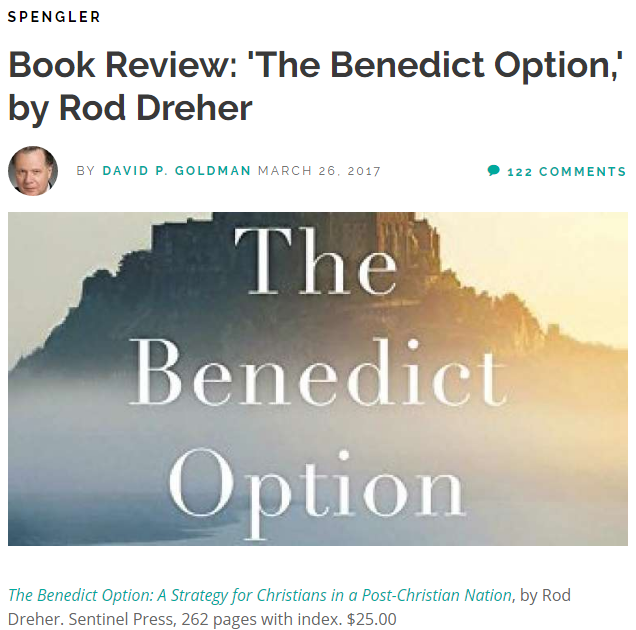 |
| The Benedict Option: Read the Review, not the book |
A question that preoccupies many of us, both in election years and non-election years, is “how can Christians (and Christianity) maintain an influence in a world that seems to trend more ungodly with each passing minute?”
One option put forth is by the Methodist-turned-Roman-Catholic-turned-Eastern-Orthodox writer Rob Dreher, is “The Benedict Option” – not named after “Pope Benedict”. Both “The Benedict Option” and “Pope Benedict” are named after the fifth-century Monastic Benedict of Nursia, who developed the famous “Rule of St. Benedict” not merely for “monasticism”, but for “a confederation of autonomous communities” living apart from the world. It is said that “most religious communities founded throughout the Middle Ages” adhered to this rule.
David Goldman has reviewed “The Benedict Option”, and he has done it in a non-fawning way:
Subscribe to:
Posts (Atom)