The John 3:16 conference has fanned into flame the embers of an old controversy that is always smoldering to one degree or another. I’ll venture a few comments of my own:
1. I’ve already stated my own position a long time ago, so I won’t repeat myself here.
http://triablogue.blogspot.com/2004/04/what-does-god-want.html
2. The term “hyper-Calvinist” is frequently used by pseudo-Calvinists as a rhetorical ploy to put real Calvinists on the defensive. But “hyper-Calvinism” is a word with a historic definition. You’re not at liberty to unilaterally redefine words to suit your agenda.
3. Apropos (2), to my knowledge, none of the Reformed Confessions (e.g. Westminster Confession, Three Forms of Unity) teaches the well-meant offer.
They may teach the free offer of the gospel, they don’t make God’s love for reprobate or desire to save them a precondition of the offer.
That being the case, you can’t retroactively argue that someone who rejects a theological innovation like the well-meant offer is not a true Calvinist. That involves a very anachronistic definition of Calvinism.
4. Early in the 20C, the CRC and the OPC took influential positions in favor of the well-meant offer. Fine. Individual denominations are free to draw the theological parameters however they please for members of their own communion. But they only speak for their own denomination.
5. One of the stock objections to the traditional position is a logical objection. Proponents of the well-mean offer insist that unless God loves the reprobate and wants to save them, that the offer of the Gospel is insincere.
But there are two basic problems with this objection:
i) The logical objection is illogical. The only thing that makes an offer genuine is if it’s true. The offer of the gospel is a conditional offer. If you do what it says (repent and believe), you will get what God promised.
The intention of the party who makes the offer is irrelevant to the bona fides of the offer—as long as the offer is true.
ii) The position of the critics is logically inconsistent. But you don’t have the right to raise logical objections to the opposing position unless your own position is logically consistent.
Here is the problem: let us grant, for the sake of argument, the presupposition of the well-meant offer, viz. the offer is insincere unless God loves the reprobate and wants to save them.
Given that presupposition, what would be the consistent position?
If:
>Limited desire is incompatible with the sincerity of the offer,
Then:
>>Limited atonement is incompatible with the sincerity of the offer,
And:
>>>Limited election is incompatible with the sincerity of the offer,
And:
>>>>Limited salvation is incompatible with the sincerity of the offer.
Logically speaking, the only position consistent with the presupposition of the well-meant is universalism.
iii) There is, of course, one logical alternative: reject the presupposition.
6. I can’t help noticing an implicit parallel between Arminians and proponents of the well-meant offer:
i) Proponents of the well-meant offer say the offer is insincere unless God loves the reprobate and wants to save them.
ii) Arminians say divine warnings about the danger of apostasy are insincere unless true believers can truly lose their salvation.
If we agree with the presupposition of the well-meant offer, then it seems to me that the Arminians are right. If we accept the well-meant offer, then we should reject the perseverance of the saints.
But proponents of the well-meant offer pose as Calvinists.
7. On a final note, I find it odd when some Christians think it’s absolutely essential that God suffer from frustrated desires. They act as though we’re in mortal peril of losing some fundamental feature of Christian theism unless we insist on the fact that God is schizophrenic.
On the face of it: the danger lies in the opposite direction. It’s far more threatening to Christian theism to insist that God is schizophrenic.
Why doesn’t God save everyone?
i) Either God is able to save everyone, but unwilling—in which case God is not omnibenevolent,
ii) Or else, God is willing to save everyone, but unable—in which case God is not omnipotent.
Those are the only logical alternatives: there is no third.

Showing posts sorted by relevance for query free offer of the gospel. Sort by date Show all posts
Showing posts sorted by relevance for query free offer of the gospel. Sort by date Show all posts
Saturday, December 06, 2008


Thursday, September 01, 2011
Come, sinners to the gospel feast
To his credit, David Ponter has now attempted a fairly serious, systematic response to my post:
Let’s see how well he does this time around.
“What is more, I really think that the attempt to fixate on parsing the word “offer,” to find any and every possible exception really misses the point.”
i) It’s critics of special redemption like Ponter who fixate on the meaning of the word “offer.” Manata and I are simply responding in kind.
ii) Manata and I aren’t looking for “exceptions” to the concept of an “offer.” Rather, the question is whether Ponter’s basic definition is too broad or two narrow. The function of counterexamples is to challenge the adequacy of his definition–not to grant the general definition, but find exceptions.
“There are two issues. The first issue is basic: Does God make an offer? Does God make a sincere offer? Does God’s offer even need to be sincere? Does God make a well-meaning offer. Does God’s offer even need to be well-meant? When the conversation turns on these sorts of questions, the conversation has gone awry already. It is already turning on Hypercalvinist versus evangelical Calvinist axis points.”
i) No, the problem is that Ponter conflates three different issues: (a) the generic concept of an offer; (b) the specific concept of a divine offer, and (c) the specific concept of a sincere offer.
He oscillates between these three different concepts as if they’re synonymous. That’s a semantic fallacy.
ii) Moreover, even if we waive the semantic fallacy, importing divine qualifications into the definition of an offer is counterproductive to Ponter’s position, for we’d have to then consider the logical relationship between reprobation and the gospel offer.
“It has been our experience that for the most part those who want to challenge the very meaning of constitutes a sincere offer are generally those who have already made a pre-commitment to Hypercalvinist categories, either tentatively or fully.”
That’s just an exercise in poisoning the well.
“For many, the debate will ultimately come down to these pre-commitments.”
My precommitments are irrelevant to this debate. I’m merely assessing Ponter’s argument on its own terms. I could do that whether I’m a 5-point Calvinist or Tibetan Buddhist.
“If one has affirmed already that God does not by revealed will desire the salvation of all men, then one is already in the Hypercalvinist tradition. This has to be so, because one cannot, on the one hand, deny that God by revealed will desires the salvation of all men and then, on the other hand, meaningfully affirm a well-meant offer.”
Not only does that beg the question what of constitutes a “well-meant” offer, but it also stipulates an essentially Arminian interpretation of Bible verses which employ adjectives like “all” or “world.”
It’s ironic for Ponter to define true Calvinism according to Arminian hermeneutics.
“How does that follow? We know that in terms of the secret will, God desires not to save the non-elect. According to evangelical Calvinism, we also know that in terms of the revealed will God desires to save the non-elect.”
I don’t concede that dichotomy. That turns on a typically Arminian misinterpretation of the prooftexts.
“So, if we deny that by revealed will that God desires to save the non-elect, and this includes the entailment that the Gospel offer does not express God’s desire to save the non-elect hearers, this means that the criteria which sustains a well-meant offer has now been voided. In the Gospel offer, it would then follow that God only desires to not save the non-elect. Thus, when God makes an appearance of seeking someone’s salvation, he is being insincere. Denial of a well-meant offer is the hallmark of hypercalvinism, if anything is.”
He keeps paraphrasing the same question-begging assertions. That does nothing to advance the argument.
“So, a well-meant or a sincere offer cannot be sustained on terms which denies that by revealed will God desires the salvation of the non-elect. A person may speak as if they are positing a well-meant offer, but in actuality, they are not.”
An evangelist isn’t responsible for what lies behind the offer. He’s simply transmitting a divine directive. An evangelist doesn’t have to have any particular theory regarding the underpinnings of the offer. What ultimately matters is not what the evangelist intended, but what God intended.
“For example, no one in the John Calvin, John Murray, John Piper tradition of Calvinism should disagree with this.”
i) What about someone in the John Owen, Francis Turretin, William Young, Paul Helm tradition of Calvinism?
ii) BTW, I’m not defending Calvinism in my response to Ponter. I’m merely evaluating the logic of his argument on its own terms.
The fundamental question at issue is not who represents “true Calvinism,” but which side has the better of the argument. The point is not to defend Calvinism, but to defend truth. If Calvinism is true, then so much the better. The important issue is not what Calvinism selects for, but what the truth selects for.
Of course, I think the truth selects for Calvinism, but I’m not beginning with Calvinism. That has it backwards.
iii) I don’t concede Ponter’s claim to have Calvin in his corner. But that’s a debate for another day.
iv) If you want a representative exposition of the traditional Reformed position on God’s will regarding the reprobate, a good place to start would be the section on reprobation (subsections 16-17), of Turretin’s Institutes, vol. 1 (Dennison, ed.).
Because Ponter knows that his own position reflects a dissenting position within Reformed tradition, he tries to drape himself in the mantle of Calvinism and put the rest of us on the defensive by pretending that he’s speaking for mainstream historical Calvinism.
“Regarding the meaning of offer, all one needs to do is look up a good dictionary. The OED is one of my favorites.”
Yet, oddly enough, Ponter doesn’t quote from the OED. It gives several definitions, some of which are irrelevant. Of the two most germane to the issue at hand, it says:
To present or tender for acceptance or refusal; to hold out (a thing) for a person to take if he will.
To propose, or express one’s readiness (to do something), conditionally on the assent of the person addressed.
How is that inconsistent with how Manata and I have defined an “offer”?
Wednesday, November 02, 2011
Murray contra Murray
Bob Gonzales draws attention to an apparent contradiction in the views of Murray and Stonehouse regarding the free offer:
http://drbobgonzales.com/2011/updating-and-refining-the-1689-baptist-confession-affirming-common-grace-and-the-sincere-offer-of-the-gospel/
Here's the relevant section:
The Love of God
Chapter XXXV purports to express more fully than has been done elsewhere in the Confession the doctrine of the church on the subject “Of the Love of God and Missions.” From the standpoint of the Reformed Faith the objections are principally three:
(1) There is a studied omission of the electing love of God, and therefore of the distinction between the love of God that is unto salvation and the general benevolence of God that is unto all but is not of itself saving. Such an omission is fatal. It is impossible to give creedal statement to the Reformed doctrine of the love of God without explicit enunciation of the particular love of God. This objection gathers all the more strength when it is remembered that the topic is not only “the Love of God” but “the Love of God and Missions,” in other words, the love of God as it is directly related to the missionary work of the church.
It is true that the missionary who has an intelligent love of the gospel and zeal for the salvation of men does not forget the benevolence that God exhibits to all, nor does he fail to impress upon men the witness it bears to the goodness of God. But the chief message of the missionary, the message that pre-eminently constrains him to preach to the lost, is the message of that love that sent the Son of God into the world, the love that is electing and effectively redemptive. This revision, then, omits what a Reformed consciousness in the performance of its paramount duty precisely demands.
(2) But not only is definition of the particular love of God studiously omitted. When the extent of God’s love is mentioned it is expressly universalized. In Section I the love of God is described as infinite and perfect love and in Section II it is said that “in the Gospel God declares His love for the world.” There is, of course, a scriptural sense in which God’s love for the world is declared in the gospel. But in the context in which this is stated in this section it is calculated to teach a doctrine of God’s love entirely different from and at variance with, Scripture teaching and Reformed standards.
(3) In Section II there is careful omission of any mention of the efficacious grace of the Holy Spirit. The reply might be given that this phase of truth is sufficiently expressed in the preceding chapter and in the Confession elsewhere. This reply is not an answer to the objection. Why is the reference to the work of the Holy Spirit in Section II left on the plane of merely suasive influence? Why, we peremptorily ask, in a creedal statement that purports to set forth the official teaching of a Reformed Church on the subject of the love of God and missions should there be omission of the very thing that alone offers any real encouragement to the missionary, namely, the love of God coming to expression in the efficacious grace of the Holy Spirit?
In brief, the objection to this chapter is that it is not Reformed, indeed, that there is nothing distinctly Reformed in it. The subject treated of lies close to the very heart of the Reformed Faith. How possibly can a formulation so destitute of Reformed truth on so vital a subject be defended in Reformed Confession? There is. no defense.
http://www.puritanboard.com/blogs/naphtalipress/articles-1903-revisions-confession-faith-murray-stonehouse-153/
The Associate Reformed Presbyterian Church in 1959 and the Evangelical Presbyterian Church of America in 1981 adopted chapters 34 and 35 of the 1903 revision. Chapter 35, touches on the doctrine of common grace and affirms God’s sincere offer of the gospel to all men. The first two paragraphs are particularly relevant:
I. God in infinite and perfect love, having provided in the covenant of grace, through the mediation and sacrifice of the Lord Jesus Christ, as way of life and salvation, sufficient for and adapted to the whole lost race of man, doth freely offer this salvation to all men in the gospel.II. In the gospel God declares his love for the world and his desire that all men should be saved; reveals fully and clearly the only way of salvation; promises eternal life to all who truly repent and believe in Christ; invites and commands all to embrace the offered mercy; and by his Spirit accompanying the word pleads with men to accept his gracious invitation.7
- I’m aware of the fact that Ned Stonehouse and John Murray wrote an article in 1937 criticizing this addition. One can read Stonehouse and Murray’s reasoning here. I honestly can’t understand why Murray would reject this particular doctrinal formula in light of his own view of the free offer that he would later articulate in 1948. Perhaps he changed his mind. Or perhaps the some of the baggage that came accompanied the 1903 revision like, for instance, the accompanying “Declaratory Statement” and unqualified affirmation of the salvation of all infants colored Murray’s view of the agenda that was behind the entire 1903 revision.
http://drbobgonzales.com/2011/updating-and-refining-the-1689-baptist-confession-affirming-common-grace-and-the-sincere-offer-of-the-gospel/
Here's the relevant section:
The Love of God
Chapter XXXV purports to express more fully than has been done elsewhere in the Confession the doctrine of the church on the subject “Of the Love of God and Missions.” From the standpoint of the Reformed Faith the objections are principally three:
(1) There is a studied omission of the electing love of God, and therefore of the distinction between the love of God that is unto salvation and the general benevolence of God that is unto all but is not of itself saving. Such an omission is fatal. It is impossible to give creedal statement to the Reformed doctrine of the love of God without explicit enunciation of the particular love of God. This objection gathers all the more strength when it is remembered that the topic is not only “the Love of God” but “the Love of God and Missions,” in other words, the love of God as it is directly related to the missionary work of the church.
It is true that the missionary who has an intelligent love of the gospel and zeal for the salvation of men does not forget the benevolence that God exhibits to all, nor does he fail to impress upon men the witness it bears to the goodness of God. But the chief message of the missionary, the message that pre-eminently constrains him to preach to the lost, is the message of that love that sent the Son of God into the world, the love that is electing and effectively redemptive. This revision, then, omits what a Reformed consciousness in the performance of its paramount duty precisely demands.
(2) But not only is definition of the particular love of God studiously omitted. When the extent of God’s love is mentioned it is expressly universalized. In Section I the love of God is described as infinite and perfect love and in Section II it is said that “in the Gospel God declares His love for the world.” There is, of course, a scriptural sense in which God’s love for the world is declared in the gospel. But in the context in which this is stated in this section it is calculated to teach a doctrine of God’s love entirely different from and at variance with, Scripture teaching and Reformed standards.
(3) In Section II there is careful omission of any mention of the efficacious grace of the Holy Spirit. The reply might be given that this phase of truth is sufficiently expressed in the preceding chapter and in the Confession elsewhere. This reply is not an answer to the objection. Why is the reference to the work of the Holy Spirit in Section II left on the plane of merely suasive influence? Why, we peremptorily ask, in a creedal statement that purports to set forth the official teaching of a Reformed Church on the subject of the love of God and missions should there be omission of the very thing that alone offers any real encouragement to the missionary, namely, the love of God coming to expression in the efficacious grace of the Holy Spirit?
In brief, the objection to this chapter is that it is not Reformed, indeed, that there is nothing distinctly Reformed in it. The subject treated of lies close to the very heart of the Reformed Faith. How possibly can a formulation so destitute of Reformed truth on so vital a subject be defended in Reformed Confession? There is. no defense.
http://www.puritanboard.com/blogs/naphtalipress/articles-1903-revisions-confession-faith-murray-stonehouse-153/
Wednesday, February 15, 2006
The Protestant Denial of Sola Gratia
This was addressed to Steve, but I couldn't resist comment. I know Steve can hold his own, but this is just one of my pet peeves. I posted an article on this theology a few weeks ago in a thread that published Jim Eliff's article "Southern Baptists An Unregenerate Denomination." I have watched the SBC and many independent churches fill the pews with unregenerate souls and bloat membership rolls for years now. So you should be able to figure out exactly what I think when I see this:
# posted by H K Flynn : 2/13/2006 10:36 PM http://www.blogger.com/comment.g?blogID=6789188&postID=113967719173577570
This is so basic. Let's put this together for H K Flynn, and let's not mince words.
On the "Free Grace" view, regeneration and election are both put outside, not inside the work of the Holy Spirit. In Calvinism we believe because we are born again and no other reason (1 John 5:1). We persevere, again because we are born again. We repent, because we are born again. We commit our lives to Christ because we are born again. We obey Christ because we are born again. The Spirit's work lies directly behind each of these. They do not arise from a state of (fallen) nature. They arise as the result of His work and all in conjunction with the gospel and the Word of God itself.
Ergo, we do not apostatize from the faith. We can backslide, but we do not apostatize. Let's not forget here that the definition of "eternal security" in Free Grace theology is "If you have at any time in the past made a commitment to Christ, you are saved." Can an unbeliever apostatize from the faith completely? The Free Grace position says "Yes." Reformed theology says "No."
R.B.C. Howell, the 2nd president of the SBC defined apostasy as the embracing of 3 evils: repudiation of the evangelical doctrine (the gospel); a gradual (if not radical) decline in morality; and a loss of spirituality of mind (conviction of sin, interest in spriitual things, love for the brethren, etc). Backsliding encompasses only one, maybe two , but not all three. Apostasy embraces all three. If a man apostatizes, he was not regenerate from the start. We cannot, of a certainty, know of another man's state in this respect, but the Free Grace position affirms the security of the believer in such a way that a man can apostatize and still be counted of the brethren. It conflates a credible profession of faith, which is what Baptists require for baptism, with a saving profession of faith and couples this with an affirmation of the security of the believer that denies the reality of spurious faith and the inevitable necessity of some degree of sanctification.
It doesn't end there, either. Oh no. This is typically what passes for soteriology in conservative/fundamental Baptist circles. Baptist ecclesiology proceeds from the notion of a regenerate church membership...not merely the universal church, but the local church as well. Free Grace Theology has conflated a saving profession of faith with a credible profession of faith. Baptists require a credible profession of faith for baptism (John L. Dagg, Manual of Theology Chapter 12, Treatise on Church Order).
Free Grace theology merely assumes these are all saving professions of faith. It is one thing to give your baptismal candidates the benefit of the doubt and mistakenly allow unregenerates into the local assembly as members. That's why a 100 percent regenerate membership is an ideal. Believer's baptism is a control, but it is not infallible.
However, the Free Grace Theology amounts to Campbellite ecclesiology without baptismal regeneration, for, if you "pray that prayer and really really mean it" and "make that decision to ask Jesus in your heart to your Lord n' Savior" (even if it is the fifteenth time you've done it...you just really really mean it this time), you can be validly baptized, and you can be a full member. These f0lks don't want to be Campellites. (God forbid they believe baptismal regeneration), but they want to be sure they have a regenerate church membership, so they turn the sinner's prayer into a sacramental prayer that functions in the same way. Presto! You get a big church with big numbers and a soteriology that says that if they apostatize, they're still considered true converts, and a sacramental prayer and an invitation have become your new sacraments.
There's a reason we call this "Easy believism." There's a reason we call this a "dispensational soteriological innovation."
It is the Free Grace Theology that bloats the membership rolls.
It is the Free Grace Theology that results in churches with 29,000 members but only 9000 or less show up on any given Sunday morning, 1/3 of which are visitors.
It is the Free Grace Theology that gives us Pastor's Conferences that are full of men who pat themselves proudly on the back for their inflated numbers without regard to the church members they actually cultivate and then get snippy when you bring up that issue.
It's Free Grace Theology that gives us an SBC President that spends 2 years touring the nation promoting a baptismal program we affectionately call "The Million Man Dunk."
So, not only is the gospel reduced and redefined, a new sacrament is invented, the ecclesiological value of a regenerate church membership is diminished, and the ordinance of baptism is trivialized. I wonder also how many have taken the Lord's Supper to their condemnation to boot.
This isn't the gospel of the Protestant Reformation. This isn't the gospel of the Bible. Arminians wonder at this. You know, I actually have Arminian friends that call this Pelagian. You have to be pretty far out there for that to happen if you ask me.
I'd add that this is the Campbellite Movement all over again. Honestly, I'm surprised nobody has really noticed that yet. The sinner's prayer has replaced baptism. All baptisms are valid and the membership is, at least at the conceptual level, considered regenerate, since all the elect are preserved but all the elect do not also persevere. Add a dose of Keswick spirituality to make sanctification a second blessing, and you have a modified form of the old restoration movement.
How does this do this you ask? Well, the logic works something like this:
The Free Grace position's definition of saving faith is exactly that of Arminian theology, it just waters it down to assent to some facts about Jesus. It's removal of the "fiducia" component of "noticia, assensus, fiducia" plus a removal of prevenient grace.. The problem of course, is that it is less Arminian than Arminianism, and that’s not a compliment.
For one thing, in Arminianism you have a doctrine of prevenient grace. Depending on what strand of Arminianism being articulated by a given theologian, this can mean a grace given to all men without exception at the time they hear the gospel that stays with them enabling them to believe. At that point, the prevenient grace become effectual. There's a "point of no return" so to speak, if the individual does not resist it. On the other hand, it is sometimes spoken of as a spiritual benefit for all men without exception that comes by way of the cross that enables them to be led to God via common grace and from common grace to special grace. Then, there are those who would say that this prevenient grace leads them to a point of "equipoise" in which the will makes an uncaused choice for some unknown reason to choose Christ or reject Christ.
The Free Grace position, if you pay close attention, never discusses prevenient grace or buries it so far from view it may as well be nonexistent. Prevenient grace is merely the universal, external call of the gospel. The Spirit "woos" people, but then He "woos" everybody.
Prevenient grace as actual Arminian soteriology teaches it is built upon a doctrine of total inability virtually identical to that of Reformed Theology. Perhaps one of these days H.K Flynn will read the Opinions of the Remonstrance and realize that his position is the historically new kid on the block, for Free Grace Theology denies this.
Free Grace theology, makes absurd exegetical comments like Dr. Jack Graham of Prestonwood Baptist Church did last year in which he ripped Romans 12:3 from its context to say that God has given every man a measure of faith. First, he assumed that "every man" is "every human being." In context, it is every believer--the brethren to whom the text is addressed. The faith discussed here has to do with Christian living and the sound judgment required for it, not saving faith. Dr. Graham interpreted this as saving faith. Then he used this to deny total inability.
Unlike the Free Grace Theologians, the Reformed community as well as, I would argue the classical Arminian community take passages like John 6:44, Romans 8:7, and 1 Cor. 2:14 and others seriously. When Scripture declares we can't do something, that means we can't do it. Free Grace theology denies this.
I'd add that Chafer was a dispensational Amyrauldian. I have friends that were at Dallas Theological Seminary before the "Free Grace" movement at the Geislerian, Dave Hunt, Zane Hodges, Herb Reavis 4 - point Arminianism + eternal security position took hold. These men believe the doctrines of grace as strongly as I do. They look at DTS now and see what has happened and can't believe their eyes. Why?
The dispensationalists of the Free Grace community have so watered Chafer down that now "Total Depravity" is interpreted to mean "We are all guilty of sin and sinful," but we are not so sinful as to be unable to contribute any spiritual good to our salvation. That's closer to Rome than Arminianism. That's closer to functional Pelagianism than Rome. Pelagius focused on the “free will” of every man, not just when they hear the gospel, to accept Christ. Why is grace needed if man has the free will to choose Christ?
So, Free Grace soteriology begins with a functionally Pelagian anthropology of man due to this denial of spiritual inability and the further denial or, at best, incoherent articulation, of prevenient grace, much less effectual grace.
Then Free Grace Theology borrows the Arminian view of election (foreseen faith). Lately, I've heard pastors in the SBC speak of us all being elect, which sounds remarkably like the universal election view of a certain Pelagius from well over a millenium ago.
Why mention this? Well, by denying monergisitic regeneration and placing election outside the grace of God, both election and regeneration are placed outside a chain of grace that results in saving faith in the believer. On this view, the work of Christ is all that is in the chain of grace, and it's not an effectual grace, for Christ does not secure salvation for the elect, He merely secures the opportunity to believe. I've even read some statements by professors at DTS that state that Christ did not die for the sin of unbelief. I've seen discussions at the Baptistboard that deny that not believing in Christ is a sin. In short, you end up with functional Unitarianism.
So, when you say this:
We say, "No you don’t." You are functional Unitarians, for you deny election and the inevitability/necessity of sanctification in such a way that you deny the covenant of redemption, which underwrites the whole reason for the Incarnation. Grace is relegated to the cross and effectual for justification and security, but not sanctification or any other spiritual benefits. This is "fire insurance" salvation nothing more. Election and regeneration are outside the chain of grace. Sanctification is a second, optional, work. Christ came to offer eternal life and to set aside and rule a people for Himself and purify them in this life as well as the next. In your treatment of sanctification, you deny this part of the Incarnation’s purpose as well. This isn't an offer of eternal life you affirm, it's an offer of fire insurance, a bill of goods I would argue that sends folks to hell with a policy in their back pocket on a regular basis. However, the Free Grace Theology wishes to maintain its doctrine of eternal security. By divorcing saving faith from regeneration, it is the Free Grace position, not the Calvinist position, that makes faith arise from a state of nature. By divorcing sanctification from the work of the Spirit beginning with regeneration and further asserting that one can embrace the three evils of apostasy from the faith and still be counted among the regenerate, you make sanctification optional an add-on, an appendage.. Ergo, if a man perseveres in the faith, it is from himself, not the Spirit at work in him, for it is not the natural, inevitable result of regeneration.
But that's not all. Then you have the whole "carnal Christian" theory to add insult to injury.
Remember this little jewel?

In this theory, men have not one regenerated new nature, but two natures, a sin nature and a new nature living side by side. When a man sins, this is attributed to his sin nature. When a man obeys this is attributed to his new nature. One would ask then, who then is to repent for sin in a man’s life? If a man has two natures at work within him, then we have a problem, for there is but one man, yet his new nature is not charged with sin, according to this theory, it is his old. This is a man with a sin nature (evil) and a new nature (good) at work within him. This is just plain old fashioned dualism. This smacks of good old fashioned Gnosticism.
So, when you say this:
We do not do this. God does not fail to sanctify that which He justifies, for God is the one who brings about the faith that justifies and, just as Paul argued in Romans, that will lead to a changed life. Justification and sanctification are separate and distinct, but they are not so separate and distinct that the latter does not always result from the former. Let’s not forget yours is the view that says Simon Magus was a true convert, a discussion I have actually had with a Free Gracer before, yet all of church history says he, Helena, and Meander founded Gnosticism. How ironic, indeed you would implicitly affirm dualism.
Ernest Reisinger, bless him, said it well:
So, Free Grace Theology affirms Sola Fide, but it's Sola Fide light. Its not composed of "noticia, assensus, fiducia" but only "noticia and assensus." It's less Arminian than than Arminius. It's closer to Rome than Arminianism, but it's actually funcitionally Pelagian, something Rome, I would argue is not, to her credit.
The Free Grace is a Unitarian grace. It may as well be Socinian, for the election of the Father is not determinative and the Spirit's work is inefffectual and negated by men's wills ad infinitum at virtually every turn. Regeneration and election and ultimately sanctification itself are all put outside of the chain of grace, so Free Grace is, in point of fact a denial of and Sola Fide Sola Gratia, for to get to Sola Fide you have to redefine it and then deny Sola Gratia.
So, Mr. Flynn, you may assert this is Sola Christus, but it denies what Christ says about faith and salvation; it's not Sola Fide except in name only and the Free Grace is not grace at all, it's a denial of, not an affirmation of , Sola Gratia. Add Baptist ecclesiology and the sinner's prayer and a pinch of Keswick spirituality and you have Neo-Campbellites.
So Free Grace is Marcionism. Hmmmm.Free Grace is the belief that those things that are essential to successfully living the Christian life can be distinguished from the offer of eternal life.
We think this is valid because the NT writers never blur the distinction between following Christ and receiving eternal life/being justified before God's legal bar of justice.
We accept and proclaim everything good coming out of the incarnation but we correlate and distingush those things that are correlated and distinguished by the NT writers.
The offer of eternal life is not a bulletin board for everything urgent in Christian theology. We proclaim the whole canon. The Free Grace enterprise insists that there is nothing free about discipleship and to mingle it with what is free inexorably dismisses the power given it by the NT wriers.
# posted by H K Flynn : 2/13/2006 10:36 PM http://www.blogger.com/comment.g?blogID=6789188&postID=113967719173577570
This is so basic. Let's put this together for H K Flynn, and let's not mince words.
"Free Grace" is a denial, not an affirmation of Sola Gratia.
On the "Free Grace" view, regeneration and election are both put outside, not inside the work of the Holy Spirit. In Calvinism we believe because we are born again and no other reason (1 John 5:1). We persevere, again because we are born again. We repent, because we are born again. We commit our lives to Christ because we are born again. We obey Christ because we are born again. The Spirit's work lies directly behind each of these. They do not arise from a state of (fallen) nature. They arise as the result of His work and all in conjunction with the gospel and the Word of God itself.
Ergo, we do not apostatize from the faith. We can backslide, but we do not apostatize. Let's not forget here that the definition of "eternal security" in Free Grace theology is "If you have at any time in the past made a commitment to Christ, you are saved." Can an unbeliever apostatize from the faith completely? The Free Grace position says "Yes." Reformed theology says "No."
R.B.C. Howell, the 2nd president of the SBC defined apostasy as the embracing of 3 evils: repudiation of the evangelical doctrine (the gospel); a gradual (if not radical) decline in morality; and a loss of spirituality of mind (conviction of sin, interest in spriitual things, love for the brethren, etc). Backsliding encompasses only one, maybe two , but not all three. Apostasy embraces all three. If a man apostatizes, he was not regenerate from the start. We cannot, of a certainty, know of another man's state in this respect, but the Free Grace position affirms the security of the believer in such a way that a man can apostatize and still be counted of the brethren. It conflates a credible profession of faith, which is what Baptists require for baptism, with a saving profession of faith and couples this with an affirmation of the security of the believer that denies the reality of spurious faith and the inevitable necessity of some degree of sanctification.
It doesn't end there, either. Oh no. This is typically what passes for soteriology in conservative/fundamental Baptist circles. Baptist ecclesiology proceeds from the notion of a regenerate church membership...not merely the universal church, but the local church as well. Free Grace Theology has conflated a saving profession of faith with a credible profession of faith. Baptists require a credible profession of faith for baptism (John L. Dagg, Manual of Theology Chapter 12, Treatise on Church Order).
Free Grace theology merely assumes these are all saving professions of faith. It is one thing to give your baptismal candidates the benefit of the doubt and mistakenly allow unregenerates into the local assembly as members. That's why a 100 percent regenerate membership is an ideal. Believer's baptism is a control, but it is not infallible.
However, the Free Grace Theology amounts to Campbellite ecclesiology without baptismal regeneration, for, if you "pray that prayer and really really mean it" and "make that decision to ask Jesus in your heart to your Lord n' Savior" (even if it is the fifteenth time you've done it...you just really really mean it this time), you can be validly baptized, and you can be a full member. These f0lks don't want to be Campellites. (God forbid they believe baptismal regeneration), but they want to be sure they have a regenerate church membership, so they turn the sinner's prayer into a sacramental prayer that functions in the same way. Presto! You get a big church with big numbers and a soteriology that says that if they apostatize, they're still considered true converts, and a sacramental prayer and an invitation have become your new sacraments.
There's a reason we call this "Easy believism." There's a reason we call this a "dispensational soteriological innovation."
It is the Free Grace Theology that bloats the membership rolls.
It is the Free Grace Theology that results in churches with 29,000 members but only 9000 or less show up on any given Sunday morning, 1/3 of which are visitors.
It is the Free Grace Theology that gives us Pastor's Conferences that are full of men who pat themselves proudly on the back for their inflated numbers without regard to the church members they actually cultivate and then get snippy when you bring up that issue.
It's Free Grace Theology that gives us an SBC President that spends 2 years touring the nation promoting a baptismal program we affectionately call "The Million Man Dunk."
So, not only is the gospel reduced and redefined, a new sacrament is invented, the ecclesiological value of a regenerate church membership is diminished, and the ordinance of baptism is trivialized. I wonder also how many have taken the Lord's Supper to their condemnation to boot.
This isn't the gospel of the Protestant Reformation. This isn't the gospel of the Bible. Arminians wonder at this. You know, I actually have Arminian friends that call this Pelagian. You have to be pretty far out there for that to happen if you ask me.
I'd add that this is the Campbellite Movement all over again. Honestly, I'm surprised nobody has really noticed that yet. The sinner's prayer has replaced baptism. All baptisms are valid and the membership is, at least at the conceptual level, considered regenerate, since all the elect are preserved but all the elect do not also persevere. Add a dose of Keswick spirituality to make sanctification a second blessing, and you have a modified form of the old restoration movement.
How does this do this you ask? Well, the logic works something like this:
The Free Grace position's definition of saving faith is exactly that of Arminian theology, it just waters it down to assent to some facts about Jesus. It's removal of the "fiducia" component of "noticia, assensus, fiducia" plus a removal of prevenient grace.. The problem of course, is that it is less Arminian than Arminianism, and that’s not a compliment.
For one thing, in Arminianism you have a doctrine of prevenient grace. Depending on what strand of Arminianism being articulated by a given theologian, this can mean a grace given to all men without exception at the time they hear the gospel that stays with them enabling them to believe. At that point, the prevenient grace become effectual. There's a "point of no return" so to speak, if the individual does not resist it. On the other hand, it is sometimes spoken of as a spiritual benefit for all men without exception that comes by way of the cross that enables them to be led to God via common grace and from common grace to special grace. Then, there are those who would say that this prevenient grace leads them to a point of "equipoise" in which the will makes an uncaused choice for some unknown reason to choose Christ or reject Christ.
The Free Grace position, if you pay close attention, never discusses prevenient grace or buries it so far from view it may as well be nonexistent. Prevenient grace is merely the universal, external call of the gospel. The Spirit "woos" people, but then He "woos" everybody.
Prevenient grace as actual Arminian soteriology teaches it is built upon a doctrine of total inability virtually identical to that of Reformed Theology. Perhaps one of these days H.K Flynn will read the Opinions of the Remonstrance and realize that his position is the historically new kid on the block, for Free Grace Theology denies this.
Free Grace theology, makes absurd exegetical comments like Dr. Jack Graham of Prestonwood Baptist Church did last year in which he ripped Romans 12:3 from its context to say that God has given every man a measure of faith. First, he assumed that "every man" is "every human being." In context, it is every believer--the brethren to whom the text is addressed. The faith discussed here has to do with Christian living and the sound judgment required for it, not saving faith. Dr. Graham interpreted this as saving faith. Then he used this to deny total inability.
Unlike the Free Grace Theologians, the Reformed community as well as, I would argue the classical Arminian community take passages like John 6:44, Romans 8:7, and 1 Cor. 2:14 and others seriously. When Scripture declares we can't do something, that means we can't do it. Free Grace theology denies this.
I'd add that Chafer was a dispensational Amyrauldian. I have friends that were at Dallas Theological Seminary before the "Free Grace" movement at the Geislerian, Dave Hunt, Zane Hodges, Herb Reavis 4 - point Arminianism + eternal security position took hold. These men believe the doctrines of grace as strongly as I do. They look at DTS now and see what has happened and can't believe their eyes. Why?
The dispensationalists of the Free Grace community have so watered Chafer down that now "Total Depravity" is interpreted to mean "We are all guilty of sin and sinful," but we are not so sinful as to be unable to contribute any spiritual good to our salvation. That's closer to Rome than Arminianism. That's closer to functional Pelagianism than Rome. Pelagius focused on the “free will” of every man, not just when they hear the gospel, to accept Christ. Why is grace needed if man has the free will to choose Christ?
So, Free Grace soteriology begins with a functionally Pelagian anthropology of man due to this denial of spiritual inability and the further denial or, at best, incoherent articulation, of prevenient grace, much less effectual grace.
Then Free Grace Theology borrows the Arminian view of election (foreseen faith). Lately, I've heard pastors in the SBC speak of us all being elect, which sounds remarkably like the universal election view of a certain Pelagius from well over a millenium ago.
Why mention this? Well, by denying monergisitic regeneration and placing election outside the grace of God, both election and regeneration are placed outside a chain of grace that results in saving faith in the believer. On this view, the work of Christ is all that is in the chain of grace, and it's not an effectual grace, for Christ does not secure salvation for the elect, He merely secures the opportunity to believe. I've even read some statements by professors at DTS that state that Christ did not die for the sin of unbelief. I've seen discussions at the Baptistboard that deny that not believing in Christ is a sin. In short, you end up with functional Unitarianism.
So, when you say this:
We accept and proclaim everything good coming out of the incarnation but we correlate and distingush those things that are correlated and distinguished by the NT writers.
We say, "No you don’t." You are functional Unitarians, for you deny election and the inevitability/necessity of sanctification in such a way that you deny the covenant of redemption, which underwrites the whole reason for the Incarnation. Grace is relegated to the cross and effectual for justification and security, but not sanctification or any other spiritual benefits. This is "fire insurance" salvation nothing more. Election and regeneration are outside the chain of grace. Sanctification is a second, optional, work. Christ came to offer eternal life and to set aside and rule a people for Himself and purify them in this life as well as the next. In your treatment of sanctification, you deny this part of the Incarnation’s purpose as well. This isn't an offer of eternal life you affirm, it's an offer of fire insurance, a bill of goods I would argue that sends folks to hell with a policy in their back pocket on a regular basis. However, the Free Grace Theology wishes to maintain its doctrine of eternal security. By divorcing saving faith from regeneration, it is the Free Grace position, not the Calvinist position, that makes faith arise from a state of nature. By divorcing sanctification from the work of the Spirit beginning with regeneration and further asserting that one can embrace the three evils of apostasy from the faith and still be counted among the regenerate, you make sanctification optional an add-on, an appendage.. Ergo, if a man perseveres in the faith, it is from himself, not the Spirit at work in him, for it is not the natural, inevitable result of regeneration.
But that's not all. Then you have the whole "carnal Christian" theory to add insult to injury.
Remember this little jewel?
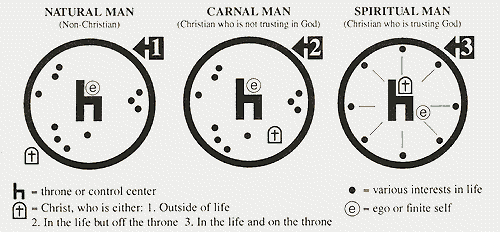
In this theory, men have not one regenerated new nature, but two natures, a sin nature and a new nature living side by side. When a man sins, this is attributed to his sin nature. When a man obeys this is attributed to his new nature. One would ask then, who then is to repent for sin in a man’s life? If a man has two natures at work within him, then we have a problem, for there is but one man, yet his new nature is not charged with sin, according to this theory, it is his old. This is a man with a sin nature (evil) and a new nature (good) at work within him. This is just plain old fashioned dualism. This smacks of good old fashioned Gnosticism.
So, when you say this:
Free Grace is the belief that those things that are essential to successfully living the Christian life can be distinguished from the offer ofeternal life.
We rightly say that what you have done is severe justification and sanctification such that the latter is viewed as a second, no, a secondary, work of grace, but, even then, it’s not a work of grace, it’s a form of dualism, for you have good and evil coexisting as separate natures in one person and the only real operative grace in this system of yours is the work of Christ, not the work of the Spirit, and that is ineffectual with respect to bringing about both saving faith (for you deny monergism) and sanctification (for you essentially render it optional and a separate and secondary work of grace that may or may not occur).We think this is valid because the NT writers never blur the distinction between following Christ and receiving eternal life/being justified before God's legal bar of justice.
We do not do this. God does not fail to sanctify that which He justifies, for God is the one who brings about the faith that justifies and, just as Paul argued in Romans, that will lead to a changed life. Justification and sanctification are separate and distinct, but they are not so separate and distinct that the latter does not always result from the former. Let’s not forget yours is the view that says Simon Magus was a true convert, a discussion I have actually had with a Free Gracer before, yet all of church history says he, Helena, and Meander founded Gnosticism. How ironic, indeed you would implicitly affirm dualism.
Ernest Reisinger, bless him, said it well:
The "Carnal Christian" teaching is primarily based on an erroneous interpretation of a single passage of Scripture (1 Cor. 3:1-4).
The "Carnal Christian" teaching perverts many other doctrines of the Christian faith.
The "Carnal Christian" teaching separates the two main doctrines of the Christian faith--justification and sanctification.
The "Carnal Christian" teaching separates the new covenant by making the act of submission to Christ optional--what God has joined together let no man or teaching put asunder.
The "Carnal Christian" teaching makes holiness, obedience and discipleship optional. See John 10:26-28; 14:21-23; 15:10; 1 Pet. 1:155,16; Heb. 12:14; Titus 2:10-14.
The "Carnal Christian" teaching breeds antinomianism and gives a false standard of what a Christian really is.
The "Carnal Christian" teaching is the mother of many of the second-work-of-grace errors.
The "Carnal Christian" teaching actually teaches two ways to heaven: one, the carnal-Christian way and two, the spiritual-Christian way--whichever your prefer.
The "Carnal Christian" teachers ignore the biblical distinction between the grounds of salvation and the grounds of assurance.
The "Carnal Christian" teaching breeds a false spirituality and Pharisaism in the so-called "spiritual Christians" who have measured up to some man-made standard of spirituality.
There ought to be no professed "spiritual Christians," much less "super-spiritual" ones! George Whitefield, a man who lived very close to his Savior, prayed all his days, "Let me begin to be a Christian." And another Christian has truly said, "In the life of the most perfect Christian there is every day renewed occasion for self-abhorrence, for repentance, for renewed application to the blood of Christ, for application of the rekindling of the Holy Spirit.
So, Free Grace Theology affirms Sola Fide, but it's Sola Fide light. Its not composed of "noticia, assensus, fiducia" but only "noticia and assensus." It's less Arminian than than Arminius. It's closer to Rome than Arminianism, but it's actually funcitionally Pelagian, something Rome, I would argue is not, to her credit.
The Free Grace is a Unitarian grace. It may as well be Socinian, for the election of the Father is not determinative and the Spirit's work is inefffectual and negated by men's wills ad infinitum at virtually every turn. Regeneration and election and ultimately sanctification itself are all put outside of the chain of grace, so Free Grace is, in point of fact a denial of and Sola Fide Sola Gratia, for to get to Sola Fide you have to redefine it and then deny Sola Gratia.
So, Mr. Flynn, you may assert this is Sola Christus, but it denies what Christ says about faith and salvation; it's not Sola Fide except in name only and the Free Grace is not grace at all, it's a denial of, not an affirmation of , Sola Gratia. Add Baptist ecclesiology and the sinner's prayer and a pinch of Keswick spirituality and you have Neo-Campbellites.
Saturday, August 27, 2011
Welty on the well-meant offer
Greg Welty said...
Hi Ynottony,
I think, then, that this is the issue you're going to have to mull over in your forthcoming reply.
You say:
"Just because there is a divine purpose to leave the non-elect in their sins everlastingly, it doesn't follow that God never, at any point, wanted their compliance to what he commanded."
And:
"He is not insincere in giving His gospel offer to the non-elect because it's still true that He wills their life, according to the revealed or preceptive will of God."
And:
"... the existence of a secret will does not diminish the existence of the revealed will."
I entirely agree with all of this. But notice that what ensures the sincerity of the free offer is, for you, the same in all three assertions above. As long as God "wants compliance to what he commanded" -- that is, as long as we affirm "the revealed or preceptive will of God" -- then that is sufficient for sincerity.
But, presumably, the advocate of Owenic limited atonement can believe in this divine "want" or "revealed will" as well. There's nothing in the Owenic version of limited atonement that excludes it (as far as I can tell). So what's sufficient grounding for you is sufficient grounding for them. Thus, if this particular grounding of the free offer works, it works for all.
So I think the task you have cut out for you in the second part of your series is giving a good argument for the view that those who believe in Owenic limited atonement can have no place for the revealed will of God. A tall order, I say :-)
Thanks for your work.
Wednesday, August 11, 2004
The death of death in Christ-2
There is a fifth way in which the five-point formula is deficient. Its very form (a series of denials of Arminian assertions) lends colour to the impression that Calvinism is a modification of Arminianism; that Arminianism has a certain primacy in order of nature, and developed Calvinism is an offshoot from it. Even when one shows this to be false as a matter of history, the suspicion remains in many minds that it is a true account of the relation of the two views themselves. For it is widely supposed that Arminianism (which, as we now see, corresponds pretty closely to the new gospel of our own day) is the result of reading the Scriptures in a "natural," unbiased, unsophisticated way, and that Calvinism is an unnatural growth, the product less of the texts themselves than of unhallowed logic working on the texts, wresting their plain sense and upsetting their balance by forcing them into a systematic framework which they do not themselves provide. Whatever may have been true of individual Calvinists, as a generalisation about Calvinism nothing could be further from the truth than this. Certainly, Arminianism is "natural" in one sense, in that it represents a characteristic perversion of biblical teaching by the fallen mind of man, who even in salvation cannot bear to renounce the delusion of being master of his fate and captain of his soul. This perversion appeared before in the Pelagianism and semi-Pelagianism of the Patristic period and the later Scholasticism, and has recurred since the seventeenth century both in Roman theology and, among Protestants, in various types of rationalistic liberalism and modern Evangelical teaching; and no doubt it will always be with us. As long as the fallen human mind is what it is, the Arminian way of thinking will continue to be a natural type of mistake. But it is not natural in any other sense. In fact, it is Calvinism that understands the Scriptures in their natural, one would have thought, inescapable meaning; Calvinism that keeps to what they actually say; Calvinism that insists on taking seriously the biblical assertions that God saves, and that He saves those whom He has chosen to save, and that He saves them by grace without works, so that no man may boast, and that Christ is given to them as a perfect Saviour, and that their whole salvation flows to them from the Cross, and that the work of redeeming them was finished on the Cross. It is Calvinism that gives due honour to the Cross. When the Calvinist sings:
"There is a green hill far away,
Without a city wall,
Where the dear Lord was crucified,
Who died to save us all;
He died the we might be forgiven,
He died to make us good;
That we might go at last to Heaven,
Saved by His precious blood."
—he means it. He will not gloss the italicised statements by saying that God’s saving purpose in the death of His Son was a mere ineffectual wish, depending for its fulfilment on man’s willingness to believe, so that for all God could do Christ might have died and none been saved at all. He insists that the Bible sees the Cross as revealing God’s power to save, not His impotence. Christ did not win a hypothetical salvation for hypothetical believers, a mere possibility of salvation for any who might possibly believe, but a real salvation for His own chosen people. His precious blood really does "save us all"; the intended effects of His self-offering do in fact follow, just because the Cross was what it was. Its saving power does not depend on faith being added to it; its saving power is such that faith flows from it. The Cross secured the full salvation of all for whom Christ died. "God forbid," therefore, "that I should glory, save in the cross of our Lord Jesus Christ."
Now the real nature of Calvinistic soteriology becomes plain. It is no artificial oddity, nor a product of over-bold logic. Its central confession, that God saves sinners, that Christ redeemed us by His blood, is the witness both of the Bible and of the believing heart. The Calvinist is the Christian who confesses before men in his theology just what he believes in his heart before God when he prays. He thinks and speaks at all times of the sovereign grace of God in the way that every Christian does when he pleads for the souls of others, or when he obeys the impulse of worship which rises unbidden within him, prompting him to deny himself all praise and to give all the glory of his salvation to his Saviour. Calvinism is the natural theology written on the heart of the new man in Christ, whereas Arminianism is an intellectual sin of infirmity, natural only in the sense in which all such sins are natural, even to the regenerate. Calvinistic thinking is the Christian being himself on the intellectual level; Arminian thinking is the Christian failing to be himself through the weakness of the flesh. Calvinism is what the Christian church has always held and taught when its mind has not been distracted by controversy and false traditions from attending to what Scripture actually says; that is the significance of the Patristic testimonies to the teaching of the "five points," which can be quoted in abundance. (Owen appends a few on redemption; a much larger collection may be seen in John Gill’s The Cause of God and Truth.) So that really it is most misleading to call this soteriology "Calvinism" at all, for it is not a peculiarity of John Calvin and the divines of Dort, but a part of the revealed truth of God and the catholic Christian faith. "Calvinism" is one of the "odious names" by which down the centuries prejudice has been raised against it. But the thing itself is just the biblical gospel. In the light of these facts, we can now give a direct answer to the questions with which we began.
"Surely all that Owen is doing is defending limited atonement?" Not really. He is doing much more than that. Strictly speaking, the aim of Owen’s book is not defensive at all, but constructive. It is a biblical and theological enquiry; its purpose is simply to make clear what Scripture actually teaches about the central subject of the gospel—the achievement of the Saviour. As its title proclaims, it is "a treatise of the redemption and reconciliation that is in the blood of Christ: with the merit thereof, and the satisfaction wrought thereby." The question which Owen, like the Dort divines before him, is really concerned to answer is just this: what is the gospel? All agree that it is a proclamation of Christ as Redeemer, but there is a dispute as to the nature and extent of His redeeming work: well, what saith the Scripture? what aim and accomplishment does the Bible assign to the work of Christ? This is what Owen is concerned to elucidate. It is true that he tackles the subject in a directly controversial way, and shapes his book as a polemic against the "spreading persuasion...of a general ransom, to be paid by Christ for all; that he dies to redeem all and every one." But his work is a systematic expository treatise, not a mere episodic wrangle. Owen treats the controversy as providing the occasion for a full display of the relevant biblical teaching in its own proper order and connection. As in Hooker’s Laws of Ecclesiastical Polity, the polemics themselves are incidental and of secondary interest; their chief value lies in the way that the author uses them to further his own design and carry forward his own argument.
That argument is essentially very simple. Owen sees that the question which has occasioned his writing—the extent of the atonement—involves the further question of its nature, since if it was offered to save some who will finally perish, then it cannot have been a transaction securing the actual salvation of all for whom it was designed. But, says Owen, this is precisely the kind of transaction that the Bible says it was. The first two books of his treatise are a massive demonstration of the fact that according to Scripture the Redeemer’s death actually saves His people, as it was meant to do. The third book consists of a series of sixteen arguments against the hypothesis of universal redemption, all aimed to show, on the one hand, that Scripture speaks of Christ’s redeeming work as effective, which precludes its having been intended for any who perish, and, on the other, that if its intended extent had been universal, then either all will be saved (which Scripture denies, and the advocates of the "general ransom" do not affirm), or else the Father and the Son have failed to do what they set out to do—"which to assert," says Owen, "seems to us blasphemously injurious to the wisdom, power and perfection of God, as likewise derogatory to the worth and value of the death of Christ."
Owen’s arguments ring a series of changes on this dilemma. Finally, in the fourth book, Owen shows with great cogency that the three classes of texts alleged to prove that Christ died for persons who will not be saved (those saying that He died for "the world," for "all," and those thought to envisage the perishing of those for whom He died), cannot on sound principles of exegesis be held to teach any such thing; and, further, that the theological inferences by which universal redemption is supposed to be established are really quite fallacious. The true evangelical evaluation of the claim that Christ died for every man, even those who perish, comes through at point after point in Owen’s book. So far from magnifying the love and grace of God, this claim dishonours both it and Him, for it reduces God’s love to an impotent wish and turns the whole economy of "saving" grace, so-called ("saving" is really a misnomer on this view), into a monumental divine failure. Also, so far from magnifying the merit and worth of Christ’s death, it cheapens it, for it makes Christ die in vain. Lastly, so far from affording faith additional encouragement, it destroys the Scriptural ground of assurance altogether, for it denies that the knowledge that Christ died for me (or did or does anything else for me) is a sufficient ground for inferring my eternal salvation; my salvation, on this view, depends not on what Christ did for me, but on what I subsequently do for myself. Thus this view takes from God’s love and Christ’s redemption the glory that Scripture gives them, and introduces the anti-scriptural principle of self-salvation at the point where the Bible explicitly says: "not of works, lest any man should boast." You cannot have it both ways: an atonement of universal extent is a depreciated atonement. It has lost its saving power; it leaves us to save ourselves. The doctrine of the general ransom must accordingly be rejected, as Owen rejects it, as a grievous mistake. By contrast, however, the doctrine which Owen sets out, as he himself shows, is both biblical and God-honouring. It exalts Christ, for it teaches Christians to glory in His Cross alone, and to draw their hope and assurance only from the death and intercession of their Saviour. It is, in other words, genuinely Evangelical. It is, indeed, the gospel of God and the catholic faith.
It is safe to say that no comparable exposition of the work of redemption as planned and executed by the Triune Jehovah has ever been done since Owen published his. None has been needed. Discussing this work, Andrew Thomson notes how Owen "makes you feel when he has reached the end of his subject, that he has also exhausted it." That is demonstrably the case here. His interpretation of the texts is sure; his power of theological construction is superb; nothing that needs discussing is omitted, and (so far as the writer can discover) no arguments for or against his position have been used since his day which he has not himself noted and dealt with. One searches his book in vain for the leaps and flights of logic by which Reformed theologians are supposed to establish their positions; all that one finds is solid, painstaking exegesis and a careful following through of biblical ways of thinking. Owen’s work is a constructive, broad-based biblical analysis of the heart of the gospel, and must be taken seriously as such. It may not be written off as a piece of special pleading for a traditional shibboleth, for nobody has a right to dismiss the doctrine of the limitedness of atonement as a monstrosity of Calvinistic logic until he has refuted Owen’s proof that it is part of the uniform biblical presentation of redemption, clearly taught in plain text after plain text. And nobody has done that yet.
"You talked about recovering the gospel," said our questioner; "don’t you mean that you just want us all to become Calvinists?"
This question presumably concerns, not the word, but the thing. Whether we call ourselves Calvinists hardly matters; what matters is that we should understand the gospel biblically. But that, we think, does in fact mean understanding it as historic Calvinism does. The alternative is to misunderstand and distort it. We said earlier that modern Evangelicalism, by and large, has ceased to preach the gospel in the old way, and we frankly admit that the new gospel, insofar as it deviates from the old, seems to us a distortion of the biblical message. And we can now see what has gone wrong. Our theological currency has been debased. Our minds have been conditioned to think of the Cross as a redemption which does less than redeem, and of Christ as a Saviour who does less than save, and of God’s love as a weak affection which cannot keep anyone from hell without help, and of faith as the human help which God needs for this purpose. As a result, we are no longer free either to believe the biblical gospel or to preach it. We cannot believe it, because our thoughts are caught in the toils of synergism. We are haunted by the Arminian idea that if faith and unbelief are to be responsible acts, they must be independent acts; hence we are not free to believe that we are saved entirely by divine grace through a faith which is itself God’s gift and flows to us from Calvary. Instead, we involve ourselves in a bewildering kind of double-think about salvation, telling ourselves one moment that it all depends on God and next moment that it all depends on us. The resultant mental muddle deprives God of much of the glory that we should give Him as author and finisher of salvation, and ourselves of much of the comfort we might draw from knowing that God is for us.
And when we come to preach the gospel, our false preconceptions make us say just the opposite of what we intend. We want (rightly) to proclaim Christ as Saviour; yet we end up saying that Christ, having made salvation possible, has left us to become our own saviours. It comes about in this way. We want to magnify the saving grace of God and the saving power of Christ. So we declare that God’s redeeming love extends to every man, and that Christ has died to save every man, and we proclaim that the glory of divine mercy is to be measured by these facts. And then, in order to avoid universalism, we have to depreciate all that we were previously extolling, and to explain that, after all, nothing that God and Christ have done can save us unless we add something to it; the decisive factor which actually saves us is our own believing. What we say comes to this—that Christ saves us with our help; and what that means, when one thinks it out, is this—that we save ourselves with Christ’s help. This is a hollow anticlimax. But if we start by affirming that God has a saving love for all, and Christ died a saving death for all, and yet balk at becoming universalists, there is nothing else that we can say. And let us be clear on what we have done when we have put the matter in this fashion. We have not exalted grace and the Cross; we have cheapened them. We have limited the atonement far more drastically than Calvinism does, for whereas Calvinism asserts that Christ’s death, as such, saves all whom it was meant to save, we have denied that Christ’s death, as such, is sufficient to save any of them. We have flattered impenitent sinners by assuring them that it is in their power to repent and believe, though God cannot make them do it. Perhaps we have also trivialised faith and repentance in order to make this assurance plausible ("it’s very simple—just open your heart to the Lord..."). Certainly, we have effectively denied God’s sovereignty, and undermined the basic conviction of religion—that man is always in God’s hands. In truth, we have lost a great deal. And it is, perhaps, no wonder that our preaching begets so little reverence and humility, and that our professed converts are so self-confident and so deficient in self-knowledge, and in the good works which Scripture regards as the fruit of true repentance.
It is from degenerate faith and preaching of this kind that Owen’s book could set us free. If we listen to him, he will teach us both how to believe the Scripture gospel and how to preach it. For the first: he will lead us to bow down before a sovereign Saviour Who really saves, and to praise Him for a redeeming death which made it certain that all for whom He died will come to glory. It cannot be over-emphasised that we have not seen the full meaning of the Cross till we have seen it as the divines of Dort display it—as the centre of the gospel, flanked on the one hand by total inability and unconditional election, and on the other by irresistible grace and final preservation. For the full meaning of the Cross only appears when the atonement is defined in terms of these four truths. Christ died to save a certain company of helpless sinners upon whom God had set His free saving love. Christ’s death ensured the calling and keeping—the present and final salvation—of all whose sins He bore. That is what Calvary meant, and means. The Cross saved; the Cross saves. This is the heart of true Evangelical faith; as Cowper sang—
"Dear dying Lamb, Thy precious blood
Shall never lose its power,
Till all the ransomed church of God
Be saved to sin no more."
This is the triumphant conviction which underlay the old gospel, as it does the whole New Testament. And this is what Owen will teach us unequivocally to believe.
Then, secondly, Owen could set us free, if we would hear him, to preach the biblical gospel. This assertion may sound paradoxical, for it is often imagined that those who will not preach that Christ died to save every man are left with no gospel at all. On the contrary, however, what they are left with is just the gospel of the New Testament. What does it mean to preach "the gospel of the grace of God"? Owen only touches on this briefly and incidentally, but his comments are full of light. Preaching the gospel, he tells us, is not a matter of telling the congregation that God has set His love on each of them and Christ has died to save each of them, for these assertions, biblically understood, would imply that they will all infallibly be saved, and this cannot be known to be true. The knowledge of being the object of God’s eternal love and Christ’s redeeming death belongs to the individual’s assurance, which in the nature of the case cannot precede faith’s saving exercise; it is to be inferred from the fact that one has believed, not proposed as a reason why one should believe. According to Scripture, preaching the gospel is entirely a matter of proclaiming to men, as truth from God which all are bound to believe and act on, the following four facts:
1) that all men are sinners, and cannot do anything to save themselves;
2) that Jesus Christ, God’s Son, is a perfect Saviour for sinners, even the worst;
3) that the Father and the Son have promised that all who know themselves to be sinners and put faith in Christ as Saviour shall be received into favour, and none cast out (which promise is "a certain infallible truth, grounded upon the superabundant sufficiency of the oblation of Christ in itself, for whomsoever [few or more] it be intended");
4) that God has made repentance and faith a duty, requiring of every man who hears the gospel "a serious full recumbency and rolling of the soul upon Christ in the promise of the gospel, as an all-sufficient Saviour, able to deliver and save to the utmost them that come to God by him; ready, able and willing, through the preciousness of his blood and sufficiency of his ransom, to save every soul that shall freely give up themselves unto him for that end."
The preacher’s task, in other words, is to display Christ: to explain man’s need of Him, His sufficiency to save, and His offer of Himself in the promises as Saviour to all who truly turn to Him; and to show as fully and plainly as he can how these truths apply to the congregation before him. It is not for him to say, nor for his hearers to ask, for whom Christ died in particular. "There is none called on by the gospel once to enquire after the purpose and intention of God concerning the particular object of the death of Christ, every one being fully assured that his death shall be profitable to them that believe in him and obey him." After saving faith has been exercised, "it lies on a believer to assure his soul, according as he find the fruit of the death of Christ in him and towards him, of the good-will and eternal love of God to him in sending his Son to die for him in particular"; but not before. The task to which the gospel calls him is simply to exercise faith, which he is both warranted and obliged to do by God’s command and promise.
Some comments on this conception of what preaching the gospel means are in order.
First, we should observe that the old gospel of Owen contains no less full and free an offer of salvation than its modern counterpart. It presents ample grounds of faith (the sufficiency of Christ, and the promise of God), and cogent motives to faith (the sinner’s need, and the Creator’s command, which is also the Redeemer’s invitation). The new gospel gains nothing here by asserting universal redemption. The old gospel, certainly, has no room for the cheap sentimentalising which turns God’s free mercy to sinners into a constitutional soft-heartedness on His part which we can take for granted; nor will it countenance the degrading presentation of Christ as the baffled Saviour, balked in what He hoped to do by human unbelief; nor will it indulge in maudlin appeals to the unconverted to let Christ save them out of pity for His disappointment. The pitiable Saviour and the pathetic God of modern pulpits are unknown to the old gospel. The old gospel tells men that they need God, but not that God needs them (a modern falsehood); it does not exhort them to pity Christ, but announces that Christ has pitied them, though pity was the last thing they deserved. It never loses sight of the Divine majesty and sovereign power of the Christ whom it proclaims, but rejects flatly all representations of Him which would obscure His free omnipotence. Does this mean, however, that the preacher of the old gospel is inhibited or confined in offering Christ to men and inviting them to receive Him? Not at all. In actual fact, just because he recognises that Divine mercy is sovereign and free, he is in a position to make far more of the offer of Christ in his preaching than is the expositor of the new gospel; for this offer is itself a far more wonderful thing on his principles than it can ever be in the eyes of those who regard love to all sinners as a necessity of God’s nature, and therefore a matter of course. To think that the holy Creator, who never needed man for His happiness and might justly have banished our fallen race for ever without mercy, should actually have chosen to redeem some of them! and that His own Son was willing to undergo death and descend into hell to save them! and that now from His throne He should speak to ungodly men as He does in the words of the gospel, urging upon them the command to repent and believe in the form of a compassionate invitation to pity themselves and choose life! These thoughts are the focal points round which the preaching of the old gospel revolves. It is all wonderful, just because none of it can be taken for granted. But perhaps the most wonderful thing of all—the holiest spot in all the holy ground of gospel truth—is the free invitation which "the Lord Christ" (as Owen loves to call Him) issues repeatedly to guilty sinners to come to Him and find rest for their souls. It is the glory of these invitations that it is an omnipotent King who gives them, just as it is a chief part of the glory of the enthroned Christ that He condescends still to utter them. And it is the glory of the gospel ministry that the preacher goes to men as Christ’s ambassador, charged to deliver the King’s invitation personally to every sinner present and to summon them all to turn and live. Owen himself enlarges on this in a passage addressed to the unconverted.
"There is a green hill far away,
Without a city wall,
Where the dear Lord was crucified,
Who died to save us all;
He died the we might be forgiven,
He died to make us good;
That we might go at last to Heaven,
Saved by His precious blood."
—he means it. He will not gloss the italicised statements by saying that God’s saving purpose in the death of His Son was a mere ineffectual wish, depending for its fulfilment on man’s willingness to believe, so that for all God could do Christ might have died and none been saved at all. He insists that the Bible sees the Cross as revealing God’s power to save, not His impotence. Christ did not win a hypothetical salvation for hypothetical believers, a mere possibility of salvation for any who might possibly believe, but a real salvation for His own chosen people. His precious blood really does "save us all"; the intended effects of His self-offering do in fact follow, just because the Cross was what it was. Its saving power does not depend on faith being added to it; its saving power is such that faith flows from it. The Cross secured the full salvation of all for whom Christ died. "God forbid," therefore, "that I should glory, save in the cross of our Lord Jesus Christ."
Now the real nature of Calvinistic soteriology becomes plain. It is no artificial oddity, nor a product of over-bold logic. Its central confession, that God saves sinners, that Christ redeemed us by His blood, is the witness both of the Bible and of the believing heart. The Calvinist is the Christian who confesses before men in his theology just what he believes in his heart before God when he prays. He thinks and speaks at all times of the sovereign grace of God in the way that every Christian does when he pleads for the souls of others, or when he obeys the impulse of worship which rises unbidden within him, prompting him to deny himself all praise and to give all the glory of his salvation to his Saviour. Calvinism is the natural theology written on the heart of the new man in Christ, whereas Arminianism is an intellectual sin of infirmity, natural only in the sense in which all such sins are natural, even to the regenerate. Calvinistic thinking is the Christian being himself on the intellectual level; Arminian thinking is the Christian failing to be himself through the weakness of the flesh. Calvinism is what the Christian church has always held and taught when its mind has not been distracted by controversy and false traditions from attending to what Scripture actually says; that is the significance of the Patristic testimonies to the teaching of the "five points," which can be quoted in abundance. (Owen appends a few on redemption; a much larger collection may be seen in John Gill’s The Cause of God and Truth.) So that really it is most misleading to call this soteriology "Calvinism" at all, for it is not a peculiarity of John Calvin and the divines of Dort, but a part of the revealed truth of God and the catholic Christian faith. "Calvinism" is one of the "odious names" by which down the centuries prejudice has been raised against it. But the thing itself is just the biblical gospel. In the light of these facts, we can now give a direct answer to the questions with which we began.
"Surely all that Owen is doing is defending limited atonement?" Not really. He is doing much more than that. Strictly speaking, the aim of Owen’s book is not defensive at all, but constructive. It is a biblical and theological enquiry; its purpose is simply to make clear what Scripture actually teaches about the central subject of the gospel—the achievement of the Saviour. As its title proclaims, it is "a treatise of the redemption and reconciliation that is in the blood of Christ: with the merit thereof, and the satisfaction wrought thereby." The question which Owen, like the Dort divines before him, is really concerned to answer is just this: what is the gospel? All agree that it is a proclamation of Christ as Redeemer, but there is a dispute as to the nature and extent of His redeeming work: well, what saith the Scripture? what aim and accomplishment does the Bible assign to the work of Christ? This is what Owen is concerned to elucidate. It is true that he tackles the subject in a directly controversial way, and shapes his book as a polemic against the "spreading persuasion...of a general ransom, to be paid by Christ for all; that he dies to redeem all and every one." But his work is a systematic expository treatise, not a mere episodic wrangle. Owen treats the controversy as providing the occasion for a full display of the relevant biblical teaching in its own proper order and connection. As in Hooker’s Laws of Ecclesiastical Polity, the polemics themselves are incidental and of secondary interest; their chief value lies in the way that the author uses them to further his own design and carry forward his own argument.
That argument is essentially very simple. Owen sees that the question which has occasioned his writing—the extent of the atonement—involves the further question of its nature, since if it was offered to save some who will finally perish, then it cannot have been a transaction securing the actual salvation of all for whom it was designed. But, says Owen, this is precisely the kind of transaction that the Bible says it was. The first two books of his treatise are a massive demonstration of the fact that according to Scripture the Redeemer’s death actually saves His people, as it was meant to do. The third book consists of a series of sixteen arguments against the hypothesis of universal redemption, all aimed to show, on the one hand, that Scripture speaks of Christ’s redeeming work as effective, which precludes its having been intended for any who perish, and, on the other, that if its intended extent had been universal, then either all will be saved (which Scripture denies, and the advocates of the "general ransom" do not affirm), or else the Father and the Son have failed to do what they set out to do—"which to assert," says Owen, "seems to us blasphemously injurious to the wisdom, power and perfection of God, as likewise derogatory to the worth and value of the death of Christ."
Owen’s arguments ring a series of changes on this dilemma. Finally, in the fourth book, Owen shows with great cogency that the three classes of texts alleged to prove that Christ died for persons who will not be saved (those saying that He died for "the world," for "all," and those thought to envisage the perishing of those for whom He died), cannot on sound principles of exegesis be held to teach any such thing; and, further, that the theological inferences by which universal redemption is supposed to be established are really quite fallacious. The true evangelical evaluation of the claim that Christ died for every man, even those who perish, comes through at point after point in Owen’s book. So far from magnifying the love and grace of God, this claim dishonours both it and Him, for it reduces God’s love to an impotent wish and turns the whole economy of "saving" grace, so-called ("saving" is really a misnomer on this view), into a monumental divine failure. Also, so far from magnifying the merit and worth of Christ’s death, it cheapens it, for it makes Christ die in vain. Lastly, so far from affording faith additional encouragement, it destroys the Scriptural ground of assurance altogether, for it denies that the knowledge that Christ died for me (or did or does anything else for me) is a sufficient ground for inferring my eternal salvation; my salvation, on this view, depends not on what Christ did for me, but on what I subsequently do for myself. Thus this view takes from God’s love and Christ’s redemption the glory that Scripture gives them, and introduces the anti-scriptural principle of self-salvation at the point where the Bible explicitly says: "not of works, lest any man should boast." You cannot have it both ways: an atonement of universal extent is a depreciated atonement. It has lost its saving power; it leaves us to save ourselves. The doctrine of the general ransom must accordingly be rejected, as Owen rejects it, as a grievous mistake. By contrast, however, the doctrine which Owen sets out, as he himself shows, is both biblical and God-honouring. It exalts Christ, for it teaches Christians to glory in His Cross alone, and to draw their hope and assurance only from the death and intercession of their Saviour. It is, in other words, genuinely Evangelical. It is, indeed, the gospel of God and the catholic faith.
It is safe to say that no comparable exposition of the work of redemption as planned and executed by the Triune Jehovah has ever been done since Owen published his. None has been needed. Discussing this work, Andrew Thomson notes how Owen "makes you feel when he has reached the end of his subject, that he has also exhausted it." That is demonstrably the case here. His interpretation of the texts is sure; his power of theological construction is superb; nothing that needs discussing is omitted, and (so far as the writer can discover) no arguments for or against his position have been used since his day which he has not himself noted and dealt with. One searches his book in vain for the leaps and flights of logic by which Reformed theologians are supposed to establish their positions; all that one finds is solid, painstaking exegesis and a careful following through of biblical ways of thinking. Owen’s work is a constructive, broad-based biblical analysis of the heart of the gospel, and must be taken seriously as such. It may not be written off as a piece of special pleading for a traditional shibboleth, for nobody has a right to dismiss the doctrine of the limitedness of atonement as a monstrosity of Calvinistic logic until he has refuted Owen’s proof that it is part of the uniform biblical presentation of redemption, clearly taught in plain text after plain text. And nobody has done that yet.
"You talked about recovering the gospel," said our questioner; "don’t you mean that you just want us all to become Calvinists?"
This question presumably concerns, not the word, but the thing. Whether we call ourselves Calvinists hardly matters; what matters is that we should understand the gospel biblically. But that, we think, does in fact mean understanding it as historic Calvinism does. The alternative is to misunderstand and distort it. We said earlier that modern Evangelicalism, by and large, has ceased to preach the gospel in the old way, and we frankly admit that the new gospel, insofar as it deviates from the old, seems to us a distortion of the biblical message. And we can now see what has gone wrong. Our theological currency has been debased. Our minds have been conditioned to think of the Cross as a redemption which does less than redeem, and of Christ as a Saviour who does less than save, and of God’s love as a weak affection which cannot keep anyone from hell without help, and of faith as the human help which God needs for this purpose. As a result, we are no longer free either to believe the biblical gospel or to preach it. We cannot believe it, because our thoughts are caught in the toils of synergism. We are haunted by the Arminian idea that if faith and unbelief are to be responsible acts, they must be independent acts; hence we are not free to believe that we are saved entirely by divine grace through a faith which is itself God’s gift and flows to us from Calvary. Instead, we involve ourselves in a bewildering kind of double-think about salvation, telling ourselves one moment that it all depends on God and next moment that it all depends on us. The resultant mental muddle deprives God of much of the glory that we should give Him as author and finisher of salvation, and ourselves of much of the comfort we might draw from knowing that God is for us.
And when we come to preach the gospel, our false preconceptions make us say just the opposite of what we intend. We want (rightly) to proclaim Christ as Saviour; yet we end up saying that Christ, having made salvation possible, has left us to become our own saviours. It comes about in this way. We want to magnify the saving grace of God and the saving power of Christ. So we declare that God’s redeeming love extends to every man, and that Christ has died to save every man, and we proclaim that the glory of divine mercy is to be measured by these facts. And then, in order to avoid universalism, we have to depreciate all that we were previously extolling, and to explain that, after all, nothing that God and Christ have done can save us unless we add something to it; the decisive factor which actually saves us is our own believing. What we say comes to this—that Christ saves us with our help; and what that means, when one thinks it out, is this—that we save ourselves with Christ’s help. This is a hollow anticlimax. But if we start by affirming that God has a saving love for all, and Christ died a saving death for all, and yet balk at becoming universalists, there is nothing else that we can say. And let us be clear on what we have done when we have put the matter in this fashion. We have not exalted grace and the Cross; we have cheapened them. We have limited the atonement far more drastically than Calvinism does, for whereas Calvinism asserts that Christ’s death, as such, saves all whom it was meant to save, we have denied that Christ’s death, as such, is sufficient to save any of them. We have flattered impenitent sinners by assuring them that it is in their power to repent and believe, though God cannot make them do it. Perhaps we have also trivialised faith and repentance in order to make this assurance plausible ("it’s very simple—just open your heart to the Lord..."). Certainly, we have effectively denied God’s sovereignty, and undermined the basic conviction of religion—that man is always in God’s hands. In truth, we have lost a great deal. And it is, perhaps, no wonder that our preaching begets so little reverence and humility, and that our professed converts are so self-confident and so deficient in self-knowledge, and in the good works which Scripture regards as the fruit of true repentance.
It is from degenerate faith and preaching of this kind that Owen’s book could set us free. If we listen to him, he will teach us both how to believe the Scripture gospel and how to preach it. For the first: he will lead us to bow down before a sovereign Saviour Who really saves, and to praise Him for a redeeming death which made it certain that all for whom He died will come to glory. It cannot be over-emphasised that we have not seen the full meaning of the Cross till we have seen it as the divines of Dort display it—as the centre of the gospel, flanked on the one hand by total inability and unconditional election, and on the other by irresistible grace and final preservation. For the full meaning of the Cross only appears when the atonement is defined in terms of these four truths. Christ died to save a certain company of helpless sinners upon whom God had set His free saving love. Christ’s death ensured the calling and keeping—the present and final salvation—of all whose sins He bore. That is what Calvary meant, and means. The Cross saved; the Cross saves. This is the heart of true Evangelical faith; as Cowper sang—
"Dear dying Lamb, Thy precious blood
Shall never lose its power,
Till all the ransomed church of God
Be saved to sin no more."
This is the triumphant conviction which underlay the old gospel, as it does the whole New Testament. And this is what Owen will teach us unequivocally to believe.
Then, secondly, Owen could set us free, if we would hear him, to preach the biblical gospel. This assertion may sound paradoxical, for it is often imagined that those who will not preach that Christ died to save every man are left with no gospel at all. On the contrary, however, what they are left with is just the gospel of the New Testament. What does it mean to preach "the gospel of the grace of God"? Owen only touches on this briefly and incidentally, but his comments are full of light. Preaching the gospel, he tells us, is not a matter of telling the congregation that God has set His love on each of them and Christ has died to save each of them, for these assertions, biblically understood, would imply that they will all infallibly be saved, and this cannot be known to be true. The knowledge of being the object of God’s eternal love and Christ’s redeeming death belongs to the individual’s assurance, which in the nature of the case cannot precede faith’s saving exercise; it is to be inferred from the fact that one has believed, not proposed as a reason why one should believe. According to Scripture, preaching the gospel is entirely a matter of proclaiming to men, as truth from God which all are bound to believe and act on, the following four facts:
1) that all men are sinners, and cannot do anything to save themselves;
2) that Jesus Christ, God’s Son, is a perfect Saviour for sinners, even the worst;
3) that the Father and the Son have promised that all who know themselves to be sinners and put faith in Christ as Saviour shall be received into favour, and none cast out (which promise is "a certain infallible truth, grounded upon the superabundant sufficiency of the oblation of Christ in itself, for whomsoever [few or more] it be intended");
4) that God has made repentance and faith a duty, requiring of every man who hears the gospel "a serious full recumbency and rolling of the soul upon Christ in the promise of the gospel, as an all-sufficient Saviour, able to deliver and save to the utmost them that come to God by him; ready, able and willing, through the preciousness of his blood and sufficiency of his ransom, to save every soul that shall freely give up themselves unto him for that end."
The preacher’s task, in other words, is to display Christ: to explain man’s need of Him, His sufficiency to save, and His offer of Himself in the promises as Saviour to all who truly turn to Him; and to show as fully and plainly as he can how these truths apply to the congregation before him. It is not for him to say, nor for his hearers to ask, for whom Christ died in particular. "There is none called on by the gospel once to enquire after the purpose and intention of God concerning the particular object of the death of Christ, every one being fully assured that his death shall be profitable to them that believe in him and obey him." After saving faith has been exercised, "it lies on a believer to assure his soul, according as he find the fruit of the death of Christ in him and towards him, of the good-will and eternal love of God to him in sending his Son to die for him in particular"; but not before. The task to which the gospel calls him is simply to exercise faith, which he is both warranted and obliged to do by God’s command and promise.
Some comments on this conception of what preaching the gospel means are in order.
First, we should observe that the old gospel of Owen contains no less full and free an offer of salvation than its modern counterpart. It presents ample grounds of faith (the sufficiency of Christ, and the promise of God), and cogent motives to faith (the sinner’s need, and the Creator’s command, which is also the Redeemer’s invitation). The new gospel gains nothing here by asserting universal redemption. The old gospel, certainly, has no room for the cheap sentimentalising which turns God’s free mercy to sinners into a constitutional soft-heartedness on His part which we can take for granted; nor will it countenance the degrading presentation of Christ as the baffled Saviour, balked in what He hoped to do by human unbelief; nor will it indulge in maudlin appeals to the unconverted to let Christ save them out of pity for His disappointment. The pitiable Saviour and the pathetic God of modern pulpits are unknown to the old gospel. The old gospel tells men that they need God, but not that God needs them (a modern falsehood); it does not exhort them to pity Christ, but announces that Christ has pitied them, though pity was the last thing they deserved. It never loses sight of the Divine majesty and sovereign power of the Christ whom it proclaims, but rejects flatly all representations of Him which would obscure His free omnipotence. Does this mean, however, that the preacher of the old gospel is inhibited or confined in offering Christ to men and inviting them to receive Him? Not at all. In actual fact, just because he recognises that Divine mercy is sovereign and free, he is in a position to make far more of the offer of Christ in his preaching than is the expositor of the new gospel; for this offer is itself a far more wonderful thing on his principles than it can ever be in the eyes of those who regard love to all sinners as a necessity of God’s nature, and therefore a matter of course. To think that the holy Creator, who never needed man for His happiness and might justly have banished our fallen race for ever without mercy, should actually have chosen to redeem some of them! and that His own Son was willing to undergo death and descend into hell to save them! and that now from His throne He should speak to ungodly men as He does in the words of the gospel, urging upon them the command to repent and believe in the form of a compassionate invitation to pity themselves and choose life! These thoughts are the focal points round which the preaching of the old gospel revolves. It is all wonderful, just because none of it can be taken for granted. But perhaps the most wonderful thing of all—the holiest spot in all the holy ground of gospel truth—is the free invitation which "the Lord Christ" (as Owen loves to call Him) issues repeatedly to guilty sinners to come to Him and find rest for their souls. It is the glory of these invitations that it is an omnipotent King who gives them, just as it is a chief part of the glory of the enthroned Christ that He condescends still to utter them. And it is the glory of the gospel ministry that the preacher goes to men as Christ’s ambassador, charged to deliver the King’s invitation personally to every sinner present and to summon them all to turn and live. Owen himself enlarges on this in a passage addressed to the unconverted.
Tuesday, August 30, 2011
Shedding crocodile tears for the lost

Tony Byrne says:
N.B. It’s not as though God is only willing and able to offer to those who are willing to receive what is offered. Whether they believe or not has no bearing on God’s willingness and ability to make the offer.
But Tony presumably believes in predestination. Therefore, God is able to make the recipient willing to accept the offer. The fact that God doesn’t make the reprobate receptive means that God is able, but unwilling, to save the unwilling recipient.
So, yes, the unwillingness of the reprobate has every bearing on God’s willingness, or lack thereof. For the unwillingness of the reprobate to accept the offer is the corollary of God’s unwillingness to make the reprobate receptive. Indeed, that’s one effect of reprobation.
Their willingness or unwillingness to receive it only has a bearing upon whether God shall give to them what is already offered. All that hear the gospel are offered by God (even the disobedient), but only those who believe get what is offered.
Tony has it backwards. It’s God’s unwillingness to save the reprobate that results in the unwillingness of the reprobate to accept the offer. God is proactive, not reactive, in this transaction.
It seems to me that the Manata-Hays conception of the gospel “offer” is reductionistic, and only deals with the manner by which the promise can be obtained (the “how”)…
i) Manata and I are responding to Ponter on his own terms. He alleges that the offer of the gospel is insincere unless the scope of the atonement is commensurate with the scope of the offer, viz. a universal offer presumes a universal atonement.
Manata and I are simply pointing out that Ponter’s inference is fallacious. Given the conditional nature of the offer, it is not inconsistent for the scope of the atonement to be narrower than the scope of the offer. So Ponter’s argument is illogical.
There may or may not be more to the offer than the dimension that Manata and I focus on, but that’s a red herring. We focus on that aspect because that’s the aspect which Ponter’s argument turns on.
…not with the benevolent nature of the promiser and what He is extending to all in in His all-inviting hands.
Given predestination, which Tony presumably believes in, God has no intention of saving the reprobate. So Tony’s depiction is misleading.
In the kind of 4-point Calvinism which Tony and Ponter propose, the offer of the gospel is like a lottery in which there’s enough money in the jackpot (due to unlimited atonement) for everyone to win the prize.
But there’s a catch: while the amount of money in the jackpot is unlimited, the number of winning tickets is limited. God didn’t give everyone a winning ticket. If you’re reprobate, there’s no ticket with your name in the hat. God made sure there was more money than tickets.
So that doesn’t seem very benevolent or loving if you ask me. Rather, that seems like taunting the lost by depositing enough money in the jackpot to provide for them without providing them a ticket with the winning number.
Their conception doesn’t deal with the object of what is offered (a loving/wooing God…
I don’t visualize God wooing male sinners. Perhaps Mel White or Vicki Gene Robinson visualize God is wooing them, but that doesn’t ring my bell. Perhaps Tony has been listening to one too many albums by Boy George or Elton John.
…with a prepared Christ able to save all whether they are elect or not), but only with how the object may be obtained (through believing you shall be saved).
In what sense is Christ able to save the reprobate?
The conditional “If you believe you shall be saved” is certainly a part of the gospel offer, but of itself it does not make up the whole of a gospel offer. It has no component of fatherly invitation or calling to something already prepared. Not only that, but it’s not even a command.
Actually, Tony’s 4-point Calvinism is like one of those high school movies in which the most popular student decides to play a cruel prank on the ugly duckling. He’s Mr. Handsome. The star athlete. Drives a Porsche.
He begins flirting with the ugly duckling. Making her think he has a crush on her. Invites her to be his prom date. He’s so successful at “wooing” her that she falls hopelessly in love with him.
Only he plans to stand her up. Dump her at the last minute.
Flynn says:
August 29, 2011 at 9:11 am
Hey Tony,
Sure, I think it comes down to the fact that they want to justify what can only be an insincere offer of forgiveness to the non-elect… And to do this they redefine what it means to offer something, opting for the claim that somehow a declaration of facts constitutes a meaningful offer.
i) Ponter made this statement two days after I posted a response to his post, in which I rang the changes on the nature of an offer. Does Ponter present a counterargument to my analysis? No. He acts as if I hadn’t scrutinized his argument.
Unfortunately, Ponter is now arguing in bad faith. The honest thing for him to do would be to acknowledge my response and interact with my counterargument.
ii) He’s the one who “redefined” the meaning of an “offer.” He gave an idiosyncratic definition. And his definition contradicts his overall position.
For that last, I mean, for some odd reason, they really do think that had Judas simply believed, he would have been saved. How strange is that. If there was no atonement for him, he can never be saved, no matter what hoops he jumps through.
That’s not how the counterfactual works. If Judas believed, then Judas would be elect. If Judas believed, then Judas would be redeemed. All of the necessary background conditions would be in place. Those whom the Father elects, the Son redeems, and the Spirit renews.
What this all tells me, too, is that they are injecting secret decree aspects into the revealed will realm. They are collapsing the secret will (and all that it comes with) into the revealed, in order to justify or ground the offer of forgiveness.
i) In my detailed response to Ponter, I didn’t introduce predestination into the analysis. I simply discussed the nature of an offer.
ii) But as far as that goes, there’s nothing wrong with considering the offer in relation to election and reprobation. Predestination is a revealed truth. Systematic theology concerns itself with how revealed truths are interrelated.
iii) The conditional nature of the gospel offer isn’t just a point of logic. Rather, that’s how the offer is revealed to us in Scripture. Scripture presents the offer of the gospel in conditional terms. So I don’t have to go around the offer to consider what stands behind the offer (i.e. predestination) to note the conditionality of the offer.
iv) Actually, 4-point Calvinists like Ponter are going behind the offer to interject unlimited atonement. They think that’s what grounds the offer.
Well, if they can go around the offer, if they are free to discuss the ulterior grounds of the offer in relation to the scope of the atonement, then I can discuss the ulterior grounds of the offer in relation to the scope of election.
v) For that matter, Scripture itself traces things back to double predestination (e.g. Jn 9-12; Rom 9-11; 1 Pet 2:6-9). So even if I did introduce the decree into my analysis, that wouldn’t be “interjecting” something into the transaction.
The decree is a revealed decree, not a secret decree. Predestination is a revealed truth.
Tony and Ponter remind me of Democrats who love social programs for the “disadvantaged.” Mind you, Democrats don’t care whether or not the social programs actually help the disadvantaged. Indeed, they fanatically promote social programs that positively harm the disadvantaged. But as long as the programs make Democrats feel good, that’s all matters–not whether the programs actually do any good. It’s the thought that counts.
Tony and Ponter resort to tearjerker rhetoric to attack special redemption, but the sob story only makes sense on the lips of a universalist. Combining a universal atonement with a universal offer which stops fatally short of universal salvation is still a bridge that abruptly ends halfway across the croc-infested river. Half a bridge is no better than no bridge.
Indeed, it holds out false hope to the lost. Given them a glimmer of hope, only to yank it away at the last minute.
Subscribe to:
Posts (Atom)