Tuesday, January 28, 2014

Modern xenoglossy


I'm going to quote a passage from a book by a noted missionary:

Now Motilones wanted to tell Yukos about Jesus. At that time they didn't understand that there were languages other than the Motilone language. They thought that the Yukos spoke just as they did. But the languages are totally different. I couldn't see how they would manage to communicate anything about Jesus.

But I wasn't going to try to restrain them. I suggested that they go to the lowland tribes, who hadn't heard about Jesus. A few days later they left. I prayed that it wouldn't be a shattering experience for them, that God would comfort them in any disappointment at being able to communicate.

They were gone for several weeks. When they got back I went to see Arabadoyca, curious about what had happened.

"How did it go?" I asked.

He was making arrows, and he looked up at me with his familiar crooked grin. "Wonderful," he said. "They had not known about Jesus before."

"And did they understand?" 

"Oh, yes, we told them a great many things about Jesus."

"You spoke to them?" 

Of course!" Arabadoyca was a little concerned about my surprise. "How would you have told them?"

"Oh…in the way way. But how do you know they understood?"

Again he looked perplexed. "Why, they told us that the did. They were very excited to hear the news, Bruchko."

"You mean you opened your mouth and spoke to the Yukos, and they understood you and talked to you, and you understood them?"

"Yes, of course."

The Yuko language is not a dialect of the Motilone language. It is a totally different language. You could never understand one from knowing the other. Yet I am sure that Arabadoyca and the others were not lying. Lying was almost unknown among the Motilones. And they had no reason to lie. There is also the fact that there now are Christians in the Yuko lowland where there were none before.

I can only conclude that God's Holy Spirit made the Motilones speak and understand Yuko. It was a miracle to me. But to the Motilones everything God does is a miracle.

Bruce Olson, Bruchko (Charisma House, updated ed., 1977), 140-42.

For more on the author's background:

Getting Judaism, and Jesus, Wrong

http://www.huffingtonpost.com/amyjill-levine/getting-judaism-and-jesus_b_4617731.html?view=print&comm_ref=false

God of the living


31 And as for the resurrection of the dead, have you not read what was said to you by God: 32 ‘I am the God of Abraham, and the God of Isaac, and the God of Jacob’? He is not God of the dead, but of the living (Mt 22:31-32).
Commentators puzzle over this argument. How does Jesus infer the resurrection from God's statement to Moses (Exod 3:6)? I've discussed this before, but now I'd like to approach it from a different angle. 
The statement in Exodus alludes to the patriarchal narratives in Genesis. And that centers on God's promise to Abraham. For instance:
Now the Lord said to Abram, “Go from your country and your kindred and your father's house to the land that I will show you” (Gen 12:1). 
for all the land that you see I will give to you and to your offspring forever (Gen 13:15). 
 And he said to him, “I am the Lord who brought you out from Ur of the Chaldeans to give you this land to possess” (Gen 15:7). 
 “8 And I will give to you and to your offspring after you the land of your sojournings, all the land of Canaan, for an everlasting possession, and I will be their God” (Gen 17:8).
But this creates a source of tension. For Abraham dies without taking possession of the land. It's already occupied. Indeed, Abraham's lifestyle is conspicuously nomadic. He's a drifter. 
Admittedly, the promise is not confined to Abraham. The promise extends to his posterity. But does the promise include his posterity to the exclusion of Abraham himself?
Moreover, it's not as if his immediate posterity take possession. Isaac never inherits the land. Jacob and Joseph die in Egypt. They effectively die in exile. 
So when does God make good on his promise to the patriarchs? Not during their lifetime. 
If, however, God resurrects them at a later date, then they will be in a position to take possession of the promised land. 

Primer on Eph 2:20


19 So then you are no longer strangers and aliens, but you are fellow citizens with the saints and members of the household of God, 20 built on the foundation of the apostles and prophets, Christ Jesus himself being the cornerstone (Eph 2:19-20).
Cessationists typically appeal to Eph 2:20 to construct the following argument:
i) A foundation is laid first. A foundation is laid once

ii) The apostles (as well as prophets) are the foundation

iii) Hence, apostles (and prophets) came to an end. That foundational stage ceased in the 1C. Apostles are gone. Prophets are gone.

Problem with that argument is that it logically extends to the superstructure. A building is a unit. The superstructure depends on the foundation.

By parity of argument, if the foundation is temporary, then the superstructure is temporary.
Hence, cessationists create a dilemma for themselves:
i) If they say the foundation is still intact, then the apostolic and prophetic offices continue–since they equate the foundation with apostles and prophets. 
ii) If, however, they say the foundation is gone, then the superstructure is gone.
Cessationists can try to evade this implication by tweaking the metaphor. For instance, they may say the effect of laying the foundation persists. 
That, however, does violence to the integrity of the metaphor. The effect of a foundation only persists if the foundation persists. Remove the foundation, and the upper stories collapse. Only an extant foundation has the effect of a foundation. The superstructure can't rest on the effect of a foundation, absent the underlying cause of the effect. 
The basic problem is the starting-point. Cessationists are casting about for a prooftext. Now, what any Christian ought to do is begin by exegeting the text. Every metaphor has limitations. We need to ask what did the author intend the metaphor to illustrate? 
It's my understanding that this is the intended scope of the architectural metaphor in Paul's argument:
i) Paul is illustrating the principle which underlies the unity of Jewish and Gentile Christians.
ii) Gentile Christians aren't like foreigners or resident aliens in ancient Israel. Rather, they are members of the same household.
iii) That's because they share a common foundation. They are built on the same foundation. Apostles, prophets, and Christ jointly form one foundation for the one people of God. 
iv) In addition, Paul is probably exploiting connotations of solidity. They are built on a firm foundation. 
That's a basic motivation for using foundational imagery. A hard level surface ensures the stability (or structure integrity) of the superstructure. 
v) Finally, Paul is making a point about new temple inaugurated eschatology. 
You can find a detailed defense of this interpretation in standard commentaries by scholars like Peter O'Brien and Frank Thielman. 
That delimits the force of the metaphor. 
Cessationists go beyond that to infer other implications. Problem is, when they do that, they not only disregard the intended scope of the metaphor, but they trip themselves up, for by pressing the metaphor in one direction, to prove cessationism, that opens up the metaphor in another direction to prove continuationism. 
It would be best if cessationists retired this text from their arsenal, because it's a double-edged sword. I think the text is neutral on the cessationist/noncessationist debate. Cessationists are far too invested in this text, and it backfires. 

Should A Work Of History Refer To People's Thoughts And Emotions, Advocate Theology, Etc.?

Critics of Acts and other Biblical documents often object to passages that describe a person's thoughts or emotions, quote what somebody said at length, or claim some other sort of knowledge that the author supposedly shouldn't have had. How could Luke have known what a person was thinking? Or the person's emotions? How likely is it that a lengthy discourse, like what Peter said on the day of Pentecost or what Paul said during one of his trials, was accurately remembered and passed down over the years? How could Luke have known what happened during highly private conversations, especially ones in which only non-Christians were involved? What about Luke's inclusion of theology in his writings or his inclusion of moral assessments of the people he's discussing? Sometimes this sort of objection is raised not just to dispute Luke's (or another Biblical author's) quality as a historian, but even to suggest that he must not have been writing in a historical genre. Supposedly, a historian shouldn't have written the way Luke did.

Monday, January 27, 2014

True love


Freewill theists accuse Calvinism of having a defective view of divine love. Of course, I've discussed this on various occasions, but now I'd like to approach it from a different angle, or at least flesh it out.

I think it's safe to say that every normal person needs to have a least one person in their life who truly loves them. No doubt they'd like to have more than one person who truly loves them, but that's the bare minimum. If they don't have that, they don't have enough to sustain them emotionally. 

And what about the abnormal people? Well, I think they're abnormal because they didn't even have that one person growing up. For some of them, it's too late. They're emotionally stunted or sociopathic.

But over and above that, I think every normal person harbors a deep-seated need to have at least one person in their life who loves them more than he (or she) loves anyone else–be it from a father, mother, or grandmother, brother or sister, husband or wife, son or daughter, best friend, girlfriend, or boyfriend. 

If everyone is special to you, then no one is all that special to you. If no one is more special to you than anyone else, then no one is special. Not really.  

I think most people hunger to be the unrivaled object of affection in at least one person's heart. Hold that uniquely special place, in the inner sanctum of their heart. 

We don't merely want to be loved the same way as everyone else, like interchangeable parts. Whether adding or subtract someone makes no difference. 

There's nothing wrong with equitable love. That has its place. But there's a yearning that will never satisfy. A yearning to be that one person in someone else's life. To occupy the center. 

And that's the stuff of many dramas. Take a drama in which two lovers are threatened by natural disaster. But for whatever reason, his beloved can't leave. Maybe she's too weak or wounded to make the arduous journey. She urges her lover to leave her behind. Save himself. But he refuses. He will stay by her side. He'd never abandon her. If she dies, she won't die alone. They will die together. 

Another variation on this theme is where two lovers are separated when natural disaster strikes. The lover is off in a safe place. It is hazardous for him to go back. But, of course, he does go back to find his beloved. At great personal risk, he repeatedly endangers himself to get back to her–heedless of the perils. 

His beloved is injured. Hanging by a thread. The only thing that keeps her going is her faith in him. She's sure that he is out there, looking for her. She knows what she means to him. He'd never give up on her. He will always come back for her–or die trying. He can't live without her. That's her only hope. 

And, of course, it's reciprocal. She means that to him because he means that to her. They're devoted to each other. Each needs the other to love, and each needs the other to love them back. A tight, unbreakable circle of mutual giving and receiving. Inseparable unless death comes between them. And even then the love remains. 

That's all very romantic, and most of the time it's not very realistic. A dramatic cliche. But it's popular, retold in countless ways, because it taps into a deep and often unrequited longing. An ideal we wish was real. We seek it, whether or not we find it. 

And it would happen more often if situations like that happened more often. It's not just fiction. In many cases, the potential is there if all the circumstances were in place.  

Some lives are strangely linked. You have widowers who die weeks or months after their wife dies. As if marriage became a mutual life support system. When one was disconnected, both died. 

Needless to say, I'm not claiming that's directly analogous to divine love. God loves us without needing us. My point, though, is that "true love" can be very discriminating. The less extensive, the more intensive. That's not the only kind of love. Not necessarily better than another kind of love. But that's a kind of love that people hanker for–more than any other kind of love.  

Schreiner reviews Wright

http://www.credomag.com/issues/Justification2.pdf

His review begins on p27 and ends on p56. His assessment begins on p44, and his criticisms begin on p47, if you wish to cut to the chase.

The curse of being average


This is unintentionally comical:


Amy Glass has a dilemma on her hands. She can't stand the idea of being average. But by definition, most folks are going to be average. That's the nature of averages. Most folks fall within the normal range of the bell curve. 

Oh, and please don't tell her, because that would crush her self-esteem, but Amy Glass is average. An average woman. An average feminist. 

Indeed, she understands that at a certain level because she herself sets the bar so low:

I want to have a shower for a woman when she backpacks on her own through Asia, gets a promotion, or lands a dream job…
Sorry to break it to you, Amy, but those "accomplishments" are pretty "average." Indeed, Amy's notion of above average is like contestants who try to get into Guinness World Records by how many hardboiled eggs they can stuff down in a minute. 

Amy can't afford to set the bar too high because that would condemn herself to being "average." It's not as though she's ever going to do anything truly extraordinary, like winning an Olympic gold medal, solving a famous math problem, making a scientific breakthrough, or becoming a world chess champion. So she has to settle for "getting a promotion" or "backpacking through Asia." 

Amy's right. Getting married and raising kids is oh-so "average." "The most common thing, ever, in the history of the world."

BTW, it's ironic that her notion of an above average accomplishment is when a feminist succeeds in doing what is average for a man. Backpacking through Asia or getting a promotion is pretty average among males. So Amy is one of those feminists who is measuring herself by men. How many men measure themselves by women…much less by feminists? 

Let's contrast the role she assigns herself with the role nature assigns her. If naturalistic evolution is true, then an accomplished woman is about on the same plane as an accomplished orangutan or chimpanzee. What self-respecting great ape wants to be an average orangutan when you can be get promoted from a beta orangutan to an alpha orangutan? 

Still, in the great scheme of things, does it really matter where you were on the pecking order of great ape society? Is having "backpacked through Asia" on your tombstone a more impressive epitaph than "loving wife and mother"? Who are you trying to impress? And if your goal in life is to impress others, then your sense of self-worth depends on the importance (or lack thereof) that other humans assign to you. 

What's so great about being extraordinary, anyway? Do geniuses lead happier lives? 

What if "average" means being what God made you to be. Is that humiliating? Or should that be fulfilling? 

Consider family photo albums. We find other people's photo albums boring. That's because the people pictured in there aren't related to us. We don't know them. We are not a part of them. 

Take a picture of an old woman. For most of us, that's all it is. Just a picture of an old woman. A stranger. She's "average." Billions like her. 

But there's someone out there who sees that picture differently. When a grow child looks at that picture, they don't see a stranger. They don't see a generic old woman. They see their own mother. And that makes all the difference. She's average to everyone else, but she's special to them. She meant nothing to the world, but she meant the world to them. 

The pestle of a godless universe grinds the average and the extraordinary into the common mortar of recyclable powder. Whether ordinary or extraordinary, we are utterly and ultimately insignificant. Replaceable. Forgettable. Interchangeable. Irrelevant. 

It's only in a Christian universe that individuals matter.

Gay thruples

http://www.charismanews.com/opinion/in-the-line-of-fire/42550-the-grammys-and-the-myth-of-marriage-equality

Luke's Use Of Sources

Critics of the gospels and Acts often object that the authors didn't cite any or enough sources. When they report something about John the Baptist, Jesus, or Paul, for example, they don't tell us where they got that information. Much could be said about Matthew, Mark, and John, but my focus here will be on Luke and Acts. Luke's lack of source citation is often contrasted to the citation of sources in the best ancient works of historiography. The suggestion is often made that Luke's not telling us where he got the information he's reporting diminishes his trustworthiness to a large degree.

Sunday, January 26, 2014

Bryan can’t see the forest while scrutinizing individual trees

Bryan has responded to my post below.

http://www.calledtocommunion.com/2010/09/modern-scholarship-rome-and-a-challenge/#comment-76686

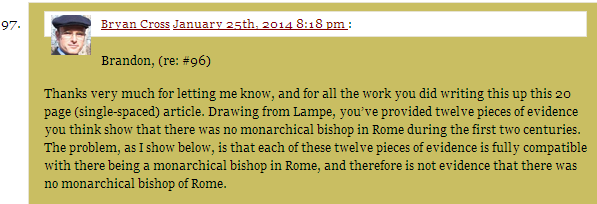
Here’s the problem with John’s claim. All the historical evidence Lampe cites in his book, even when taken together in aggregate, is fully compatible with there being a monarchical bishop in Rome. Twelve times zero is still zero; it isn’t greater than one times zero. Because each of the pieces of evidence Lampe cites (not just the twelve Brandon picked out as the strongest pieces of evidence, but the other things Lampe discusses in his book) is fully compatible with there being a monarchical bishop in Rome, putting them all together does not provide any increase in the likelihood of the truth of Lampe’s conclusion, over the likelihood of its falsity.

In fact, there are several problems.

First of all, Bryan is misconstruing again. Lampe’s evidence doesn’t even address “bishops in Rome” up to a certain point. Lampe’s aim is to draw a picture. In fact, he crafts a vivid account of the churches in the city of Rome, using the positive historical evidence that we do have.

The healing debate


I listened to the White/Brown debate on healing. It's a ramshackle debate. Sometimes White and Brown debate each other, sometimes they debate the moderator, sometimes they field questions from audience.

In general, I thought Brown had the better of the argument, but there are some tensions in his position–which I will get to. 

i) White appeared to come into the debate to dispute a position other than Brown's position. The majority position: it is always God's will to heal.  

That lack of preparation was a weakness in the debate. Apparently, White hadn't studied Brown's position. 

ii) In his opening statement, Brown said the gifts continue to eschaton (1 Cor 13).

The gifts are not reserved for the apostles, but for the common good. The list (1 Cor 12:28) separates the gift of healing from apostles. He later added that in the NT we see non-apostles performing miracles. 

He denied healing on demand. Healing is not automatic. For in that very letter, Paul mentions sick churchgoers at the same time the gifts were flourishing.

iii) In his opening statement, and later on, White argued that over the course of NT church history, we seen the gifts petering out. He compared Acts 3, where some people are healed by Peter's shadow, with the Timothy's chronic illness, and the further fact that Paul didn't (couldn't?) heal Trophimus. He also stressed Paul's incurable "thorn in the flesh." 

White discerns a transitional phase even during NT times. He appealed to the Pastorals, where Paul is writing to the next generation, looking beyond the apostolic period. White noted that in the Pastors, provision is made for windows. But if the charismatic position is correct, why didn't God simply resurrect their late husbands?

White appealed to the evidential value of miraculous healing to divinely accredit the apostles. 

White also said, throughout the debate, that God is free in the exercise of his gift of healing. We can't command the power of God. 

iv) Brown countered that if Book of Acts is trying to show us that the gift of healing was on the wane, why, in last chapter, does it record Paul healing every sick person brought to him on Malta? That's hardly a decrease. 

Brown mentioned the Timothy was gifted through the imposition of hands, as well as guided by prophetic words. So Brown sees the Pastorals as charismatic. 

Brown appealed to categorical promises like Jn 14:12 and Jas 5:14-16. 

He reminded White that there were sick churchgoers in Corinth. So we don't see the gift fading away. Rather, it was never automatic.  You don't push a button and it happens.

And he reminded White that in 1 Cor 12:28, healing is not an apostolic gift.

Brown said resurrections are very rare even in the NT. That's the exception, not the rule. 

In general, I think his pushback was strong. Not only did he counter White's argument, but he already anticipated some of White's objections in his opening statement. Because, apparently, White hadn't boned up on Brown's specific position in advance, White was recycling stock cessationist objections to continuationism which failed to anticipate or target Brown's actual position. 

v) There are other tensions in White's argument. 

a) White's appeal to divine freedom is at odds with his cessationism. For if cessationism is true, then that's a case of divine self-limitation rather than divine freedom. Although God is still free to heal directly, he is no longer free to heal by empowering a second party to heal the sick. 

b) Likewise, the appeal to divine freedom is at odds with White's appeal to a pattern whereby healers or gifts of healing peter out during the course of NT history. For if God retains the freedom to heal or refrain from healing, then it's unpredictable. God is free to gift someone to be a healer at any time and place. 

vi) But there were also tensions in Brown's position. He says we should build our position on revealed promises rather than experience. And he rejects the caveat that we should pray conditional prayers for healing ("If it be your will"). Rather, we should pray with expectant faith. 

Problem is, Brown's prooftexts create an expectation. They are predictive. "Do this, and that will happen." 

There's nothing wrong with judging by experience if they promise a particular experience. 

Conversely, if, when we practice Jas 5, the patient isn't usually healed, then it's wishful thinking to pray for healing with expectant faith. That's a false expectation. And that invites disillusionment when our hopes are dashed. 

So Brown has difficulty finessing his prooftexts with reality. That should cause him to reconsider his interpretation. 

vii) The issue of whether God wills or sends illness cropped up throughout the debate. One question from the audience challenged White's appeal to Paul's thorn in the flesh. This came from Satan rather than God. 

White countered that Satan's intentions can't be the ultimate explanation. Why would Satan do something to Paul to keep him from boasting. He wants to trip him up. 

Behind Satan's agenda is God's ulterior agenda. God is using Satan. Satan is the unwitting instrument. Satan intends to do harm, but God intends to do good. Satan ends up doing God's will, in spite of Satan's malicious intent. God's beneficial intent overrides Satan's malicious intent. And that was in the cards all along. 

viii) On a related note, Brown argued that if God wills sickness, then a prayer for healing runs counter to God's will. 

That's one of the old uncomprehending objections to Calvinism. 

a) To begin will, God wills sickness as a means to an end, not an end it in itself. Not illness for the sake of illness, but to facilitate some second-order good–either for ourselves or another. 

b) We don't know ahead of time if God has willed to answer our prayer. Perhaps our illness has served its divinely-appointed purpose. God predestined our illness, but if he answers our prayer, that's a predestined answer to prayer. So there's no inconsistency here. Indeed, that's one way of discovering God's will. 

Bryan Cross: Is he lazy, dishonest, or not as smart as everyone thinks he is?

Bryan Cross has apparently been caught with his hand in the cookie jar. Looking at his comment in response to Brandon’s review, it appears as if the choices in the headline here are the three choices.

I’ve left the following in response to his comment at the Called to Communion thread where this discussion is going on. He has rejected the following comment (which is identical to what I’ve posted in the comments here):

Bryan, in comment #97, you say:

Drawing from Lampe, you’ve provided twelve pieces of evidence you think show that there was no monarchical bishop in Rome during the first two centuries. The problem, as I show below, is that each of these twelve pieces of evidence is fully compatible with there being a monarchical bishop in Rome, and therefore is not evidence that there was no monarchical bishop of Rome.

[I said]: This is a mischaracterization of Brandon’s entire piece. It is a subtle mischaracterization, though, and it coheres with my claim that it is your method to selectively utilize the tactic of “mental reservation” to make your points for you.

Acts' Authorship

Craig Keener notes that dating the book of Acts to the second century "remains a distinctly minority position" (n. 74 on 395). He argues at length for an earlier dating. Whoever wrote the document seems to have been writing in the first century. Keener writes:

He [the author of Acts] grows more detailed in the Pauline material in Acts and especially the "we" material in Acts 20-28, the most recent material and that on which he appears most fully informed….

Saturday, January 25, 2014

"Heaven is for real"


I'm going to comment on a three evangelical book reviews of an alleged NDE:


Let me say at the outset that I haven't read the book, and I don't intend to. I'm also dubious about the recollections of a 3-4 year old. I'm not a child psychologist, but to my knowledge, kids that age have underdeveloped short-term memories. BTW, it's odd that reviewers disagree on whether he was 3 or 4 at the time. 

In addition, kids that age don't clearly distinguish between reality and make-believe. So I don't consider Colton to be a reliable witness. 

Furthermore, how trustworthy this is depends on the credibility of the parents as well as the boy. 

If I wanted to disprove Colton’s experience on grounds of logic or consistency I might point in a couple of different directions. In the first place, Colton is a toddler who speaks like an adult. His verbatim quotes sound nothing like a 4-year old, and I think I can say this with some authority as the father of a 4-year old (Challies). 
Some of the words that Colton supposedly spoke as a four-year-old seem more like words an adult would speak, but perhaps that’s due to his father’s memories as he tried to reconstruct his son’s words from years earlier (Alcorn).
Of the reviews I've read, that's the most cogent criticism. How much of this account is Colton's, and how much is Todd's reconstruction or embellishment? 
This kind of proof is exactly the kind of proof we should not need and should not want. Blessed are those who do not see and yet believe (Challies).
i) I agree that we shouldn't use NDEs as proof. That doesn't mean they can't furnish evidence. 
ii) Moreover, it's not necessarily a question of wanting it. Given the prevalence of reported NDEs, it's a question of evaluating this phenomenon one way or the other. 

I’ve already given you the broad outline. Colton dies (or something close to it) and visits heaven for an unknown period of time. He returns to his body and over the months and years that follow tells his parents about his time in heaven. He tells about spending time with Jesus, about meeting the sister he never knew he had, about fluttering around with wings, about the pearly gates, and on and on (Challies). 
Heaven is for Real is written by an evangelical pastor, Todd Burpo, and tells of his then four-year-old son Colton, who survived emergency surgery and later told his family that he went to Heaven. Colton described seeing Jesus and meeting his miscarried sister and his great-grandfather, who died before he was born (Alcorn).
It's odd how Alcorn and Challies gloss over these details. Yet if this is accurate, then it would be classic evidence of a veridical NDE and/or OBE. Information Colton could only acquire if he crossed over. Do Alcorn and Challies not understand the criteria for assessing veridical NEDs and OBEs? 
Many supporters of the book claim that any and all objections pale in the face of the supernatural knowledge that Colton reveals--things that were humanly impossible for him to know. For example, he said that he had met his other sister in Heaven. When told by his mother that Cassie was his only sister, his shocking response was, "No....I have two sisters. You had a baby die in your tummy, didn't you?" (p. 94). Colton had never been told of the "painful episode" of the miscarriage, and his parents never knew the gender of the fetus. Colton added, "In heaven, this little girl ran up to me, and she wouldn't stop hugging me....She said she just can't wait for you and Daddy to get to heaven" (Berean). 
That experience took place when three-year-old Colton was undergoing emergency surgery for a ruptured appendix. Not too long afterward, he told his parents that he saw them praying for him outside the operating room. When they asked how he knew what they had been doing he said, "Cause I could see you....I went up out of my body and I was looking down and I could see the doctor working on my body. [Scripture tells us that death takes place when the spirit vacates the body. Yet there was no medical report of a clinical death during Colton's surgery.] And I saw you and Mommy. You were in a little room by yourself, praying; and Mommy was in a different room, and she was praying and talking on the phone" (Berean).
This misses the point. Suppose his clinical death wasn't medically confirmed. Yet he was in the O.R. at the time. So how could he be aware of what was happening outside the O.R.? For that matter, he couldn't even see what was happening in the O.R. He was unconscious at the time. 
So assuming this is accurate, it's either a case of clairvoyance or an OBE. 
What we do know about that and other types of drug-induced conditions of mind (even dream states, meditation, and an overworked imagination) is that multitudes of people have reported experiences that seem to validate everything from clinical or near-death events to past-lives journeys to abductions on UFOs. They also reveal information for which they had no basis of knowledge prior to their experiences. It may be that an altered state of consciousness creates a condition in which the mind is like a blank screen, open to outside input. Spirit entities, whose goal it is to undermine the Word of God and deceive the world, might have that ability to program the blank screen and could therefore take advantage of anyone in such a highly susceptible condition (see Dave Hunt, Occult Invasion , pp. 187-90). But again, no one knows for sure how such things take place (Berean).
This assumes a demon knew about his late sister, and grandfather, as well as where his parents were, and what they were doing, during surgery.  
Now, what do I do with a book like this one? It seems to me that there are only a couple of options available to me. I can accept it, agreeing that this little boy is legitimate—he went to heaven and is now telling the tale for our edification. Or I can reject what this boy is saying—he did not go to heaven and this book is fictitious. If I go with this second option (which is exactly what I am doing) I now have two choices before me: either the boy (and/or his parents) is a liar or he genuinely believes he experienced something that he did not actually experience (Challies).
i) Even if the boy is mistaken, that doesn't make him a liar. As I said before, I think kids that age naturally blur reality and make-believe.  
ii) Now we do have to make allowance for the possibility that his parents are hucksters who wrote the book to make money. At the same time, they didn't know ahead of time that this would be a best-seller. So we're judging that in retrospect. 
More seriously, I was concerned about Colton’s claim that people in Heaven have wings (he says he too had wings while there), and other details that fit popular lore about Heaven, but don’t fit Scripture. In the Bible, some angels are portrayed as having wings, most are not. But never is any human being in Heaven or anywhere else said to have wings. Some beings in Heaven, according to Colton, have halos. But that’s not in the Bible. It’s from popular art in the Greek and Roman era and more recently in the Christian art of the Middle Ages. And of course we see it in our popular culture depictions of heaven, including cartoons.These things suggested to me that perhaps this child has seen and heard things about Heaven that worked their way into his imagining Heaven, as opposed to coming from an actual experience in Heaven (Alcorn).
I think that's pedantic, as well as naive.
i) To begin with, the Bible records visions of heaven. Yet the imagery is cultural accommodated. So, in principle, God could accommodate a child's understanding. The child could experience heaven in terms comprehensible to a child. An age-appropriate heaven. 
ii) In addition, Alcorn seems to be assuming that heaven has objective features. But the intermediate state is a disembodied state. So it's more like a collective dream or VR program. Simulated sensory input. 
iii) The artistic device of "halos" represents the underlying fact that heavenly beings are luminous. There are many examples in Scripture. 
First, the Bible gives us no indication whatsoever that God will work in this way and that he will call one of us to heaven and then cause us to return. It is for man to die once and then the resurrection (Challies). 
Does Challies deny that clinically dead patients are sometimes resuscitated? What happens to their consciousness during the interval between clinical death and resuscitation? Unless Challies is an annihilationist, he doesn't think the soul ceases to exist.   
The only biblical example we have of a man being caught up to heaven is Paul and it’s very interesting that he was forbidden to tell anything about it. And the reason he even mentioned this experience was not to offer encouragement that heaven exists, but to serve as a part of his “gospel boasting.” He saw heaven and was told to say nothing about it. This was a unique experience in a unique time and for a unique reason (Challies).
That's very selective. The Bible records several informative visions of heaven. 
So what's the bottom line?
i) Assuming that Colton had a veridical experience, I think the most plausible interpretation is that his account combines elements of recollection and imagination. 
ii) And, of course, this isn't coming straight for Colton. This is filtered through his dad's editorial voice. So there's the question of how much his dad filled in the gaps with creative interpolations. 
iii) How seriously we take this account depends, not only on Colton's reliability, but his parents. 
In sum, I think this account is too iffy to put much stock in it. At the same time, I think it exposes a lack of sophistication on the part of evangelical reviewers. They have a rigid, compartmentalized outlook that fails to ask the right questions or draw necessary distinctions. 

Founding the church


20 built on the foundation of the apostles and prophets, Christ Jesus himself being the cornerstone, 21 in whom the whole structure, being joined together, grows into a holy temple in the Lord (Eph 2:20-21). 
11 And he gave the apostles, the prophets, the evangelists, the shepherds and teachers (4:11).
Eph 2:20 is a favorite prooftext for cessationism. But I'll note two problems with that inference:
i) If we equate the foundation with the apostolate, and if we say the apostolate was temporary, then the foundation was temporary. But if the foundation is temporary, the superstructure is temporary. The superstructure rests on the foundation. Remove the foundation and the upper stories collapse. So either cessationists are overworking the metaphor or they are mistaken to equate the foundation with the apostolate.
One solution is to equate the foundation, not with the apostolate, but with apostolic doctrine. Apostles were temporary, but their teaching is permanent. 
ii) During the construction phase, you lay the foundation before you build the superstructure. What is under is earlier. Since the upper stories rest on the foundation, the foundation is the first thing to put in place.
If we press the metaphor, that would mean the apostles antedate evangelists, pastors, and NT teachers. But even if that's true of the Twelve, that's not true of the apostolate generally. For instance, Paul was an apostle, but by the time God commissioned Paul, the church was up and running. There were elders and evangelists who antedate Paul's apostleshipTherefore, Eph 2:20 isn't strictly chronological. 

Acts' Historicity

Craig Keener writes:

Just as later apocryphal gospels diverge further from Palestinian and Semitic traits in the early strata of the Jesus tradition, so these apocryphal acts [of the second century and later] often diverge much further from the undisputed epistles' portrait of Paul than Luke's Acts does….

Luke abridges, rather than expands, the adventures and signs available to him; cf. 2 Cor 11:23-12:9; 12:12; Rom 15:19…

Friday, January 24, 2014

Choices


I’ve read that she sang Gershwin songs for American officers, after the war. “Yes,” she says, “and I stole everything possible to eat. Because, you know, after the war, we had nothing to eat. We had nothing. One egg a year. Can you imagine, one egg a year? And we could have 68 grams of butter a month.” (About two and a half ounces.) 
“I went into the officers clubs, and they had everything. They would make a big loaf of bread or something, and whatever was not eaten, they threw away. And we had not the right to take it. Ja. It was not fraternité, not at all. Whatever I could steal, I did. 
“Once, there was a brown paste. It was something to eat, so I took it.” It turned out to be peanut butter. “We had never heard of it.” I ask, “Do you like peanut butter?” “I don’t eat it, but yes: I like peanut butter with crunches in it. Fattening, though.” 
I say, “After the war [with all the privations she has described], the rest of your life must have seemed easy. The hard part was at the beginning; all the rest was easier.” 
“I didn’t feel it so,” she responds. “No, when you have nothing, you have your will. All you can think about is overcoming. Overcoming obstacles. You just go forward. You don’t think, you just do it. You have no choice. Then, afterward, you have choices — and that is difficult.” 
http://www.nationalreview.com/node/369194/print

What are universities for?

"What are universities for?" by Nigel Biggar.

Problems With A Conspiracy View Of The Resurrection

In another thread, Thomas Keningley wrote:

On a tangential note, Jason, can you point me to any resources, from you or elsewhere, arguing against "Conspiracy theory" used as an alternative to the resurrection to explain the apostolic preaching, i.e. the disciples conspired with other [supposed, on this theory] eyewitnesses to cook up the resurrection which they then preached from Pentecost?

Here's my response:

An Extended Review of Peter Lampe’s “From Paul to Valentinus: Christians at Rome in the First Two Centuries”

From Paul to Valentinus: Christians at Rome in the First Two Centuries
From Paul to Valentinus: Christians at Rome
 in the First Two Centuries
Brandon Addison has posted an Extended Review of Peter Lampe’s “From Paul to Valentinus” at https://reformation500.wordpress.com/. This is something that I myself have wanted to do for a long time, but have never had the time to do it.

The papacy is critical to Roman Catholic sensibilities about itself. Now with the doctrine of “papal infallibility”, it is a cornerstone of Roman Catholic epistemology – you’ll hear some apologists saying things like “because of the papacy (and papal authority), we have the ability to know with certainty what’s really ‘divine revelation’ and what’s merely ‘human opinion’.”

Growing up as a Roman Catholic, I was certain that the papacy had been a strong, firm, well-defined institution from the days of Peter – when he founded the church at Rome and was the first bishop there – his bishoprick extending for 25 years. Then there was a grand and glorious history of popes down through the next 2000 years.

In holding to the doctrine of the papacy (and it is a doctrine of the Roman Catholic church – and remember, doctrines can never change), Roman Catholics have intertwined this doctrine tightly with the history behind it. In fact, with reference to the papacy, history is so intertwined with dogma that it is referred to by theologians as a “dogmatic fact”.

This has been defined by an eminent Catholic theologian as “historical fact so intimately connected with some great Catholic truths that it would be believed even if time and accident had destroyed all of the original evidence therefor” (Shotwell and Loomis, in the 1927 introduction to their work “The See of Peter” (New York, NY: Columbia University Press, ©1927, 1955, 1991), pgs xxiii–xxiv).

Shotwell and Loomis were among the first researchers of the 20th century to explore the history of the papacy in depth, but they weren’t the last. Others explored the history and theology of that period, and exploded the notion that Peter was at Rome for 25 years – if at all. Oscar Cullman’s 1953 work “Peter: Disciple, Apostle, Martyr” applied historical and exegetical methodologies to the New Testament (and post-NT writings) about Peter and concluded that yes, while Peter was important, there was no such thing as “apostolic succession”. Cullman was a Lutheran and a very ecumenically-minded one at that. He was one of the Protestant observers at Vatican II. Karl Barth joked with him that his tombstone would carry the inscription “advisor to three popes.”

But Lampe has provided the crowning achievement on a century’s-worth of work on the earliest papacy. Relying on a methodology that seemingly scrutinizes every scrap of paper from that period (Rome in the first two centuries), every grave and cemetery, every inscription, every archaeological find, Lampe provides a clear and compelling picture of what it was like to be a Christian in Rome during those centuries.

And while being totally non-polemical throughout the whole project, Lampe’s work gives us a keen insight into Rome in the first two centuries that almost totally excludes the notion that there was a pope, or a “successor to Peter”, or in fact, that there was even a single bishop in charge in the city during those first two centuries.

Acts' Genre

Craig Keener writes:

I will finally conclude, in agreement with the majority of scholars, that Acts fits the ancient genre of history…

Even if Luke provides narrative structure where his sources are incomplete (as probably in the Gospel), such detailed correspondence with extrinsic sources at such numerous points (see ch. 7 below) is virtually unheard of in novels….

Milankovitch cycles


For the sake of argument, let's suppose macroevolution is true. Let's also suppose various parts of the world are fairly stable over time.

On those assumptions, the fossil record embedded in the geological column of a given region would be vertical snapshot of how local species evolved. Something approximating a control group. Based on the law of superposition, species lower down would be more primitive while species higher up would be more advanced. 

Now let's introduce Milankovitch cycles. Orbital eccentricity, axial precession, and axial tilt are cyclical variations which combine to affect the distance and position of the earth in relation to the sun. Solar variation is another factor. 

In theory, these cycles effect climate change. Because they are mutually independent, and have different durations, they intersect in complex ways.  

Assuming this is roughly correct, I assume it will affect biogeography and even biodiversity. Fauna and flora are sensitive to climate. If a wetter region becomes dryer, or vice versa, if a warmer region becomes cooler, and vice versa, that will impact local fauna and flora. 

Some species may adapt to new conditions. Some species may migrate out of the affected area while other species may migrate into the affected area. Some species may become extinct because they can't adapt and lack the mobility go migrate, or because natural barriers impede migration. 

Although we think of migration in terms of fauna rather than flora, since plants immobile, seeds are widely dispersible by various natural mechanisms. So it's possible for exotic flora to be transported to a new region. 

But consider how these factors would affect the fossil record. You'd no longer have a continuous record of species from the same area. Rather, that would be disrupted by preexisting and coexisting exotic species migrating into the area, to supplant previous occupants, which either migrated out of the area or went extinct. 

This, in turn, complicates the inference that the geological column charts the continuous evolution of local species. For the sequence no longer represents the history of a stable control group. Rather than a clean diachronic progression, you have synchronous species from different regions that relocate. It's horizontal as well as vertical. Change in place as well as time. 

Is a species higher up evolved from a species lower down? Or is this an exotic species which, due to climate change, migrated to a more hospital environment? A preexisting species that coexisted with species further down? 

I'm not qualified to assess these variables. But it's something I consider when Darwinians confidently appeal to the fossil record.