Preterist and postmillennialist Jeff Durbin has recently put out a spate of material and videos on eschatology. The problem with them is they are incredibly shallow, clichéd, and dismissive of futurist interpretation. They may work for his listeners but not thinking people.
I was actually disappointed because I like some of the other material he has put out on abortion and such. I recently challenged him to debate ex-preterist, now-futurist Dr. Brock Hollett, who was willing to debate. Pastor Durbin cited his health and declined the debate. Fine, but he did not show any willingness to debate once his health cleared up. The invitation remains open. Nevertheless.
I found his argumentation against premillennialism and futurism to be really, really bad (he and Gary DeMar are stuck in the 1970s and 80s on pop-pretrib literature and show zero familiarity with scholarly or even semi-scholarly futurist literature).
I wanted to at least respond to him so his listeners and readers can hear the other side—surely he will encourage this. We shall see.
So to begin, I have chosen to start with his mishandling of Jesus's "left behind" passage in Matthew 24. Recently in an in-studio interview with DeMar, he gave a cursory and flawed reason why he thinks it is the righteous who are left and the wicked taken rather than the other way around. So I will juxtapose his reasoning (the righteous are left behind) with my reasons for my interpretation (the righteous are taken).
I trust this will be an instructive exercise why Durbin should not be dismissive of the futurist interpertation. The following link is to my response to Durbin on the left behind passage.
https://www.alankurschner.com/2019/09/05/a-reply-to-jeff-durbins-mishandling-the-left-behind-passage/

Showing posts with label prewrath. Show all posts
Showing posts with label prewrath. Show all posts
Thursday, September 05, 2019


Monday, September 10, 2018
Is the millennium timeless?
Here's an interesting post by Alan Kurschner:
Premillennialists and amillennialists agree with each other that the thousand years reference denotes a temporal period, that is, a historical period. What we disagree on is when it will begin. Amillennialists think it started at Christ’s first coming, so they view it as interadvental, that is, between Jesus’s first and second coming. Premillennialists on the other hand think the millennial period will begin in the future at Christ’s second coming, so they view it as postadvental.
i) There are amils who identify the millennium with the intermediate state. The logic of that position means the millennium antedates the first advent of Christ. If the millennium is conterminous with the intermediate state, then that goes all the way back to the antediluvians. Abel would be the first person to enter the millennium. The first saint to die and thereby pass into the intermediate state.
ii) It might be argued that while the millennium/intermediate state isn't chronologically coordinated with the first advent of Christ, it's teleologically coordinated inasmuch as the merit of Christ retroactively saved OT saints.
But I want to address another view on the millennium. There are some interpreters who think that the thousand years reference does not denote a period of time at all, so they would hold to a non-temporal construal of the thousand years reference. Typically they would read an exclusively symbolic meaning of the expression, for example, referring to the victory and vindication of the saints. So for these interpreters they would see the fulfillment of the millennium occurring not in the course of a period of extended time, but only thematically, at the second coming of Jesus.One of their key arguments against a temporal interpretation of the millennium (pre-, post-, and amillennial) is to point out that numbers in the book of Revelation are symbolic, that is, we should not take them literally (e.g. 144,000). I would argue against this because there are clear examples that this is not the case (e.g. John wrote to seven literal churches), so we should not make sweeping blanket statements when it comes to numbers in the book of Revelation, which seems to be the case with many interpreters. Leaving aside this point, I want to reply to this objection by making a different point.
i) That argument either proves too little or too much. For instance, Preterists identify Babylon as Rome since any 1C Mediterranean reader would recognize Rome as the city of seven hills (Rev 17:9). Yet Alan is a futurist.
ii) Even in a scheme where the numerology is purely symbolic, odds are that every so often a symbolic number will coincidentally match a literal counterpart. That's statistically inevitable since there will always be 2 of something, 3 of something, 12 of something, &c. For instance, Rome isn't the only city with seven hills.
iii) Although there may have been seven literal churches in Asia Minor at the time of writing, were there only seven churches? Even in the same city you might have more the one house-church. So how do we count them?
Was each letter sent individually to each church? Or were the letters bundled with the rest of Revelation and distributed to all the churches within John's purview? Every church which had a copy of the Apocalypse heard all seven letters read aloud. Is that just seven churches? The seven letters appear to be integrated with the Apocalypse as a whole, so it seems unlikely that they ever circulated separately.
iv) As one commentator notes:
Next is the flow of time within the visionary world…But in the visionary world this "short" period extends from Christ's first coming until his final return. Visionary time does not correspond to chronological time in the readers' world. Revelation was written decades after the death of Jesus, yet the entire period of the church's conflict with evil fits within the three and a half years of visionary time (11:2-3). C. Koester, Revelation (Yale 2014), 120-21.
Back to Alan:
In the book of Revelation, when it comes to these non-temporal interpreters, they will agree that—not all numbers—but the particular numbers which designate temporal periods do in fact refer to historical periods of time. For example, designations such as “ten days” [2:10], “short time” [12:7–10], “three and one-half years, 42 months or 1290 days” [11:2, 3; 12:6, 14; 13:5] are typically interpreted as symbolic by virtually all of these interpreters, but, they also would view them as indicating historical periods of time, not necessarily the literal designation, but nevertheless, a period of time (e.g. “42 months” is symbolic of the church age, they will claim; yet the church age by definition denotes a historical period of time).My question then is why would all these other references to temporal designations in the Apocalypse refer to actual temporal, historical periods (and also possessing symbolic meaning), but the reference to the thousand years is singled out as a non-temporal period? Just like all the other temporal designations, why can’t the thousand year reference also denote both a symbolic meaning and a temporal meaning? This does not require the interpreter to think that it refers to a literal thousand year period (though I do not think there is reason to think it does not refer to a literal thousand years), but at least it could indicate an undetermined period of time.
i) A radical position might classify Revelation as literature, like Perelandra. Or like a movie. In a novel or movie, the flow of time is subdivided into a series of episodes. There's what the periods represent in plot terms. But they don't represent anything outside the fictional world of the movie or novel.
That's not my own interpretation. I simply mention it to draw attention to a potential objection.
ii) One issue is the need to distinguish visionary time from real time. Revelation is like an extended symbolic dream. The dream is episodic. The question is what those correspond to in real life.
iii) As timebound creatures we necessarily experience reality in temporal intervals. The real question is not whether the millennium is temporal, but whether the episodes in Revelation chart a unilinear sequence of unrepeatable events. Does real history (past, present, future) run along a parallel track?
An alternative interpretation is to construe some of these episodes as stereotypical kinds of ordeals which Christians at different times and places may experience. If, say, the millennium represents the intermediate state of the saints, then believers enter the millennium at different times because they die at different times throughout the course of human history.
Saturday, July 28, 2018
Who Is Left Behind? The Wicked or the Righteous?
I am not pretribulational, but I believe those who are left behind in Matt 24 are the wicked and those taken are the righteous.
Sometimes I get the sense that people want to believe that those who are taken are the wicked for judgment because they don't want to share the same view with the Left Behind movie on this point. There is another reason why interpreters have wrongly thought that those who are left are the righteous.
I am posting a video where I was recently interviewed on this topic. I don't intend to start an eschatology debate. My intention here is to bring to light some evidence that is practically ignored in the literature, both scholarly and popular. My point in this interview is to explain that the separation that occurs at the parousia depicted in Matt 24:31 is ignored in every discussion when this topic is broached.
I also bring to light some meanings of Greek words and correcting a certain bad rendering in many English translations.
Listen to the entire interview before drive-by commenting!
Sometimes I get the sense that people want to believe that those who are taken are the wicked for judgment because they don't want to share the same view with the Left Behind movie on this point. There is another reason why interpreters have wrongly thought that those who are left are the righteous.
I am posting a video where I was recently interviewed on this topic. I don't intend to start an eschatology debate. My intention here is to bring to light some evidence that is practically ignored in the literature, both scholarly and popular. My point in this interview is to explain that the separation that occurs at the parousia depicted in Matt 24:31 is ignored in every discussion when this topic is broached.
“And he will send his angels with a loud trumpet blast, and they will gather his elect from the four winds, from one end of heaven to the other.” (Matt 24:31)And yet, it is the most important point, because the illustrations of those taken and left behind are relating back to the parousia event. It is the whole point of invoking the illustrations, similitudes, and parables in the first place. In addressing this topic, so many interpreters begin by first going outside Matt 24, rather than first starting with the immediate context.
I also bring to light some meanings of Greek words and correcting a certain bad rendering in many English translations.
Listen to the entire interview before drive-by commenting!
Thursday, June 04, 2015
10 Reasons Why the Amillennial Concurrent-Recapitulation Framework of the Book of Revelation Does NOT Work
 http://www.alankurschner.com/37
In part 2, I gave about 10 reasons against the concurrent-recapitulatory interpretation of the book of Revelation while arguing for the consecutive-progressive framework.
Seals, Trumpets, Bowls – At the Same Time or One After the Other?
Consecutive-Progressive
The prewrath position interprets a sequential chronological framework for the seals, trumpets, and bowls. That is, the seal-trumpet-bowl septets (sets of seven) will happen in a consecutive-progressive fashion with each septet consecutively following each other. For example, the trumpet septet cannot begin until the seventh seal is opened; and the bowl septet cannot begin before the seventh trumpet is blown. The last judgment element of the day of the Lord’s wrath will be the seventh bowl. Accordingly, the seventh seal and the seventh trumpet serve as transitions to the next set of God’s climaxing judgments, culminating with the seventh bowl.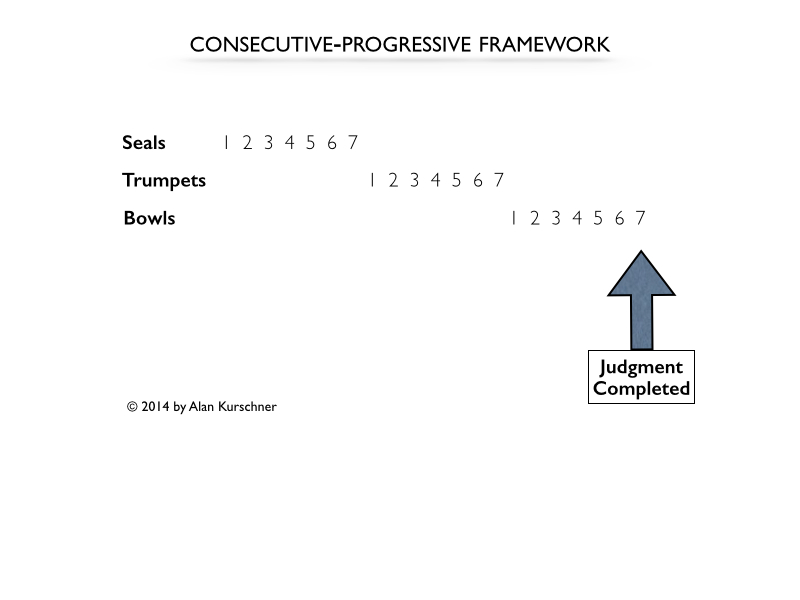
Concurrent-Recapitulation
Posttribulationists (and Amillennialists) subscribe instead to a concurrent-recapitulation framework with the septets occurring at the same time with the judgment elements giving different emphases or perspectives. For example, it is said that the sixth seal, sixth trumpet, and six bowl describe the same event from a different angle. Accordingly, the last element in the day of the Lord’s wrath describes the seventh of each septet; thus, the seventh seal, seventh trumpet, and seventh bowl is the same event from different perspectives. And there are those posttribulationists who hold that it does not describe the exact same event, but they affirm that the three elements occur roughly at the same time. For all practically purposes, the main point is that both of these posttrib interpretations do not view the trumpets and bowls occurring after the seventh seal is opened.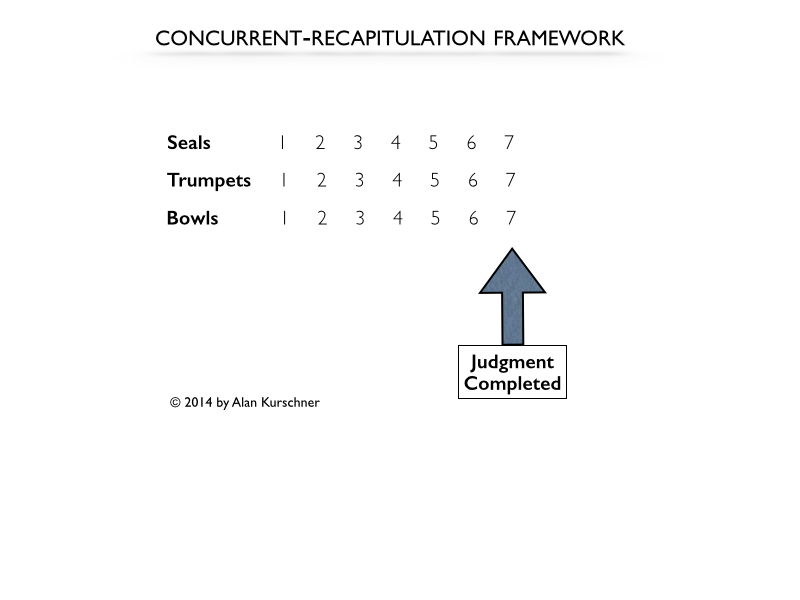
I should note that this debate does not hinge on whether each judgment element within the septets succeed each other; that is not the issue. The main question is: does each of the three septets themselves succeed each other (consecutive) or do they simultaneously unfold (concurrent)? My aim is to demonstrate that the concurrent view is flawed. I will also argue for the consecutive nature to the three septets, showing that the seventh seal does not depict the culmination but the introduction to the day of the Lord via the seven trumpets and culminating in the seven bowls. The following reasons are now given against this concurrent-recapitulatory framework of the septets, while at the same time, I will show the consecutive-progressive structure is the most natural interpretation.
The Seventh Seal Prepares for the Trumpets
"Now when the Lamb opened the seventh seal there was silence in heaven for about half an hour. Then I saw the seven angels who stand before God, and seven trumpets were given to them." (Rev 8:1–2 emphasis mine) In this passage, there is an explicit cause and effect action between the opening of the seventh seal and the introduction to the seven trumpets. It is difficult how any interpreter can read the trumpets happening before the seventh seal is opened. It is a clear contradiction according to Revelation 8:1–2. The opening of the seventh seal prepares for the trumpets. In addition, when the seventh seal is opened, there is a moment of silence functioning to contrast with the ensuing booming sounds: “Then the angel took the censer, filled it with fire from the altar, and threw it on the earth, and there were crashes of thunder, roaring, flashes of lightning, and an earthquake” (Rev 8:5). Jauhiainen makes an excellent point regarding the silence:The recapitulation theory would be more convincing if the sixth seal were silence and the seventh the ‘end’, and not vice versa, as John has them. Beale (Revelation, 125, 446–54) attempts to address this problem by claiming that it is ‘clear from repeated references to silence in the OT and Jewish apocalyptic writings’ that silence is ‘a figurative expression of judgment’ (125). He is correct in seeking a link between silence and judgment in the primary OT background texts he adduces, Hab 2:20, Zeph 1:7 and Zech 2:13. However, the contexts of these references to silence suggest that silence is not ‘an expression of judgment’ but rather something that precedes judgments and/or the Day of the Lord. Thus in Zephaniah the reason for silence is given in the same verse: ‘for the day of the Lord is near.’Therefore, the opening of the seventh seal is the last condition for the scroll to be opened, encompassing the ensuing trumpet judgments (cf. Rev 8:1–6).
The Septets Increase in Intensity and Scope
The narrative of the seals, trumpets, and bowls conspicuously intensify. The seals exhibit “natural” events: wars, famine, plague, and bloodshed; while the trumpets and bowls exhibit “supernatural” events such as hideous demonic creatures torturing the wicked, massive divine devastation on the earth, etc. Further, the scope of activity progressively intensifies; for example, the fourth seal mentions a quarter of the earth, the trumpets a third of the earth, and the bowls affect the whole earth. In addition, the seals encompass believers and unbelievers, with the trumpets targeting specifically the ungodly. And while the bowls are also directed to the ungodly, its focus is on the beast’s kingdom and his subjects (e.g., bowls 1, 3, 5, 6). These factors demonstrate the septets do not recapitulate the same events; instead, they exhibit three separate consecutive series of judgments: the seals function as precursors to the day of the Lord’s wrath, the trumpets initiate his wrath, and the bowls execute the completion of his wrath.Confirmation from Jesus
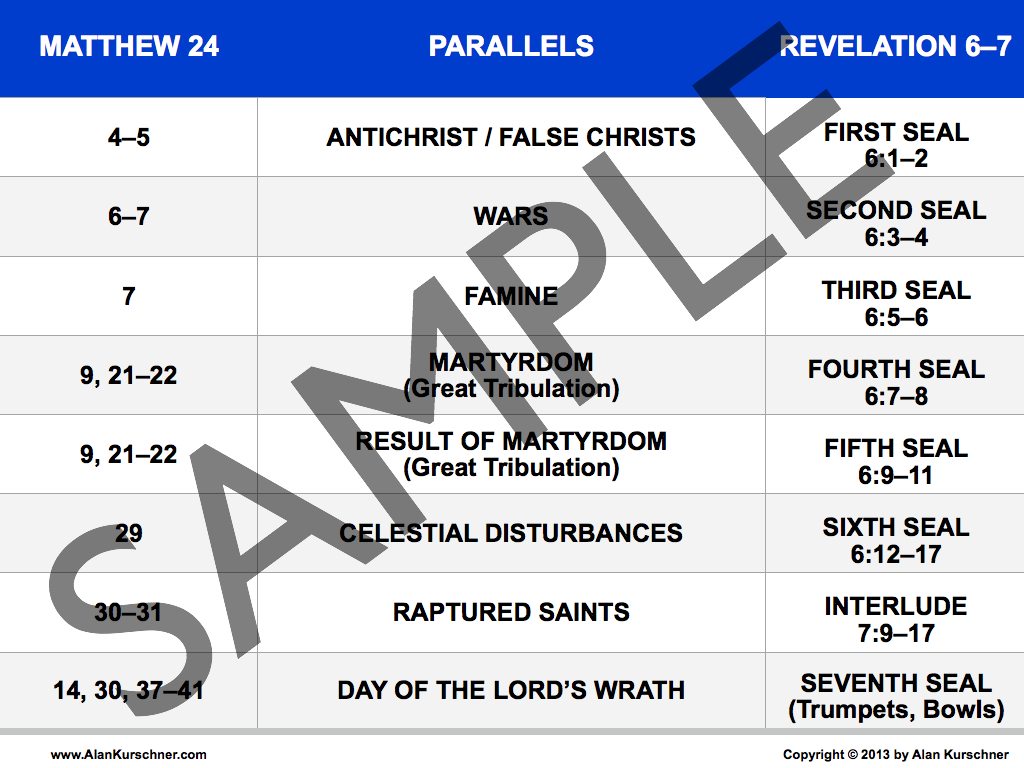
Jesus’ teaching on the beginning of birth pangs, great tribulation, the celestial sign, and the gathering of the elect corresponds with the seven seals (see this chart). Jesus warned not to confuse the end with the beginning of birth pangs. He taught the great tribulation will happen before his return signaled by the celestial disturbance. This supports that the seals should be distinguished from the wrath in the trumpets and bowls.The Fifth-Seal Martyrs
The fifth-seal martyrs cry out to God for justice and implore him to avenge their blood: “How long, Sovereign Master, holy and true, before you judge those who live on the earth and avenge our blood?” (Rev 6:10). This clearly shows the day of the Lord’s wrath has not begun; thus to place any trumpet or bowl judgments before the fifth seal is contradictory. In addition, the prayers of the martyrs are about to be answered after the seventh seal is opened through the trumpet judgments (Rev 8:1–4), connecting it back to their supplications in the fifth seal.The Sixth-Seal Celestial Event
The sixth seal signals the impending wrath of God, not the culmination of it. Joel’s parallel passage reads, “I will produce portents both in the sky and on the earth—blood, fire, and columns of smoke. The sunlight will be turned to darkness and the moon to the color of blood, before the day of the LORD comes—that great and terrible day!” (Joel 2:30–31). This celestial disturbance causes the ungodly in the sixth seal to flee to the caves because they recognize the impending wrath of God (Rev 6:15–17). Luke also narrates the wrath of God ensuing the celestial event (Luke 21:25–36; cf. Matt 24:29–30). Therefore, it is mistaken to place any trumpet or bowl judgments before the sixth seal.Destruction of the Earth Happens After—Not Before—the Seventh Seal
In Revelation 7 there is an interlude portraying two groups being delivered-protected, one on earth and the other in heaven. The group on earth are seen to be 144,000 Jews. A seal is given on their foreheads as protection from the coming wrath: “Do not damage the earth or the sea or the trees until we have put a seal on the foreheads of the servants of our God” (Rev 7:3). This verse should put to rest any doubt the trumpets and bowls happen before the seventh seal. Notice the earth, sea, and trees are not destroyed up to this point before the seventh seal is opened. It is only when the seventh seal is opened the first two trumpet judgments begin to destroy the earth, sea, and trees: The first angel blew his trumpet, and there was hail and fire mixed with blood, and it was thrown at the earth so that a third of the earth was burned up, a third of the trees were burned up, and all the green grass was burned up. Then the second angel blew his trumpet, and something like a great mountain of burning fire was thrown into the sea. A third of the sea became blood, and a third of the creatures living in the sea died, and a third of the ships were completely destroyed. (Rev 8:7–9) It is a contradiction to claim otherwise. Moreover, the fifth trumpet describes demonic-locust creatures being commanded, “not to damage the grass of the earth, or any green plant or tree, but only those people who did not have the seal of God on their forehead” (Rev 9:4). This trumpet judgment has in view the protective seal on their forehead; thus, it is a contradiction to place the fifth trumpet before the seventh seal! (Rev 7:3).Woe! Woe! Woe!
The last three trumpets are identified ominously as three woes (ouai): “Then I looked, and I heard an eagle flying directly overhead, proclaiming with a loud voice, “Woe! Woe! Woe to those who live on the earth because of the remaining sounds of the trumpets of the three angels who are about to blow them!” (Rev 8:13). The three woes convey the finality and intensity of God’s wrath, along with the devastating painful effects upon the ungodly. The temporal language in Revelation 9:12 also shows past action (“The first woe has passed”) and future action (“but two woes are still coming after these things”). This demonstrates two things: (1) the trumpet judgments follow a sequence, and (2) they show uniqueness distinguishing them from the seals and the bowl judgments. Thus, the trumpet judgments are not the seals and bowls “expressed from different perspectives.”Incompatible Depictions
The concurrent theory points out similarities between the septets, especially the trumpet and bowl septets. For example, it is argued, since the fourth trumpet and the fourth bowl relates to the sun, they must refer to the same event, or at least occur at the same time. But a closer look shows they are divergent elements. In the fourth trumpet, the sun is partially darkened; in contrast, the fourth bowl depicts heat scorching the ungodly (Rev 8:12; 16:8–9).Theophanic Lightning, Thunder, Earthquake
The climactic theophanic judgment in the seventh bowl reads: “Then there were flashes of lightning, roaring, and crashes of thunder, and there was a tremendous earthquake—an earthquake unequaled since humanity has been on the earth, so tremendous was that earthquake.” (Rev 16:18) There are two other similar theophanic statements in Revelation 8:5 and 11:19 (three if you count Revelation 4:5). Concurrent interpreters argue that these instances represent the same event because of their similarity. But similarity does not equal identity. A closer reading shows in each instance the theophanic depiction intensifies and anticipates Revelation 16:18, which is the most intense theophany of them all, the consummation of God’s judgment. It is also not clear how a recapitulation could be valid with Revelation 4:5 portraying the throne room happening before any seals are opened! All of this leads Jauhiainen to comment:Granted that 8:5 and 11:19 anticipate 16:18–21, this intensification would seem to indicate that the consummation of temporal judgments is approaching, and not that it has already been reached in 8:1 and then recapitulated twice. Thus, in 8:5 the formula heralds the coming of God in judgment, symbolized by the trumpets.[…] and 11:19 looks forward to the pouring out of the bowls. The last bowl in 16:18–21 completes the judgments, together with an emphasis on the uniqueness of the final earthquake and with the voice from the throne saying, ‘It is done!’
God’s Wrath is Finished
Revelation 15:1 reads: “Then I saw another sign in heaven, great and amazing, seven angels with seven plagues, which are the last, for with them the wrath of God is finished” (ESV). This verse contains a sequence of God’s wrath, which says the seven plagues (bowls) are “last” (eschatos). This strongly implies the trumpet septet precedes the bowls because “with them the wrath of God is finished (teleō).” In other words, the bowl judgments will fulfill God’s final purpose in the day of the Lord. Thus, it is unnatural to interpret the bowl septet happening at the same time as the trumpet septet. The natural reading, instead, conveys the bowls following the trumpets.The Imagery of the “Bowl”
The trumpet judgments require a substantive time to unfold; for example, the fifth trumpet lasts five months. In contrast, the nature and purpose of the bowl judgments occur rapidly. The New Testament mentions at least fifteen different vessels, jars, bowls, baskets, and other containers in antiquity. In our instance, the term for “bowl” is phialē, meaning a “broad, shallow bowl.” This choice of imagery of “broad and shallow” is not arbitrary since is connotes a swift judgment, for the pouring out of God’s final wrath will happen quickly. This imagery also evokes a salvo of bowls being emptied like a grand finale to a fireworks display, in contradistinction to the imagery of the trumpet judgments.Conclusion
The collective reasons above establish that the book of Revelation intends a consecutive-progressive framework. The concurrent-recapitulatory theory fails because it forces the trumpets and bowls to unfold before the seventh seal is opened. The opening of the seventh seal does not culminate the day of the Lord's wrath—it initiates it. The posttrib presupposition that the second coming begins in Revelation 19 with Christ in the sky with his armies causes a strain in the natural reading of Scripture; in this case, collapsing together the seals, trumpets, and bowls to make the resurrection event in Revelation 7 happen in association with the Armageddon event in Revelation 19. Further, it is a contradiction, as argued above, to place God's wrath before the seventh seal is opened, as well as before the resurrection in Revelation 7. Prewrath takes the event of Christ in the sky with his heavenly armies preparing for the battle of Armageddon as one of the last judgment events after the trumpet and bowl judgments. The parousia does not begin with Armageddon; it begins between the sixth seal and the seventh seal, when God's people receive their resurrected bodies and enter the Father's presence as portrayed in Revelation 7.Links mentioned:
www.alankurschner.com/2015/05/28/seals-trumpets-bowls-in-the-book-of-revelation-concurrent-recapitulation-or-consecutive-progressive-part-1-of-2-ep-36/
www.alankurschner.com/wp-content/uploads/2013/06/Prewrath-Charts.003.jpg
Monday, October 20, 2014
Tuesday, July 22, 2014
Premillennialism and Las Vegas
I appreciate Steve's recent, thoughtful millennial posts of late, reasoned analysis and insight for the millennial debate.
I am a premillennialist for several good reasons. In a few weeks in Las Vegas I will be giving a lecture on one of these reasons which I believe is airtight:
http://www.alankurschner.com/las-vegas-bible-prophecy-conference-aug-7-9/
For a preview of my argument, see this brief article:
http://www.alankurschner.com/2011/12/04/premillennial-nuggets-a-plea-to-amillennialists-to-read-revelation-201-6-in-context/
Also, here is a related article that is helpful:
http://www.alankurschner.com/2012/03/04/against-amillennialism-on-the-freedom-and-binding-of-satan-in-revelation-202-3-compared-with-revelation-129/
Maybe I can convince Steve to join me in Vegas.
I can't finish this post without a shameless plug for my new book!
I am a premillennialist for several good reasons. In a few weeks in Las Vegas I will be giving a lecture on one of these reasons which I believe is airtight:
http://www.alankurschner.com/las-vegas-bible-prophecy-conference-aug-7-9/
How to Give a Premillennial Airtight Argument Against Amillennialism
Did the binding of Satan mentioned in
Revelation 20:1-3 occur at the first coming of Christ or will it occur
at the second coming of Christ? This is the watershed question in the
millennial debate. Kurschner will equip you with what he considers the
best biblical argument against Amillennialism, explaining that the
binding of Satan cannot happen before the second coming of Christ. You can use this argument with the best that Amillennial teachers have to offer.
For a preview of my argument, see this brief article:
http://www.alankurschner.com/2011/12/04/premillennial-nuggets-a-plea-to-amillennialists-to-read-revelation-201-6-in-context/
Also, here is a related article that is helpful:
http://www.alankurschner.com/2012/03/04/against-amillennialism-on-the-freedom-and-binding-of-satan-in-revelation-202-3-compared-with-revelation-129/
Maybe I can convince Steve to join me in Vegas.
I can't finish this post without a shameless plug for my new book!
Subscribe to:
Posts (Atom)