Showing posts with label Amillennialism. Show all posts

Tuesday, August 06, 2019

Problems in the Amillennial Interpretation of the Binding of Satan

The following problems that J. Webb Mealy raise are never dealt adequately—or at all—in Amillennial literature.

“[Amillennialism believes since] Satan’s release from prison and destruction (Rev. 20:7–10) is connected with the parousia, then the time of his imprisonment “so that he should deceive the nations no longer” (20:3) seems to be coterminous with the career of the beast (which also ends at the parousia). But this is impossible, since the beast’s career is portrayed in Revelation as the time of Satan’s greatest success ever in deceiving the human race (fn. In Rev. 12:9, Satan is characterized as the one who “deceives the whole world.” In context, the events of ch. 13 graphically picture the full outworking of this deception, and by no means its limitation).

Further, it does no good for this view to over-interpret the report of Satan’s release from the abyss in Rev. 20:8 to mean that the only sense in which Satan had previous been bound was that he could not then deceive the nations in such a way as to “gather them together for the war.” For to do this is not only to ignore the explicit cosmological import of such passages as Rev. 12:9–17, but it is also to forget the fact that “Har-Magedon” is but the last episode in Satan’s “war”  with the saints. In Rev. 13:7 it was the beast himself who was given authority throughout his career and who was, in concert with Satan, to “make war with the saints and to overcome them.” The beast’s career, in other words, far from being the time of Satan’s binding in this regard, is undeniably the time of his power par excellence to deceive the nations into making war on the “camp” of the saints.” It is thus only at the parousia that the power to practice even this particular kind of deception is taken away from Satan.

What is taken away for the first time at the parousia is however, given back a thousand years later, when Satan is released from the abyss, and is permitted once again to instigate an attack on the people of God (Rev. 20:7–10). Thus a completely lucid and coherent sequence is established between Rev. 19:11—20:3 on the one hand, and 20:7–10 on the other: the power to deceive is first removed from Satan, and then subsequently restored. This means that the battle described in 20:7–10 can in no way be identified with the battle of Har-Margedon, since in spite of any similarities between the two scenes, what happens to Satan in the one manifestly precedes what happens to him in the other” (Mealy, After the Thousand Years, 20–21).


Sunday, July 14, 2019

Revelation: inside and out

Revelation is one of those books of the Bible that many Christian readers keep coming back to. Unlike, say, 1-2 Kings, which has a straightforward plot and little subtext, Revelation is hard to reduce to a single perspective. From modern readers, the added appeal of Revelation is that it's the most cinematic book of the Bible. 

To my knowledge, premils typically think Revelation has a linear plot (at least Rev 5-22) whereas modern-day amils typically think it has a cyclical plot, although the return of Christ breaks the cycle. But perhaps that's a false dichotomy. 

Consider a comparison. A plot device in science fiction is the temporal loop. Here's an illustration of what I mean: a character wakes up in a bedroom. He glances at the clock. It shows the time and date. He gets dressed and goes outside. Nothing feels unusual. During the course of the day he witnesses a cycling accident, notices a pretty jogger, and sees a customer spill coffee at the cafe. He goes to bed, wakes up in the same bedroom, glances at the clock. Everything repeats. Between the character falling asleep or waking up, the cycle resets. 

This happens several times without variation until he has an unshakable sense of déjà vu. Hasn't he seen all this before? Hasn't he done all this before? How long has this been happening? It can't be real. He must be stuck on some sort of illusion. 

This time, when he wakes up, he tries to change a variable, hoping that will break the cycle. He intervenes to prevent the cycling accident. When he wakes up, it's the same date. So he changes a different variable. He intervenes to prevent the coffee from spilling. He takes sleeping pills to oversleep or sets the alarm clock to wake up in the middle of the night. 

He hopes, through dumb luck, to change the key variable, like flipping a switch. Finally he wakes up, glances at the clock, and it's a day later. Or he wakes up in different bedroom. He made his escape. He's back to reality. 

Is the plot linear or cyclical? Depends on the standpoint of the observer. From the viewpoint of the character, inside the temporal loop, the experience is cyclical. The action keeps returning to where it began. In a sense, it has no beginning or ending, like a Möbius strip–constantly folding back on itself. 

But suppose this is a movie. From the standpoint of the movie viewer, outside the temporal loop, the experience is linear. The movie viewer doesn't experience a day repeating itself. Rather, he watches a character experience a day repeating itself. 

In that respect, Revelation operates at two different levels. There's the internal standpoint of John. His experience is immersive. He is drawn into the world of the vision, as if he's there. 

By contrast, there's the external standpoint of the reader. He is reading the description of John's experience from outside the world of the vision, as an outside observer. His experience is characterized by linearity, as he reads one scene after another in literary succession. The reader isn't like a character who wakes up on the same day, over and over again. Rather, it's like watching a character wake up on the same day, over and over again. 

However, it would be possible for a reader, using his own imagination in addition to John's imagination, to see the action through the eyes of the narrator. Projecting himself into the world of the vision, using John's description as a conduit. Making an effort to visualize the picturesque descriptions as if the reader was standing there, seeing it for himself. That takes more effort, but it's a rewarding exercise. 

So Revelation may exhibit linearity and periodicity alike, depending on whether we adopt a standpoint inside the visionary world or outside the visionary world. These are two different reading strategies. 

Likewise, if you were a moviemaker, filming Revelation, you'd have to choose which standpoint to display. Cinematically, I'd opt for the immersive standpoint. 

And, to complete the parallel, there's a sense in which John exits the loop when Jesus returns–in the vision. The return of Christ breaks the cycle. 

In addition, there's a certain parallel with the Fourth Gospel, anchored in the dual consciousness of Christ. At a human level, Jesus experiences time from within the standpoint of 1C earthbound observer. He processes time as present, moment by moment.

Yet he also says things to indicate that he's conscious of the past, of OT history. Not remembering, as if he was there–although that would be impressive enough. But as if he is there (at least at the level of consciousness). Equally conscious of all times. In addition, he says things things to indicate that he's ever-conscious of his eternal state. From that standpoint, he's outside any particular time or place, and ultimately beyond time and space entirely. 

Moreover, the narrator says things about Jesus that reinforce the same shifting perspectives. A timebound consciousness side-by-side a consciousness that transcends time. An awareness that's simultaneous with all times and ultimately outside of time.    

Thursday, June 20, 2019

The Revelation maze

To my knowledge, premils think Revelation has a linear plot while many modern-day amils think Revelation has a cyclical plot, although 19-22 break the cycle with a definitive denouement. 

Linear and cyclical are both spatial metaphors. Ways to structure time figuratively. 

Here's an alternative to a linear or cyclical plot alike: suppose Revelation is like a maze. In terms of John's experience, it's like an extended dream in which the scenes keep shifting. An immersive experience in which he's an observer in the visionary world. Dreams can be like a maze, where the dreamer is seeking a destination or looking for a way out. A maze has an entrance and an exit. And it's possible to make progress from one end to the other. But there's a certain amount of backtracking. Entry points with no outlet. 

Real life has blind alleys, wrong turns, and dead-ends. You see the same thing coming and going. Backing out. Turning around. 

Suppose John's experience is like working his way through a maze. Take the binding of Satan. He's unbound, then he's bound, then he's unbound. In the vision, John is traveling in one direction. He sees Satan bound and unbound because John is moving forwards and backwards. The vision hits a wall, and he has to turn around and look for another way out. That leads to repeated sightings. In a maze, Satan may be both bound and unbound. It's not a matter of when but where. In a maze, retracing your steps or walking in circles is analogous to moving backward in time or temporal loops. 

Monday, October 01, 2018

On the interpretation of dreams

I'd like to revisit this issue:


This post is really about the hermeneutics of Revelation, but I'll back into it. Dreams have always fascinated humans. And that includes the interpretation of dreams. Traditionally, that's because dreams were thought to be premonitions, which gave rise to oneiromancy. 

Although some dreams are premonitory, most dreams are imaginary. Yet even imaginary dreams may be very interesting to the dreamer. After all, dreams tap into our personal memories and imagination. They represent the subconscious projection of the dreamer. Sometimes they allegorize what happened during the day. Sometimes they allegorize our fears or yearnings. 

So even though most dreams aren't premonitory, they may still hold personal significance. And that raises the question of whether they are worth interpreting. Does the symbolism have any real meaning–albeit a private encoded meaning, unique to each dreamer? Do dreams have their own logic? Is it just a case of finding the key?

In addition, since humans share a common nature, do dreams have some collective significance? Do some dreams embed transcultural symbolism?

Conversely, perhaps there is no logic to a dream. It epitomizes  imagination untethered to reason. Consciousness imposes logic on the subconscious. On that view, there's no hidden meaning. Nothing to interpret. 

Some dreams, while they last, have a narrative structure, while other dreams have abrupt scene changes. Some directors experiment with nonlinear narrative to evoke or mimic dreaming. We find this episodic quality in visionary revelation like Zechariah. 

Do discontinuous dream sequences have an inner logic, or is this just the mind at play? This issue crops up in commentaries on Revelation. Is it primarily linear or nonlinear narration? Premil scholars think it's primarily linear while amil commentators think its primarily cyclical. Idealists think it's entirely cyclical–like Finnegans Wake. 

Is there a third approach? Suppose discontinuous dream sequences exhibit spacial logic rather than chronological logic. They unfold in space rather than time. Architectural structuring. 

What I mean by that is this: suppose dream scenes are like opening doors to rooms. Each room is different. Abruptly shifting from one scene to another is like opening the door to a new room and walking inside. 

In a sense, a house is one big room, one large space, subdivided into smaller rooms. There's an internal relationship between different rooms within the same house. Or different stories. Perhaps an attic and basement. So it's not entirely random. 

In addition, there can be rooms within rooms. A walk-in closet in a bathroom in a bedroom. 

There's another distinction between inside and outside. You can open doors inside the house–to rooms, closets, and hallways inside the house–or you can open a front door, side door, or backdoor to go outside. 

Furthermore, the yard might be walled in, so that you can subdivide "outside" into space between the house and the wall–as well as space beyond the wall. Likewise, in Roman, monastic, and Islamic architecture (e.g. domus, cloister, Getty Villa, Alhambra), there might be inner courtyards as well as outer courtyards. Paradoxically, there's an outside inside the building. A microcosm of the macrocosm. 

Bunyan's Pilgrim's Progress uses linear space (a road story) while The Holy War uses nonlinear space (a fortified city). For his part, Dante combines both. 

Suppose the layout or floor plan of Revelation is architectural. Rev 1-18 is more like inside space. Alternating rooms. Heaven, earth, netherworld. Rev 19-20 are transitional while 21-22 are more expansive. Suppose, as we read the Apocalypse, we visualize moving in space–like moving from room to room, or going outside. 

Sometimes divine revelation is like opening a door to the past or future. Normally those doors are locked. But the seer is allowed to open those doors and go inside. Perhaps time itself is more like that.  

Monday, September 10, 2018

Is the millennium timeless?

Here's an interesting post by Alan Kurschner:


Premillennialists and amillennialists agree with each other that the thousand years reference denotes a temporal period, that is, a historical period. What we disagree on is when it will begin. Amillennialists think it started at Christ’s first coming, so they view it as interadvental, that is, between Jesus’s first and second coming. Premillennialists on the other hand think the millennial period will begin in the future at Christ’s second coming, so they view it as postadvental.

i) There are amils who identify the millennium with the intermediate state. The logic of that position means the millennium antedates the first advent of Christ. If the millennium is conterminous with the intermediate state, then that goes all the way back to the antediluvians. Abel would be the first person to enter the millennium. The first saint to die and thereby pass into the intermediate state.

ii) It might be argued that while the millennium/intermediate state isn't chronologically coordinated with the first advent of Christ, it's teleologically coordinated inasmuch as the merit of Christ retroactively saved OT saints. 

But I want to address another view on the millennium. There are some interpreters who think that the thousand years reference does not denote a period of time at all, so they would hold to a non-temporal construal of the thousand years reference. Typically they would read an exclusively symbolic meaning of the expression, for example, referring to the victory and vindication of the saints. So for these interpreters they would see the fulfillment of the millennium occurring not in the course of a period of extended time, but only thematically, at the second coming of Jesus.

One of their key arguments against a temporal interpretation of the millennium (pre-, post-, and amillennial) is to point out that numbers in the book of Revelation are symbolic, that is, we should not take them literally (e.g. 144,000). I would argue against this because there are clear examples that this is not the case (e.g. John wrote to seven literal churches), so we should not make sweeping blanket statements when it comes to numbers in the book of Revelation, which seems to be the case with many interpreters. Leaving aside this point, I want to reply to this objection by making a different point.

i) That argument either proves too little or too much. For instance, Preterists identify Babylon as Rome since any 1C Mediterranean reader would recognize Rome as the city of seven hills (Rev 17:9). Yet Alan is a futurist. 

ii) Even in a scheme where the numerology is purely symbolic, odds are that every so often a symbolic number will coincidentally match a literal counterpart. That's statistically inevitable since there will always be 2 of something, 3 of something, 12 of something, &c. For instance, Rome isn't the only city with seven hills. 

iii) Although there may have been seven literal churches in Asia Minor at the time of writing, were there only seven churches? Even in the same city you might have more the one house-church. So how do we count them?

Was each letter sent individually to each church? Or were the letters bundled with the rest of Revelation and distributed to all the churches within John's purview? Every church which had a copy of the Apocalypse heard all seven letters read aloud. Is that just seven churches? The seven letters appear to be integrated with the Apocalypse as a whole, so it seems unlikely that they ever circulated separately. 

iv) As one commentator notes:

Next is the flow of time within the visionary world…But in the visionary world this "short" period extends from Christ's first coming until his final return. Visionary time does not correspond to chronological time in the readers' world. Revelation was written decades after the death of Jesus, yet the entire period of the church's conflict with evil fits within the three and a half years of visionary time (11:2-3). C. Koester, Revelation (Yale 2014), 120-21. 

Back to Alan:

In the book of Revelation, when it comes to these non-temporal interpreters, they will agree that—not all numbers—but the particular numbers which designate temporal periods do in fact refer to historical periods of time. For example, designations such as “ten days” [2:10], “short time” [12:7–10], “three and one-half years, 42 months or 1290 days” [11:2, 3; 12:6, 14; 13:5] are typically interpreted as symbolic by virtually all of these interpreters, but, they also would view them as indicating historical periods of time, not necessarily the literal designation, but nevertheless, a period of time (e.g. “42 months” is symbolic of the church age, they will claim; yet the church age by definition denotes a historical period of time).

My question then is why would all these other references to temporal designations in the Apocalypse refer to actual temporal, historical periods (and also possessing symbolic meaning), but the reference to the thousand years is singled out as a non-temporal period? Just like all the other temporal designations, why can’t the thousand year reference also denote both a symbolic meaning and a temporal meaning? This does not require the interpreter to think that it refers to a literal thousand year period (though I do not think there is reason to think it does not refer to a literal thousand years), but at least it could indicate an undetermined period of time.

i) A radical position might classify Revelation as literature, like Perelandra. Or like a movie. In a novel or movie, the flow of time is subdivided into a series of episodes. There's what the periods represent in plot terms. But they don't represent anything outside the fictional world of the movie or novel.

That's not my own interpretation. I simply mention it to draw attention to a potential objection. 

ii) One issue is the need to distinguish visionary time from real time. Revelation is like an extended symbolic dream. The dream is episodic. The question is what those correspond to in real life. 

iii) As timebound creatures we necessarily experience reality in temporal intervals. The real question is not whether the millennium is temporal, but whether the episodes in Revelation chart a unilinear sequence of unrepeatable events. Does real history (past, present, future) run along a parallel track? 

An alternative interpretation is to construe some of these episodes as stereotypical kinds of ordeals which Christians at different times and places may experience. If, say, the millennium represents the intermediate state of the saints, then believers enter the millennium at different times because they die at different times throughout the course of human history. 

Wednesday, September 06, 2017

Revelation then and now

Many scholars view the 1C as the proper frame of reference for interpreting Revelation. You also have scholars who think Revelation has a futuristic dimension, but is grounded the 1C. Even though, say, Rev 19-22 looks far ahead, they think much of Revelation speaks directly to the situation facing 1C Christians. 

But here's an interesting thing about Revelation: from a 1C standpoint, it's surreal and hyperbolic. Yet as of the 20-21C, the surreal, hyperbolic aspects are becoming increasingly feasible. 

That doesn't necessarily mean we should interpret the imagery literally. I myself think it's dream-like. Things are possible in dreams that are physically impossible. 

But it is striking that technological advances make the literal interpretation of Revelation more realistic, in terms of hitech analogues to the ancient imagery. 

Wednesday, April 26, 2017

Narrative order

A friend asked me to comment on this:

[The amillennial] approach does not fit the literary movement of Revelation. John pictures the period between Christ’s exaltation and return as the time of Satan’s banishment from heaven to earth, where he deceives the nations and persecutes the saints (Rev 12:1–17). By way of contrast, in 20:1–3 Satan is confined in the abyss, which means that he cannot deceive the nations “anymore” (eti), just as defeat in heaven meant that he had no place there “any longer” (12:8) and Babylon’s fall mean that life was not found there “anymore” (18:21–23). Satan does not deceive anyone during the millennium (20:4–6), but deception resumes afterwards (20:7–8; Mounce; Osborne). If the vision of Satan persecuting the faithful in 12:1–17 shows the present character of earthly life, the vision of Satan’s binding assures people that the present situation is not the final one. Evil will be defeated in ways that are not now evident (Boring; Giesen; Murphy) [Craig R. Koester, Revelation: A New Translation with Introduction and Commentary, 785.]

1. Recapitulatory parallelism

Warfield is the earliest writer I've seen appeal to this. It was, of course, popularized by Hendrickson, and later picked up by Beale and Poythress. Metzger defends it as well.

I think there's some truth to it. When I first read Revelation through several times as a young Christian, I was struck by how the narrative structure was cyclical to some degree. That's before I read any commentaries advocating recapitulatory parallelism.

That said, there are limitations to that analysis:

i) While I think Revelation has a degree of periodicity, efforts to subdivide it into 7 sections strike me as artificial. Also, I doubt the book is that literary. This isn't Dante or T. S. Eliot. I don't expect Revelation to be that symmetrical. I don't think it's that kind of work.

ii) Although Revelation has a degree of periodicity, it's both linear and cyclical. There's progression towards a definitive climax. So it's not endless repetition circling back on itself like Finnegans Wake. 

2. Visionary genre

Poythress makes the point that Revelation originates in a vision. So the question is whether the sequence is chronological or psychological. Michaels raises the same basic issues. And I think that's a legitimate query.  

To be sure, that's more of a question rather than an answer. In principle, that could be a false dichotomy. Maybe the sequence in which God revealed these scenes to John are chronological. Or maybe John edited his visionary experience into a chronological sequence–assuming he'd know the actual order of events.

3. The nature of narrative sequence

i) To my knowledge, there are roughly three types of literary genres that use plotlines: historical narratives, fictional narratives, and historical fiction. The whole issue of narrative sequence is interesting and perhaps underexplored. 

Take intervals. Our preference is to group intervals by longer or shorter units of time: we group minutes with minutes, hours with hours, days with days, weeks with weeks, months with months, years with years, decades with decades, centuries with centuries, millennia with millennia.

By the same token, our preference is to group sequential intervals by common type: a day follows a day, a week follows a week, a month follows a month, &c.

One consequence is the natural tendency to group intervals in concentric temporal relationships. For instance, we group months within a year, weeks within a month, days within a week.

So there's concentricity as well as linearity. Sequences within sequences. 

As a rule, we prefer to add days to days, weeks to weeks, years to years, &c. We prefer to say a day is sooner or later than another day, rather than a week is sooner or later than a day. We have an ordinal numerical sequence of days that begins with each new month and terminates with that particular month, then starts all over again with the new month. Self-contained intervals that are expansive when linked with other self-contained intervals. 

Of course, there are times when that breaks down. Is May later than April? Depends. If the same year, yes. But April 1941 is later than May 1940, while May 1939 is sooner than April 1940. 

So context is crucial. Are there temporal markers that clarify relative sequence? Are we comparing days to days? Years to years? A month in one year to a month in another year?

ii) Or take autobiographies. These are wildly disproportionate in terms of how much detail is lavished on particular intervals of time. That's because a human life consists of some personally significant events, along with many average days, weeks, and months. An autobiography will focus on events significant to the writer. He will write a lot about shorter significant intervals and only write a little about longer average intervals. So there's a certain paradox, where more time is given to less time and less time is given to more time. 

If he didn't make explicit that he was discussing what happened to him in the course of a day, a week, a month, or a year, it might be impossible to gauge the length of the intervals comprising the sequence. Whether he was skipping over extensive intervals. 

We also have this in Scripture. Luke and Acts are about the same length, but Acts covers a much longer span of time. Although Genesis is just one book, it covers a far longer span of time than Exodus-Deuteronomy combined (even if we omit the legal material). 

iii) And that's historical narrative. In fictional narrative or historical fiction, the chronology of the plot follows dramatic logic rather than an actual historical order of events. 

iv) Allegory is a subgenre. The plot that may in some sense parallel reality, but the correspondence isn't a mirror image of reality. 

v) Back to historical narrative, consider what's involved in writing a history of WWII. You have to write about developing events in England, France, Germany, Italy, Austria, Japan, North Africa, the USA, &c. So a historian will have to write about a certain interval of time in one country, then back up and write about an interval of time in another country, because there are so many parallel as well as intersecting events and developments. A historian sometimes has to back up to go forward. To pick up where he left off as he narrates the evolution and intersection of events in each major country that figured in the war. 

And if we think Revelation is about world history, will it be any less complex?

Sunday, October 11, 2015

The Day of the Lord


There are some who maintain that the Day of the Lord will be a literal twenty-four hour day, mostly those holding to a variant of posttribulationism, as well as amillennialism. 
In contrast, the prophets often used “day” to denote the epochal time when God would break into history in glory and judgment, bringing the ungodly to account.  
In those contexts, it is clearly a figurative expression denoting an epoch of [millennial blessings, not a twenty-four hour day. 
http://www.alankurschner.com/2011/12/04/the-day-of-the-lord-is-not-a-literal-24-hour-day/

i) I agree with Alan that yom has a wider semantic range. Same applies to its NT counterparts, which carry over from OT usage.

Also, it's not the meaning of yom in isolation, but the meaning of yom in a stereotypical phrase ("day of Yahweh")–which may be idiomatic. 

ii) I think "epoch" is misleading. Even making allowance for the semantic range of yom, "epoch" has different connotations than "day." 

iii) In the OT, a "day" can denote a "time" of deliverance, judgment, disaster, &c. There it's synonymous with an "event."

iv) An interesting example is Jn 8:56, where "my day" seems to be equivalent to the inauguration of the Messianic age.

v) I don't see how amillennialism entails that the day of the Lord must be a 24-hour period. In amil theology, the following things happen when Jesus returns:

a) Christians who are alive on earth at the time of his return will be glorified.

b) Christ will decisively and finally subjugate his enemies (unbelievers).

c) The general resurrection

d) The final judgment.

I don't think amillennialism requires all those things to happen within a 24-hour interval. Rather, I think "the Day of the Lord" has an inceptive sense. If Jesus literally returns, then by definition, he will return on a calendar day. So I think the "Day of the Lord" marks a terminus ad quo, but not a terminus ad quem–in the sense of a 24-hour span of time. When will these things happen? When Jesus returns. They are time-indexed to his return. 

vi) To take one example, Scripture doesn't spell out the mechanics of the final judgment. Will that involve a past life regression in which your life is replayed like a movie? Will it select for your private sins? Will that be on display for everyone to see? Will every human be judged in that sense, or only unbelievers?

Even if it's confined to unbelievers, that's a somewhat time-consuming event, although it might be a psychological experience, like a dream, where the passage of time is accelerated. If this is a serial judgment, where everybody is judged one at a time by that process, it would be extremely time-consuming. There are billions of unbelievers, past and present, to judge. 

Perhaps separate concurrent judgments are in view. And maybe the point is not that spectators see this unfold in real time, but that there's a public record. A record that's available for viewing. For instance, consider all the things that Josef Mengele did behind closed doors. Things that view people, except his victims, ever witnessed. 

vii) I think the larger point Alan is angling at is that in amil eschatology, the final events at the Parousia are synchronized so that all these things either overlap or happen in rapid succession. They needn't be strictly simultaneous. But they cluster in a brief interval, all triggered by the return of Christ.

In premillennialism, by contrast, the same events are spaced out. That's because premils use Revelation as a chronological framework. Events must happen in that sequence. Other endtime events not recorded in Revelation are intercalated in the framework.

In amil eschatology, it could take longer than a single day. Point is, though, premil eschatology requires a lot of extra time in a way that amil eschatology does not. It's not so much that the interval can't be longer on an amil timetable, but that the interval can't be shorter on a premil timetable. 

There is, though, another sense in which, in amil eschatology, endtime events are spread out over the course of the church age. The first advent of Christ inaugurates the final phase of world history. 

So to some extent it's a question of where to put these events. When they begin. In amillennialism, the countdown begins sooner. In premillennialism, it's more backloaded. 

In amillennialism, it starts out slow but picks up speed at the end. The pace accelerates heading into the final stretch. The key events take place close in time. In premillennialism, by contrast, the countdown begins much later, but once the stopwatch clicks, there's more spacing between events. 

Thursday, June 04, 2015

10 Reasons Why the Amillennial Concurrent-Recapitulation Framework of the Book of Revelation Does NOT Work

Alan Kurschner itunes 600 http://www.alankurschner.com/37

In part 2, I gave about 10 reasons against the concurrent-recapitulatory interpretation of the book of Revelation while arguing for the consecutive-progressive framework.


Seals, Trumpets, Bowls – At the Same Time or One After the Other?

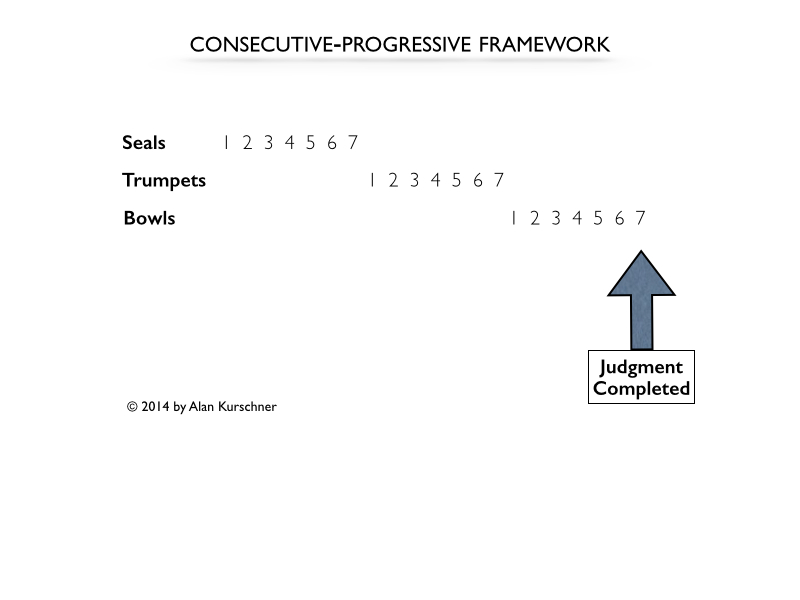
Consecutive-Progressive
The prewrath position interprets a sequential chronological framework for the seals, trumpets, and bowls. That is, the seal-trumpet-bowl septets (sets of seven) will happen in a consecutive-progressive fashion with each septet consecutively following each other. For example, the trumpet septet cannot begin until the seventh seal is opened; and the bowl septet cannot begin before the seventh trumpet is blown. The last judgment element of the day of the Lord’s wrath will be the seventh bowl. Accordingly, the seventh seal and the seventh trumpet serve as transitions to the next set of God’s climaxing judgments, culminating with the seventh bowl.
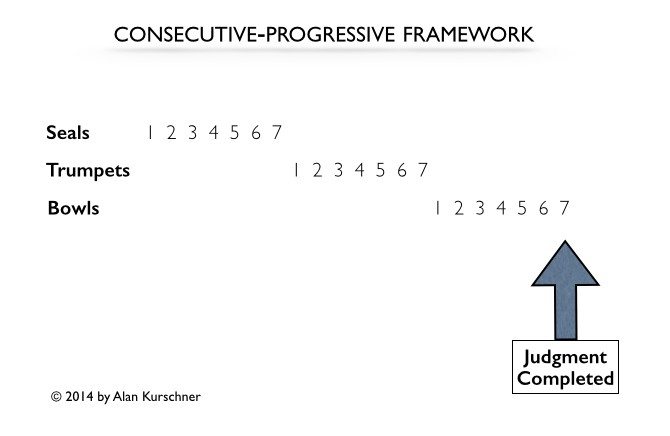
  prewrath, seals, trumpets, bowls.001
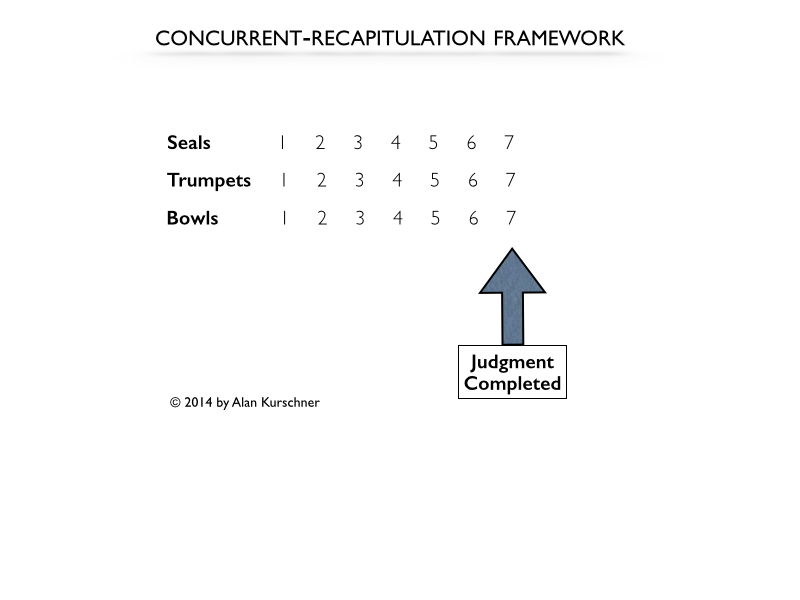
Concurrent-Recapitulation
Posttribulationists (and Amillennialists) subscribe instead to a concurrent-recapitulation framework with the septets occurring at the same time with the judgment elements giving different emphases or perspectives. For example, it is said that the sixth seal, sixth trumpet, and six bowl describe the same event from a different angle. Accordingly, the last element in the day of the Lord’s wrath describes the seventh of each septet; thus, the seventh seal, seventh trumpet, and seventh bowl is the same event from different perspectives. And there are those posttribulationists who hold that it does not describe the exact same event, but they affirm that the three elements occur roughly at the same time. For all practically purposes, the main point is that both of these posttrib interpretations do not view the trumpets and bowls occurring after the seventh seal is opened.
posttribulationism, seals, trumpets, bowls.001


I should note that this debate does not hinge on whether each judgment element within the septets succeed each other; that is not the issue. The main question is: does each of the three septets themselves succeed each other (consecutive) or do they simultaneously unfold (concurrent)? My aim is to demonstrate that the concurrent view is flawed. I will also argue for the consecutive nature to the three septets, showing that the seventh seal does not depict the culmination but the introduction to the day of the Lord via the seven trumpets and culminating in the seven bowls. The following reasons are now given against this concurrent-recapitulatory framework of the septets, while at the same time, I will show the consecutive-progressive structure is the most natural interpretation.
The Seventh Seal Prepares for the Trumpets
"Now when the Lamb opened the seventh seal there was silence in heaven for about half an hour. Then I saw the seven angels who stand before God, and seven trumpets were given to them." (Rev 8:1–2 emphasis mine) In this passage, there is an explicit cause and effect action between the opening of the seventh seal and the introduction to the seven trumpets. It is difficult how any interpreter can read the trumpets happening before the seventh seal is opened. It is a clear contradiction according to Revelation 8:1–2. The opening of the seventh seal prepares for the trumpets. In addition, when the seventh seal is opened, there is a moment of silence functioning to contrast with the ensuing booming sounds: “Then the angel took the censer, filled it with fire from the altar, and threw it on the earth, and there were crashes of thunder, roaring, flashes of lightning, and an earthquake” (Rev 8:5). Jauhiainen makes an excellent point regarding the silence:
The recapitulation theory would be more convincing if the sixth seal were silence and the seventh the ‘end’, and not vice versa, as John has them. Beale (Revelation, 125, 446–54) attempts to address this problem by claiming that it is ‘clear from repeated references to silence in the OT and Jewish apocalyptic writings’ that silence is ‘a figurative expression of judgment’ (125). He is correct in seeking a link between silence and judgment in the primary OT background texts he adduces, Hab 2:20, Zeph 1:7 and Zech 2:13. However, the contexts of these references to silence suggest that silence is not ‘an expression of judgment’ but rather something that precedes judgments and/or the Day of the Lord. Thus in Zephaniah the reason for silence is given in the same verse: ‘for the day of the Lord is near.’
Therefore, the opening of the seventh seal is the last condition for the scroll to be opened, encompassing the ensuing trumpet judgments (cf. Rev 8:1–6).
The Septets Increase in Intensity and Scope
The narrative of the seals, trumpets, and bowls conspicuously intensify. The seals exhibit “natural” events: wars, famine, plague, and bloodshed; while the trumpets and bowls exhibit “supernatural” events such as hideous demonic creatures torturing the wicked, massive divine devastation on the earth, etc. Further, the scope of activity progressively intensifies; for example, the fourth seal mentions a quarter of the earth, the trumpets a third of the earth, and the bowls affect the whole earth. In addition, the seals encompass believers and unbelievers, with the trumpets targeting specifically the ungodly. And while the bowls are also directed to the ungodly, its focus is on the beast’s kingdom and his subjects (e.g., bowls 1, 3, 5, 6). These factors demonstrate the septets do not recapitulate the same events; instead, they exhibit three separate consecutive series of judgments: the seals function as precursors to the day of the Lord’s wrath, the trumpets initiate his wrath, and the bowls execute the completion of his wrath.
Confirmation from Jesus
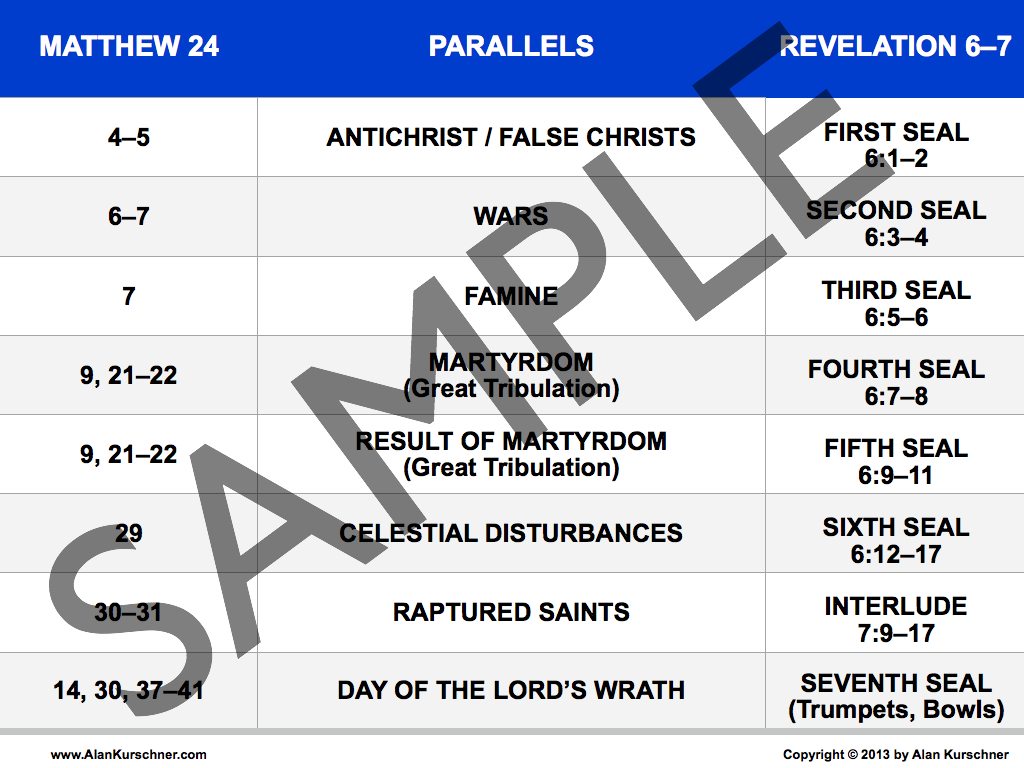
Jesus’ teaching on the beginning of birth pangs, great tribulation, the celestial sign, and the gathering of the elect corresponds with the seven seals (see this chart). Jesus warned not to confuse the end with the beginning of birth pangs. He taught the great tribulation will happen before his return signaled by the celestial disturbance. This supports that the seals should be distinguished from the wrath in the trumpets and bowls.
The Fifth-Seal Martyrs
The fifth-seal martyrs cry out to God for justice and implore him to avenge their blood: “How long, Sovereign Master, holy and true, before you judge those who live on the earth and avenge our blood?” (Rev 6:10). This clearly shows the day of the Lord’s wrath has not begun; thus to place any trumpet or bowl judgments before the fifth seal is contradictory. In addition, the prayers of the martyrs are about to be answered after the seventh seal is opened through the trumpet judgments (Rev 8:1–4), connecting it back to their supplications in the fifth seal.
The Sixth-Seal Celestial Event
The sixth seal signals the impending wrath of God, not the culmination of it. Joel’s parallel passage reads, “I will produce portents both in the sky and on the earth—blood, fire, and columns of smoke. The sunlight will be turned to darkness and the moon to the color of blood, before the day of the LORD comes—that great and terrible day!” (Joel 2:30–31). This celestial disturbance causes the ungodly in the sixth seal to flee to the caves because they recognize the impending wrath of God (Rev 6:15–17). Luke also narrates the wrath of God ensuing the celestial event (Luke 21:25–36; cf. Matt 24:29–30). Therefore, it is mistaken to place any trumpet or bowl judgments before the sixth seal.
Destruction of the Earth Happens After—Not Before—the Seventh Seal
In Revelation 7 there is an interlude portraying two groups being delivered-protected, one on earth and the other in heaven. The group on earth are seen to be 144,000 Jews. A seal is given on their foreheads as protection from the coming wrath: “Do not damage the earth or the sea or the trees until we have put a seal on the foreheads of the servants of our God” (Rev 7:3). This verse should put to rest any doubt the trumpets and bowls happen before the seventh seal. Notice the earth, sea, and trees are not destroyed up to this point before the seventh seal is opened. It is only when the seventh seal is opened the first two trumpet judgments begin to destroy the earth, sea, and trees: The first angel blew his trumpet, and there was hail and fire mixed with blood, and it was thrown at the earth so that a third of the earth was burned up, a third of the trees were burned up, and all the green grass was burned up. Then the second angel blew his trumpet, and something like a great mountain of burning fire was thrown into the sea. A third of the sea became blood, and a third of the creatures living in the sea died, and a third of the ships were completely destroyed. (Rev 8:7–9) It is a contradiction to claim otherwise. Moreover, the fifth trumpet describes demonic-locust creatures being commanded, “not to damage the grass of the earth, or any green plant or tree, but only those people who did not have the seal of God on their forehead” (Rev 9:4). This trumpet judgment has in view the protective seal on their forehead; thus, it is a contradiction to place the fifth trumpet before the seventh seal! (Rev 7:3).
Woe! Woe! Woe!
The last three trumpets are identified ominously as three woes (ouai): “Then I looked, and I heard an eagle flying directly overhead, proclaiming with a loud voice, “Woe! Woe! Woe to those who live on the earth because of the remaining sounds of the trumpets of the three angels who are about to blow them!” (Rev 8:13). The three woes convey the finality and intensity of God’s wrath, along with the devastating painful effects upon the ungodly. The temporal language in Revelation 9:12 also shows past action (“The first woe has passed”) and future action (“but two woes are still coming after these things”). This demonstrates two things: (1) the trumpet judgments follow a sequence, and (2) they show uniqueness distinguishing them from the seals and the bowl judgments. Thus, the trumpet judgments are not the seals and bowls “expressed from different perspectives.”
Incompatible Depictions
The concurrent theory points out similarities between the septets, especially the trumpet and bowl septets. For example, it is argued, since the fourth trumpet and the fourth bowl relates to the sun, they must refer to the same event, or at least occur at the same time. But a closer look shows they are divergent elements. In the fourth trumpet, the sun is partially darkened; in contrast, the fourth bowl depicts heat scorching the ungodly (Rev 8:12; 16:8–9).
Theophanic Lightning, Thunder, Earthquake
The climactic theophanic judgment in the seventh bowl reads: “Then there were flashes of lightning, roaring, and crashes of thunder, and there was a tremendous earthquake—an earthquake unequaled since humanity has been on the earth, so tremendous was that earthquake.” (Rev 16:18) There are two other similar theophanic statements in Revelation 8:5 and 11:19 (three if you count Revelation 4:5). Concurrent interpreters argue that these instances represent the same event because of their similarity. But similarity does not equal identity. A closer reading shows in each instance the theophanic depiction intensifies and anticipates Revelation 16:18, which is the most intense theophany of them all, the consummation of God’s judgment. It is also not clear how a recapitulation could be valid with Revelation 4:5 portraying the throne room happening before any seals are opened! All of this leads Jauhiainen to comment:
Granted that 8:5 and 11:19 anticipate 16:18–21, this intensification would seem to indicate that the consummation of temporal judgments is approaching, and not that it has already been reached in 8:1 and then recapitulated twice. Thus, in 8:5 the formula heralds the coming of God in judgment, symbolized by the trumpets.[…] and 11:19 looks forward to the pouring out of the bowls. The last bowl in 16:18–21 completes the judgments, together with an emphasis on the uniqueness of the final earthquake and with the voice from the throne saying, ‘It is done!’
God’s Wrath is Finished
Revelation 15:1 reads: “Then I saw another sign in heaven, great and amazing, seven angels with seven plagues, which are the last, for with them the wrath of God is finished” (ESV). This verse contains a sequence of God’s wrath, which says the seven plagues (bowls) are “last” (eschatos). This strongly implies the trumpet septet precedes the bowls because “with them the wrath of God is finished (teleō).” In other words, the bowl judgments will fulfill God’s final purpose in the day of the Lord. Thus, it is unnatural to interpret the bowl septet happening at the same time as the trumpet septet. The natural reading, instead, conveys the bowls following the trumpets.
The Imagery of the “Bowl”
The trumpet judgments require a substantive time to unfold; for example, the fifth trumpet lasts five months. In contrast, the nature and purpose of the bowl judgments occur rapidly. The New Testament mentions at least fifteen different vessels, jars, bowls, baskets, and other containers in antiquity. In our instance, the term for “bowl” is phialē, meaning a “broad, shallow bowl.” This choice of imagery of “broad and shallow” is not arbitrary since is connotes a swift judgment, for the pouring out of God’s final wrath will happen quickly. This imagery also evokes a salvo of bowls being emptied like a grand finale to a fireworks display, in contradistinction to the imagery of the trumpet judgments.
Conclusion
The collective reasons above establish that the book of Revelation intends a consecutive-progressive framework. The concurrent-recapitulatory theory fails because it forces the trumpets and bowls to unfold before the seventh seal is opened. The opening of the seventh seal does not culminate the day of the Lord's wrath—it initiates it. The posttrib presupposition that the second coming begins in Revelation 19 with Christ in the sky with his armies causes a strain in the natural reading of Scripture; in this case, collapsing together the seals, trumpets, and bowls to make the resurrection event in Revelation 7 happen in association with the Armageddon event in Revelation 19. Further, it is a contradiction, as argued above, to place God's wrath before the seventh seal is opened, as well as before the resurrection in Revelation 7. Prewrath takes the event of Christ in the sky with his heavenly armies preparing for the battle of Armageddon as one of the last judgment events after the trumpet and bowl judgments. The parousia does not begin with Armageddon; it begins between the sixth seal and the seventh seal, when God's people receive their resurrected bodies and enter the Father's presence as portrayed in Revelation 7.

Links mentioned:

www.alankurschner.com/2015/05/28/seals-trumpets-bowls-in-the-book-of-revelation-concurrent-recapitulation-or-consecutive-progressive-part-1-of-2-ep-36/

www.alankurschner.com/wp-content/uploads/2013/06/Prewrath-Charts.003.jpg

Friday, October 17, 2014

70 weeks


24 “Seventy weeks are decreed about your people and your holy city, to finish the transgression, to put an end to sin, and to atone for iniquity, to bring in everlasting righteousness, to seal both vision and prophet, and to anoint a most holy place. 25 Know therefore and understand that from the going out of the word to restore and build Jerusalem to the coming of an anointed one, a prince, there shall be seven weeks. Then for sixty-two weeks it shall be built again with squares and moat, but in a troubled time. 26 And after the sixty-two weeks, an anointed one shall be cut off and shall have nothing. And the people of the prince who is to come shall destroy the city and the sanctuary. Its end shall come with a flood, and to the end there shall be war. Desolations are decreed. 27 And he shall make a strong covenant with many for one week, and for half of the week he shall put an end to sacrifice and offering. And on the wing of abominations shall come one who makes desolate, until the decreed end is poured out on the desolator” (Dan 9:24-27).
I'm going to discuss several different interpretations of this passage.
1. There's the liberal interpretation, which relates this to the Antiochean crisis in the mid-2C BC. This suffers from some basic problems:
i) It's predicated a the secular assumption that there is no God who reveals the future.
ii) It identifies the character who's "cut off" as Onias III. However, even on liberal dating schemes, that's off by over 70 years. Liberals salvage that identification by blaming the anachronism on the the anonymous author of Daniel, who was confused. Of course, that's a circular argument. Their identification is inconsistent with the evidence. So they preemptively discount falsifying counterevidence.
iii) Antiochus never destroyed the temple or the city (of Jerusalem). And that's hardly an incidental detail.
iv) Likewise, what does the "strong covenant" refer to in his career? 
v) Ironically, liberals have their own gap theory, when they split the seven weeks from the sixty-two weeks. Likewise, they split the "prince" and "anointed one" in vv25-26a into two different figures. Nothing necessarily wrong with that, but it disqualifies them from attacking amils and premils who draw similar distinctions. 
2. Some interpretations think there are two characters in view. A protagonist and an antagonist. This, in turn, has two basic variations:
i) Jesus is the protagonist, while Titus and Hadrian are the antagonists. Titus and Hadrian destroy the temple and/or the city (of Jerusalem).
ii) Jesus is the protagonist, while a future Antichrist is the antagonist.
3. Apropos 2(ii):
On this view, Dan 9:26 refers to 1C events while v27 refers to still future events. The "covenant" is a treaty or nonaggression pact which the Antichrist makes with the Jews on his rise to power. He later reneges on the deal. 
What are we to make of this interpretation? 
i) I think proponents are correct to believe that the 1C events did not exhaust Dan 9:24-27.
ii) There's nothing inherently ad hoc about positing temporal gaps. Both amils and premils do this. Arguably, that's clearly in view in Daniel, at one point or another. As one scholar notes:
But you notice between verse 2 and 3 there is an unmentioned interval of over 150 years. Daniel simply passes from Xerxes who attacked Greece, to Alexander the Great, who destroyed the Persian Empire. Daniel skips over 150 years without any reference to it. 
…in chapter 2, chapter 7, and chapter 9 he [E. J. Young] is very much against the idea of an unmentioned interval between two great events. But here he assumes a jump of at least two thousand years without it being mentioned between verse 11:35 and 36…Young, without saying so, assumes an unmentioned interval of at least 2000 years at this point between Antiochus Epiphanes and the Antichrist. 
http://faculty.gordon.edu/hu/bi/ted_hildebrandt/otesources/27-daniel/macrae_daniel_text_audio/macrae_daniel_lecture10.pdf
Of course, making allowance for temporal gaps doesn't justify posting temporal gaps without sufficient exegetical justification.
iii) However, both 9:26 and 9:27 share a common "desolation" motif. "Desolation" in v27 is a carryover from "desolation" v26. It seems arbitrary to split them up.
In addition, it's artificial to drive a wedge between "city and the sanctuary" in v26 and "sacrifice and offering" in v27. Those are clearly interrelated concepts. Jerusalem and the temple are where sacrifice and offering take place. 
iv) In addition, if we correlation Dan 9:24-27 with the Olivet Discourse, Jesus is, in part, answering a question about the Second Temple. The Herodian temple. That's the frame of reference. Not a Millennial temple.
v) Proponents of this view tend to flip back and forth. V24 is mainly about the future, although "atoning for iniquity" is about the past (i.e. the Crucifixion). Vv25-26 shift back to the past (i.e. the public ministry of Christ) while v27 shifts to the far future. It's a very choppy interpretation, which breaks up the flow of the passage. Not just gaps, but reversals.
In fairness, though, prophecy might include flashbacks and flash forwards. 
vi) There's nothing inherently wrong with the idea that the Antichrist might make a temporary treaty with the Jews. However, the text itself doesn't say that or imply that. In addition, I think that's out of context (see below).
4. Some interpretations think there's just one character in view throughout. That has two basic variations:
i) Christ is the consistent referent.
ii) The Antichrist is the consistent referent.
5) Apropos 4(ii), this suffers from a couple of basic problems:
i) It shares some problems with #3. 
ii) Arguments for the messianic interpretation militate against it (see below).
Apropos 4(i), on this view:
i) The Crucifixion moots the sacrificial system. In effect, the city and sanctuary are destroyed by his definitive redemptive death. At that point they've outlived their rationale. 
ii) The Crucifixion is the abomination of desolation.
iii) The "strong covenant" refers to the new covenant, foretold by Jeremiah (Jer 31). And we know that Jeremiah's oracles were on Daniel's mind (Dan 9:2). 
iv) There's a pun between "cutting" a covenant (an idiomatic term for making a covenant) and the Messiah who is "cut off" (i.e. crucified).
v) The church age is the 70th week. It began in the past, but the ending is future. 
6) I think elements of (5) are very appealing. But it suffers from some weaknesses:
i) Why would we favor a figurative interpretation when the temple and the city were actually razed by Titus and Hadrian's forces? The wording of the oracle, combined with subsequent events, invites a literal interpretation.
ii) Although, taken by itself, the Crucifixon is uniquely "abominable," in what sense would the Crucifixion be a sign or advance warning to flee Jerusalem and head for the hills decades ahead of time? It makes no sense of how that functions in the Olivet Discourse. 
7) It's possible to combine some details of these different interpretations.
i) For instance, who destroyed Jerusalem? Literally, that was Titus and Hadrian. Yet they were agents of God. So God destroyed it. And the Jews brought it on themselves. So they destroyed it–when they repudiated the Messiah. From that moment on, its doom was a foregone conclusion. And there's a sense in which Jesus destroyed it by rendering it obsolete.  
ii) Just as Antiochus was a type of Roman emperors or a type of Antichrist, Roman emperors can be a type of Antichrist. 
Likewise, one can view the fall of Jerusalem as a type of endtime deliverance and judgment. 

Wednesday, October 15, 2014

Parsing the Olivet Discourse


I'm going to say a bit more about my interpretation of the Olivet Discourse. My interpretation is provisional.

1) One complication is the fact that this discourse is recorded, with variations, in all three Synoptic Gospels. So one question is how to correlate them.

2) Some scholars, based on the assumption of Markan priority, as well as the further assumption that Mark's version is more "authentic" (because it's earlier and less subject to embellishment than Matthew and Luke), take Mark's version as the standard of comparison.

Although I think Markan priority is plausible, I don't think that makes his version more authentic than the other two.

3) Other scholars center their analysis on Matthew's version because that's the most detailed. And I think that's logical, although it's important to qualify that by comparing Matthew with Mark and Luke.

4) There are roughly three basic interpretive approaches one can take to the Olivet Discourse:

i) Interpret the text preteristically throughout.

ii) Interpret the text futuristically throughout.

iii) Interpret the first part preteristically and the second part futuristically. 

All three approaches can appeal to some verses which support their approach. All three approaches must square their interpretation with problem passages that seem to be at odds with their approach. It's difficult to consistently carry through any of the three approaches. 

5) I myself incline to 4(iii). What about difficulties with that approach?

i) One source of ambiguity is due to the fact that we're dealing with a prediction that is, in some measure, modeled on OT exemplars. So the language is, to that extent, allusive and impressionistic rather than precisely descriptive. 

ii) In Biblical typology, an earlier event can foreshadow a later event. But that's a two-way street. Typology assumes similarity between type and antitype. But in that case, just as an earlier event can foreshadow a later event, a later event can backshadow an earlier event. Even if the Olivet discourse is predicting an event in the near future (the First Jewish Revolt) as well as another event in the distant future (the Parousia), it wouldn't be surprising if it sometimes uses similar language for both, inasmuch as type and antitype are, in fact, similar to some degree. Typology involves repetitive historical patterns.

iii) I'm inclined to say the first part of the text emphasizes the First Jewish Revolt while the second part emphasizes the Return of Christ, which has yet to eventuate. 

Let's also consider some specific verses:

6) Who are the Messianic pretenders? In principle, this could refer to two different kinds of claimants:

i) These could be men who claim to be the real Messiah, in contrast to Jesus. That claim would be more likely to mislead some Jews or Jewish-Christians. 

ii) These could be men who claim to be Jesus. They are Jesus come back. That claim would be more likely to mislead some Gentile Christians. 

iii) Preterists identify these claimants with some 1C candidates. One problem with that identification is that Jesus says at least some of the claimants gain a following by performing miracles. So that sets the bar pretty high, even for impostors. 

7) There's some difficulty correlating the "abomination of desolation" with a 1C event. Considered in isolation, the best candidate for that identification would be the Roman desecration of the temple, after the Romans sacked Jerusalem and invaded the city. But in context, that's much too late to serve as advance warning to get out while the getting is good. 

Some preterists correlate the "abomination of desolation" with the Zealot desecration of the temple. That's probably their best bet. But whether that's how the disciples, or the original readers of the Synoptic Gospels, would construe the reference, is a different question.

8) Even if, taken in isolation, it's possible to interpret the "coming Son of Man" imagery in Mt 24 preteristically, doesn't that commit the preterist to interpreting Mt 25 preteristically as well? 

9) There's the question of what "the end" refers to. In context, does that denote fall of Jerusalem or the Parousia?

10) What does the phrase "wars and rumors of wars" refer to? Was there ever a time in human history when you didn't have wars and rumors of war? That makes even less sense on a global, purely futuristic interpretation. 

If, however, this alludes to the ramp up to the First Jewish Revolt, then that makes a lot of sense. When you hear about insurrection in Jerusalem and Judea, now is the time to get out of Dodge, for once the Roman armies occupy the countryside and surround the city, you're trapped. 

11) What about earthquakes? These are so random that they don't seem to be advance warning. Perhaps, though, the point is not the occurrence of these signs in isolation, but an unusual conjunction of independent signs.

12) The imagery of someone on the rooftop having to leave everything behind naturally suggests an elevated vantage-point from which the observer could see the advancing Roman armies. Had he heeded the preliminary signs, that would have given him sufficient lead-time to make his escape with provisions, at a good time of year for travel. But if you wait until you can see the whites of their eyes, than you waited too long. You are likely to be overtaken. Your escape route cut off. Weather may be rotten for travel by foot. You're lack provisions. I think this section is clearly concerned with location conditions in and around Jerusalem. If you wait until the Roman counterattack is imminent, you just ran out of time. 

13) On a global, futurist interpretation, it's hard to see how leaving town would protect you from end-of-the-world events. Surely there's nowhere to run under that scenario. And the time of year would be irrelevant. 

14) I don't see how the futurist interpretation of Mt 24:33 makes sense in light of vv30-31. If, at that point, you are actually witnessing the return of Christ, then the signs have surely outlived their usefulness. For what they signify is now evident to all. 

15) I take the "whole world" (Mt 24:14) to be an idiomatic designation for the Roman Empire. 

16) Some futurists cite Mt 24:29 to prove that we're not dealing with two different events, widely separately in time. There are, however, two problems with that appeal:

i) The Greek adverb (eutheos) is often used as a transitional device to segue from one scene to another. A syntactical convention. It allows for narrative compression. Indefinite intervals. The implied duration must be supplied by context or other clues. 

ii) And it's only used in Matthew's version of the Discourse. 

17) Apropos (16), The disciples ask Jesus about two events. Since one event is actually earlier (indeed, much earlier!) than the other, that's the order in which he answered them. First the fall of Jerusalem-related events, then Parousia-related events. First and second. 

One is earlier, one is later. They seem close together because he's responding to a two-part question. But the fact that they're close together in the sequence of the answer doesn't mean they're close together in the sequence of time. 

18) Some futurists appeal to Mt 24:21. However, I take that to be a warning to get out of Dodge before the Romans besiege Jerusalem, for once Jerusalem is surrounded by Roman armies, and the countryside occupied, there's no exit. 

In other words, a reference to the First Jewish Revolt, expressed in hyperbolic, end-of-the-world jargon, for which there's OT precedent.  

A warning, decades ahead of time, for true believers in Jerusalem, to evacuate when the signs of that particular catastrophe were coming to pass. And that's distinct from the Parousia. 

Some might object that it's artificial to take the first part as referring to the near future (1C events) and the second part as referring to the distant future (the Parousia), but the disciples asked a two-part question, so Jesus is, to some extent, answering them on their own terms. That's how they framed the question. So it's a part 1, part 2 answer. But in reality, these are separate events. 

Of course, if they ask the wrong question, he's free to reformulate the question. But there's nothing to indicate that he recast the question.