Thursday, January 25, 2018

On Jordan's bank

A traditional crux is why Jesus underwent baptism. John's baptism symbolized repentance, yet Jesus had nothing to be penitent about.

1. There's an aspect of mutual attestation. Jesus is vouching for John's vocation, and John returns the favor. By the same token, it gives John a very public opportunity to bear witness to Christ.

2. Mt 2-4 is crisscrossed with new Exodus typology, so the baptism and temptation of Christ probably play on that theme. To some degree, he's recapitulating the history of Israel, only he succeeds where Israel fails.

3. In that regard, the location of the baptism is emblematic. Not just any body of water, but the Jordan river. That was a border of ancient Israel. Joshua and the Israelites had to cross the Jordan river to enter the promised land. By undergoing baptism, Jesus is situated on that evocative border–between Israel and the wilderness.

4. That's reinforced by the temptation, where he enters the wilderness. That triggers associations with the experience of the Exodus generation. The fact that Jesus quotes from Deuteronomy, three times in a row, bolsters allusions to the history of Israel in the Sinai desert. 

5. In addition, Christians must face trials and temptations, so Jesus is setting an example to emulate. 

6. The vicarious symbolism of his actions at the outset of his public ministry preps the reader for the vicarious atonement to come. Jesus is already acting in a representative capacity, by reprising the role of Israel. This involves the same general principle as vicarious atonement. Acting on behalf of and in lieu of another or others.  

7. Why did Satan tempt him?

i) For one thing, this indicates that Jesus got the attention of the dark side–like radar and satellite surveillance to detect inbound ICBMs. Jesus poses a threat to the dark side. His public baptism alerts the enemy to a mortal foe. 

ii) Apropos (i), the dark side sends its top gun to confront Jesus. Not a demon but the leader of the cosmic rebellion. The dark side can't afford to ignore Jesus. 

6. Mark mentions that Jesus was with wild animals. Some scholars think this foreshadows the experience of Christians who were martyred in the Colosseum. Torn apart by vicious beasts. 

How did Pharisees commit an unforgivable sin?

Discussions of the unforgivable sin typically cluster around a few issues. What exactly is the unforgivable sin? What makes it unforgivable? Why is speaking against Jesus forgivable, but speaking against the Holy Spirit is unforgivable? Is this sin uniquely tied  to the setting of Christ's public ministry, or can it be committed today? And that in turn raises the pastoral issue. How should you counsel someone who fears or despairs of having committed this sin?

Not surprisingly, the unforgivable sin is usually discussed from a Christian viewpoint. From our side. 

But I'd like to discuss this from the Jewish side. Suppose an Orthodox Jew was reading this account. From the Jewish side, what was sinful about the allegation, much less unpardonable? 

After all, Deut 13 alerts Jews to be on guard against false prophets. Even if they perform supernatural feats, they must be disregarded if they tempt Israel to commit apostasy. 

But given the specter of an unforgivable sin, how can any man dare to question a messianic pretender with that threat hanging over his head? Doesn't the possibility of a false prophet who can perform supernatural feats imply demonic or diabolical empowerment? What else is the source of his uncanny ability?

And from their viewpoint, Jesus was leading Jews astray by flouting Mosaic commands and prohibitions. Suggesting that he was the replacement of the Mosaic covenant. And even claiming to be Yahweh. What could be more blasphemous than that? 

So doesn't the terrifying threat of the unforgivable sin generate a hopeless dilemma when assessing a religious claimant? 

I've never seen the unforgivable sin discussed from that angle. I'll take a stab at some answers:

i) The Pharisees don't simply raise the possibility that dominical exorcisms are diabolical. They don't merely express reservations on that account. Rather, they confidently present that as the true explanation. 

Perhaps if someone merely made allowance for that consideration as a possible explanation, it would be less culpable.

ii) The Gospels present the Pharisees as having malicious motives. Full of mock piety and hypocrisy. Flaunting religiosity as a cover for personal venality. Perhaps their malevolence is an aggravating factor which renders them inexcusable. 

iii) The specific context isn't miracles in general but exorcism in particular. The OT has no record of prophets casting out demons. So perhaps that's one kind of miracle which a false prophet can't successfully perform. 

Indeed, Jesus says their accusation generates an antinomy. Satan working at cross-purposes with himself. 

iv) Evidence for the messiahship of Christ isn't confined to the argument from miracles, but includes the argument from prophecy and typology. That goes beyond what the false prophet in Deut 13 is said to be able to perform. 

Although the false prophet in Deut 13 can make true predictions, he can't inspire other prophets to make predictions about him. But if Jesus is fulfilling OT prophecy, then that's different.  

v) In the Gospels, Jesus challenges their interpretation of the OT. Perhaps that, too, renders them inexcusable. 

Wednesday, January 24, 2018

Alleged historical errors in the Gospels


Should women teach in seminaries?

Recently, John Piper took an utterly unsurprising position on women teaching in seminaries:
https://www.desiringgod.org/interviews/is-there-a-place-for-female-professors-at-seminary
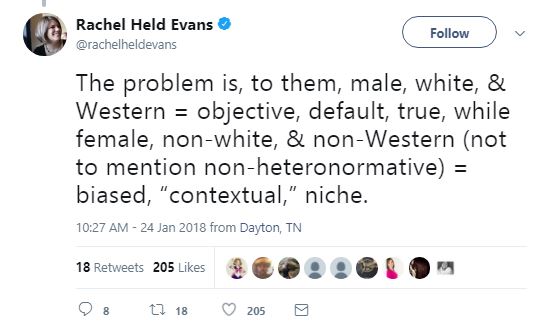
Funny to see the shocked reaction, as if he doesn't have a mile long paper trail on these issues. Here was the funniest reaction I've seen:

As if the Patriarchy is a white Western invention. As if non-white, traditional Third-World cultures are egalitarian and non-heteronormative.
On this issue I agree with Piper in some respects, but not in others. Before getting to the main point, I'll make some ancillary observations:
i) I don't think it's coincidental that Piper is an older generation Southerner. I expect his complementarianism is largely a continuation of a traditional Southern chivalric code. I don't say that as a criticism.
ii) He somewhat overstates the purpose of seminaries. Although they basically exist to train pastors, they offer MAR degrees as well as MDiv degrees.
iii) Although he bases his position on a complementarian reading of 1 Tim 2:12, he doesn't seem to object to women wielding authority over men in principle or women teaching men in principle. He doesn't seem to object to female professors at a Christian college. Rather, his argument is geared to the nature of pastoral formation.
iv) I agree with him on complementarianism.
v) I agree with him that it's ad hoc to say women can teach men to teach parishioners, but women can't teach parishioners directly.
vi) He oversimplifies pastoral ministry. A pastor of a small church does everything. By contrast, megachurches have compartmentalized ministries. Due to the size of the congregation, the ratio of pastor to parishioner, and the financial resources of a megachurch, what one man must do singlehandedly when pastoring a small church gets delegated to several different ministers at a megachurch.
That complicates his complementarianism. Take visitation ministry or a woman's Bible study.
vii) Does Piper think it's permissible for a pastor to read a commentary by Karen Jobes, but not to attend a class by Karen Jobes? If so, what's the essential difference?
viii) A good pastor doesn't necessarily have the same skill set as a good seminary prof, or vice versa. Seminary professors can outstanding scholars or thinkers, but abysmal communicators. Likewise, great scholars and thinkers may be sorely deficient in social skills.
ix) Now I'd like to get to the main point. I disagree with Piper's position on this particular issue. The rationale Piper gives for his position is unwittingly at odds with complementarian anthropology. Sophisticated complementarians aren't voluntarists. They don't think Biblical gender roles are arbitrary social constructs. Rather, they think these mirror stereotypical physical and psychological differences between men and women.
Yet Piper unintentionally acts as if these roles are interchangeable. He thinks that if male seminarians view male seminary profs. as pastoral role models, and if you put a woman in the same slot, then male seminarians will view women as pastoral role models.
Which ironically assumes that men relate to women the same way they relate to men when women occupy the same social role or institutional position. But I find that highly dubious and contrary to complementarian anthropology.
In my observation, men measure themselves by other men while women measure themselves by other women. Men don't measure themselves by women and women don't measure themselves by men. The psychological dynamic between men and women is different even when the social roles or institutional positions are artificially the same.
That's one reason we defend heterosexual marriage. Mothers can't take the place of fathers while fathers can't take the place of mothers. Kids need both. One person can't successfully play both roles.
The father/son dynamic, mother/son dynamic, father/daughter dynamic, mother/daughter dynamic, brother/brother dynamic, brother/sister dynamic, and sister/sister dynamic are all different.
Suppose the military put a woman in charge of a Navy SEAL team. Would the male members of that team relate to her the same way they relate to a male comrade just because she was given the same position? Are you kidding me?
Another example is the difference between male and female hymnodists. Male hymnodists have a different sensibility than female hymnodists.
I think it's wholly unrealistic to suppose that if a normal man has a female seminary professor, he will view her the same way he'd view a male seminary professor, as though male-on-male psychology is transferable to male-on-female psychology. This is not to deny that men can look up to women, and women can look up to men–but it doesn't mean they're consciously or subconsciously thinking that a member of the opposite sex embodies what they aspire to be like. That's just not how human nature is wired. Women are not an example of how to be a man. Men are not an example of how to be a woman.
There are, of course, some generic virtues they can share in common. Some Christian women exhibit perseverance in adversity or even moral heroism. We can admire that in members of either sex. But by the same token, that's not a lay/clerical distinction.


Reading the Gospels as history

https://www.youtube.com/watch?v=z-dvzMUplio

Motives of credibility

I'd like to examine another argument by Bryan Cross. These are comments he made on his Tu Quoque post:


The motives of credibility establish with moral certainty the divine origin and divine authority of the Catholic Church [314]

Here again you’re conflating the period of inquiry and the life of faith, as if what one in the period of inquiry would do entails epistemic equivalence between Protestants on the one hand, and on the other, Catholics living the life of Catholic faith. But a person in the period of inquiry is not in the epistemically equivalent state of the Catholic living the life of faith. Moreover, what would hypothetically serve as a motive of discredibility in the period of inquiry would not be even possible for that entity in which, through the motives of credibility, one may come to divine faith... The Catholic in the life of faith knows that the Church through God’s divine protection cannot teach false doctrine, and is therefore not subjecting the Church’s doctrine to the judgment of his own interpretation of Scripture, but instead allowing the Church to guide and form his interpretation of Scripture.

Again, this conflates the period of inquiry into the motives of credibility, with the life of faith. The person in the stage of inquiry into the motives of credibility is, like the Protestant, not in an epistemic position of acknowledging and submitting to a divinely authorized magisterium. But that does not mean or entail that the Catholic living the life of faith, and thus having come to know and believe in the divine authority of the Church Christ founded, is in the same epistemic condition as the inquirer, or as the Protestant [#324]

i) The issue is whether Bryan's unconditional commitment to Roman Catholicism reflects the mindset of a cult member, where nothing can ever disprove the cult leader. And this isn't just hypothetical. After all, there are lots of religious claimants out there. They can't all be true. 

ii) Bryan endeavors to distinguish between the preconversion stage of inquiry and the postconversion "life of faith" (or "divine faith"). Once an individual converts to Catholicism, he's made an irreversible commitment. Crossed a line of no-return. At that juncture the convert relinquishes his own judgment to the superior judgment of the magisterium. 

iii) One problem with Bryan's position is his claim that "the Catholic in the life of faith knows that the Church through God’s divine protection cannot teach false doctrine." Does a convert to Rome actually know that to be the case–or does he merely believe that to be the case?

Bryan says "the motives of credibility establish with moral certainty the divine origin and divine authority of the Catholic Church."

That's a tremendously strong claim. What does Bryan mean by the "motives of credibility"? Here's out he defines it in another post:

God makes known His voice by way of marks that are unmistakable, i.e. something that only God can do (i.e. miracles). These are what are called the motives of credibility, by which we recognize God’s word as God’s word. (2′)

Motives of credibility allow us to make the transition from human faith to divine faith. (3′)

The motives of credibility allow the act of faith to be reasonable, and make the act of disbelief unreasonable; without them the act of faith would be unreasonable, and would lay us open to superstition. (3′)

Four categories of signs serving as motives of credibility:

(1) miracles, (5′)
(2) prophecies (6′)
(3) the Church (7′)
(4) the wisdom and beauty of revelation itself, and Christ Himself (7′)

The Catechism on the motives of credibility (8′)

Thus the miracles of Christ and the saints, prophecies, the Church’s growth and holiness, and her fruitfulness and stability “are the most certain signs of divine Revelation, adapted to the intelligence of all”; they are “motives of credibility” (motiva credibilitatis), which show that the assent of faith is “by no means a blind impulse of the mind.” (CCC 156)


iv) But how do the motives of credibility, thus defined, single out the church of Rome? Keep in mind that at the stage of inquiry, there's no prior assumption that the motives of credibility point to Rome. Why would an inquirer suppose the argument from miracles or argument from prophecy selects for Roman Catholicism in particular rather than Christianity in general? 

Keep in mind, too, that in church history, up to the present, Roman Catholicism has no monopoly on reported miracles and prophecies. That's paralleled in Protestant circles. 

Likewise, how does (4) select for Roman Catholicism?

At the stage of inquiry, the Catholic identification of (3) is not a given, but something to be established. 

v) Bryan never allows for the possibility that a Catholic convert is sometimes justified in reexamining his conversion. Yet converts have more experience after conversion, and therefore have additional information they didn't have during the preliminary investigation. In that respect, a convert is sometimes in a better position to reconsider his conversion than an inquirer. A convert can make a more informed evaluation by virtue of his postconversion experience. This applies to conversion in general, where converts sometimes have second thoughts after they become better acquainted with the movement/institution/tradition they converted to. 

How it looks from the inside may be dramatically different than how it looks from the outside. With that additional insight, why is he not in a better position than before to judge that he made a mistake? 

To begin with, he may continue his studies upon conversion. And that may lead him to encounter objections he didn't consider beforehand.

In addition, there's a difference between knowledge by description and knowledge by acquaintance. Prior to conversion, he studied an abstract, idealized version of Roman Catholicism. A construct of Roman Catholic theologians and apologists.

But now, based on his firsthand experience, as an insider, he may discover a mismatch between the propaganda and the reality. There's nothing in principle that rules that out. To the contrary, that's assessing Catholicism on the basis of evidence he didn't have at his disposal prior to conversion. He now has a comparative frame of reference. 

Tuesday, January 23, 2018

Self-identify as fit for communion

Like transgenderism, as the revisionist policy of Pope Francis shakes out, it comes down to how communicants self-identify:

https://www.firstthings.com/web-exclusives/2018/01/mr-fit-goes-to-communion

I'll do for you if you do for me

It's funny to see how liberals impute hypocrisy to Trump supporters. They still don't have a clue: 

i) The relationship between Trump and his supporters is like a military alliance: If you defend us, we'll defend you.

Insofar as the Trump administration is acting in the interests of freedom-loving Americans, insofar as the Trump administration is protecting their Constitutional rights, they will support him. So long as his administration is sticking up for them, they stick up for him. It's a reasonable, predictable reaction.

ii) Everyone ought to be personally virtuous. Everyone ought to be virtuous in their private life.

However, what sets a politician apart from a private citizen is their role as public policymakers. (In some cases, the same could be said for some Fortune 500 CEOs.)

At that level, the question at issue is not what choices a politician makes in his own life, but how his policies determine my choices in life. I'm not responsible for what he does in his private life–for good or ill. I don't make those decisions for him. The issue is what decisions he makes for me and my dependents. 

In terms of laws and regulations, what does he permit, prohibit, or mandate? The primary question isn't how he lives his own life, but whether he lets me live me do the same.  

As a rule, what a politician does in his personal life is his own business. But does he mind his own business where I'm concerned? Does he accord to others the same prerogative he accords to himself? 

In both (i) & (ii), there's a principle of reciprocity. 

Is Christianity dying in America?

http://thefederalist.com/2018/01/22/new-harvard-research-says-u-s-christianity-not-shrinking-growing-stronger/

Facts don't care about your feelings

Ironically, gay propagandist Andrew Sullivan pens a commonsense piece attacking the transgender component of the LGBT alliance by defending gender binaries:

http://nymag.com/daily/intelligencer/2018/01/sullivan-metoo-must-choose-between-reality-and-ideology.html

Jesus Is All the World to Me

Do we believe the hymns we sing? Here's somebody who took the lyrics to heart:

https://epistleofdude.wordpress.com/2018/01/22/mabel-and-the-emotional-problem-of-suffering/

Blinker hood

Protestantism itself has no visible catholic Church. It has only denominations, congregations, believers and their children. Within Protestantism there is not some one additional entity to which the term “visible catholic Church” refers, consisting of these denominations, congregations, believers and their children...What allowed the authors of the Westminster Confession to believe sincerely that there was a “visible catholic Church” other than the Catholic Church headed by the Pope, was a philosophical error. This was the error of assuming that unity of type is sufficient for unity of composition. In actuality, things of the same type do not by that very fact compose a unified whole. For example, all the crosses that presently exist all have something in common; they are each the same type of thing, i.e. a cross. But they do not form a unified whole composed of each individual cross around the world. This crucifix, for example, in the St. Louis Cathedral Basilica, is not a part of a unified whole consisting of all the crucifixes in the world. All crucifixes are things of the same specific type, but that does not in itself make them parts that compose a unified whole spread out around the world...One way to determine whether something is an actual whole or merely a plurality of things...

...when Matthew records Jesus saying to Peter in Matthew 16:18, “upon this rock I will build My Church”, and then saying, in Matthew 18:17, “tell it to the Church”, and “listen to the Church”, the most natural way of understanding these passages is that the term ‘ekklesia’ (‘Church’) is being used in the same way in all three places. And it is clear in the Matthew 18 passages that ‘ekklesia’ there refers to the visible Church, not a merely spiritual entity. 


i) Catholic convert Bryan Cross is unintentionally comical because he wears a blinker hood. All he's done here is to invent his own definition of visibility, then proclaim that the Protestant faith fails to measure up to his idiosyncratic definition. But Bryan's tendentious yardstick was never our standard of comparison.

ii) Actually, it's unlikely that Matthew is using ekklesia in quite the same way in Mt 16 & 18. Mt 16 is a statement about the church in general while Mt 18 is a statement about local church discipline.

iii) To play along with Bryan's illustration, individual crucifixes aren't "merely a plurality of things". Bryan must know that's a false description. A "mere plurality of things" would be disparate things that share nothing essential in common. By contrast, individual crucifixes are samples or instances of the same kind of thing. They all have the same basic design. Similar shape. As well as the same symbolic purpose and significance. 

Bryan says that's insufficient for unity of composition. Suppose he's right. So what? Why should unity of composition in his specialized sense be the criterion for visibility? That's a highly idiosyncratic definition of visibility. 

iv) Variation on a theme are an interesting phenomenon. Take snowflakes. Pachelbel's canon. The Mandelbrot set. Are they "merely a plurality of things"? No. They share essential unity. 

Take da Vinci's Virgin of the Rocks. Da Vinci painted two versions of the same scene. Are they one painting or two? In a certain respect they're two different paintings, but there are degrees of difference. You can have two paintings on a different subject or two paintings on the same subject. Two paintings by different painters or two paintings by the same painter. In this case, they exemplify the one idea. Whether we count them as one or two depends on the level of abstraction.  

v) Both in principle and practice, the concept of the church is not univocal. It can stand for different things. The church has some perennial elements, like church office and sacraments. These continue from one generation to the next. 

Christianity has a corporate dimension because humans are social creatures. Moreover, humans who are otherwise unrelated can share the same experience of saving grace. That makes them a spiritual family.

But there's an interplay and overlay between the natural family and the spiritual family. In this life, natural and spiritual affinities intersect but they don't coincide. Three overlapping circles. And there's a sorting process after death. 

Helicopter parents

Perhaps the number one objection to the Protestant faith is doctrinal diversity. The "scandal" of denominations. Catholics contrast that to Mother Church, who guides the faithful into the fullness of truth.

The maternal metaphor is revealing. Scripture never uses a maternal metaphor for the church. 

It's a cliche of child-rearing that, for better or worse, parents make the major decisions for kids when their kids are below a certain age, but as they hit adolescence or thereabouts, kids need to be given increasing independence to wean them off parental dependence. That's because kids are supposed to grow up and be able to make it on their own in life. That includes the necessary freedom to make their own mistakes.

The lifecycle is new to every generation. Each generation discovers life anew. Although grown children can sometimes benefit from parental experience and advice, parents are fallible. There's a first time for everything. Adulthood was a novel experience for your parents. They had to learn from experience just like the rest of us. They made mistakes, too!

Protestants make mistakes. That's part of growing up. Like learning to ride a bike. Fall down, get up, try again. 

Living in your mother's basement, being spoonfed, having helicopter parents on speed dial, never having to assume adult responsibilities, is arrested development. That's Catholicism. 

Not only does it keep Catholics in a state of immaturity, but it fosters a false sense of security. Although some people find it easier to let other people make the major decisions for them, those to whom they delegate the decision-making process aren't necessarily any wiser. Some parents are foolish. Some mothers are overprotective. 

Yes, there are too many denominations (including the church of Rome). Yes, there's too much doctrinal diversity (including Catholic factions). But that's the price you pay for growing up. Having to think for yourself. 

Catholics need to vacate mom's basement, cast off the training wheels, and face the challenges of adulthood without helicopter parents. 

Monday, January 22, 2018

Fireproof

20 And he ordered some of the mighty men of his army to bind Shadrach, Meshach, and Abednego, and to cast them into the burning fiery furnace. 21 Then these men were bound in their cloaks, their tunics,[e] their hats, and their other garments, and they were thrown into the burning fiery furnace. 22 Because the king's order was urgent and the furnace overheated, the flame of the fire killed those men who took up Shadrach, Meshach, and Abednego. 23 And these three men, Shadrach, Meshach, and Abednego, fell bound into the burning fiery furnace.

24 Then King Nebuchadnezzar was astonished and rose up in haste. He declared to his counselors, “Did we not cast three men bound into the fire?” They answered and said to the king, “True, O king.” 25 He answered and said, “But I see four men unbound, walking in the midst of the fire, and they are not hurt; and the appearance of the fourth is like a son of the gods.”

26 Then Nebuchadnezzar came near to the door of the burning fiery furnace; he declared, “Shadrach, Meshach, and Abednego, servants of the Most High God, come out, and come here!” Then Shadrach, Meshach, and Abednego came out from the fire. 27 And the satraps, the prefects, the governors, and the king's counselors gathered together and saw that the fire had not had any power over the bodies of those men. The hair of their heads was not singed, their cloaks were not harmed, and no smell of fire had come upon them (Dan 3:20-27).

There are readers who find this unbelievable or hard to believe. In that regard, the description of Polycarp as fireproof presents a striking parallel to Daniel's friends in the furnace:

Polycarp 15:2
The fire, making the appearance of a vault, like the sail of a vessel filled by the wind, made a wall round about the body of the martyr; and it was there in the midst, not like flesh burning, but like [a loaf in the oven or like] gold and silver refined in a furnace. For we perceived such a fragrant smell, as if it were the wafted odor of frankincense or some other precious spice.

Polycarp 16:1
So at length the lawless men, seeing that his body could not be consumed by the fire, ordered an executioner to go up to him and stab him with a dagger. And when he had done this, there came forth [a dove and] a quantity of blood, so that it extinguished the fire; and all the multitude marvelled that there should be so great a difference between the unbelievers and the elect.


The martyrdom of Polycarp is presented as an eyewitness account. To my knowledge, it's generally considered to be authentic. 

The account includes a premonition (5:2), and audible divine voice (9:1). Although an unbeliever will dismiss that as legendary embellishment, it helps to explain Polycarp's indomitable courage in the face to death by torture. 

Jordan Peterson: Christianity and common grace

https://nimcanada.org/2018/01/22/jordan-peterson-and-christianity-2/

Why Stay Protestant

https://medium.com/@MatthewSchultz/why-stay-protestant-435b5e1006a0

Parsing Catholic miracles

1. From time to time I discuss reputed Catholic miracles. What position should evangelicals take regarding these claims? Are Catholic miracles bogus? Do Catholic miracles accredit the Roman Catholic faith? This post makes no effort to be exhaustive. I'll give some examples to illustrate general principles. 

2. There are different kinds of Catholic miracles. 

i) Some Catholic miracles are attributed to Catholic saints, viz., levitation, biolocation, inedia, luminosity, stigmata, exorcism.

ii) Some Catholic miracles are attributed to dead Catholic saints, viz, Marian apparitions, incorrupt corpses/odor of sanctity, liquefaction of blood.

iii) Some Catholic miracles are attributed to Catholic objects, viz. weeping/bleeding madonnas, bleeding Host. 

3. What's a Catholic miracle?

Both the noun and the adjective are ambiguous. What does it mean to be a Catholic miracle?

i) Bogus. Fraudulent.

ii) A genuine supernatural event.

If (ii), that's subdivisible into:

a) A divine miracle

b) A paranormal or occultic phenonomenon

iii) What does it mean to be a Catholic miracle? 

For instance, the Martyrdom of Polycarp says he was fireproof when the Romans tried to burn him alive. Assuming that's true, should that be classified as a Catholic miracle? Was Polycarp Roman Catholic? Or is that an anachronistic designation? He wasn't Catholic in the sense that Ignatius Loyola was Catholic, or Matthias Joseph Scheeben–much less Joseph Ratzinger. 

iv) For a Catholic, as the intended beneficiary. If some Catholics are bona fide Christians, God might perform miracles for their benefit, just as he does for Christians generally. 

v) To a Catholic, but for someone else. God might perform a miracle, not for the immediate effect but the long-range effect. 

vi) To authenticate the Roman Catholic faith. 

These are't mutually exclusive distinctions. Some apply in some cases, while others apply in other cases. 

4. Sources

The material on Catholic miracles is a swamp. There's loads of stuff on RadTrad websites, but that's unreliable. Here's some examples of more scholarly sources: Herbert Thurston, The Physical Phenomena of Mysticism; Michael Grosso, The Man Who Could Fly: St. Joseph of Copertino and the Mystery of Levitation; Stanford Poole, The Guadalupan Controversies in Mexico; Our Lady of Guadalupe: The Origins and Sources of a Mexican National Symbol, 1531-1797; Jacalyn Duffin, Medical Miracles: Doctors, Saints and Healing in the Modern World.

5. Naturalistic explanations

i) Consider the cult of Padre Pio. There's evidence that he used carbonic acid. If so, his stigmata might be the result of self-mutilation. 

ii) To establish if bilocation happens, we need evidence from both locations to verify that the individual was in fact at two different places at the same time. A kind of reverse alibi where there are witnesses or other types of evidence to verify that the individual was at one place at the same time the same individual was at another place. By the same token, in order to ID the individual, witnesses must have a comparative frame of reference to recognize the individual in question. Finally, the sighting must distinguish between bilocation and apparitions. Do ostensible examples meet those condition? 

iii) In principle, some eucharistic miracles might be staged. A homemade communion wafer with ingredients designed to have a chemical reaction that simulates blood when immersed in wine. Or actual human blood could be one of the ingredients. 

iv) Catholic tropes

There are stereotypical miracles attributed to Catholic saints. Is that because Catholic saints typically experience these types of miracles, or is that a cliche motif of the hagiographic genre? 

v) What happens when the miracle fails? For instance: 


6. Supernatural explanations

i) Miracles are, at most, a necessary rather than sufficient criterion to authenticate a religious claimant. That needs to be combined with other kinds of evidence.

Moreover, it can be indirect. For instance, Jesus performed miracles as well as choosing representatives (the disciples) to pick up where he left off after the Ascension. It isn't necessary for each and every disciple or apostle to perform miracles to attest their vocation as a bona fide messenger of God. If Jesus performed miracles that validate his mission, and if Jesus picked the disciples, then his action authenticates their mission. There's a kind of transference. 

ii) The miracles attributed to St. Joseph Copertino include levitation, psychokinesis, poltergeist activity, and materialization of objects. 

a) Even if genuine, there's nothing specifically Christian about that phenomena. That sort of thing can be paralleled in quality literature on the paranormal. For instance:


b) By the same token, there's nothing specifically divine about such phenomena. If genuine, it's more like a supernatural stunt. They fail to exhibit divine wisdom, justice, mercy, holiness, and truth. We'd expect a divine miracle to have a certain dignity or fittingness. Not just be something weird or frivolous. 

c) From what I've read, there's a connection between possession and levitation. 

iii) Here's a programmatic text on false prophets:

13 “If a prophet or a dreamer of dreams arises among you and gives you a sign or a wonder, 2 and the sign or wonder that he tells you comes to pass, and if he says, ‘Let us go after other gods,’ which you have not known, ‘and let us serve them,’ 3 you shall not listen to the words of that prophet or that dreamer of dreams. For the Lord your God is testing you, to know whether you love the Lord your God with all your heart and with all your soul. 4 You shall walk after the Lord your God and fear him and keep his commandments and obey his voice, and you shall serve him and hold fast to him. 5 But that prophet or that dreamer of dreams shall be put to death, because he has taught rebellion against the Lord your God, who brought you out of the land of Egypt and redeemed you out of the house of slavery, to make you leave the way in which the Lord your God commanded you to walk. So you shall purge the evil from your midst (Deut 13:1-5).

According to that text:

i) It's possible for a false prophet to perform genuine miracles

ii) If it happens, that's a test of faith. Rather than finding that persuasive, the faithful are duty-bound to disregard the miracle. 

That principle is reaffirmed in the NT:

For false messiahs and false prophets will arise and perform great signs and wonders, so as to lead astray, if possible, even the elect (Mt 24:24).

But even if we or an angel from heaven should preach to you a gospel contrary to the one we preached to you, let him be accursed (Gal 1:8).

And no wonder, for even Satan disguises himself as an angel of light (2 Cor 11:14).

Here's another example:

13 And I saw a beast rising out of the sea, with ten horns and seven heads, with ten diadems on its horns and blasphemous names on its heads. 2 And the beast that I saw was like a leopard; its feet were like a bear's, and its mouth was like a lion's mouth. And to it the dragon gave his power and his throne and great authority. 3 One of its heads seemed to have a mortal wound, but its mortal wound was healed, and the whole earth marveled as they followed the beast. 4 And they worshiped the dragon, for he had given his authority to the beast, and they worshiped the beast, saying, “Who is like the beast, and who can fight against it?”

5 And the beast was given a mouth uttering haughty and blasphemous words, and it was allowed to exercise authority for forty-two months. 6 It opened its mouth to utter blasphemies against God, blaspheming his name and his dwelling, that is, those who dwell in heaven. 7 Also it was allowed to make war on the saints and to conquer them.

11 Then I saw another beast rising out of the earth. It had two horns like a lamb and it spoke like a dragon. 12 It exercises all the authority of the first beast in its presence, and makes the earth and its inhabitants worship the first beast, whose mortal wound was healed. 13 It performs great signs, even making fire come down from heaven to earth in front of people, 14 and by the signs that it is allowed to work in the presence of the beast it deceives those who dwell on earth, telling them to make an image for the beast that was wounded by the sword and yet lived. 15 And it was allowed to give breath to the image of the beast, so that the image of the beast might even speak and might cause those who would not worship the image of the beast to be slain (Rev 13:1-7,11-15).

i) These are delusive miracles. Their express purpose is to mislead and to attest a counterfeit religion. A parody of the Christian faith. 

ii) The church of Rome literally waged war against Protestant believers (cf. Rev 13:7).

iii) "Giving breath" to the image suggests a statue that supernaturally comes to life. Compare that to weeping/bleeding madonnas, or the crucifix of Limpias. Even if some of those reports are the real deal, that doesn't automatically authenticate Roman Catholicism. Indeed, the malevolent design of some miracles is to mimic the real deal. That's the nature of spiritual counterfeiting. 

iv) I'm not suggesting that Rev 13 is a direct prediction of Roman Catholicism. Rather, I think Revelation supplies paradigm-examples of repeatable kinds of events that recur in the course of church history. Likewise, I'm not suggesting that these explanations prove that Catholic miracles are occultic. Rather, we need to make allowance for that possibility. 

7. Regarding eucharistic miracles in particular:

Blood is a potent symbol in Christianity because we're redeemed by the blood of Christ. And that's foreshadowed by bloody animal sacrifice in the OT. It's not coincidental that counterfeit religion trades on that symbolism:

And another sign appeared in heaven: behold, a great red dragon, with seven heads and ten horns, and on his heads seven diadems (Rev 12:3).

And he carried me away in the Spirit into a wilderness, and I saw a woman sitting on a scarlet beast that was full of blasphemous names, and it had seven heads and ten horns (17:3).

The dragon (Satan) and the beast (Antichrist) are both blood red. Their color deliberately evokes Christian symbolism. Incidentally, that's applicable to the liquefaction of blood (St. Januarius) as well as eucharistic miracles. 

In that connection, here's another instructive passage:

17 Thus says the Lord, “By this you shall know that I am the Lord: behold, with the staff that is in my hand I will strike the water that is in the Nile, and it shall turn into blood…19 And the Lord said to Moses, “Say to Aaron, ‘Take your staff and stretch out your hand over the waters of Egypt, over their rivers, their canals, and their ponds, and all their pools of water, so that they may become blood, and there shall be blood throughout all the land of Egypt, even in vessels of wood and in vessels of stone.’”

20 Moses and Aaron did as the Lord commanded. In the sight of Pharaoh and in the sight of his servants he lifted up the staff and struck the water in the Nile, and all the water in the Nile turned into blood. 21...There was blood throughout all the land of Egypt. 22 But the magicians of Egypt did the same by their secret arts. (Exod 7:17-22).

The text is ambiguous because Hebrew uses the same word for blood and the color red. Nevertheless, the Egyptian magicians were able to muster a counter-miracle that mimicked the bloody water. That's reminiscent of eucharistic miracles. 

I'm not claiming they're identical. Rather, that's one explanation we should take into consideration when we evaluate these claims.

8. Taking stock

When assessing reported Catholic miracles, it isn't necessary to sift the material. Even if some Catholic miracles are genuine, that doesn't prove Catholicism to be true. 

Sunday, January 21, 2018

12 Strong

http://godawa.com/12-strong-salvific-masculinity-destroys-islamic-imperialism/

"What I Learned in the Peace Corps in Africa: Trump Is Right"

http://www.americanthinker.com/articles/2018/01/what_i_learned_in_peace_corps_in_africa_trump_is_right.html

Nativity accounts

Critics allege that the nativity accounts are mutually contradictory. Here's how two scholars arrange them:

Annunciation (Lk 1:26-38)

Mary visits Elizabeth (Lk 1:39-56)

Birth of John the Baptist (Lk 1:57-66)

Benedictus (1:67-80)

Joseph's reassuring dream (Mt 1:18-25)

Jesus born in Bethlehem (Lk 2:1-7)

Angelic announcement to shepherds (Lk 2:8-20)

Presentation in the Temple (Lk 2:21-38)

The Magi (Mt 2:1-12)

Holy Family flees to Egypt (Mt 2:13-15)

Massacre of the innocents (Mt 2:16-18)

Holy Family returns to Nazareth (Mt 2:19-23; Lk 2:39-40)

D. Bock, Jesus According to Scripture (Baker 2002), chap. 2; G. Knight, A Simplified Harmony of the Gospels (Holman 2001), vii.

Both scholars have the same sequence of events.