
Showing posts with label sacraments. Show all posts
Showing posts with label sacraments. Show all posts
Sunday, August 23, 2026
How Discussions Of Baptismal Regeneration Are Often Misframed
Advocates of baptismal regeneration often frame discussions of the subject with a small handful of Biblical passages that allegedly teach the doctrine. Supposedly, we should judge the issue primarily or solely on the basis of passages that discuss baptism.


Sunday, February 22, 2026
Is baptismal regeneration a significant problem only if baptism is a work?
Baptism is a work, for reasons I've discussed elsewhere, like here. But even if it weren't a work, there would still be many reasons to consider baptismal regeneration problematic and in more than a minor way. See here for an overview of a double-digit number of problems with viewing baptism as a means of justification. Here and here are a couple of posts in which I discuss some of the bad fruit of baptismal regeneration, bad fruit that I think is significant and doesn't require viewing baptism as a work.
People often frame things in terms of whether including baptism with faith as a means of justification constitutes a false gospel. (It does, but that's not what I'm addressing here.) They'll often cite Galatians 1:8-9 in particular. But this isn't an all-or-nothing situation. Baptismal regeneration wouldn't have to be maximally bad in order to be bad or to be bad to more than a small extent. We recognize that in other contexts. If a church leader has some moral problems in his life, we don't dismiss those problems as insignificant just because they aren't maximally bad. It's remarkable how many people will acknowledge that baptismal regeneration is false, yet will act as though it should be of little concern if it doesn't rise to the level of Galatians 1. There's a large gray area between something being of little concern and something rising to the level of the anathema of Galatians.
People often frame things in terms of whether including baptism with faith as a means of justification constitutes a false gospel. (It does, but that's not what I'm addressing here.) They'll often cite Galatians 1:8-9 in particular. But this isn't an all-or-nothing situation. Baptismal regeneration wouldn't have to be maximally bad in order to be bad or to be bad to more than a small extent. We recognize that in other contexts. If a church leader has some moral problems in his life, we don't dismiss those problems as insignificant just because they aren't maximally bad. It's remarkable how many people will acknowledge that baptismal regeneration is false, yet will act as though it should be of little concern if it doesn't rise to the level of Galatians 1. There's a large gray area between something being of little concern and something rising to the level of the anathema of Galatians.
Tuesday, February 10, 2026
The Diversity Of Baptismal Beliefs And Practices In The Medieval Era
It's often claimed that every Christian before the Reformation believed in baptismal regeneration, that only heretics opposed it, that only an extremely small number of Christians did, or some such thing. That kind of claim simultaneously makes the concept of justification apart from baptism look weaker and baptismal regeneration look stronger.
But many people believed in justification apart from baptism prior to the Reformation, as I've documented elsewhere. And among those who assigned some type of soteriological efficacy to baptism, there was widespread disagreement about the sort of efficacy involved, and soteriological efficacy was also attributed to other rituals (or sacraments, ceremonies, or whatever you want to call them): the laying on of hands, foot washing, etc. See here for a discussion of many examples from the patristic era. So, justification apart from baptism was more widely held before the Reformation than is typically suggested, and there wasn't the sort of unified alternative to it that we're told there was. Rather, there was a wide diversity of alternatives.
But many people believed in justification apart from baptism prior to the Reformation, as I've documented elsewhere. And among those who assigned some type of soteriological efficacy to baptism, there was widespread disagreement about the sort of efficacy involved, and soteriological efficacy was also attributed to other rituals (or sacraments, ceremonies, or whatever you want to call them): the laying on of hands, foot washing, etc. See here for a discussion of many examples from the patristic era. So, justification apart from baptism was more widely held before the Reformation than is typically suggested, and there wasn't the sort of unified alternative to it that we're told there was. Rather, there was a wide diversity of alternatives.
Sunday, January 18, 2026
Advocates Of Baptismal Regeneration Rely On Implicit Arguments
In a post last year, I discussed several implicit lines of evidence for belief in justification apart from baptism among the early extrabiblical sources. As I mentioned there, all of us rely on implicit reasoning across many contexts in life, including when making judgments about Biblical and patristic issues. You wouldn't be able to function for a single day in your life without relying on implicit reasoning at some point. I gave some examples of how advocates of baptismal regeneration use some implicit arguments to support their own position. Yet, people often reject implicit arguments because of their implicit rather than explicit nature, or they assign implicit arguments less significance than those arguments actually have. Even many opponents of baptismal regeneration seem to get taken in by that sort of bad reasoning, to the point that they won't cite any extrabiblical sources who seem to support their view in an implicit way, since the evidence isn't explicit. Whether that's due to peer pressure, confusing a preference for explicit evidence with a need for it, or whatever else, it's a mistake.
Tuesday, October 28, 2025
Interpretations Of Interpretations
We're often told that disagreements over how to interpret scripture suggest that we should look to extrabiblical sources to interpret scripture for us. There's some validity to that notion, as long as due weight is being assigned to the evidence scripture itself provides and the extrabiblical sources are being handled appropriately. But when you get to the extrabiblical sources, such as the church fathers, you find that they sometimes seem unclear, inconsistent, or problematic in some other way. Even where there isn't a problem, or much of a problem, with those extrabiblical sources, different people interpret them differently. It's similar to the situation with scripture. And if you look to other sources, such as scholarship, to clarify the extrabiblical sources in question, you find that there sometimes are ambiguities, disagreements, etc. among those sources as well.
Circumstances like these range across a spectrum. There's less disagreement on some issues than others. But the need for going to extrabiblical sources and how much help they provide are often overestimated.
Elsewhere, I've cited G.W.H. Lampe's comments on the many ambiguities, inconsistencies, and other problems among the patristic sources concerning baptism, the laying on of hands, and other rites. Here are some of Lampe's comments on problems in later sources commenting on the fathers:
"Many modern writers have adopted the unhappy course of trying to pick out from the vast mass of patristic literature on Baptism such texts as favour their own theories. Such methods ignore the confusion to which we have just referred. The Fathers did not try to resolve this confusion as long as the rite of initiation remained one whole, comprising both Baptism and Confirmation, for so long as that state of affairs was maintained the theological difficulties remained latent. It is not therefore surprising to find that, for example, Mason and Umberg were able to discover plenty of authority for the view that the gift of the indwelling Spirit is bestowed by means of the laying on of hands, and not by water-baptism, Wirgman was no less easily able to show that the Fathers taught that the indwelling presence of the Spirit was conferred by water-baptism and that an increase of grace was given for spiritual progress by the laying on of hands, while Thornton finds it equally possible to demonstrate that in the teaching of the Fathers the indwelling of the Spirit is regarded as being withheld until Confirmation, which he associates particularly with anointing. It is also unfortunate that some important books were written on this subject before the date and authorship of some of the relevant documents had been fairly established, and that, as a result, the picture which they present of the historical development of the doctrine of Baptism and Confirmation is distorted." (The Seal Of The Spirit [Eugene, Oregon: Wipf & Stock Publishers, 2004], 194-95)
Circumstances like these range across a spectrum. There's less disagreement on some issues than others. But the need for going to extrabiblical sources and how much help they provide are often overestimated.
Elsewhere, I've cited G.W.H. Lampe's comments on the many ambiguities, inconsistencies, and other problems among the patristic sources concerning baptism, the laying on of hands, and other rites. Here are some of Lampe's comments on problems in later sources commenting on the fathers:
"Many modern writers have adopted the unhappy course of trying to pick out from the vast mass of patristic literature on Baptism such texts as favour their own theories. Such methods ignore the confusion to which we have just referred. The Fathers did not try to resolve this confusion as long as the rite of initiation remained one whole, comprising both Baptism and Confirmation, for so long as that state of affairs was maintained the theological difficulties remained latent. It is not therefore surprising to find that, for example, Mason and Umberg were able to discover plenty of authority for the view that the gift of the indwelling Spirit is bestowed by means of the laying on of hands, and not by water-baptism, Wirgman was no less easily able to show that the Fathers taught that the indwelling presence of the Spirit was conferred by water-baptism and that an increase of grace was given for spiritual progress by the laying on of hands, while Thornton finds it equally possible to demonstrate that in the teaching of the Fathers the indwelling of the Spirit is regarded as being withheld until Confirmation, which he associates particularly with anointing. It is also unfortunate that some important books were written on this subject before the date and authorship of some of the relevant documents had been fairly established, and that, as a result, the picture which they present of the historical development of the doctrine of Baptism and Confirmation is distorted." (The Seal Of The Spirit [Eugene, Oregon: Wipf & Stock Publishers, 2004], 194-95)
Tuesday, October 07, 2025
Support For Reformation Beliefs Among The Pre-Reformation Hussites (Part 2)
Some of the Hussites held to "an outright denial of any notion of Christ's presence in the eucharist...In time, Tabor arrived at a eucharistic position very comparable to the symbolic teaching." (Murray Wagner, Petr Chelcicky [Scottsdale, Pennsylvania: Herald Press, 1983], 59-60) Craig Atwood compares the Taborite view to Ulrich Zwingli's (The Theology Of The Czech Brethren From Hus To Comenius [University Park, Pennsylvania: The Pennsylvania State University Press, 2009], 252). Wagner summarizes:
Tuesday, August 19, 2025
Baptismal real presence?
We're frequently told that we should hold a highly efficacious view of baptism or the eucharist because the church fathers and other pre-Reformation sources often expressed such a view. As I've mentioned before, we also find other views among the pre-Reformation sources, so we need to take those other views into account as well. Another problem with appeals to highly efficacious language in these sources is that they also used such language in many other contexts, including contexts in which modern proponents of a highly efficacious view of baptism or the eucharist don't hold such an efficacious view of those other things. See the many examples discussed in my post here on pre-Reformation views of initiatory rites. That post cites a book by G.W.H. Lampe, and here are some other comments he made in that same book:
He [Melito of Sardis] strongly emphasizes the theory of the Spirit's presence in the [baptismal] water, which, though quite unscriptural, becomes a commonplace in the Fathers and is developed by some ancient authors into a doctrine approximating to that of a 'Real Presence' of the Spirit in the font....
Again, on the other hand, the doctrine of a sort of 'Real Presence' of the Spirit in the water of Baptism is clearly expressed in the Homily on the Blessing of Jacob [attributed to Hippolytus]...
Zeno of Verona describes the baptismal water as 'aqua viva Spiritu sancto et igne dulcissimo temperata', and Gaudentius connects the miracle of Cana with the presence of the Spirit in the water and its reception by the baptized. These are, no doubt, expressions of pious rhetoric, but Cyril has a genuine doctrine of the Spirit's 'real presence' in the water, a theory amounting almost to a conception of the transubstantiation of water into Spirit, John of Damascus explains that the Spirit comes upon the water through epiclesis, and we must not ignore the significance of the common practice of dipping torches into the font
(The Seal Of The Spirit [Eugene, Oregon: Wipf & Stock Publishers, 2004], 115, 144, 211-12)
Sunday, June 22, 2025
Robbing Prebaptismal Faith To Enrich Baptism
There's a lot of talk in some circles about the alleged importance of having a more efficacious view of baptism. Supposedly, it's a problem (often treated as if it's a big problem) that some people aren't assigning more significance to baptism. Typically, that concern is out of proportion to other concerns we ought to have.
Sunday, February 09, 2025
How many ways are there to be justified?
There are some Biblical passages that can seem to support justification through something other than faith if the passages are taken in isolation. For example, Matthew 19:16-21 could be taken as evidence for salvation through selling your possessions and giving the money to the poor. John 6:53, if it's thought to refer to the eucharist, could be taken to prove justification through participation in the eucharist. John 13:8 teaches salvation through foot washing. Acts 2:38 teaches baptismal regeneration. Acts 8:17 teaches that we're justified through the laying on of hands. Etc.
Sunday, February 05, 2023
The History Of Belief In Justification Apart From Baptism
We've written far too much on the subject for me to link everything here. But I want to provide links to some examples of our more important posts on the topic. I plan to supplement this post with more links in the future when warranted. You may want to periodically return here to check for updates.
Thursday, February 02, 2023
The Early Development Of Baptismal Beliefs And Practices
Advocates of baptismal justification and some other views of baptism (e.g., infant baptism) often speak of their views as if they were universally agreed upon in earlier centuries. Some of the groups involved even claim that they belong to an institution that's always held all apostolic teaching in unbroken succession throughout church history, that the institution is infallible, that all or a large percentage of the church fathers were part of their institution, and so forth. So, it's significant accordingly if we see early baptismal theology being more developmental and varied than claims like the ones I just mentioned would suggest. And for those who think there was an early departure from apostolic teaching on one or more baptismal issues, evidence of development and variation in early views of baptism can provide significant evidence for their position accordingly.
Monday, July 29, 2019
You Ought To Believe In A Real Absence
Roman Catholics (and others) often criticize those who don't believe in a physical presence of Christ in the eucharist by referring to that view as "the real absence", in contrast to the real presence. They often act as though the phrase "real absence" does so much heavy lifting that they don't need to do much beyond applying that label to their opponents' view. But there's nothing wrong with absence in this context, and it actually makes a lot more sense than the alternative.
For one thing, the original backdrop to the eucharist involved the absence of a physical presence in the Passover elements:
"That the bread 'is' his body means that it 'represents' it; we should interpret his words here no more literally than the disciples would have taken the normal words of the Passover liturgy, related to Deuteronomy 16:3 (cf. Stauffer 1960:117): 'This is the bread of affliction which our ancestors ate when they came from the land of Egypt.' (By no stretch of the imagination did anyone suppose that they were re-eating the very bread the Israelites had eaten in the wilderness.) Those who ate of this bread participated by commemoration in Jesus' affliction in the same manner that those who ate the Passover commemorated in the deliverance of their ancestors....M. Pesah. 10:6 uses the Passover wine as a metaphor for the blood of the covenant in Ex. 24:8" (Craig Keener, A Commentary On The Gospel Of Matthew [Grand Rapids, Michigan: Eerdmans, 1999], 631, n. 27 on 631)
Secondly, Biblical precedent gives us reason to conclude that no physical transformation has occurred if there's an absence of physical evidence of such a transformation. For example, in John 2, Jesus didn't change the water into wine under the appearance of remaining water. He didn't heal lepers and blind men under the appearance of their remaining leprous and blind. Physical miracles produced the sort of corresponding physical evidence you'd expect. The absence of such evidence in the context of the eucharist is most reasonably taken as implying the absence of such a physical transformation.
Lastly, scripture teaches us that Jesus is to be absent for a while (Matthew 24:23-27, Mark 14:7, John 14:2-3, 14:28, Acts 1:11, 3:21). He's still spiritually present, and you have to allow for exceptions to the generalities in the passages I just cited (e.g., Jesus' appearance to Paul on the road to Damascus, which seems to have been a physical appearance, like the other resurrection appearances). But a belief in Jesus' physical presence in the eucharist would have him physically present frequently, if not all of the time or the large majority of the time.
When discussing the eucharist, Paul refers to how it proclaims Jesus' death until he comes (1 Corinthians 11:26). That sort of language makes more sense if Jesus is physically absent, but will return physically in the future. It makes less sense if he's continually physically present, but will also come physically in some other sense in the future. Much the same can be said about Paul's comments on being "absent from the Lord" in 2 Corinthians 5:6 (see, also, Philippians 1:23, 1 Thessalonians 4:17).
An especially significant passage in this context is Mark 14:7. The surrounding context involves the Passover and the Last Supper. Jesus is anointed by a woman and makes the comment in verse 7 about how they won't always have him around to do good to him as that woman did, whereas they'll always have the poor around to do good to them. The passage refers to how the woman has anointed his body, and he refers to how she's prepared him for burial. The focus is on the physical, especially Jesus' body. What comes between Mark 14:7 and the burial? The events commemorated in communion. So, those events are included in how the woman has done good to Jesus. In fact, as I've documented elsewhere, Jesus' burial was a prominent theme in early Christianity, often referred to in gospel summaries, baptism, etc. The implication of Jesus' comment in Mark 14:7 is that doing good to him bodily in that context isn't something they'll always be able to do. Yet, that's what Catholics claim to do frequently in communion. They honor Jesus' body in communion in various ways, with altars, monstrances, church services, etc., worship him in that context, and so on.
If the physical presence of Christ in the eucharist is as significant as Catholics make it out to be, and they experience it as often as they claim to, then it's harder to make sense of these New Testament references to the absence of Jesus. And keep in mind that the issue isn't whether it's possible to reconcile these passages with the Catholic view. Rather, the issue is which view makes the most sense of the evidence.
There's no shame in believing in a real absence. In fact, that view is more consistent with the original context of the eucharist, the physical evidence we have pertaining to the eucharist and how that evidence relates to the history of Biblical miracles, and the Biblical affirmation of the absence of Jesus.
For one thing, the original backdrop to the eucharist involved the absence of a physical presence in the Passover elements:
"That the bread 'is' his body means that it 'represents' it; we should interpret his words here no more literally than the disciples would have taken the normal words of the Passover liturgy, related to Deuteronomy 16:3 (cf. Stauffer 1960:117): 'This is the bread of affliction which our ancestors ate when they came from the land of Egypt.' (By no stretch of the imagination did anyone suppose that they were re-eating the very bread the Israelites had eaten in the wilderness.) Those who ate of this bread participated by commemoration in Jesus' affliction in the same manner that those who ate the Passover commemorated in the deliverance of their ancestors....M. Pesah. 10:6 uses the Passover wine as a metaphor for the blood of the covenant in Ex. 24:8" (Craig Keener, A Commentary On The Gospel Of Matthew [Grand Rapids, Michigan: Eerdmans, 1999], 631, n. 27 on 631)
Secondly, Biblical precedent gives us reason to conclude that no physical transformation has occurred if there's an absence of physical evidence of such a transformation. For example, in John 2, Jesus didn't change the water into wine under the appearance of remaining water. He didn't heal lepers and blind men under the appearance of their remaining leprous and blind. Physical miracles produced the sort of corresponding physical evidence you'd expect. The absence of such evidence in the context of the eucharist is most reasonably taken as implying the absence of such a physical transformation.
Lastly, scripture teaches us that Jesus is to be absent for a while (Matthew 24:23-27, Mark 14:7, John 14:2-3, 14:28, Acts 1:11, 3:21). He's still spiritually present, and you have to allow for exceptions to the generalities in the passages I just cited (e.g., Jesus' appearance to Paul on the road to Damascus, which seems to have been a physical appearance, like the other resurrection appearances). But a belief in Jesus' physical presence in the eucharist would have him physically present frequently, if not all of the time or the large majority of the time.
When discussing the eucharist, Paul refers to how it proclaims Jesus' death until he comes (1 Corinthians 11:26). That sort of language makes more sense if Jesus is physically absent, but will return physically in the future. It makes less sense if he's continually physically present, but will also come physically in some other sense in the future. Much the same can be said about Paul's comments on being "absent from the Lord" in 2 Corinthians 5:6 (see, also, Philippians 1:23, 1 Thessalonians 4:17).
An especially significant passage in this context is Mark 14:7. The surrounding context involves the Passover and the Last Supper. Jesus is anointed by a woman and makes the comment in verse 7 about how they won't always have him around to do good to him as that woman did, whereas they'll always have the poor around to do good to them. The passage refers to how the woman has anointed his body, and he refers to how she's prepared him for burial. The focus is on the physical, especially Jesus' body. What comes between Mark 14:7 and the burial? The events commemorated in communion. So, those events are included in how the woman has done good to Jesus. In fact, as I've documented elsewhere, Jesus' burial was a prominent theme in early Christianity, often referred to in gospel summaries, baptism, etc. The implication of Jesus' comment in Mark 14:7 is that doing good to him bodily in that context isn't something they'll always be able to do. Yet, that's what Catholics claim to do frequently in communion. They honor Jesus' body in communion in various ways, with altars, monstrances, church services, etc., worship him in that context, and so on.
If the physical presence of Christ in the eucharist is as significant as Catholics make it out to be, and they experience it as often as they claim to, then it's harder to make sense of these New Testament references to the absence of Jesus. And keep in mind that the issue isn't whether it's possible to reconcile these passages with the Catholic view. Rather, the issue is which view makes the most sense of the evidence.
There's no shame in believing in a real absence. In fact, that view is more consistent with the original context of the eucharist, the physical evidence we have pertaining to the eucharist and how that evidence relates to the history of Biblical miracles, and the Biblical affirmation of the absence of Jesus.
Wednesday, April 17, 2019
Mass and movie theaters
1. Catholic apologists like to poke fun at Protestant sacraments. When Protestants take communion, "they are just eating bread"–unlike the Mass. When they undergo baptism, they "just get wet".
i) Now, there's a sense in which that's true. From a metaphysical standpoint, the bread is just bread, the wine is just wine. And guess what–Catholics are just eating bread like the rest of us. When people make the sacraments more than they are, it's a necessary corrective to explain that the bread is just bread, the wine is just wine.
ii) But at another level that's simplistic and misleading. It's like saying the famous bust of Nefertiti is just a rock. That's true at a metaphysical level. The bust is composed of stone.
But in another respect, a statue isn't just a rock. A statue is representational. The bust of Nefertiti has a referential dimension. It stands for Nefertiti. It resembles Nefertiti. A symbol involves a relation that points beyond itself.
Take people who have family pictures on their work desk or fireplace mantle or on their Smartphone. To a stranger, those pictures are just pictures. But if those are your family members, then looking at the pictures has an emotional resonance and recognition that's lacking in the case of strangers.
2. Many of us have seen houses with a wall-length mirror in the living room or bathroom. It creates the illusion of space. It apparently doubles the size of the room. It looks like two halves of the same room.
From a certain angle, it doesn't seem to be a mirror. Rather, it looks like you could walk right through the mirror into the room beyond the mirror.
A related example is a wall-length flatscreen TV or a projector screen. The image has field depth. So it looks like the viewer could step right into that scene. Step right into that world–beyond the screen.
But, of course, that's an optical illusion. A 3D illusion. In each case, there's nothing in back of the image. It's just a projection. A one-dimensional image. Surface without depth or reality.
To take another example: from time to time I experience migraine auras. At that point the best thing to do is lie down in a dark room until the aura dissipates. I can't read or write because the image is in front of what I'm trying to look at. The image is between me and what I'm trying to look at. I can't see through it or around it.
3. Let's list some examples of Catholic theology:
• Purgatory
• Transubstantiation
• The Immaculate Conception
• The Assumption of Mary
• The Beatific Vision
• The intercession of the saints
• Baptismal regeneration
• Holy orders confer indelible mark on soul
• Blessing water and holy oil (sacramentals)
Now, what do these share in common? The common denominator is that Catholic believers posit something indetectable. Something behind-the-scenes. It isn't based on empirical knowledge. It isn't based on intuitive knowledge. There's no direct evidence that there is in fact anything in back of what they see or believe. Like a mirror, TV screen, or migraine aura, that's something they project onto reality. Something they imagine to be the case. It's not in the object but in their mind. A reflection of their own faith. Not behind the sensible world, but in front of the viewer, in his mind's eye. Between the believer, between the viewer, and the object.
I'm not saying imperceptible things don't exist. I'm not saying we can't have indirect evidence for imperceptible things. But that's the rub with Catholic dogmas. There is no evidence. That's why they fall back on sheer ecclesiastical fiat. The raw authority of the church to arbitrarily promulgate dogma.
Catholics are sitting in front of a mirror or projector screen. The sanctuary is their movie theater. An exercise in sheer belief and wishful-thinking that superimposes itself on the object. In reality, there's nothing above and beyond the object or their pious imagination.
Saturday, March 23, 2019
Should foot-washing be a sacrament?
i) It's just a matter of arbitrary ecclesiastical tradition that it's not a third sacrament (or church ordinance, if you prefer).
ii) It has been incorporated in the Maundy-Thursday services of some liturgical denominations. In addition, some Pentecostal and Anabaptist denominations practice foot-washing.
iii) It is possible to practice the rite pridefully. "We honor the Lord's command, unlike all those other disobedient denominations!"
iv) Strictly speaking, Jn 13:1-17 is not a direct command to Christians generally, but a command to the disciples in the Upper Room. Not all commands addressed to the disciples are applicable to Christians in general. On the other hand, it would be too facile to say that no commands addressed to the disciples have a broader application.
v) A basic problem is the difference between modern foot-washing and the original event. Back then, pedestrians used to walk barefoot or with open sandals on dusty, muddy, and (literally) crappy streets and dirt roads. In addition, the action of Jesus was spontaneous. The disciples had no advance notice.
By contrast, Christians who attend a foot-washing service know what to expect. Presumably, most of them wash their feet at home beforehand. Trim their toenails. Wear fresh socks. Deodorize their shoes. And drive to church. So the situation is almost diametrically the opposite of foot-washing at the Last Supper. It loses the original impact.
vi) So I think the way to honor the principle exemplified by foot-washing is to apply that analogously rather than mechanically (literally). To take a hypothetical example, suppose a young Victorian aristocrat has a valet. Suppose his valet contracts TB–at the time a fatal and highly contagious disease.
Normally, he'd die in a sanitarium (a kind of quarantine) or simply be kicked out, to die on the streets. But suppose the young aristocrat decides to personally care for his ailing valet. The consumptive valet is allowed to sleep in his master's bedroom. Indeed, in his master's bed. His master sleeps on a cot.
The master feeds, and bathes his ailing valet. Takes him to the bathroom. Cares for his terminal valet until the valet dies of TB. Reads the Bible to him. And collects from the BCP. All the while assuming the risk that he will be infected by TB through so much physical contact with his consumptive valet.
That honors the meaning of the rite in a way that attending a Maundy-Thursday service does not. (Although Maundy-Thursday service may be worthwhile for other reasons.)
vii) Of course, that's a hypothetical example. And not very realistic in a modern American context. Here's another example: suppose, during a high school football game, a player is seriously injured. He lives with his mom. During his convalesce, he needs help doing certain things–private things which would be humiliating to have his mom to perform. So some players on the opposing team volunteer to go to his house twice a day (morning and evening) to help him out. That's not embarrassing because it's man to man. That's analogous to the significance of foot-washing at the Last Supper. We should cultivate the habit of thinking about how to implement the foot-washing principle creatively.
Saturday, December 09, 2017
Thomas Aquinas was the Problem; the Reformation was the Solution
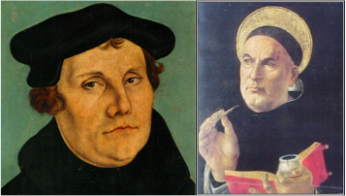
“Where was your Church before Aquinas”
Ever since the Reformation, Roman Catholics have been fond of asking, “Where was your Church before the Reformation”. Protestants have a good reply to that: “Where was your Church before Aquinas”.
Peter Lombard (in his “Sentences”) summarized church teaching up to that point (approximately 1150). Aquinas later opposed Lombard on one key point (“justification extra nos”, or the external righteousness of Christ), and Luther took up Lombard’s side:
In book 1, Distinction 17 of his famed Sentences, Lombard, discussing religious justification, asked: “Is the love by which we are saved a created habit in our soul, or is it the very person of the Holy Spirit dwelling within us?” Is that which heals and saves a person part of his own nature, something he himself has developed as his own possession [inherent righteousness], or is it the indwelling spirit of God, a divine power in him but not of him [alien righteousness]?
Lombard opted for the latter solution, maintaining that the love by which people love God and their fellow man so as to merit salvation [“merit” being a whole ’nother story] was the spirit of God working internally, without their aid or volition. Man is saved by an uncreated, not a created habit, by uncreated, not created, love, by the holy spirit within, not by an acquired talent he can call his very own. When the young Luther wrote hs commentary on the Sentences in 1509/10, he strongly agreed, against the majority of scholastics, with this interpretation by Lombard.
Thomas Aquinas opposed Lombard in this issue, arguing that saving charity [“charity” being “love” in the Roman Catholic schema] must be a voluntary act arising from a disposition man could call his own.
Roman Catholics claim that Martin Luther was the innovator, but in reality, Thomas Aquinas was a far more extensive innovator than Luther ever was. The problem was, “The Church of Rome” liked what Aquinas had to say, and they canonized it.
The Reformers sought to roll back many of the changes that Aquinas put into place. And in doing so, they relied on earlier traditions than did Aquinas.
It was Aquinas who not only introduced Aristotle to the Roman church, but he wrapped Aristotelian philosophy around Christian doctrine and handed it to “the Church” as a complete package. One that supported the Roman Church’s view of its own authority and necessity.
Friday, September 29, 2017
The Water and the Wine
For Christians who take an interest in the paedocommunion debate, this should be a useful resource:
http://www.latimertrust.org/index.php/publications/studies/60-ls61
Beckwith is nearly always informative and insightful. Of course, paedobaptism is a necessary presupposition. Baptists reject the premise, of which paedocommunion is an extension.
http://www.latimertrust.org/index.php/publications/studies/60-ls61
Beckwith is nearly always informative and insightful. Of course, paedobaptism is a necessary presupposition. Baptists reject the premise, of which paedocommunion is an extension.
Saturday, June 18, 2016
The nullification of the faithful
Pope Francis recently said most Catholic marriages are null. The crisis management team at the Vatican has now issued a revised statement.
The pope isn't saying anything theologically innovative. The valid reception depends on the right intention of the recipient.
But the effect of his statement is to imply that most contemporary married Catholics who were married in the Church, are actually committing fornication.
I'd add that the issue isn't confined to married couples. As we know, a significant percentage of the Catholic clergy are homosexual. Many of them are active homosexuals. When they took holy orders, they had no intention of abstaining from sexual relations. Doesn't that invalidate their ordination? And if they were invalidly ordained, then that nullifies their sacramental actions.
If they baptize your child, that nullifies baptism. Nothing really happened. If they absolve you of sin, that nullifies absolution. Nothing really happened. If they celibates Mass, that nullifies transubstantiation. You're just eating bread.
Friday, April 25, 2014
Sources on the History of Welch's Grape Juice Replacing Wine at the Turn of the Twentieth Century
This past year I gave a Ph.D. presentation on "Evangelicals and the Lord’s Supper: Turning Wine into Grape Juice in Nineteenth-Century America"
Someone asked me to post some selected bibliography from my research:
McCormick, Scott. The Lord’s Supper: A Biblical Interpretation. Philadelphia: Westminster Press, 1966.
See also:
http://www.sermonaudio.com/sermoninfo.asp?SID=322111921180
"From Supper to 'Sacrament': Why the Early Church Moved from Supper to Bread and Wine" by John Mark Hicks [online]
Someone asked me to post some selected bibliography from my research:
Blocker, Jack S.,
and David M. Fahey. Alcohol and
Temperance in Modern History: An International Encyclopedia 2 Vol.
2003.
Burns,
Eric. The Spirits of America: A
Social history of Alcohol. Philadelphia, PA: Temple University Press, 2004.
Chazanof,
William. Welch’s Grape Juice: From
Corporation to Co-operative. Syracuse, NY: Syracuse University Press, 1977.
Hallett, Anthony,
and and Diane Hallett. “Thomas B. Welch, Charles E Welch.” Entrepreneur Magazine Encyclopedia of Entrepreneurs. New York: John
Wiley and Sons, 2008.
Mathison, Keith
A. Given for You: Reclaiming Calvin’s
Doctrine of the Lord’s Supper. Phillipsburg, NJ: P & R Publishing,
2002.
McCormick, Scott. The Lord’s Supper: A Biblical Interpretation. Philadelphia: Westminster Press, 1966.
Moore, Russell. Understanding Four Views On the Lord’s Supper.
Grand Rapids, Mich: Zondervan, 2007.
Norwood,
Frederick Abbott. The Story of American
Methodism: A History of the United Methodists and Their Relations.
Nashville: Abingdon Press, 1974.
O’Brien, Betty A.
“The Lord’s Supper: Fruit of the Vine or Cup of Devils?” Methodist History 31.4.,1993. [This article is particularly helpful]
____________. “The
Lord’s Supper Traditional Cup of Unity or Innovative Cups of Individuality.” Methodist History 32.2., 1994.
Vineland Greater
Chamber of Commerce Membership Directory & Community Guide. “History of
Vineland.” http://www.vinelandcity.org/History.htm
Willard, Frances
Elizabeth. Woman and Temperance: Or, The
Work and Workers of the Woman’s Christian Temperance Union. New York: Arno
Press, 1972.
Williamson, G. I.
Wine in the Bible & the Church. Phillipsburg,
NJ: Pilgrim, 1976.
See also:
http://www.sermonaudio.com/sermoninfo.asp?SID=322111921180
"From Supper to 'Sacrament': Why the Early Church Moved from Supper to Bread and Wine" by John Mark Hicks [online]
Monday, December 13, 2010
The Lord's Supper in Paul
THE LORD’S SUPPER IN PAUL:
AN IDENTITY-FORMING PROCLAMATION OF THE GOSPEL
James M. Hamilton Jr.
AN IDENTITY-FORMING PROCLAMATION OF THE GOSPEL
James M. Hamilton Jr.
In a strange twist of God’s providence, we find ourselves grateful for the ways that the Corinthian church struggled. We are not grateful that they sinned but grateful that their problems provoked Paul to apply the gospel to their lives in ways that continue to instruct. Paul’s letters are occasional, and scholars often observe that
if the Corinthians had not provoked Paul to address their abuse of the Lord’s Table, the Lord’s Supper might not have been directly addressed in his letters.
Paul’s words in 1 Cor 11:17–34 explain that the Lord’s Supper is a proclamation of the gospel made by those who embrace the gospel,those whose identity is shaped by the gospel. In order to establish this thesis we must understand the abuses of the Lord’s Supper in the church in Corinth, and these abuses are tangled up with the other problems in the church that Paul addresses. Throughout 1 Corinthians,
Paul addresses Corinthian error with Christian gospel. The fact that the Lord’s Supper is a proclamation of the gospel made by those who embrace the gospel makes what Paul says about the Lord’s Supper in 1 Corinthians 10–11 relevant to the issues Paul addresses in 1 Corinthians 1–9. (keep reading)
Subscribe to:
Posts (Atom)