Showing posts with label The Roots of the Reformation. Show all posts

Saturday, December 09, 2017

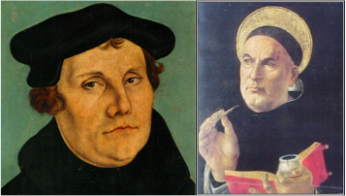
Thomas Aquinas was the Problem; the Reformation was the Solution

“Where was your Church before Aquinas”


Ever since the Reformation, Roman Catholics have been fond of asking, “Where was your Church before the Reformation”. Protestants have a good reply to that: “Where was your Church before Aquinas”.

Peter Lombard (in his “Sentences”) summarized church teaching up to that point (approximately 1150). Aquinas later opposed Lombard on one key point (“justification extra nos”, or the external righteousness of Christ), and Luther took up Lombard’s side:


In book 1, Distinction 17 of his famed Sentences, Lombard, discussing religious justification, asked: “Is the love by which we are saved a created habit in our soul, or is it the very person of the Holy Spirit dwelling within us?” Is that which heals and saves a person part of his own nature, something he himself has developed as his own possession [inherent righteousness], or is it the indwelling spirit of God, a divine power in him but not of him [alien righteousness]?

Lombard opted for the latter solution, maintaining that the love by which people love God and their fellow man so as to merit salvation [“merit” being a whole ’nother story] was the spirit of God working internally, without their aid or volition. Man is saved by an uncreated, not a created habit, by uncreated, not created, love, by the holy spirit within, not by an acquired talent he can call his very own. When the young Luther wrote hs commentary on the Sentences in 1509/10, he strongly agreed, against the majority of scholastics, with this interpretation by Lombard.

Thomas Aquinas opposed Lombard in this issue, arguing that saving charity [“charity” being “love” in the Roman Catholic schema] must be a voluntary act arising from a disposition man could call his own.

Roman Catholics claim that Martin Luther was the innovator, but in reality, Thomas Aquinas was a far more extensive innovator than Luther ever was. The problem was, “The Church of Rome” liked what Aquinas had to say, and they canonized it.

The Reformers sought to roll back many of the changes that Aquinas put into place. And in doing so, they relied on earlier traditions than did Aquinas.

It was Aquinas who not only introduced Aristotle to the Roman church, but he wrapped Aristotelian philosophy around Christian doctrine and handed it to “the Church” as a complete package. One that supported the Roman Church’s view of its own authority and necessity.

Saturday, November 08, 2014

Grace Alone, Faith Alone, Christ Alone

For anyone who'd like a brief and excellent overview of the theological issues that the Reformation was all about, this is it: Grace Alone, Faith Alone, Christ Alone, from a recent Reformation Day conference.

More audio here.

Thursday, October 16, 2014

“The Influence of Patristic Literature upon the Reformation”, Part 2

Nathan Rinne has just published Part 2 of a series with the rough title of “The Influence of Patristic Literature upon the Reformation”:

“In his groundbreaking work on the Italian monk and theologian Ambrose Traversari (1386-1439) Charles L Stinger, professor of history at Buffalo University, describes the revival of patristic studies at the beginning of the 15th century.

According to Stinger, significant catalyst for that revival was the desire on the part of humanists to confront Aristotelian scholastic theology with what they considered to be a superior alternative.

While Stinger’s treatment of the topic ends with the Council of Basel-Ferrara-Florence (1431-47), he makes the somewhat startling claim that a revival in patristic studies would continue all the way into the 17th century as a discernable conflict between patristic and scholastic theology, a conflict that would only come to an end when Protestant theologians “began to return to [Aristotelian] dialectics to analyze the orthodox creedal formulations of the Augsburg Confession and Heidelberg Catechism.”…

Read the entire piece here.

Here is Part 1: “Was a significant aspect of the Reformation a revival of patristic theology?”

Saturday, October 04, 2014

The Influence of Patristic Literature upon the Reformation

The Influence of Patristic Literature upon the Reformation

Relatively unknown is the fact that by the beginning of the 17th century, over 1600 volumes had been printed that contained the writings of the church fathers of both the west and the east. It is these works that provided the content for Jacques Paul Migne’s (1800-1875) massive 386 volume Patrologiae cursus completes. But even more startling, by delving into the question of the publication of just the collected-works editions of the church fathers that appeared between the years of 1460 and 1570, the distinct impression is made that the works of the church fathers in their entirety must have been much more influential in the Reformation period than has up until now been acknowledged. Simply an awareness of the common availability of the writings of the ancient church in the 16th century thus affords a new vista from which the theological developments of the period can be assessed.

Friday, June 21, 2013

The Roots of the Reformation: Indulgences

Indulgences: “Christ’s Satisfaction of Sins was Not Enough”

I’m reading The Roots of the Reformation: Tradition, Emergence and Rupture (by G.R. Evans, Downers Grove, IL: Intervarsity Press, ©2012). This is a work that looks at the issues that were prominent in the Reformation, and traces them back to their origins, either in the Scriptures or in the history of the church. I’m finding this to be a highly useful work in understanding those theological and doctrinal issues that the Reformers addressed.

One of those issues still around is “indulgences”. In 1999, Pope John Paul II issued his Papal Bull Incarnationis Mysterium, on “the mystery of the Incarnation” of the Son of God, which provided the rationale and modern justification for the notion that “indulgences” are still valid and can be given out by the pope.

I’ll look first at how Pope John Paul explained these indulgences, then how they actually “developed” in church history.