Showing posts with label Indulgences. Show all posts

Wednesday, October 23, 2019

Venial sin

i) The Bible doesn't have an exhaustive list of sins.

ii) Catholicism has made-up sins.

iii) The gravity of sin ranges along a continuum. While it's easy to spot the extremes, it's blurry in the middle. So sin doesn't neatly bifurcate into two kinds of sin: mortal and venial. 

iv) Even the same sin can vary in culpability.

v) Outside of Christ every sin is a mortal (i.e. damnable) sin. 

Wednesday, July 11, 2018

Merit offsets

Once upon a time there was a monk named San José del Inmaculado Corazón de María. (To be precise, he wasn't technically a saint at the time. That's what he went by after canonization.) 

During his lifetime, San José was already renown for his supererogatory merit. According to the celestial bank manager at the Thesaurus Meritorum, San José had the highest credit rating of any monk in the past 700 years.

However, San José had one peccadillo: he was a cannibal. His ancestors were Amazonian headhunters, and despite his fervent conversion to the One True Church®, he could never kick the habit. Tofu failed to sate his appetite for something more exotic. 

Although his Father Confessor had reservations about San José's culinary proclivities, his unrivaled merit score made him far too valuable for the monastery to discharge. Besides, so long as his supererogatory merits offset his dietary transgressions, he was still so holy that he could bypass Purgatory with merit to spare. Like a rechargeable phone card, his get-out-of-Purgatory-free card was always topped up with pulsating ergs of merit. On birthdays, he'd indulge (pardon the pun) in a sampler platter from multiple victims, then charge it to his get-out-of-Purgatory-free card. 

He even loaned it out to his bishop in exchange for a daily supply of fresh meat. What his bishop did with it I will leave to your sordid imagination. 

Saturday, September 05, 2015

Papal indulgences


The Catholic Church, instructed by the Holy Spirit and in accordance with sacred Scripture and the ancient Tradition of the Fathers, has taught in the holy Councils and most recently in this ecumenical Council that there is a purgatory and that the souls detained there are helped by the acts of intercession (suffragia) of the faithful, and especially by the acceptable sacrifice of the altar.

Related Canon 30 from the Council of Trent's Decree on Justification (Sixth Session, 1547)

30.  If anyone says that after the grace of justification has been received the guilt is so remitted and the debt of eternal punishment so blotted out for any repentant sinner, that no debt of temporal punishment remains to be paid, either in this world or in the other, in purgatory, before access can be opened to the kingdom of heaven, anathema sit ["let him be anathema" or excommunicated]. 
http://www.crossroadsinitiative.com/library_article/775/Decree_on_Purgatory_Council_of_Trent.html 
1030 All who die in God's grace and friendship, but still imperfectly purified, are indeed assured of their eternal salvation; but after death they undergo purification, so as to achieve the holiness necessary to enter the joy of heaven. 
http://www.vatican.va/archive/ccc_css/archive/catechism/p123a12.htm 
1471 "An indulgence is a remission before God of the temporal punishment due to sins whose guilt has already been forgiven, which the faithful Christian who is duly disposed gains under certain prescribed conditions through the action of the Church which, as the minister of redemption, dispenses and applies with authority the treasury of the satisfactions of Christ and the saints."81 [Paul VI, apostolic constitution, Indulgentiarum doctrina, Norm 1.] 
http://www.vatican.va/archive/ccc_css/archive/catechism/p2s2c2a4.htm

i) If, for the sake of argument, you accept the Tridentine premise, then there's a certain inner logic between purgatory and indulgences. In the Tridenine definition, purgatory involves retributive punishment. It's about guilt. Paying off your debt. Same thing with the treasury of merit. The "satisfactions" of Christ and the saints presume the same forensic category.

If you think there's a treasury of merit which the pope can tap into, then, within that framework, it makes sense to say your purgatorial sentence is subject to commutation or pardon. Someone else paid the debt. Someone else made restitution on your behalf.  

ii) Mind you, even on its own terms, that's dubious. It operates with a quantitative view of guilt, as if as sinner has incurred x units of guilt which may be offset by x units of merit. But why think guilt is quantitative rather than qualitative? There are other problems, but I'll pass on that.

iii) Another problem is the contradiction between the traditional conception of purgatory and the contemporary conception (in Roman Catholicism). The contemporary conception has undergone a paradigm-shift from retributive justice to remedial justice. From objective guilt to subjective corruption. Purgatory is now a process of postmortem sanctification to purify the decedent before he is ready for heaven.

But even if you grant that for the sake of argument, it clashes with the traditional theology of indulgences. If purgatory is necessary to complete your sanctification, then that process can't be accelerated or short-circuited by a papal indulgence. Rather, that would operate at its own pace. However long it takes you to eradicate your sinful disposition. An indulgence would prematurely convey you to heaven, before the refining fire has had time burn away the dross.  

So you end up with a hybrid theology of purgatory and indulgences, combining disparate elements from two incompatible paradigms.  

Monday, October 21, 2013

The Official, Papally-Sanctioned Way to Pay Someone’s Way Out of Purgatory

“God and I decree and grant
that, if you give a certain
sum of money for the repair
 of the church, your relative
gets out of Purgatory”.
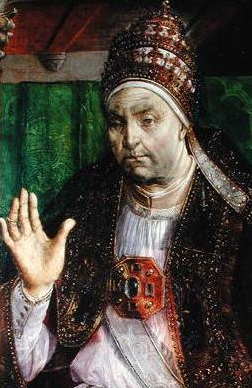
Indulgence for the Dead [From the Bull in favor of the Church of St. Peter of Xancto, Aug. 3, 1476], Pope Sixtus IV (1471-1484)

Roman Catholics tell us that it was the abuse of Indulgences, not the Indulgences themselves, that caused the Reformation. They say The Catholic Church does not now nor has it ever approved the sale of indulgences.

They say “the Church has never taught the selling of indulgences”, meaning it was never a doctrine, and in this, they comfort themselves. It’s not one of those two or three ex cathedra statements that has been issued all through history, and so, a miss is as good as a mile. No harm, no foul, eh?

At some point, though, you’ve got to stop with the scholastic hair-splitting. If it looks like a duck and walks like a duck and has a bill like a duck and quacks like a duck, at some point you are justified in saying, “it really is a duck”.

Well, in this case, it is as close to a doctrine as you can get without it being an “ex cathedra teaching”. Here (while looking up other things), I found this “plenary indulgence”, (with “plenary” meaning “total”) issued by a pope, given in exchange for money.

Denzinger (©1954): 723a In order that the salvation of souls may be procured rather at that time when they need the prayers of others more, and when they can be of benefit to themselves less, by Apostolic authority from the treasure of the Church wishing to come to the aid of the souls who departed from the life united with Christ through charity, and who, while they lived, merited that they be favored by such indulgence; desiring this with paternal selection, in so far as with God's help we can, confident in the mercy of God and in the plenitude of His power, we both [that is, “we the Pope, and God”] concede and grant that, if any parents, friends, or other faithful of Christ, moved in behalf of these souls who are exposed to purgatorial fire for the expiation of punishments due them according to divine justice, during the aforementioned ten year period give a certain sum of money for the repair of the church of Xancto, or a value according to an arrangement with the dean or overseer of said church, or our collector by visiting said church or send it during said ten year period through messengers delegated by the same, we grant as a suffrage a plenary remission to assist and intercede for the souls in purgatory, in whose behalf they paid the said sum of money or the value, as mentioned above, for the remission of punishments.

Denzinger, at least, thought highly enough of this statement to place it in his “Sources of Catholic Dogma”. I wonder if any of the Catholic Answers folks are more knowledgeable than was old Henry Denzinger.

Friday, June 21, 2013

The Roots of the Reformation: Indulgences

Indulgences: “Christ’s Satisfaction of Sins was Not Enough”

I’m reading The Roots of the Reformation: Tradition, Emergence and Rupture (by G.R. Evans, Downers Grove, IL: Intervarsity Press, ©2012). This is a work that looks at the issues that were prominent in the Reformation, and traces them back to their origins, either in the Scriptures or in the history of the church. I’m finding this to be a highly useful work in understanding those theological and doctrinal issues that the Reformers addressed.

One of those issues still around is “indulgences”. In 1999, Pope John Paul II issued his Papal Bull Incarnationis Mysterium, on “the mystery of the Incarnation” of the Son of God, which provided the rationale and modern justification for the notion that “indulgences” are still valid and can be given out by the pope.

I’ll look first at how Pope John Paul explained these indulgences, then how they actually “developed” in church history.