
Showing posts with label bible prophecy. Show all posts
Showing posts with label bible prophecy. Show all posts
Thursday, February 04, 2021
Is there a pattern to the Bible's miracles?
"Is there a Pattern to the Bible’s Miracles?" (Joel Arnold)


Friday, June 24, 2016
Tyre and Babylon in Bible prophecy
I. I was asked to give some examples of fulfilled non-Messianic prophecies.
1. Before discussing examples, we need to back up. For the argument from prophecy to work, the oracle must take place before the event. And there must be something uncanny about the fulfillment. Something that can't reasonably be chalked up to a coincidence or lucky guess.
These conditions can pose a dilemma of sorts inasmuch as unbelievers who think the description is too accurate to be lucky or coincidental will use the correspondence to date the oracle. They will say that just goes to show it must be after the fact! Of course, that becomes a circular, unfalsifiable posture.
2. As I've remarked before, predicting the future can present something of a paradox. If the terms of fulfillment are too recognizable in advance, that can tip people off, which enables them to thwart the prediction. So the description must be puzzling to readers ahead of time. It is necessary to make the terms of fulfillment recognizable after the fact, but not beforehand.
It's kind of like a spy who knows his communications may be monitored, so he must speak in coded terms that are recognizable to his case officer, but not to eavesdroppers.
3. We must rule out self-fulfilling prophecy, where an agent reads the oracle and sets about to make it happen. That's where knowledge of the oracle influences the outcome. That's not be a case of foresight, but imitation.
II. The fall of Babylon
27 who says to the deep, ‘Be dry; I will dry up your rivers’; 28 who says of Cyrus, ‘He is my shepherd, and he shall fulfill all my purpose’ (Isa 44:27-28).
1. Liberals don't think this oracle issued from the preexilic prophet Isaiah. Rather, they think Isa 40-55 is exilic. However, even on a liberal timeframe, the reference to Cyrus (v28) is anachronistic since he's a borderline postexilic figure. So even on a liberal dating scheme, this would still involve a genuine prediction about someone who'd be unknown to the original audience. Therefore, liberals salvage their position by stipulating that "Cyrus" must be a subsequent scribal interpolation. There is, of course, no textual evidence for that hypothesis. It's a necessary postulate to shore up the liberal position.
2. Another complication is the meaning of v27, and its relation to v28. Here's what one liberal commentator proposes:
As a whole, vv26b-28a work in the reverse of historical order, from Yhwh's ultimate intention (v26b) via the event that will make it possible (v27) to the means of that event's taking place and the intention's being fulfilled (v28a). In that context, v27 can hardly be simply a reference back to creation or Red Sea…nor is it merely a general statement. While it no doubt indicates that Babylon can be overcome, it would be prosaic to refer it simply to Cyrus' famous alleged diverting of the Euphrates to facilitate his capture of Babylon, referred to by Herodotus (I, 191) and Xenophon (Cyropedia 7). J. Goldingay, The Message of Isaiah 40-55 (T&T Clark, 2005), 258-259.
i) He concedes that this is a prediction about the fall of Babylon.
ii) He concedes that v27 can't simply be stock imagery about the creation or Red Sea crossing.
iii) Although he discounts a reference to Cyrus diverting the Euphrates, he cites two ancient historians who say that's what Cyrus did. Should he be so dismissive of multiple, independent attestation?
iv) Given that the reference to Cyrus occurs right on the heels of Yahweh's threat to "dry up the rivers" of Babylon, in the context of an oracle about the impending downfall of Babylon, surely the inference is irresistible that it does, indeed, refer to Cyrus diverting the Euphrates upstream so that his troops could use the dry river bed (or drained canals) to walk right under the defensive walls of Babylon.
v) He says a reference to Cyrus diverting the Euphrates would be "prosaic". Well, if you think the viewpoint of the passage is retrospective, then that might be prosaic. If, however, you think the viewpoint of the passage is prospective, then it would be astounding that a prophet could not only anticipate (and name!) the rise of Cyrus, but anticipate the ingenious tactic he used to sidestep Babylon's reputedly impregnable defensive system.
There is, moreover, corroborative evidence to support the accounts of Herodotus and Xenophon:
As part of the rebuilding of the new palace area on the citadel Nebuchadrezzar cleared and rebuilt the main canal…The location of more than twenty named canals in and around the city is currently a subject being studied…This site [Opis] for the northernmost defense wall for the Babylonian area suits the operation by Cyrus when he diverted the River Euphrates at such a distance as not to arouse immediate suspicion. This allowed the element of surprise for the attack on the city along the dried-up river and canal beds which gave access under and through the walls into the citadel itself. D. J. Wiseman, Nebuchadrezzar and Babylon (Oxford, 1991), 61-62.
Herodotus (1. 191) indicates that the Persians gained entrance into Babylon by diverting the Euphrates River. Some scholars find this difficult to accept. But as Herodotus accurately described it, and as the excavations of Robert Koldewey confirmed, the city of Babylon was not only bisected by the Euphrates but was also penetrated by many canals. The height of the Euphrates would have been at its lowest level at this time of year, normally about twelve feet deep. If the famine (mentioned in more than one text) was caused by a dry year, the level would have been even lower. E. Yamauchi, Persia and the Bible (Baker, 1990), 86.
Not only is the rise of Cyrus naturally unforeseeable, but the stratagem he used to circumvant Babylon's defense system is naturally unforeseeable.
IV. The fall of Tyre
26 In the eleventh year, on the first day of the month, the word of the Lord came to me: 2 “Son of man, because Tyre said concerning Jerusalem, ‘Aha, the gate of the peoples is broken; it has swung open to me. I shall be replenished, now that she is laid waste,’ 3 therefore thus says the Lord God: Behold, I am against you, O Tyre, and will bring up many nations against you, as the sea brings up its waves. 4 They shall destroy the walls of Tyre and break down her towers, and I will scrape her soil from her and make her a bare rock. 5 She shall be in the midst of the sea a place for the spreading of nets, for I have spoken, declares the Lord God. And she shall become plunder for the nations, 6 and her daughters on the mainland shall be killed by the sword. Then they will know that I am the Lord.7 “For thus says the Lord God: Behold, I will bring against Tyre from the north Nebuchadnezzar[ king of Babylon, king of kings, with horses and chariots, and with horsemen and a host of many soldiers. 8 He will kill with the sword your daughters on the mainland. He will set up a siege wall against you and throw up a mound against you, and raise a roof of shields against you. 9 He will direct the shock of his battering rams against your walls, and with his axes he will break down your towers. 10 His horses will be so many that their dust will cover you. Your walls will shake at the noise of the horsemen and wagons and chariots, when he enters your gates as men enter a city that has been breached. 11 With the hoofs of his horses he will trample all your streets. He will kill your people with the sword, and your mighty pillars will fall to the ground. 12 They will plunder your riches and loot your merchandise. They will break down your walls and destroy your pleasant houses. Your stones and timber and soil they will cast into the midst of the waters (Ezk 26:1-12).
i) Even a liberal commentator like Allen defends the basic accuracy of Ezekiel's prediction. Nebuchadnezzar's campaign against Tyre was successful:
The siege was successful and Tyre did pass into Babylonian control. In a list of royal hostages at Nebuchadnezzar's court, to be dated about 570 BC, the king of Tyre has the initial place…About 564 BC, Baal, Ethbaal's successor as king of Tyre, was replaced by a Babylonian High Commissioner. L. Allen, Ezekiel 20-48 (Word, 1990), 109.
ii) However, that's not the most impressive feature of the oracle. The oracle would be baffling to the original readers due to its detailed description of siege warfare. Because Tyre was an island fortress, it would normally be impervious to the techniques of siege warfare. That's a land-based operation.
Moreover, it's not as though Ezekiel was ignorant of Tyre's geography. He repeatedly mentions its marine setting. Hence, we'd expect Ezekiel to describe a naval bombardment rather than siege warfare. On the face of it, then, his description is nonsensical and technically infeasible.
Yet natural expectations to the contrary notwithstanding, it turns out that Ezekiel was prescient. 250 years later, Alexander the Great built a causeway from the mainland to the island. That enabled him to bring siege works to bear on fortified city.
But historians were still perplexed at how Alexander could build a causeway across a kilometer of ocean. Only in the late 20C, after scientific investigation, was it discovered that a submerged sandbar connected Tyre to the mainland. Alexander was able to construct his causeway on that natural platform:
Although Nebuchandezzar initiated the fulfillment of the oracle, Alexander completed the fulfillment of the oracle. Yet it would be naturally impossible to foresee Alexander's engineering feat.
Thursday, June 04, 2015
10 Reasons Why the Amillennial Concurrent-Recapitulation Framework of the Book of Revelation Does NOT Work
 http://www.alankurschner.com/37
In part 2, I gave about 10 reasons against the concurrent-recapitulatory interpretation of the book of Revelation while arguing for the consecutive-progressive framework.
Seals, Trumpets, Bowls – At the Same Time or One After the Other?
Consecutive-Progressive
The prewrath position interprets a sequential chronological framework for the seals, trumpets, and bowls. That is, the seal-trumpet-bowl septets (sets of seven) will happen in a consecutive-progressive fashion with each septet consecutively following each other. For example, the trumpet septet cannot begin until the seventh seal is opened; and the bowl septet cannot begin before the seventh trumpet is blown. The last judgment element of the day of the Lord’s wrath will be the seventh bowl. Accordingly, the seventh seal and the seventh trumpet serve as transitions to the next set of God’s climaxing judgments, culminating with the seventh bowl.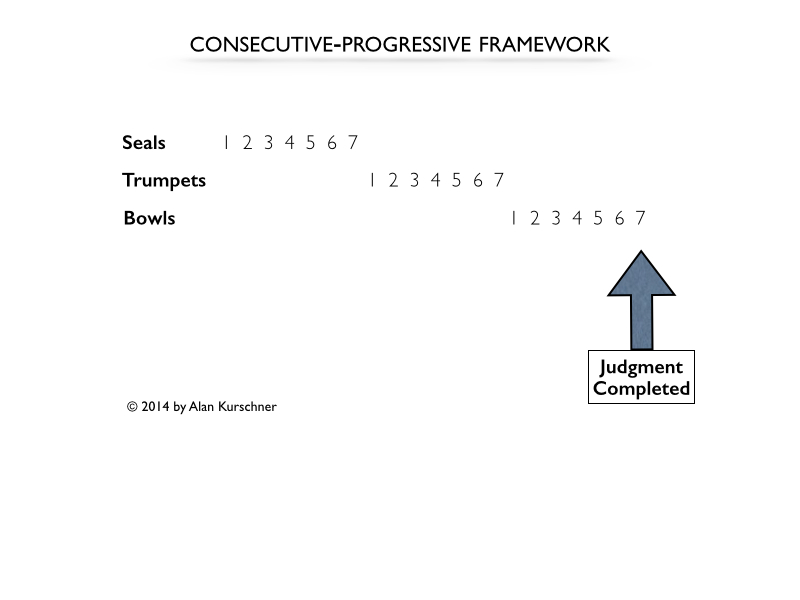
Concurrent-Recapitulation
Posttribulationists (and Amillennialists) subscribe instead to a concurrent-recapitulation framework with the septets occurring at the same time with the judgment elements giving different emphases or perspectives. For example, it is said that the sixth seal, sixth trumpet, and six bowl describe the same event from a different angle. Accordingly, the last element in the day of the Lord’s wrath describes the seventh of each septet; thus, the seventh seal, seventh trumpet, and seventh bowl is the same event from different perspectives. And there are those posttribulationists who hold that it does not describe the exact same event, but they affirm that the three elements occur roughly at the same time. For all practically purposes, the main point is that both of these posttrib interpretations do not view the trumpets and bowls occurring after the seventh seal is opened.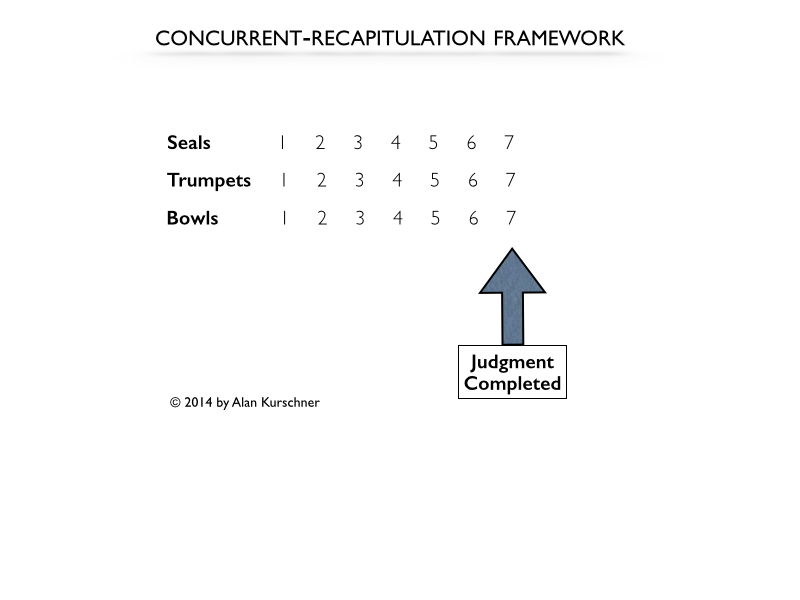
I should note that this debate does not hinge on whether each judgment element within the septets succeed each other; that is not the issue. The main question is: does each of the three septets themselves succeed each other (consecutive) or do they simultaneously unfold (concurrent)? My aim is to demonstrate that the concurrent view is flawed. I will also argue for the consecutive nature to the three septets, showing that the seventh seal does not depict the culmination but the introduction to the day of the Lord via the seven trumpets and culminating in the seven bowls. The following reasons are now given against this concurrent-recapitulatory framework of the septets, while at the same time, I will show the consecutive-progressive structure is the most natural interpretation.
The Seventh Seal Prepares for the Trumpets
"Now when the Lamb opened the seventh seal there was silence in heaven for about half an hour. Then I saw the seven angels who stand before God, and seven trumpets were given to them." (Rev 8:1–2 emphasis mine) In this passage, there is an explicit cause and effect action between the opening of the seventh seal and the introduction to the seven trumpets. It is difficult how any interpreter can read the trumpets happening before the seventh seal is opened. It is a clear contradiction according to Revelation 8:1–2. The opening of the seventh seal prepares for the trumpets. In addition, when the seventh seal is opened, there is a moment of silence functioning to contrast with the ensuing booming sounds: “Then the angel took the censer, filled it with fire from the altar, and threw it on the earth, and there were crashes of thunder, roaring, flashes of lightning, and an earthquake” (Rev 8:5). Jauhiainen makes an excellent point regarding the silence:The recapitulation theory would be more convincing if the sixth seal were silence and the seventh the ‘end’, and not vice versa, as John has them. Beale (Revelation, 125, 446–54) attempts to address this problem by claiming that it is ‘clear from repeated references to silence in the OT and Jewish apocalyptic writings’ that silence is ‘a figurative expression of judgment’ (125). He is correct in seeking a link between silence and judgment in the primary OT background texts he adduces, Hab 2:20, Zeph 1:7 and Zech 2:13. However, the contexts of these references to silence suggest that silence is not ‘an expression of judgment’ but rather something that precedes judgments and/or the Day of the Lord. Thus in Zephaniah the reason for silence is given in the same verse: ‘for the day of the Lord is near.’Therefore, the opening of the seventh seal is the last condition for the scroll to be opened, encompassing the ensuing trumpet judgments (cf. Rev 8:1–6).
The Septets Increase in Intensity and Scope
The narrative of the seals, trumpets, and bowls conspicuously intensify. The seals exhibit “natural” events: wars, famine, plague, and bloodshed; while the trumpets and bowls exhibit “supernatural” events such as hideous demonic creatures torturing the wicked, massive divine devastation on the earth, etc. Further, the scope of activity progressively intensifies; for example, the fourth seal mentions a quarter of the earth, the trumpets a third of the earth, and the bowls affect the whole earth. In addition, the seals encompass believers and unbelievers, with the trumpets targeting specifically the ungodly. And while the bowls are also directed to the ungodly, its focus is on the beast’s kingdom and his subjects (e.g., bowls 1, 3, 5, 6). These factors demonstrate the septets do not recapitulate the same events; instead, they exhibit three separate consecutive series of judgments: the seals function as precursors to the day of the Lord’s wrath, the trumpets initiate his wrath, and the bowls execute the completion of his wrath.Confirmation from Jesus
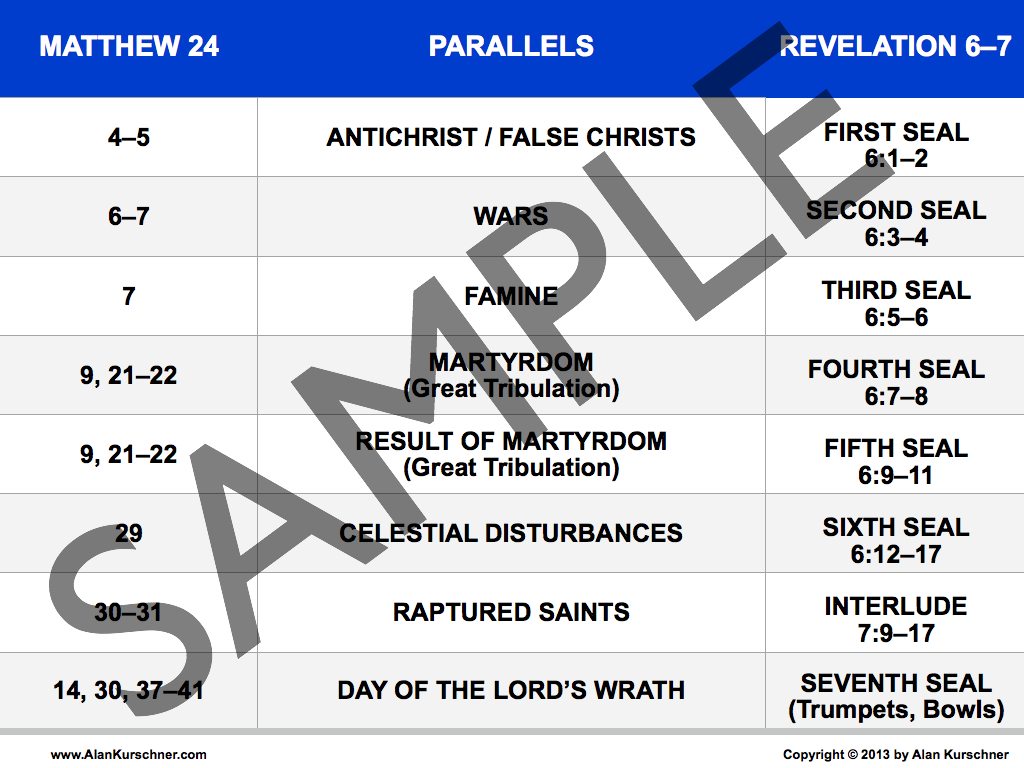
Jesus’ teaching on the beginning of birth pangs, great tribulation, the celestial sign, and the gathering of the elect corresponds with the seven seals (see this chart). Jesus warned not to confuse the end with the beginning of birth pangs. He taught the great tribulation will happen before his return signaled by the celestial disturbance. This supports that the seals should be distinguished from the wrath in the trumpets and bowls.The Fifth-Seal Martyrs
The fifth-seal martyrs cry out to God for justice and implore him to avenge their blood: “How long, Sovereign Master, holy and true, before you judge those who live on the earth and avenge our blood?” (Rev 6:10). This clearly shows the day of the Lord’s wrath has not begun; thus to place any trumpet or bowl judgments before the fifth seal is contradictory. In addition, the prayers of the martyrs are about to be answered after the seventh seal is opened through the trumpet judgments (Rev 8:1–4), connecting it back to their supplications in the fifth seal.The Sixth-Seal Celestial Event
The sixth seal signals the impending wrath of God, not the culmination of it. Joel’s parallel passage reads, “I will produce portents both in the sky and on the earth—blood, fire, and columns of smoke. The sunlight will be turned to darkness and the moon to the color of blood, before the day of the LORD comes—that great and terrible day!” (Joel 2:30–31). This celestial disturbance causes the ungodly in the sixth seal to flee to the caves because they recognize the impending wrath of God (Rev 6:15–17). Luke also narrates the wrath of God ensuing the celestial event (Luke 21:25–36; cf. Matt 24:29–30). Therefore, it is mistaken to place any trumpet or bowl judgments before the sixth seal.Destruction of the Earth Happens After—Not Before—the Seventh Seal
In Revelation 7 there is an interlude portraying two groups being delivered-protected, one on earth and the other in heaven. The group on earth are seen to be 144,000 Jews. A seal is given on their foreheads as protection from the coming wrath: “Do not damage the earth or the sea or the trees until we have put a seal on the foreheads of the servants of our God” (Rev 7:3). This verse should put to rest any doubt the trumpets and bowls happen before the seventh seal. Notice the earth, sea, and trees are not destroyed up to this point before the seventh seal is opened. It is only when the seventh seal is opened the first two trumpet judgments begin to destroy the earth, sea, and trees: The first angel blew his trumpet, and there was hail and fire mixed with blood, and it was thrown at the earth so that a third of the earth was burned up, a third of the trees were burned up, and all the green grass was burned up. Then the second angel blew his trumpet, and something like a great mountain of burning fire was thrown into the sea. A third of the sea became blood, and a third of the creatures living in the sea died, and a third of the ships were completely destroyed. (Rev 8:7–9) It is a contradiction to claim otherwise. Moreover, the fifth trumpet describes demonic-locust creatures being commanded, “not to damage the grass of the earth, or any green plant or tree, but only those people who did not have the seal of God on their forehead” (Rev 9:4). This trumpet judgment has in view the protective seal on their forehead; thus, it is a contradiction to place the fifth trumpet before the seventh seal! (Rev 7:3).Woe! Woe! Woe!
The last three trumpets are identified ominously as three woes (ouai): “Then I looked, and I heard an eagle flying directly overhead, proclaiming with a loud voice, “Woe! Woe! Woe to those who live on the earth because of the remaining sounds of the trumpets of the three angels who are about to blow them!” (Rev 8:13). The three woes convey the finality and intensity of God’s wrath, along with the devastating painful effects upon the ungodly. The temporal language in Revelation 9:12 also shows past action (“The first woe has passed”) and future action (“but two woes are still coming after these things”). This demonstrates two things: (1) the trumpet judgments follow a sequence, and (2) they show uniqueness distinguishing them from the seals and the bowl judgments. Thus, the trumpet judgments are not the seals and bowls “expressed from different perspectives.”Incompatible Depictions
The concurrent theory points out similarities between the septets, especially the trumpet and bowl septets. For example, it is argued, since the fourth trumpet and the fourth bowl relates to the sun, they must refer to the same event, or at least occur at the same time. But a closer look shows they are divergent elements. In the fourth trumpet, the sun is partially darkened; in contrast, the fourth bowl depicts heat scorching the ungodly (Rev 8:12; 16:8–9).Theophanic Lightning, Thunder, Earthquake
The climactic theophanic judgment in the seventh bowl reads: “Then there were flashes of lightning, roaring, and crashes of thunder, and there was a tremendous earthquake—an earthquake unequaled since humanity has been on the earth, so tremendous was that earthquake.” (Rev 16:18) There are two other similar theophanic statements in Revelation 8:5 and 11:19 (three if you count Revelation 4:5). Concurrent interpreters argue that these instances represent the same event because of their similarity. But similarity does not equal identity. A closer reading shows in each instance the theophanic depiction intensifies and anticipates Revelation 16:18, which is the most intense theophany of them all, the consummation of God’s judgment. It is also not clear how a recapitulation could be valid with Revelation 4:5 portraying the throne room happening before any seals are opened! All of this leads Jauhiainen to comment:Granted that 8:5 and 11:19 anticipate 16:18–21, this intensification would seem to indicate that the consummation of temporal judgments is approaching, and not that it has already been reached in 8:1 and then recapitulated twice. Thus, in 8:5 the formula heralds the coming of God in judgment, symbolized by the trumpets.[…] and 11:19 looks forward to the pouring out of the bowls. The last bowl in 16:18–21 completes the judgments, together with an emphasis on the uniqueness of the final earthquake and with the voice from the throne saying, ‘It is done!’
God’s Wrath is Finished
Revelation 15:1 reads: “Then I saw another sign in heaven, great and amazing, seven angels with seven plagues, which are the last, for with them the wrath of God is finished” (ESV). This verse contains a sequence of God’s wrath, which says the seven plagues (bowls) are “last” (eschatos). This strongly implies the trumpet septet precedes the bowls because “with them the wrath of God is finished (teleō).” In other words, the bowl judgments will fulfill God’s final purpose in the day of the Lord. Thus, it is unnatural to interpret the bowl septet happening at the same time as the trumpet septet. The natural reading, instead, conveys the bowls following the trumpets.The Imagery of the “Bowl”
The trumpet judgments require a substantive time to unfold; for example, the fifth trumpet lasts five months. In contrast, the nature and purpose of the bowl judgments occur rapidly. The New Testament mentions at least fifteen different vessels, jars, bowls, baskets, and other containers in antiquity. In our instance, the term for “bowl” is phialē, meaning a “broad, shallow bowl.” This choice of imagery of “broad and shallow” is not arbitrary since is connotes a swift judgment, for the pouring out of God’s final wrath will happen quickly. This imagery also evokes a salvo of bowls being emptied like a grand finale to a fireworks display, in contradistinction to the imagery of the trumpet judgments.Conclusion
The collective reasons above establish that the book of Revelation intends a consecutive-progressive framework. The concurrent-recapitulatory theory fails because it forces the trumpets and bowls to unfold before the seventh seal is opened. The opening of the seventh seal does not culminate the day of the Lord's wrath—it initiates it. The posttrib presupposition that the second coming begins in Revelation 19 with Christ in the sky with his armies causes a strain in the natural reading of Scripture; in this case, collapsing together the seals, trumpets, and bowls to make the resurrection event in Revelation 7 happen in association with the Armageddon event in Revelation 19. Further, it is a contradiction, as argued above, to place God's wrath before the seventh seal is opened, as well as before the resurrection in Revelation 7. Prewrath takes the event of Christ in the sky with his heavenly armies preparing for the battle of Armageddon as one of the last judgment events after the trumpet and bowl judgments. The parousia does not begin with Armageddon; it begins between the sixth seal and the seventh seal, when God's people receive their resurrected bodies and enter the Father's presence as portrayed in Revelation 7.Links mentioned:
www.alankurschner.com/2015/05/28/seals-trumpets-bowls-in-the-book-of-revelation-concurrent-recapitulation-or-consecutive-progressive-part-1-of-2-ep-36/
www.alankurschner.com/wp-content/uploads/2013/06/Prewrath-Charts.003.jpg
Subscribe to:
Posts (Atom)