Showing posts with label Peter Lampe. Show all posts

Thursday, January 05, 2017

Debunking an over-used Irenaeus quote on “Papal Succession”

In this definitive work on Irenaeus
the city of Rome is not even mentioned.
Someone posted this quote from Irenaeus in response to Jerry Walls’s comment on Facebook about the Roman Catholic Church having claimed to have “compiled the Bible” (and by the way, Jerry agrees it is "Simplistic, self-serving hubris":

The great early Father, St. Irenaeus in the mid-100’s felt a little differently (Against Heresies III, 2-4):

[T]hat tradition derived from the apostles, of the very great, the very ancient, and universally known Church founded and organized at Rome by the two most glorious apostles, Peter and Paul; as also [by pointing out] the faith preached to men, which comes down to our time by means of the successions of the bishops. For it is a matter of necessity that every Church should agree with this Church, on account of its preeminent authority, that is, the faithful everywhere, inasmuch as the tradition has been preserved continuously by those [faithful men] who exist everywhere.

The blessed apostles, then, having founded and built up the Church, committed into the hands of Linus the office of the episcopate. Of this Linus, Paul makes mention in the Epistles to Timothy. To him succeeded Anacletus; and after him, in the third place from the apostles, Clement was allotted the bishopric. This man, as he had seen the blessed apostles, and had been conversant with them, might be said to have the preaching of the apostles still echoing [in his ears], and their traditions before his eyes. Nor was he alone [in this], for there were many still remaining who had received instructions from the apostles....

Soter having succeeded Anicetus, Eleutherius does now, in the twelfth place from the apostles, hold the inheritance of the episcopate. In this order, and by this succession, the ecclesiastical tradition from the apostles, and the preaching of the truth, have come down to us. And this is most abundant proof that there is one and the same vivifying faith, which has been preserved in the Church from the apostles until now, and handed down in truth.”

Jerry referred them to Peter Lampe; someone else commented that “if you don’t have a succinct answer, you probably don’t have an answer”. Here is a succinct response that I posted:

Tuesday, March 25, 2014

The role of “critical scholarship” when looking at ancient works

I’ve been responding to some of the comments in the Called to Communion thread following up on Brandon Addison’s excellent article there describing the ancient church at Rome:

Ray Stamper #28, you said:

as a man formed within and by the intellectual presuppositions dominating academic historical-critical scholarship, the methodological assumptions behind Lampe’s approach to the documentary monuments of the earliest Christian centuries are precisely the same methodological assumptions which determine his approach to the sacred canon.

How do you know this? Do you know the man? Or are you just speculating?

Further down you say:

Far from irrelevant, Lampe’s methodological assumptions most certainly threaten the confessional standards of Reformed churches – and that is the point at hand.

In fact, Lampe’s work on Chapter 16 of Romans (arguing that it was a part of the original document and not something added-on later) is state-of-the-art conservative scholarship, cited by Schreiner and Moo (themselves conservative exegetes who honor the text), for example, in their commentaries on Romans. Both of those men are knowledgeable, confessional Protestants, fully versed in “Lampe’s methodological assumptions”, and not, in any way, as you say, “threatened”.

So if this is your “point at hand”, then it seems as if you need to re-think it.

Monday, March 24, 2014

History vs. Roman Catholicism

Brandon Addison
Brandon Addison has published a 25,000 word guest article at the Called to Communion site, entitled (by the CTC folks) “The Quest for the Historical Church: A Protestant Assessment”.

Brandon is a 2012 MDiv graduate of WSCal. He’s seen friends of his, including Joshua Lim, be sucked in by the seemingly slick presentation of Roman Catholicism proffered by Called to Communion.

In the article, Brandon addresses head-on the Called to Communion claim that the Roman Catholic Church is “The Church that Christ Founded”, from a historical perspective, largely by analyzing head-on the notion of “apostolic succession” – showing that it was a later development that was not part of the thinking of the first-century church.

He begins by pointing out that what he has to say is not idiosyncratic, but rather is commonly held, even among Roman Catholics, that “the general consensus among Roman Catholic scholars is that the notion of an episcopate originating with Peter is virtually non-existent in the academic world”.

Sunday, January 26, 2014

Bryan can’t see the forest while scrutinizing individual trees

Bryan has responded to my post below.

http://www.calledtocommunion.com/2010/09/modern-scholarship-rome-and-a-challenge/#comment-76686

Here’s the problem with John’s claim. All the historical evidence Lampe cites in his book, even when taken together in aggregate, is fully compatible with there being a monarchical bishop in Rome. Twelve times zero is still zero; it isn’t greater than one times zero. Because each of the pieces of evidence Lampe cites (not just the twelve Brandon picked out as the strongest pieces of evidence, but the other things Lampe discusses in his book) is fully compatible with there being a monarchical bishop in Rome, putting them all together does not provide any increase in the likelihood of the truth of Lampe’s conclusion, over the likelihood of its falsity.

In fact, there are several problems.

First of all, Bryan is misconstruing again. Lampe’s evidence doesn’t even address “bishops in Rome” up to a certain point. Lampe’s aim is to draw a picture. In fact, he crafts a vivid account of the churches in the city of Rome, using the positive historical evidence that we do have.

Bryan Cross: Is he lazy, dishonest, or not as smart as everyone thinks he is?

Bryan Cross has apparently been caught with his hand in the cookie jar. Looking at his comment in response to Brandon’s review, it appears as if the choices in the headline here are the three choices.

I’ve left the following in response to his comment at the Called to Communion thread where this discussion is going on. He has rejected the following comment (which is identical to what I’ve posted in the comments here):

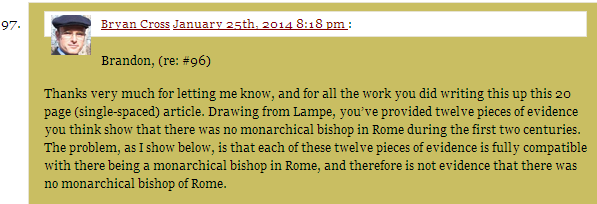
Bryan, in comment #97, you say:

Drawing from Lampe, you’ve provided twelve pieces of evidence you think show that there was no monarchical bishop in Rome during the first two centuries. The problem, as I show below, is that each of these twelve pieces of evidence is fully compatible with there being a monarchical bishop in Rome, and therefore is not evidence that there was no monarchical bishop of Rome.

[I said]: This is a mischaracterization of Brandon’s entire piece. It is a subtle mischaracterization, though, and it coheres with my claim that it is your method to selectively utilize the tactic of “mental reservation” to make your points for you.

Friday, January 24, 2014

An Extended Review of Peter Lampe’s “From Paul to Valentinus: Christians at Rome in the First Two Centuries”

From Paul to Valentinus: Christians at Rome in the First Two Centuries
From Paul to Valentinus: Christians at Rome
 in the First Two Centuries
Brandon Addison has posted an Extended Review of Peter Lampe’s “From Paul to Valentinus” at https://reformation500.wordpress.com/. This is something that I myself have wanted to do for a long time, but have never had the time to do it.

The papacy is critical to Roman Catholic sensibilities about itself. Now with the doctrine of “papal infallibility”, it is a cornerstone of Roman Catholic epistemology – you’ll hear some apologists saying things like “because of the papacy (and papal authority), we have the ability to know with certainty what’s really ‘divine revelation’ and what’s merely ‘human opinion’.”

Growing up as a Roman Catholic, I was certain that the papacy had been a strong, firm, well-defined institution from the days of Peter – when he founded the church at Rome and was the first bishop there – his bishoprick extending for 25 years. Then there was a grand and glorious history of popes down through the next 2000 years.

In holding to the doctrine of the papacy (and it is a doctrine of the Roman Catholic church – and remember, doctrines can never change), Roman Catholics have intertwined this doctrine tightly with the history behind it. In fact, with reference to the papacy, history is so intertwined with dogma that it is referred to by theologians as a “dogmatic fact”.

This has been defined by an eminent Catholic theologian as “historical fact so intimately connected with some great Catholic truths that it would be believed even if time and accident had destroyed all of the original evidence therefor” (Shotwell and Loomis, in the 1927 introduction to their work “The See of Peter” (New York, NY: Columbia University Press, ©1927, 1955, 1991), pgs xxiii–xxiv).

Shotwell and Loomis were among the first researchers of the 20th century to explore the history of the papacy in depth, but they weren’t the last. Others explored the history and theology of that period, and exploded the notion that Peter was at Rome for 25 years – if at all. Oscar Cullman’s 1953 work “Peter: Disciple, Apostle, Martyr” applied historical and exegetical methodologies to the New Testament (and post-NT writings) about Peter and concluded that yes, while Peter was important, there was no such thing as “apostolic succession”. Cullman was a Lutheran and a very ecumenically-minded one at that. He was one of the Protestant observers at Vatican II. Karl Barth joked with him that his tombstone would carry the inscription “advisor to three popes.”

But Lampe has provided the crowning achievement on a century’s-worth of work on the earliest papacy. Relying on a methodology that seemingly scrutinizes every scrap of paper from that period (Rome in the first two centuries), every grave and cemetery, every inscription, every archaeological find, Lampe provides a clear and compelling picture of what it was like to be a Christian in Rome during those centuries.

And while being totally non-polemical throughout the whole project, Lampe’s work gives us a keen insight into Rome in the first two centuries that almost totally excludes the notion that there was a pope, or a “successor to Peter”, or in fact, that there was even a single bishop in charge in the city during those first two centuries.

Monday, July 15, 2013

Updates on the recent Edinburgh Peter Conference

The Centre for the Study of Christian Origins located at Edinburgh recently held a conference on Peter in History. As you might guess, the historical work here will be extremely important. Peter Lampe, Markus Bockmuehl, Tobias Niklas, Timothy Barnes, Margaret Williams, and Larry Hurtado all were speakers at the conference.

They’ll be dribbing out some of the results from the conference before a book is published a year or 18 months down the road. You can check on the progress here.

Sunday, June 23, 2013

Conference on Peter in Peter in Earliest Christianity: Last Chance to Register

The Centre for the Study of Christian Origins will be sponsoring a Conference on Peter, July 4-6, 2013, at the University of Edinburgh, Scotland.

The Peter in Earliest Christianity Conference will cover the topics of the historical Peter, Peter in Galilean and Roman Archaeology and Peter in the first three centuries. Speakers will include Timothy Barnes, Markus Bockmuehl, Sean Freyne, Larry Hurtado, Peter Lampe, Tobias Nicklas, and Margaret Williams.

http://christianorigins.co.uk/peterconference/

There’s still a chance to register:

http://christianorigins.co.uk/2013/06/23/peter-conference-information-for-delegates-and-last-chance-to-register/

My understanding (from comments I’ve left on Dr. Hurtado’s blog) is that the papers from this conference will be published in a single work some time after the conference. That’s something to look forward to. Still, I dearly wanted to attend this conference, simply as a way of meeting some of the writers whose work I myself have been writing about these last few years. But my recent employment situation has suggested otherwise.

Dr. Hurtado says “There are now some 50 already registered, but we could accommodate another 15-20.”

Saturday, June 18, 2011

Understanding the Early Development of the House Churches in Rome, Part 3

Part 1
Part 2

I want to take a look at one of the “travel” paragraphs in Acts:
After three months we set sail in a ship that had wintered in the island, a ship of Alexandria, with the twin gods [the Greek gods Castor and Pollux] as a figurehead. Putting in at Syracuse, we stayed there for three days. And from there we made a circuit and arrived at Rhegium. And after one day a south wind sprang up, and on the second day we came to Puteoli. There we found brothers and were invited to stay with them for seven days. And so we came to Rome. And the brothers there, when they heard about us, came as far as the Forum of Appius and Three Taverns to meet us. On seeing them, Paul thanked God and took courage. And when we came into Rome, Paul was allowed to stay by himself, with the soldier that guarded him (Acts 28:11-16).
Having owned a study Bible most of my adult life, I can testify that this is one of those passages that I read over quickly, maybe referencing a nearby map, and then skipping on to “meatier” topics.

But this is a first-person factual account upon which an historian, who naturally looks to such attested accounts, can hang his hat. By the time Paul first got to Rome, there were Christians there.