Thursday, June 04, 2015

10 Reasons Why the Amillennial Concurrent-Recapitulation Framework of the Book of Revelation Does NOT Work

Alan Kurschner itunes 600 http://www.alankurschner.com/37

In part 2, I gave about 10 reasons against the concurrent-recapitulatory interpretation of the book of Revelation while arguing for the consecutive-progressive framework.


Seals, Trumpets, Bowls – At the Same Time or One After the Other?

Consecutive-Progressive
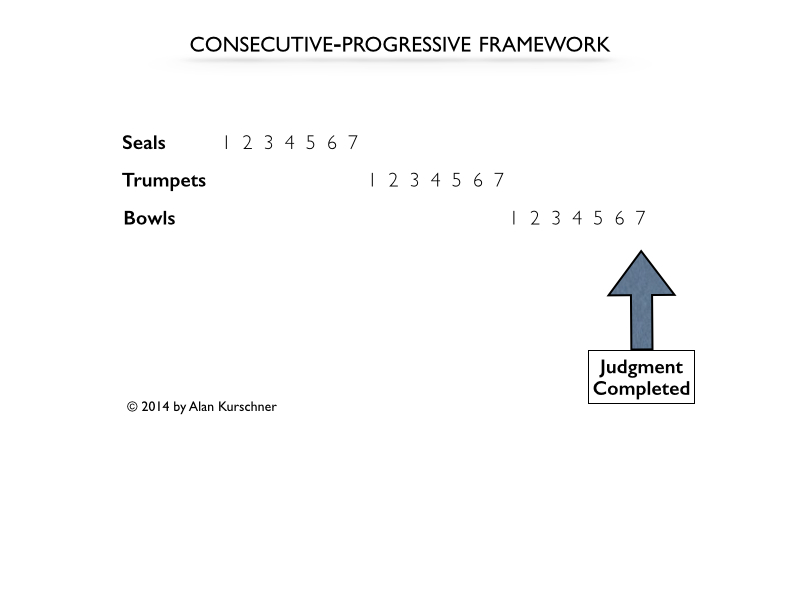
The prewrath position interprets a sequential chronological framework for the seals, trumpets, and bowls. That is, the seal-trumpet-bowl septets (sets of seven) will happen in a consecutive-progressive fashion with each septet consecutively following each other. For example, the trumpet septet cannot begin until the seventh seal is opened; and the bowl septet cannot begin before the seventh trumpet is blown. The last judgment element of the day of the Lord’s wrath will be the seventh bowl. Accordingly, the seventh seal and the seventh trumpet serve as transitions to the next set of God’s climaxing judgments, culminating with the seventh bowl.
  prewrath, seals, trumpets, bowls.001
Concurrent-Recapitulation
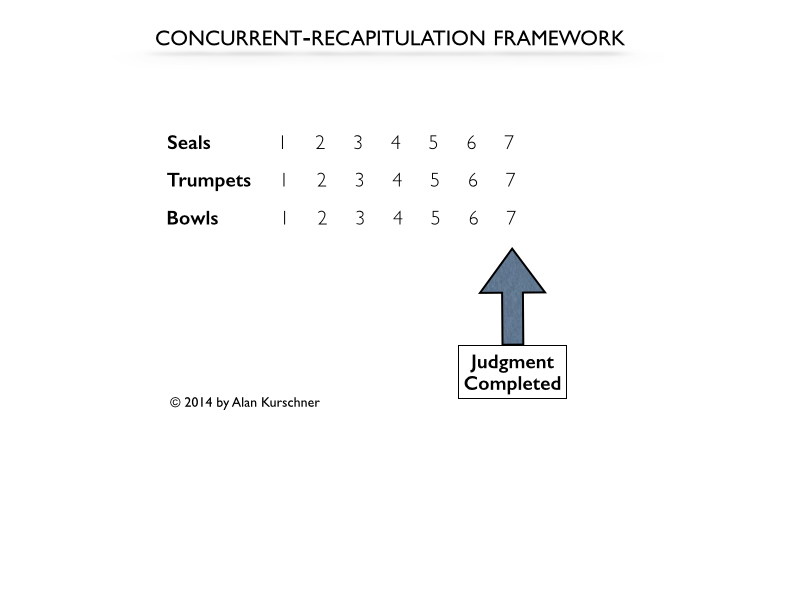
Posttribulationists (and Amillennialists) subscribe instead to a concurrent-recapitulation framework with the septets occurring at the same time with the judgment elements giving different emphases or perspectives. For example, it is said that the sixth seal, sixth trumpet, and six bowl describe the same event from a different angle. Accordingly, the last element in the day of the Lord’s wrath describes the seventh of each septet; thus, the seventh seal, seventh trumpet, and seventh bowl is the same event from different perspectives. And there are those posttribulationists who hold that it does not describe the exact same event, but they affirm that the three elements occur roughly at the same time. For all practically purposes, the main point is that both of these posttrib interpretations do not view the trumpets and bowls occurring after the seventh seal is opened.
posttribulationism, seals, trumpets, bowls.001


I should note that this debate does not hinge on whether each judgment element within the septets succeed each other; that is not the issue. The main question is: does each of the three septets themselves succeed each other (consecutive) or do they simultaneously unfold (concurrent)? My aim is to demonstrate that the concurrent view is flawed. I will also argue for the consecutive nature to the three septets, showing that the seventh seal does not depict the culmination but the introduction to the day of the Lord via the seven trumpets and culminating in the seven bowls. The following reasons are now given against this concurrent-recapitulatory framework of the septets, while at the same time, I will show the consecutive-progressive structure is the most natural interpretation.
The Seventh Seal Prepares for the Trumpets
"Now when the Lamb opened the seventh seal there was silence in heaven for about half an hour. Then I saw the seven angels who stand before God, and seven trumpets were given to them." (Rev 8:1–2 emphasis mine) In this passage, there is an explicit cause and effect action between the opening of the seventh seal and the introduction to the seven trumpets. It is difficult how any interpreter can read the trumpets happening before the seventh seal is opened. It is a clear contradiction according to Revelation 8:1–2. The opening of the seventh seal prepares for the trumpets. In addition, when the seventh seal is opened, there is a moment of silence functioning to contrast with the ensuing booming sounds: “Then the angel took the censer, filled it with fire from the altar, and threw it on the earth, and there were crashes of thunder, roaring, flashes of lightning, and an earthquake” (Rev 8:5). Jauhiainen makes an excellent point regarding the silence:
The recapitulation theory would be more convincing if the sixth seal were silence and the seventh the ‘end’, and not vice versa, as John has them. Beale (Revelation, 125, 446–54) attempts to address this problem by claiming that it is ‘clear from repeated references to silence in the OT and Jewish apocalyptic writings’ that silence is ‘a figurative expression of judgment’ (125). He is correct in seeking a link between silence and judgment in the primary OT background texts he adduces, Hab 2:20, Zeph 1:7 and Zech 2:13. However, the contexts of these references to silence suggest that silence is not ‘an expression of judgment’ but rather something that precedes judgments and/or the Day of the Lord. Thus in Zephaniah the reason for silence is given in the same verse: ‘for the day of the Lord is near.’
Therefore, the opening of the seventh seal is the last condition for the scroll to be opened, encompassing the ensuing trumpet judgments (cf. Rev 8:1–6).
The Septets Increase in Intensity and Scope
The narrative of the seals, trumpets, and bowls conspicuously intensify. The seals exhibit “natural” events: wars, famine, plague, and bloodshed; while the trumpets and bowls exhibit “supernatural” events such as hideous demonic creatures torturing the wicked, massive divine devastation on the earth, etc. Further, the scope of activity progressively intensifies; for example, the fourth seal mentions a quarter of the earth, the trumpets a third of the earth, and the bowls affect the whole earth. In addition, the seals encompass believers and unbelievers, with the trumpets targeting specifically the ungodly. And while the bowls are also directed to the ungodly, its focus is on the beast’s kingdom and his subjects (e.g., bowls 1, 3, 5, 6). These factors demonstrate the septets do not recapitulate the same events; instead, they exhibit three separate consecutive series of judgments: the seals function as precursors to the day of the Lord’s wrath, the trumpets initiate his wrath, and the bowls execute the completion of his wrath.
Confirmation from Jesus
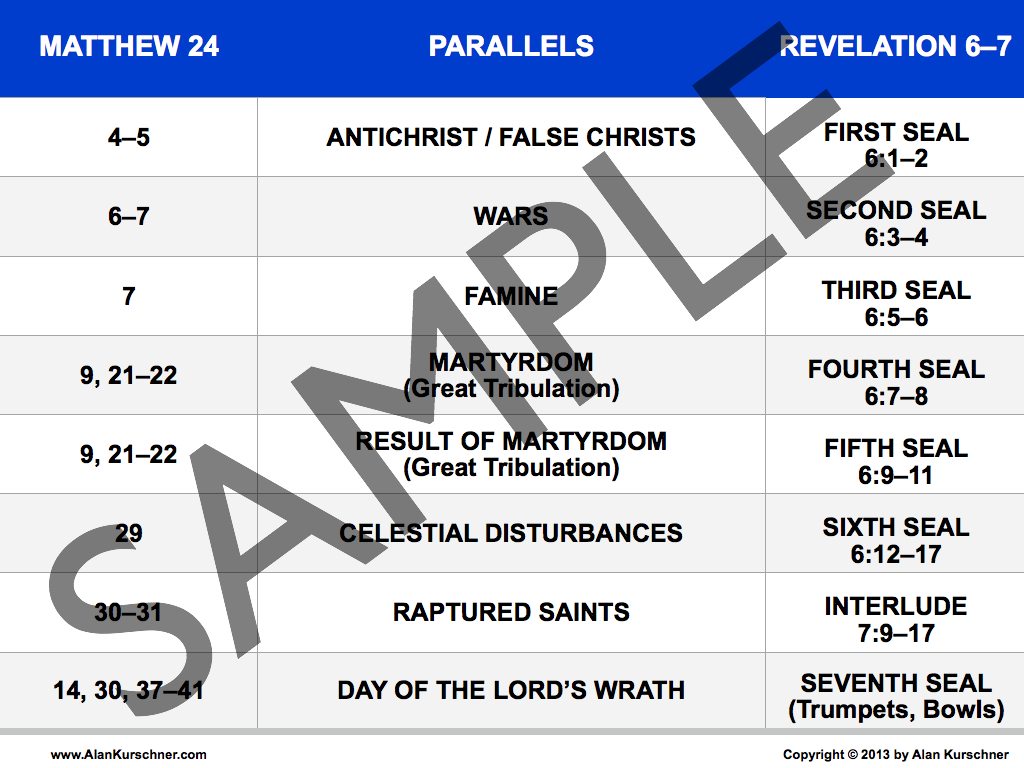
Jesus’ teaching on the beginning of birth pangs, great tribulation, the celestial sign, and the gathering of the elect corresponds with the seven seals (see this chart). Jesus warned not to confuse the end with the beginning of birth pangs. He taught the great tribulation will happen before his return signaled by the celestial disturbance. This supports that the seals should be distinguished from the wrath in the trumpets and bowls.
The Fifth-Seal Martyrs
The fifth-seal martyrs cry out to God for justice and implore him to avenge their blood: “How long, Sovereign Master, holy and true, before you judge those who live on the earth and avenge our blood?” (Rev 6:10). This clearly shows the day of the Lord’s wrath has not begun; thus to place any trumpet or bowl judgments before the fifth seal is contradictory. In addition, the prayers of the martyrs are about to be answered after the seventh seal is opened through the trumpet judgments (Rev 8:1–4), connecting it back to their supplications in the fifth seal.
The Sixth-Seal Celestial Event
The sixth seal signals the impending wrath of God, not the culmination of it. Joel’s parallel passage reads, “I will produce portents both in the sky and on the earth—blood, fire, and columns of smoke. The sunlight will be turned to darkness and the moon to the color of blood, before the day of the LORD comes—that great and terrible day!” (Joel 2:30–31). This celestial disturbance causes the ungodly in the sixth seal to flee to the caves because they recognize the impending wrath of God (Rev 6:15–17). Luke also narrates the wrath of God ensuing the celestial event (Luke 21:25–36; cf. Matt 24:29–30). Therefore, it is mistaken to place any trumpet or bowl judgments before the sixth seal.
Destruction of the Earth Happens After—Not Before—the Seventh Seal
In Revelation 7 there is an interlude portraying two groups being delivered-protected, one on earth and the other in heaven. The group on earth are seen to be 144,000 Jews. A seal is given on their foreheads as protection from the coming wrath: “Do not damage the earth or the sea or the trees until we have put a seal on the foreheads of the servants of our God” (Rev 7:3). This verse should put to rest any doubt the trumpets and bowls happen before the seventh seal. Notice the earth, sea, and trees are not destroyed up to this point before the seventh seal is opened. It is only when the seventh seal is opened the first two trumpet judgments begin to destroy the earth, sea, and trees: The first angel blew his trumpet, and there was hail and fire mixed with blood, and it was thrown at the earth so that a third of the earth was burned up, a third of the trees were burned up, and all the green grass was burned up. Then the second angel blew his trumpet, and something like a great mountain of burning fire was thrown into the sea. A third of the sea became blood, and a third of the creatures living in the sea died, and a third of the ships were completely destroyed. (Rev 8:7–9) It is a contradiction to claim otherwise. Moreover, the fifth trumpet describes demonic-locust creatures being commanded, “not to damage the grass of the earth, or any green plant or tree, but only those people who did not have the seal of God on their forehead” (Rev 9:4). This trumpet judgment has in view the protective seal on their forehead; thus, it is a contradiction to place the fifth trumpet before the seventh seal! (Rev 7:3).
Woe! Woe! Woe!
The last three trumpets are identified ominously as three woes (ouai): “Then I looked, and I heard an eagle flying directly overhead, proclaiming with a loud voice, “Woe! Woe! Woe to those who live on the earth because of the remaining sounds of the trumpets of the three angels who are about to blow them!” (Rev 8:13). The three woes convey the finality and intensity of God’s wrath, along with the devastating painful effects upon the ungodly. The temporal language in Revelation 9:12 also shows past action (“The first woe has passed”) and future action (“but two woes are still coming after these things”). This demonstrates two things: (1) the trumpet judgments follow a sequence, and (2) they show uniqueness distinguishing them from the seals and the bowl judgments. Thus, the trumpet judgments are not the seals and bowls “expressed from different perspectives.”
Incompatible Depictions
The concurrent theory points out similarities between the septets, especially the trumpet and bowl septets. For example, it is argued, since the fourth trumpet and the fourth bowl relates to the sun, they must refer to the same event, or at least occur at the same time. But a closer look shows they are divergent elements. In the fourth trumpet, the sun is partially darkened; in contrast, the fourth bowl depicts heat scorching the ungodly (Rev 8:12; 16:8–9).
Theophanic Lightning, Thunder, Earthquake
The climactic theophanic judgment in the seventh bowl reads: “Then there were flashes of lightning, roaring, and crashes of thunder, and there was a tremendous earthquake—an earthquake unequaled since humanity has been on the earth, so tremendous was that earthquake.” (Rev 16:18) There are two other similar theophanic statements in Revelation 8:5 and 11:19 (three if you count Revelation 4:5). Concurrent interpreters argue that these instances represent the same event because of their similarity. But similarity does not equal identity. A closer reading shows in each instance the theophanic depiction intensifies and anticipates Revelation 16:18, which is the most intense theophany of them all, the consummation of God’s judgment. It is also not clear how a recapitulation could be valid with Revelation 4:5 portraying the throne room happening before any seals are opened! All of this leads Jauhiainen to comment:
Granted that 8:5 and 11:19 anticipate 16:18–21, this intensification would seem to indicate that the consummation of temporal judgments is approaching, and not that it has already been reached in 8:1 and then recapitulated twice. Thus, in 8:5 the formula heralds the coming of God in judgment, symbolized by the trumpets.[…] and 11:19 looks forward to the pouring out of the bowls. The last bowl in 16:18–21 completes the judgments, together with an emphasis on the uniqueness of the final earthquake and with the voice from the throne saying, ‘It is done!’
God’s Wrath is Finished
Revelation 15:1 reads: “Then I saw another sign in heaven, great and amazing, seven angels with seven plagues, which are the last, for with them the wrath of God is finished” (ESV). This verse contains a sequence of God’s wrath, which says the seven plagues (bowls) are “last” (eschatos). This strongly implies the trumpet septet precedes the bowls because “with them the wrath of God is finished (teleō).” In other words, the bowl judgments will fulfill God’s final purpose in the day of the Lord. Thus, it is unnatural to interpret the bowl septet happening at the same time as the trumpet septet. The natural reading, instead, conveys the bowls following the trumpets.
The Imagery of the “Bowl”
The trumpet judgments require a substantive time to unfold; for example, the fifth trumpet lasts five months. In contrast, the nature and purpose of the bowl judgments occur rapidly. The New Testament mentions at least fifteen different vessels, jars, bowls, baskets, and other containers in antiquity. In our instance, the term for “bowl” is phialē, meaning a “broad, shallow bowl.” This choice of imagery of “broad and shallow” is not arbitrary since is connotes a swift judgment, for the pouring out of God’s final wrath will happen quickly. This imagery also evokes a salvo of bowls being emptied like a grand finale to a fireworks display, in contradistinction to the imagery of the trumpet judgments.
Conclusion
The collective reasons above establish that the book of Revelation intends a consecutive-progressive framework. The concurrent-recapitulatory theory fails because it forces the trumpets and bowls to unfold before the seventh seal is opened. The opening of the seventh seal does not culminate the day of the Lord's wrath—it initiates it. The posttrib presupposition that the second coming begins in Revelation 19 with Christ in the sky with his armies causes a strain in the natural reading of Scripture; in this case, collapsing together the seals, trumpets, and bowls to make the resurrection event in Revelation 7 happen in association with the Armageddon event in Revelation 19. Further, it is a contradiction, as argued above, to place God's wrath before the seventh seal is opened, as well as before the resurrection in Revelation 7. Prewrath takes the event of Christ in the sky with his heavenly armies preparing for the battle of Armageddon as one of the last judgment events after the trumpet and bowl judgments. The parousia does not begin with Armageddon; it begins between the sixth seal and the seventh seal, when God's people receive their resurrected bodies and enter the Father's presence as portrayed in Revelation 7.

Links mentioned:

www.alankurschner.com/2015/05/28/seals-trumpets-bowls-in-the-book-of-revelation-concurrent-recapitulation-or-consecutive-progressive-part-1-of-2-ep-36/

www.alankurschner.com/wp-content/uploads/2013/06/Prewrath-Charts.003.jpg

CHI's

http://lydiaswebpage.blogspot.com/2015/06/the-chis-crazier-more-you-learn-about.html

Gendered souls


Faithful Christians regard transgenderism as a denial of God's design for human nature. In this post I'll field a potential philosophical/theological objection to that position. I haven't actually run across this objection. But if it was raised, it might leave some Christians stumped, so I will take a whack at it. 

Traditionally, Christian theologians have been dualists. That's in large part due to the traditional understanding of the intermediate state. On this view, when a human dies, what that really means is their body dies. But they have an incorporeal soul which survives. And the soul is the "seat" of human personality (mind, consciousness). 

Depending on the philosophy that sponsors it, you have varieties of Christian dualism. Augustine was more Platonic, Aquinas was more Aristotelian. I myself am a Cartesian interactionist. 

Now here's the challenge: a "progressive Christian" might object that if the soul is the essence of the person, then our body doesn't define our gender. If substance dualism is true, then gender is either grounded in the soul rather than the body, or vice versa. In either case, they are separable. 

If gender is psychological, then the body is incidental. Conversely, if gender is physical, but the soul is your core identity, then gender is incidental to who you reallyare. 

So this poses a prima facie dilemma for Christian dualism. Let's scrutinize that argument:

i) Some professing Christians are physicalists. For them, gender is either physical or socially constructed. If the former, then if a human is identical to his body, that relieves the dilemma. If the latter, that, too, relieves or relativizes the dilemma.

However I think physicalism is false. There are theological, philosophical, and scientific objections to physicalism. I won't rehearse them. My point is simply that I don't think that's a viable solution to the proposed dilemma. 

ii) There's some ambiguity over what it means to be "essentially" human. For instance, I used to be a teenager. That was a temporary state. But while it lasted, that was a genuine part of who I was. And that was an important part of who I was.

This goes to the ambiguities of personal identity. How can I be the same person if I change? 

When I was a teenager, that was a defining aspect of my identity. Even though I can still be me after I lose that property, that doesn't mean it was extrinsic to who I was at the time. To be a teenage boy is, among other things, to experience the world as a teenage boy, perceive the world as a teenage boy. To feel a certain way. To have that particular viewpoint. Although it's temporary, it's just a real, runs just as deep, as being a middle-aged man. 

By parity of argument, even if (ex hypothesi) gender identity is separable from who we are, that doesn't make it extrinsic to who we are.

ii) Apropos (i), one could argue that even if (ex hypothesi) gender is grounded in the body, so long as we are embodied agents, that's a natural, basic part of who we are. To be an embodied agent is to be a gendered agent. For a human to be a disembodied agent, although that's metaphysically possible, is an artificial condition. A defective condition. 

iii) Suppose that gender is grounded in the soul. Each soul is innately gendered. Even though gender has a physical expression, gender also, or fundamentally, consists of character traits. Stereotypically masculine or feminine character traits. 

That model might seem to grant the dilemma. If that's the case, then gender isn't defined by genetics or anatomy. 

Mind you, as I've already endeavored to demonstrate under (ii-iii), that's simplistic. But there are other difficulties with that conclusion:

That carries the tacit admission that there's something wrong with gender dysphoria. A mismatch between psychology and physiology, viz. a man who feels trapped inside a woman's body. That's an aberration. That's not the way it's supposed to be. 

Even though it's not morally wrong, it's like a genetic defect or mental illness. It may not be culpable, but it can be a glitch. Not a design flaw, but flawed execution. 

However, transgender apologists refuse to concede that. Rather, they wish to say transgender identity is a legitimate variety along the gender spectrum. Admittedly, there are tensions within the trans community. After all, folks who undergo hormone therapy, plastic surgery, and/or sex-change operations to relieve their sense of gender dysphoria clearly think there's something amiss.

On the other hand, transgender apologists are like people who resent being classified as disabled. For instance, you have members of the deaf community who  oppose cochlear implants because that suggest there's something wrong with being deaf. Even though it isn't wrong in the moral sense, they still bristle at the implication that their condition is "defective."

iv) I'd add that this can have a moral dimension. Here we need to distinguish between morality and blame. Suppose a brain cancer patient develops sociopathic urges. Even though we don't think he's blameworthy for his sociopathic urges, it's still the case that what he wants to do to other people is objectively evil. 

Likewise, people with senile dementia may say or do inappropriate things. Even though, in their state of diminished responsibility, we don't consider their conduct blameworthy, it is still inappropriate.

v) In addition, even if (ex hypothesi) the soul is innately gendered, that doesn't mean the body is a secondary consideration is the assignment of gender. To the contrary, we'd expect God to design human nature such that gendered souls have matching bodies. It is fitting for a masculine soul to have a masculine body; fitting for a feminine soul to have a feminine body. Body and soul are complementary. 

As embodied agents, our bodies are the primary medium through which we express ourselves. A masculine soul will have a corresponding physical expression, while a feminine would will have a corresponding physical expression. A male body that exemplifies masculine character traits or a female body that exemplifies feminine character traits. You put a racing car motor in a racing car body. 

vi) To take a comparison, suppose you had an alien species with a particular artistic sensibility, for music or the fine arts. It would be fitting for God to give them a visual system or auditory system suited to their psychological appreciation for certain sounds, colors, and combinations thereof. 

vii) Now let's consider the alternative. What if souls are initially genderless. Gender-neutral. A blank slate, gender-wise.

That doesn't mean gender is grounded in the body. That doesn't mean gender is inessential to our psychological makeup.

Rather, that might mean gender is an acquired characteristic. When the soul is united to a male or female body, that begins to condition the soul. The soul experiences the world via a male or female body. That's how the soul perceives the world.

Even if gender is initially a physical property, yet as a result of psychological conditioning, that becomes a psychological property as well. Saturation exposure to a gender-specific embodied experience fosters corresponding character traits. You think like a man or woman. 

viii) Moreover, this can be permanent. It becomes integral to your personality. Some experiences are transformative. To be a parent or a spouse can effect an irreversible change in your personality. 

ix) When you die, when the soul is "separated" from the body, those acquired characteristics carry over. That's indelible imprinted on the soul (as it were). Who we are is the result of nature and nurture. 

x) Likewise, the intermediate state is not the final state. It's temporary. We were meant to be embodied agents, and we will resume our physical experience at the general resurrection. So that's not ancillary to who we are. Rather, that's an essential feature of human destiny-for better or worse.  

Man or muppet?

Some allege there's a biological basis for transsexualism due to the "fact" that there's an area of the brain responsible for gender identity which in MF transsexuals appears to display female patterns.

Let's say we can alter the area of a person's brain supposedly responsible for their identity to physically resemble the neuroanatomy of a chicken, and that this would thereby make the person believe they are indeed a chicken. Does this mean the person is really a chicken? What about everything else that's human about the person?

Wednesday, June 03, 2015

Brody has two mommies!


The transgender fad generates some intriguing conundra for atheism. Militant atheists like Richard Carrier have been riding that bandwagon. It advances their own agenda to hitch their caboose to the steam engine of the power elite.
Unsurprisingly, Carrier is a critic of the virgin birth. But how does that mesh with his endorsement of the transgender ideology? 
If transgender ideology is true, then there's a sense in which Brody Jenner is the product of a virginal conception–or the functional equivalent. Brody has no daddy, but he does have two mommies (Linda Thompson, Caitlyn Jenner)! He wasn't fathered by Caitlyn, since a woman can't father a child. Only a transphobic bigot would presume to say that Brody was fathered by Bruce Jenner.
As GLAAD instructs us, coming out as transgender is retroactive:
DO refer to her as Caitlyn Jenner. DON’T refer to her by her former name. She has changed it, and should be accorded the same respect received by anyone who has changed their name. Since Caitlyn Jenner was known to the public by her prior name, it may be necessary initially to say "Caitlyn Jenner, formerly known as Bruce Jenner…" However, once the public has learned Jenner's new name, do not continually refer to it in stories. 
DO use female pronouns (she, her, hers) when referring to Caitlyn Jenner. 
DO avoid male pronouns and Caitlyn's prior name, even when referring to events in her past. For example, "Prior to her transition, Caitlyn Jenner won the gold medal in the men's decathlon at the Summer Olympics held in Montreal in 1976." 
AVOID the phrase "born a man" when referring to Jenner. If it is necessary to describe for your audience what it means to be transgender, consider: "While Caitlyn Jenner was designated male on her birth certificate, as a young child she knew that she was a girl."
So Brody never had a father. He's literally fatherless. He's the product of trans parthenogenesis. 

Transgender Etiquette

http://firedoglake.com/2012/06/08/netroots-nation-2012s-statement-on-transgender-etiquette/

"Contraception and chastity"


Here's an oft-quoted statement by Catholic philosopher Elizabeth Anscombe:
If contraceptive intercourse is permissible, then what objection could there be after all to mutual masturbation, or copulation in vase indebito, sodomy, buggery (I should perhaps remark that I am using a legal term here - not indulging in bad language), when normal copulation is impossible or inadvisable (or in any case, according to taste)? It can't be the mere pattern of bodily behaviour in which the stimulation is procured that makes all the difference! But if such things are all right, it becomes perfectly impossible to see anything wrong with homosexual intercourse, for example. I am not saying: if you think contraception all right you will do these other things; not at all. The habit of respectability persists and old prejudices die hard. But I am saying: you will have no solid reason against these things. You will have no answer to someone who proclaims as many do that they are good too. You cannot point to the known fact that Christianity drew people out of the pagan world, always saying no to these things. Because, if you are defending contraception, you will have rejected Christian tradition.
The entire essay is currently available here:
A few preliminaries:
i) I believe her primary audience is Catholic. She's writing to and for Catholics. As such, she sometimes mounts an argument from authority which is legitimate when addressing a Catholic audience, but begs the question in reference to a Protestant reader. 
ii) Then there's the question of terminology. I don't know the intended distinction between sodomy and buggery. These are often used a synonyms. However, buggery may be broader category, which includes both oral and sex. 
iii) Assuming that's the intended distinction, it doesn't ipso facto follow that if one is wrong, both are wrong. In principle, anal intercourse could be intrinsically wrong whereas oral sex could be morally permissible under some circumstances. To condemn both requires a supporting argument, which she doesn't furnish. She just takes for granted that oral sex is morally equivalent to anal intercourse, both of which are morally equivalent to contraceptive intercourse. That's understandable when addressing a Catholic audience, where certain things are taken for granted. It's more a question of why be Catholic. But given Catholicism, you can simply punt to the authority of the Magisterium–at least in principle. However, that appeal has no sway for a Protestant reader.
iv) Conversely, is she using "sodomy" as a synonym for homosexuality, or a synonym for anal sex? 
v) In addition, there's a potential moral distinction between oral sex involving a heterosexual married couple and a homosexual man performing fellatio on another man. What would make it wrong is not the act itself, but by whom and on whom it's performed. 
To take a comparison, erotic kissing between a man and a woman is morally permissible, whereas erotic kissing between two men is morally impermissible. In both cases it's the same act. What makes it licit in one case and illicit in the other concerns the parties to the act and not the act itself. My purpose is not to argue that point, but simply draw attention to distinctions which she fails to make.

Consensual incest is another example. Copulation between a parent and a grown child involves the same sex act as copulation between a man and wife, yet that doesn't make them morally equivalent. The moral differential factor is not the nature of the act, but the nature of the parties to the act. 
vi) The same issue arises in the case of "mutual masturbation." In principle, that could be homosexual or heterosexual. If the latter, that could be marital, premarital, or extramarital. To say it's wrong in general demands a supporting argument. The fact that homosexual, and heterosexual pre/extramarital mutual masturbation is wrong doesn't entail that heterosexual marital mutual masturbation is wrong. 
Suppose, for instance, a married couple uses that as foreplay. Or suppose, for some reason, that a married couple can't engage in sexual intercourse. Is mutual masturbation wrong in that situation? If so, Anscombe needs to supply an argument. 
To ask, even rhetorically, "what objection could there be after all to…sodomy…when normal copulation is impossible or inadvisable…it becomes perfectly impossible to see anything wrong with homosexual intercourse" is very slack reasoning. Normal copulation refers to heterosexual copulation. If that's impossible or inadvisable, how does it follow that homosexual alternatives would become unobjectionable? If the context begins with heterosexual conjugal relations, how do impediments to that suddenly shift the sexual repertoire to sodomy? Perhaps she's using "sodomy" as a sexual technique (anal sex) rather than sex with a partner of the same gender (man on man). If so, that would keep all the examples within the confines of heterosexual relations. 
vii) There are at least two moral objections to anal intercourse:
a) It's unpleasant to the recipient.
b) It's hazardous–especially to the recipient. 
c) I'd add that there's a potential objection to oral sex on the same grounds: is it hazardous? 
viii) If, however, she's using "sodomy" as a synonym for homosexuality, the insinuation is that once you decouple sex from procreative intent, there's no moral distinction between homosexual and heterosexual activity. But that's not a straightforward inference. There are several moral objections to homosexual activity:
a) It is hazardous. Male and female bodies are sexually complementary in ways that two bodies of the same gender are not. That results in physically destructive behavior as well as diseases that are either unique to homosexual activity or aggravated by homosexual activity. 
b) Humans of the same gender are psychologically unsuited to form erotic emotional bonds with each other. It's a kind of mental illness. 
There are "solid reasons" for (vii) and (viii) alike. It's intellectually irresponsible for Anscombe to say otherwise. Indeed, that's inconsistent with her larger position. There are natural law arguments against anal intercourse and homosexuality. And she herself resorts natural law ethics. 
ix) Then there's the meaning of the phrase "copulation in vase indebito." That's a quaint technical term in Catholic moral theology. I don't know if she's using it to denote anal sex or "Onanism" (i.e. coitus interruptus). If the latter, that begs the question, since the very issue in dispute is whether contraception is morally licit or illicit. If the former, see above. 
Furthermore, while one doesn't have to be learned (nobody has to be learned) or able to give a convincing account of the reasons for a teaching - for remember that the Church teaches with the authority of a divine commission, and the Pope has a prophetical office, not a chair of science or moral philosophy or theology - all the same the moral teaching of the Church, by her own claims, is supposed to be reasonable. Christian moral teachings aren't revealed mysteries like the Trinity. The lack of clear accounts of the reason in the teaching was disturbing to many people. Especially, I believe, to many of the clergy whose job it was to give the teaching to the people.
That exposes a dilemma for Catholic apologists like Anscombe. The argument from authority won't work, even if you acknowledge the religious authority in question, because moral theology is grounded in natural law, and natural law reasoning must rise and fall on the merits of the argument from proper function. The argument should work on its own terms, within the natural law framework. It should be sound apart from appeals to religious authority. The arguments must be reasonable on their own grounds. 
As a Catholic apologist, Anscombe must play the hand she was dealt. But what if her denomination's position on birth control is ad hoc? Then her supporting arguments will be ad hoc. Ultimately, the supporting arguments can't be better than the underlying position they are deployed to defend. 
Again, with effective contraceptive techniques and real physiological knowledge available, a new question came to the fore. I mean that of the rational limitation of families. Because of ignorance, people in former times who did not choose continence could effect such limitation only by obviously vile and disreputable methods. So no one envisaged a policy of seeking to have just a reasonable number of children (by any method other than continence over sufficient periods) as a policy compatible with chastity. Indeed the very notion "a reasonable number of children" could hardly be formulated compatibly with thinking at once decently and realistically. It had to be left to God what children one had.
With society becoming more and more contraceptive, the pressure felt by Catholic married people became great. The restriction of intercourse to infertile periods "for grave reasons" was offered to them as a recourse - at first in a rather gingerly way (as is intelligible in view of the mental background I have sketched) and then with increasing recommendation of it. For in this method the act of copulation was not itself adapted in any way so as to render it infertile, and so the condemnation of acts of contraceptive intercourse as somehow perverse and so as grave breaches of chastity, did not apply to this. All other methods, Catholics were very emphatically taught, were "against the natural law".
The substantive, hard teaching of the Church which all Catholics were given up to 1964 was clear enough: all artificial methods of birth control were taught to be gravely wrong if, before, after, or during intercourse you do something intended to turn that intercourse into an infertile act if it would otherwise have been fertile.
The new knowledge, indeed, does give the best argument I know of that can be devised for allowing that contraceptives are after all permissible according to traditional Christian morals. The argument would run like this: There is not much ancient tradition condemning contraception as a distinct sin. The condemnations which you can find from earliest times were almost all of early abortion (called homicide) or of unnatural vice. But contraception, if it is an evil thing to do, is distinct from these, and so the question is really open.
i) Which is a backdoor admission that artificial contraception doesn't really contradict tradition. It's anachronistic to prooftext opposition to contraception from church fathers or scholastic theologians, for given their primitive scientific understanding, they were unable to distinguish between abortion and contraception. So even if you think we should defer to the wisdom of church fathers and scholastic theologians, you can't invoke their opinion in this case, for it involves a more specialized question than they were in a position to consider at the  time. 
ii) And, of course, this has no cachet for Protestants. It's not that we should simply disregard tradition. Rather, tradition has no inherent authority. We should give the church fathers and scholastic theologians a respectful hearing. But it comes down to the quality of their arguments. They are not authority figures. 
We have seen that the theological defence of the Church's teaching in modern times did not assimilate contraception to abortion but characterized it as a sort of perversion of the order of nature. The arguments about this were rather uneasy, because it is not in general wrong to interfere with natural processes.
That's a very significant caveat, which she doesn't pursue. To oppose contraception along those lines, you'd need to present and defend a principle according to which interfering with natural processes is generally permissible, but wrong in this particular (or analogous) instance. However, having raised the issue, Anscombe fails to develop that line of thought. Perhaps because that's a dead-end. So she must look elsewhere to bolster her position. But she just leaves it hanging out there. 
At this point she draws hairsplitting distinctions regarding intent. Perhaps that's the principle which distinguishes licit from illicit interference with natural processes–at least in this case:
For it was obvious that if a woman just happened to be in the physical state which such a contraceptive brings her into by art no theologian would have thought the fact, or the knowledge of it, or the use of the knowledge of it, straightaway made intercourse bad. Or, again, if a woman took an anovulant pill for a while to check dysmenorrhea no one would have thought this prohibited intercourse. So, clearly, it was the contraceptive intention that was bad, if contraceptive intercourse was: it is not that the sexual act in these circumstances is physically distorted. This had to be thought out, and it was thought out in the encyclical Humanae Vitae.
Here, however, people still feel intensely confused, because the intention where oral contraceptives are taken seems to be just the same as when intercourse is deliberately restricted to infertile periods. In one way this is true, and its truth is actually pointed out by Humanae Vitae, in a passage I will quote in a moment. But in another way it's not true.
The reason why people are confused about intention, and why they sometimes think there is no difference between contraceptive intercourse and the use of infertile times to avoid conception, is this: They don't notice the difference between "intention" when it means the intentionalness of the thing you're doing - that you're doing this on purpose - and when it means a further or accompanying intention with which you do the thing. For example, I make a table: that's an intentional action because I am doing just that on purpose. I have the further intention of, say, earning my living, doing my job by making the table. Contraceptive intercourse and intercourse using infertile times may be alike in respect of further intention, and these further intentions may be good, justified, excellent. This the Pope has noted. He sketched such a situation and said: "It cannot be denied that in both cases the married couple, for acceptable reasons," (for that's how he imagined the case) "are perfectly clear in their intention to avoid children and mean to secure that none will be born." This is a comment on the two things: contraceptive intercourse on the one hand and intercourse using infertile times on the other, for the sake of the limitation of the family.
But contraceptive intercourse is faulted, not on account of this further intention, but because of the kind of intentional action you are doing. The action is not left by you as the kind of act by which life is transmitted, but is purposely rendered infertile, and so changed to another sort of act altogether.
There's all the world of difference between this and the use of the "rhythm" method. For you use the rhythm method not just by having intercourse now, but by not having it next week, say; and not having it next week isn't something that does something to today's intercourse to turn it into an infertile act; today's intercourse is an ordinary act of intercourse, an ordinary marriage act. 
i) The problem with this argument is that it falls short of what she needs to prove. It is not enough to draw distinctions between one kind of contraceptive intent and another kind of contraceptive intent. For that, by itself, fails to explain what makes one licit and the other illicit. So she needs to take it to the next step by explicating why that's a morally salient distinction. Yet she simply drops the analysis at that crucial juncture of the argument. 
ii) Her omission is striking. She was a very capable philosopher. What is more, she was married to a very capable philosopher. Both were pious Catholics who wrote in defense of traditional moral theology. If, despite putting their heads together, she's unable to explain and defend why "artificial" contraceptive intent is wrong–unlike "natural" contraception intent–then the prospects for making that argument must be pretty dim. This is about as good as it gets. Elizabeth Anscombe and Peter Geach were the power couple of Catholic philosophers. 
iii) And remember that by her own admission, it should be possible to mount a purely rational justification for the moral teaching of the church. A rationale that's independent of the church's authority. So she fails to solve the problem she posed for herself, as she herself framed the terms of success. 
A severe morality holds that intercourse (and may hold this of eating, too) has something wrong about it if it is ever done except explicitly as being required for that preservation of human life which is what makes intercourse a good kind of action. But this involves thoroughly faulty moral psychology. God gave us our physical appetite, and its arousal without our calculation is part of the working of our sort of life. Given moderation and right circumstances, acts prompted by inclination can be taken in a general way to accomplish what makes them good in kind and there's no need for them to be individually necessary or useful for the end that makes them good kinds of action. Intercourse is a normal part of married life through the whole life of the partners in a marriage and is normally engaged in without any distinct purpose other than to have it, just as such a part of married life.
A problem with that comparison is that some of our food consumption is purely for pleasure. It has no practical justification. Take deserts. We don't do that for the nutritional value. And the pleasure isn't a side-effect of nutrition. Rather, pleasure is the only motivation, and not an incidental consequence. Some deserts may have a bit of nutritional value, but we'd consume the desert absent nutritional value. That's not even a secondary consideration, much less the primary consideration. 

Transgender tennis


As I've remarked before, one of the things I appreciate about the transgender movement is its chaotic potential to destroy liberal ideology from within. For instance, what happens when second-tier male tennis players who aren't good enough to win major championships decide to play the transgender card and invade the women's tennis circuit? What happens when they "discover" their inner womanhood and take over women's tennis? A man who isn't quite good enough to beat the very best male tennis players may well be good enough to beat the all the top female tennis players. 

And that's just one sport. That's just for starters. 

Who can stop them? What's the argument? 

You've come a long way, baby


i) I'm of two minds about discussing Bruce Jenner's "transition." Like Josh Duggar's past, these aren't events that merit national attention. They have no intrinsic importance beyond the affected parties.

They only acquire a larger significance when certain people make them more important than they are. And in that respect they sometimes merit comment. 

The social engineers like to make certain individuals iconic figures for the cause. 

ii) Apropos (i), there's a Satanic mastermind behind what we are seeing. And I'm not speaking figuratively.

The dark side is infiltrating strategic institutions. Corrupt the church ("gay clergy"). Corrupt the military ("gays in the military"). Corrupt sports.

Male athletes symbolize masculinity. I'm by no means suggesting you have to be athletic to be manly. I'm just discussing the symbolism.

iii) One of the ironic things about the Vanity Fair cover is that it actually subverts the logic of the transgender movement. We're told gender is a state of mind. It's not about biology. It's not about male or female bodies.

But if that's the case, why is it so important for Jenner to look like a woman? And not just that. But to look like a girly-girl. A fashion model. If gender identity is separable from the body, why does he try so hard to look like Rene Russo?

If it's that important to appear feminine, why is it unimportant to be feminine–in terms of physiology and genetics? Why mimic female anatomy if gender is a state of mind?

So the whole presentation gives the lie to the transgender philosophy. In order to sell the message to the general public, the vehicle subverts the message. 

iv) In addition, the picture is fishy. Take the hair. Is that for real? Or is that a wig? He's pushing 66. At that age, many men are bald or balding.

v) Likewise, take the face. Once again, he's pushing 66. And he lives in sunny Southern California. I assume he spends lots of time out of doors.

Between his age and his exposure to sunshine, shouldn't his face be fairly weatherbeaten by now? So something is off.

By the same token, what happened to that square jaw he used to have? The facial bone structure of a classic jock? 

Is it cosmetic surgery? Makeup and lighting? Is it photoshopped? 

vi) It looks more convincing because no one is standing beside him. In real life, Jenner is 6' 2". How many women are that tall? If you stuck him in a group of men and women, it would shatter the illusion.

vii) One function of the long loose hair is to help disguise the fact that he has the broad shoulders of a male athlete.

The demure pose allows him to conceal his hands. 6' 2" jocks don't have lady-like hands–or feet. 

Likewise, the pose tries as best it can to downplay the muscular thighs.

If, according to transgender activists/apologists, gender is a purely psychological identity with no essential genetic or physiological component, then why did Jenner go to such lengths (extreme makeover surgery) to look feminine?
Why the desperate effort to efface his masculine appearance and superimpose a feminine simulacrum if gender is just a state of mind?
viii) I wonder if one of Jenner's problems was that he peaked at age 26. What do you do for an encore? Having won the gold medal in his mid-twenties, what do you do for the rest of your life? What do you do with the rest of your life? Did he have a plan? Or was it a big letdown after the prize?

ix) There's an American burlesque tradition of tough guys who dress in drag. It's a lark. A sight-gag. 

What makes it funny is the contrast between appearance and reality. A he-man who plays against type. It only works because the man's masculinity is beyond reproach. Powder-puff football is another example. 

If the performer were actually effeminate, it would backfire. That's why it's not funny when Jenner does it. It's just pathetic.

It reminds me of Michael Jackson's self-mutilation. Cosmetic surgery which defaced his racial identity. Made him look like a circus clown. It also reminds me of some actresses like Joan Crawford and Mae West who didn't know when to stop. 

x) Apropos (ix), it's revealing to contrast this with tough-guy actors of the past, viz. Humphrey Bogart, Charles Bronson, Sean Connery, Kirk Douglas, Clint Eastwood, Charlton Heston, Burt Lancaster, Steve McQueen, Robert Mitchum, Edward G. Robinson, Frank Sinatra, John Wayne. 

The cultural elite is hellbent on sabotaging the masculine image. I'm not suggesting these actors were Christian role-models. But common grace can preserve a residual witness to the natural order.  

xi) Jenner is shaking his fist at God. Hurling his God-given manhood back in God's face. Simultaneously perverting the gifts of the manhood and womanhood alike.

There are Christians who say we should pray for Jenner. I appreciate the sentiment. But I don't think that being rich and famous entitles one to special consideration. Honestly, I don't sympathize with Jenner. There are millions of people more deserving of my sympathies. Why should celebrities be the priority? 

As a gay atheist, I want to see the church oppose same-sex marriage

http://blogs.spectator.co.uk/coffeehouse/2015/05/as-a-gay-atheist-i-want-to-see-the-church-oppose-same-sex-marriage/

Tuesday, June 02, 2015

Aging atheist syndrome


Over at DC, John Loftus was recently having a cryfest because Jeff Lowder dissed his debate performance with David Wood on the Resurrection.

A few quick observations:

i) Loftus exhibits aging atheist syndrome. I've observed a number of prominent unbelievers who becoming increasingly bitter as they age, viz. Nietzsche, H. G. Wells, H. L. Mencken, Mark Twain, Thomas Paine, Quentin Smith, Richard Carrier, Richard Dawkins, 

Likewise, I wonder if Keith Parsons, Robert Price, Jerry Coyne, and PZ Myers were always this sour. Christopher Hitchens could be charming when he wasn't drunk:


Atheism is a grim worldview, and as the padding of youth wears out, there's nothing to insulate the atheist from the polar night of despair. 

ii) Carrier, Lowder, and Loftus are all very vain, image-conscious men. However, Loftus suffers from an inferiority complex.

Aside from the fact that Lowder is at a better place in life than Loftus, he has too much self-regard to publicly humiliate himself the Loftus so often does. Loftus just can't restrain himself. He has nothing to look forward to. 

He can't stand to be belittled, yet he makes himself an object of ridicule. He brings upon himself the very thing he finds intolerable. If you show people where your buttons are, they will push your buttons. It's so predictable.

iii) When I say he suffers from an inferiority complex, I don't mean that as a putdown. Many men and women struggle with feelings of inadequacy or even self-loathing. In my observation, that usually goes back to childhood. A father they could never please. Lacking social acceptance in junior high and high school.

What's ironic about Loftus is that he pushes away the very thing and only thing that would salve his condition. Everyone benefits from the Gospel in different ways. That includes people who struggle with low self-esteem. The Gospel can compensate for a lack of self-worth. But Loftus shuns the very medicine that would alleviate his pain. 

The Quiverfull movement


In this post I'm just sketching the lay of the land. 
i) The Duggar scandal has drawn attention to some related issues. There's an overlap between the homeschooling movement, the Quiverfull movement, and the Patriarchy movement. These are separable, and they are often separate in practice, but some members of one group belong to two or all three groups. 
ii) I think much of the hostility towards the Duggars is due to the fact that some young liberals find the very idea of childbearing offensive. An antinatalist philosophy is taking hold in secular circles. Couples who prefer dogs to kids. They disapprove of childbearing. They're into "saving the planet" from "overpopulation." 
iii) I don't know much about the Patriarchy movement. I'm guessing that Doug Wilson is probably its best representative. By that I mean, if you wish to evaluate the Patriarchy movement, he's probably the most articulate, responsible, and nuanced spokesman. I expect that he makes the best case that can be made for it.
I believe the Patriarchy movement intersects with the "Christian courtship" movement–as an alternative to dating. Likewise, the headcovering movement. 
There's a "family" of positions. 
I believe the Bayly brothers straddle some of these positions. 
Keep in mind that the liberal media and "progressive Christians" use "patriarchy" as an abusive synonym for complementarianism. The go-to site for complementarianism is the Council on Biblical Manhood and Womanhood. 
iv) I don't know much about the Quiverfull movement, but even though it's Protestant, it seems to take the Roman Catholic position to its logical conclusion.
Although I disagree with his position, I think Bryan C. Hodge has made what is the most scholarly case for traditional opposition to contraception, from an evangelical perspective. 
v) Critics of complementarianism can point to cases of abuse. That, however, needs to be counterbalanced against horrors stories involving feminism. In a fallen world, whoever has power is in a position to abuse their authority. In a fallen world, abuse of power is inevitable. 

Consent: the god without reason

http://whatswrongwiththeworld.net/2015/06/consent_the_god_without_a_reas.html

Prelapsarian predation


The new anti-somatic Gnosticism


The face of the new anti-somatic Gnosticism: The sick national conspiracy to pretend that Bruce Jenner is a woman because he is mentally confused, has surgically mutilated his male body, and received plastic reconstruction surgery to give him a not entirely successful appearance as a woman, to the fanfare of the twisted leftwing elite and with the financial windfall of a reality TV show. For that he gets an award for "courage": "Shortly after the cover reveal, ESPN announced that Caitlyn, a former Olympian, will receive the Arthur Ashe Courage Award at the EPSY Awards in July." The man needs help; instead he gets validation for his neurosis. This is not love. This is functional hate.
Continue to respect the stamp of masculine gender that the Creator bestowed on Jenner by using a masculine pronoun of Jenner and his parents' chosen masculine name for him. "Transgender" is a misnomer.
As if to underscore the complaint and rebellion, “sex reassignment surgery” (SRS)—a benign name for what others might designate intentional mutilation or butchering—is major, painful, and expensive surgery whose results are incomplete at best. One has to go far in an effort to overturn God’s design and even then it is never complete. Typically SRS involves the surgical removal of perfectly healthy internal genitals (testes or ovaries/uterus) and radical alteration of perfectly healthy external genitalia. For male-to-female (MF) transsexuals this involves “vaginoplasty”: gutting the insides of the penis, creating a “vaginal” cavity, and constructing a “clitoris” from the head of the penis.... For MF transsexuals “transformation” also entails painful electrolysis of facial hair and sometimes also electrolysis of body hair, facial plastic surgery, voice surgery, breast implants, and silicone injections in the hips and buttocks.
The superficial character of these attempts at physical reassignment is obvious from the fact that the chromosomal inheritance doesn’t change. Functioning internal genitalia consistent with the new sex cannot be created. The “reassigned” body does not respond by producing its own other-sex hormones (whether testosterone or estrogen). Hormone treatment, through patch, pill, or injection, is lifelong. Fertility is destroyed. For MF transsexuals the new “vagina” must be regularly dilated through the use of dildo-like plastic rods. And even after very expensive and complete procedures most transsexuals still don’t quite look, sound, and act like members of the sex to which they were allegedly reassigned.
Jenner appears to fit the profile of an "autogynephilic transsexual" to a "t." Autogynephilic transsexuals are, as the name suggests, erotically aroused by the thought or image of themselves as women (auto for “self,” gyne for “woman,” and philic for “loving”; i.e., loving oneself as a woman). They tend to be attracted to women and men, sometimes to one or the other or, if asexual, to neither. Chiefly, however, they are sexually excited by the image of themselves as females with vaginas. As adolescent boys they found sexual gratification through secretly wearing women’s lingerie, looking in a mirror, and masturbating to that image. Since autogynephilic transsexuals as boys engaged in male sports and had male friends, they were not perceived by others to be particularly feminine boys. Typically they have been married to a woman before becoming an overt transsexual, find employment in ‘masculine occupations’ (technology, science, etc.), don’t come out publicly as women until their late thirties or beyond, and have a more difficult time than "homosexual transsexuals" in passing themselves off as women.
Essentially autogynephilic transsexuals are misdirected heterosexuals who have transferred the woman of their desires from outside themselves to within themselves; in short, they are men who are heterosexually oriented to the woman inside them. Anne Lawrence refers to them as “men trapped in men’s bodies” rather than “women trapped in men’s bodies.” For obvious reasons it is not unusual for autogynephilic transsexuals to hide from others the fact that they get sexual thrills from thinking of themselves as a woman.
See further my article, "Transsexuality and Ordination" at http://www.robgagnon.net/artic…/TranssexualityOrdination.pdf

Dembski on NDEs


Hi Jeremy,
Thanks for alerting me to this article in your email to me (and others). I enjoyed reading it. That said, I’m not sympathetic to your approach or conclusions.
It seems that you are putting forward a false dichotomy: brain activity vs. objective experience of heaven. As a nonmaterialist, I don’t see consciousness as ultimately reducible to brain activity (I think you give neuroscience way too much credit). Thus it seems that people, especially in circumstances of extremity such as near death, could have access to a nonmaterial realm that at the same time provides them information they might not have accessed through some material chain of causation. (I address this general point at length in my forthcoming book BEING AS COMMUNION: http://www.ashgate.com/isbn/9781472437853 ; I also address NDEs directly there.)
For you, a boy seeing his deceased sister who was lost through a miscarriage is him subconsciously piecing together items of information that he received from his parents and other sources through normal chains of material causation. But what if such information never got to him? It’s speculation on your part that the information had to get to him through “normal channels.”
The NDEs that have persuaded me most are those where patients access information about their setting (usually a hospital) to which they would have had no direct access. Now one can always argue that these are not controlled experiments, and so there might have been some access after all. This is how James Randi and other skeptics deal with all psi phenomena. And I see you taking the same tack. The type of skepticism that you seem to be buying into is dealt with, in my view, effectively in Dean Radin’s THE CONSCIOUS UNIVERSE. The take-away lesson for NDEs for me is that people do have access to sources of information that are not reducible to purely material explanations (and thus at odds with a materialist neuroscience).
As for the insights people with NDEs have about heaven, one can hold them up to theological yardsticks and find them wanting. But I’m not sure that invalidates them. I’ll grant you that none of these experiences that I’ve seen recorded or written about have provided information that would unequivocally implicate the supreme being of the universe (as a mathematician, for instance, I would like very much for an NDE to provide a proof of the Riemann Hypothesis or the Goldbach Conjecture).
But let’s not forget that the Bible itself doesn’t provide such slamdunk information of an afterlife. Jesus had more than an NDE — he actually was dead and came back. When he came back from the dead, why was he unrecognizable? As people saw him after his resurrection, did he always look the same? Did his apparent age stay fixed? The Bible doesn’t say. But it does seem to indicate that every time people saw him, they had to do more than a double-take to make sure it was him — they actually had to interact with him.
So, if people have NDEs and claim to glimpse heaven, I’m not ready to dismiss it because the visions don’t match up with some objective scene, as we might require of people if we were to ask them to describe Central Park in New York. I personally don’t have a problem with subjective features conditioning our view of heaven. It may even be that we can consciously shift or simultaneously experience aspects of heaven in multiple ways. Granted, this is pure speculation. But such considerations lead me to be more open to these experiences of the afterlife than you are.

Rape-inflation rhetoric


I wouldn't normally comment on the Duggar scandal. However, I see that philosopher Paul Moser is back on the war path, plugging a post by Zach Hunt. The Duggar scandal is a pretext to attack the Bible and Bible-believing Christians. The point of my post is not to defend the Duggars, but to defend Christians against scurrilous guilt-by-association.

i) Josh has been accused of molesting "minors." However, that's misleading inasmuch as he himself was a minor at the time. From what I've read, he just turned 14. Both he and the victims were minors. And underage boy, with underage girls. 

In addition, he's accused of "fondling" the "breasts" of some girls. That suggests the victims weren't prepubescent girls. Rather, they were old enough to have breasts. Say age 12 or thereabouts. 

So, to judge by the report, this involves misconduct between an adolescent boy and adolescent girls, about one or two years apart.

In fact, it's unclear from what I've read if he was even older than the girls. When reports say it was his "younger sisters," "younger" qualifies "sisters." That doesn't necessarily mean they were younger than their brother. Rather, "younger sisters" stands in contrast to their other sisters. They were younger than their older sisters.

Moreover, the misconduct in question involves fondling the erogenous zones. Given the nature of the offense, and how close they were in age, that isn't anywhere close to "rape" or "sexual violence." Rather, that's sexual harassment. 

There's a rape-inflation rhetoric that's popular in feminism because it's politically expedient. 

ii) By the way, suppose that was reversed. Suppose a 12-year-old girl sexually fondled a 13-year-old boy–without prior consent. Would the critics be outraged that the girls weren't prosecuted? Or is there a double standard in play?

iii) If fondling is all there was to it, and if Josh and the girls were just one or two few years apart, then I don't think the parents had a moral duty to report him to the authorities. I think that's the kind of situation which should be handled within the family. Parental discipline.

If he was incorrigible, that's different. Also, I don't know if or how he was disciplined. 

iv) Mind you, it's important to get the girls' side of the story. It could be worse. 

To the extent that there are bigger issues here:

v) What were his qualifications to be hired for a top spot at the Family Research Council? None that I can see. 

It was just celebrity. Apparently, the Duggars are folk heroes in some reactionary Christian circles (e.g. Quiverfull movement, Patriarchy movement). 

vi) Mike Huckabee and Michael Brown are right to say that what he did was forgivable. However, the way they cast the issue is somewhat confused.

Forgiveness is a category mistake for anyone who wasn't even wronged by him. 

vii) Moser's comparison is typically confused. Islam does sanctify terrorism. 

By contrast, Christianity doesn't sanctify "sexual violence."

viii) The Duggar scandal has nothing to do with Christians in general. 

Abolition of Reason

A new ebook in response to Abolish Human Abortion.

Monday, June 01, 2015

From Olympian to drag queen

Vanity Fair has a cover fearing the debut of "Caitlyn Jenner."
Full size image


In related news, how about Eddie Murphy:


Does atheism have a higher intrinsic probability than theism?


One Bayesian style argument for atheism I run across on the internet goes like this:

The more specific the claim, the lower the intrinsic probability. Atheism is merely nonbelief in God or gods. That's simpler, less specific than theism, much less Christian theism in particular.

Seems to me there are two basic problems with that strategy:

i) It artificially isolates atheism, as a bare proposition, from godless reality. But don't we need to compare one state of affairs with another state of affairs? 

What's the overall complexity of reality without God compared to reality with God? Is reality with God a more specific claim? Is reality without God a simpler claim?

ii) What about the proposition that before God made the world, only God existed. Is that claim more specific or less specific than naturalism?

There's also the ambiguity of complex with respect to what. For instance, take decorated pottery. That's more complex than unadorned pottery. But would it be sensible to say that the existence of decorated poetry has less intrinsic probability than merely utilitarian pottery?

Poetry is more complex than prose. Likewise, there are novelists who revel in complexity, viz. Umberto Eco, Italo Calvino, James Joyce.

By the same token, composers like Bach revel in complexity. 

That's a facet of human creativity which mirrors divine creativity.

As a friend of mind observes:

That entire approach is foolish because it acts as if we are in a pre-evidential state--a state with no evidence on the subject. The non-existence of my mother is also "simpler" than her existence with respect to a situation where I have no evidence, but, y'know, I have plenty of reason to believe that my mother exists! It would be much less simple to try to explain away the evidence for my mother's existence while denying her existence. That would require a more complex hypothesis than the hypothesis of her existence (e.g., someone pretending to be my mother who isn't really my mother, my having come into existence somehow without a mother, etc.). 

The non-existence of anything can be regarded as simpler than the existence of anything, but that doesn't mean the most rational position is the belief that nothing exists! Entities should not be multiplied without necessity, but we are constantly confronted with the evidential necessity of postulating entities, from atoms to zebras, from other minds to God.

Sunday, May 31, 2015

Antipope Francis: “I feel like saying something heretical…”

“And it comes to my mind to say something
that may be foolish, or perhaps a heresy,
I don’t know.”
Yes, as someone has put it, “Pope Francis” is the gift that keeps on giving. When I say he “keeps on giving”, I mean he “keeps on saying things that his handlers – keepers of the ‘infallibility’ – find distressing because of the confusion they create”.

We remember “who am I to judge?” and “don’t be like rabbits” (when it comes to having children). But based on his latest statement, it seems to me that “Pope Francis” is saying these kinds of things in a calculated way, to heighten the impact.

Look at what he said last week to “a group focused on unity” (source):

Dear brothers and sisters, division is a wound in the body of the Church of Christ. And we do not want this wound to remain open. Division is the work of the Father of Lies, the Father of Discord, who does everything possible to keep us divided.

Together today, I here in Rome and you over there, we will ask our Father to send the Spirit of Jesus, the Holy Spirit, and to give us the grace to be one, “so that the world may believe”. I feel like saying something that may sound controversial, or even heretical, perhaps.

Whoops! A pope uttering a heretical utterance? Is he baiting us?

But there is someone who “knows” that, despite our differences, we are one. It is he who is persecuting us. It is he who is persecuting Christians today, he who is anointing us with (the blood of) martyrdom. He knows that Christians are disciples of Christ: that they are one, that they are brothers! He doesn’t care if they are Evangelicals, or Orthodox, Lutherans, Catholics or Apostolic…he doesn’t care!

The one who “knows” and “doesn’t care” is the Devil. To my knowledge, no Roman Catholic doctrine is based on what the Devil thinks. So a pope can say pretty much anything about “what the Devil thinks” and he would know that it’s not “heresy”.

This raises the question, why would “Pope Francis” bring up the tantalizing possibility that “what I’m going to say may be heresy”?

The possibility that “Pope Francis” wouldn’t know whether or not seems beyond the realm of possibility. According to one “traditionalist” website, it is a pope’s duty “to be informed on these matters”.

So he didn’t not know this. That leaves the other possibility as a live one: he said this intentionally, merely to be provocative.

To these traditionalists, he is “Antipope Francis”.

Bergoglio’s gig this time: intentional deception.

Mark Twain's premonition


Mark Twain's premonition of his brother's death:

--------------------------------------------------------- 

Then in the early days  of May, 1858, came a tragic trip–the last trip of that fleet and famous steamboat. I have told all about it in one of my books called "Old Times on the Mississippi." But it is not likely that I told the dream in that book…It is impossible that I can ever have published it, I think, because I never wanted my mother to know about that dream, and she lived several years after I published that volume. 

I had found a place on the Pennsylvania for my brother Henry, who was two years my junior…he was a "mud" clerk…The dream begins when Henry had been a mud clerk about three months…On the night of the dream he started away at eleven, shaking hands with the family, and said good-bye according to custom. I mention that hand-shaking as a good-bye was not merely the custom of that family, but the custom of the region–the custom of Missouri, I may say…These good-byes of Henry's were always executed in the family sitting-room on the second floor, and Henry went from that room and downstairs without further ceremony. But this time my mother went with him to the head of the stairs and said good-bye again, as I remember it she was moved to do this by something in Henry's manner, and she remained at the head of the stairs as he descended. When he reached the door he hesitated, and climbed the stairs and shook hands good-buy once more.

In the morning, when I awoke I had been dreaming, and the dream was so vivid, so like reality, that it deceive me, and I thought it was real. In the dream I had seen Henry a corpse. He lay in a metallic burial case. He was dressed in a suit of my clothing, and on his breast lay a great bouquet of flowers, mainly white roses, with a red rose in the center…I walked to 14th, and to the middle of the block beyond…before it suddenly flashed upon me that there was nothing real about this–it was only a dream. 

Henry always joined my watch about nine in the evening, when his own duties were ended, and we often walked my rounds and chattered together until midnight. This time we were to part, and so the night before the boat sailed I gave Henry some advice.

Two or three days afterward the boat's boilers exploded at Ship Island, below Memphis, early one morning…I found Henry stretched upon a mattress on the floor of a great building, along with thirty or forty other scalded and wounded persons, and was promptly informed, by some indiscreet person, that he had inhaled steam; that his body was badly scalded, and that he would live but a little while; also, I was told that the physicians and nurses were giving their whole attention to persons who had a chance of being saved. They were shorthanded in the matter of physicians and nurses; and Henry and such others as were considered to be fatally hurt were receiving only such attention as could be spared, from time to time, from the more urgent cases. 

The physicians on watch were young fellows hardly out of the medical college, and they made a mistake–they had no way of measuring the eight of a grain of morphine, so they guessed at it and gave him a vast quantity heaped on the end of a knife-blade, and the fatal effects were soon apparent. He was carried to the dead-room and I went away for a while to a citizen's house and slept off some of my accumulated fatigue–and meantime something was happening. The coffins provided for the dead were of unpainted white pine, but in this instance some of the ladies of Memphis had made up a fund of sixty dollars and bought a metallic case, and when I came back and entered the dead-room Henry lay in that open case, and he was dressed in a suit of my clothing. He had borrowed it without my knowledge during our last sojourn in St. Louis; and I recognized instantly that my dream of several weeks before was here exactly reproduced, so far as the details went–and I think I missed one detail; but that one was immediately supplied, for just then an elderly lady entered the place with a large bouquet consisting mainly of white roses, and in the center of it was a red rose, and she laid it on his breast. 

I don't believe that I ever had any doubts whatever concerning the salient points of the dream, for those points are of such a nature that they are pictures, and pictures can be remembered, when they are vivid, much better than one can remember remarks and unconcreted facts. Although it has been so many years since I have told that dream, I can see those pictures now just as clearly defined as if they were before me in this room. I have not told the whole dream. There was a good deal more of it. I mean I have not told all that happened in the dream's fulfillment. After the incident in the dead-room I may mention one detail, and that is this. When I arrived in St. Louis with the casket it was about eight o'clock in the morning…When I went upstairs there stood the two chairs which I had seen in my dream… Autobiography of Mark Twain, Volume 1: The Complete and Authoritative Edition (U. of California Press, 2010). 129-133. 

God or Natural Law: A False Dichotomy

http://www.mandm.org.nz/2015/05/god-or-natural-law-a-false-dichotomy.html#more-11872