Showing posts with label Biblical Theology. Show all posts

Wednesday, February 17, 2021

The Akedah

Regarding God testing Abraham's faith by telling Abraham to offer his son Isaac as a burnt offering in Genesis 22:

I think there's dramatic irony in Gen 22. The events of the story turn out to be the opposite of what one would have expected at the climax of the narrative.

My understanding is human sacrifice to various gods occurred among many ancient Neareastern cultures. An ancient Neareasterner (like Abraham) might not unreasonably expect Yahweh to be like these other gods too.

Yet Gen 22 has a twist ending. The twist ending of the story is that Yahweh isn't like other gods.

Quite the contrary. Yahweh doesn't demand Abraham sacrifice Isaac. Rather Yahweh "provides" a ram caught in a thicket by its horns for Abraham to sacrifice. As such, Abraham learns Yahweh is the God who "provides", not a god who takes. Yahweh is the God who unilaterally blesses his followers, not a god who requires things in a quid pro quo fashion from his followers. Yahweh is the merciful God, not a god who must always exact his pound of flesh. Yahweh blessed Abraham because Abraham trusted Yahweh, not because Abraham literally killed and sacrificed his son Isaac in exchange for blessings like a pagan god might wish. These are the kinds of lessons Yahweh imparted to Abraham - and to us.

So this was a happy reversal of fortunes from Abraham and Isaac's perspective. They didn't have to do what they thought they had to do.

What's more, this happy reversal of fortunes in turn points to the One who reversed their fortunes - namely, Yahweh. Such that Abraham and Isaac, along with the audience, are led to ask: what kind of God is this, this Yahweh? Yahweh is not like heathen gods. Instead Yahweh is the God of promise, provision, blessing, grace.

Monday, November 23, 2020

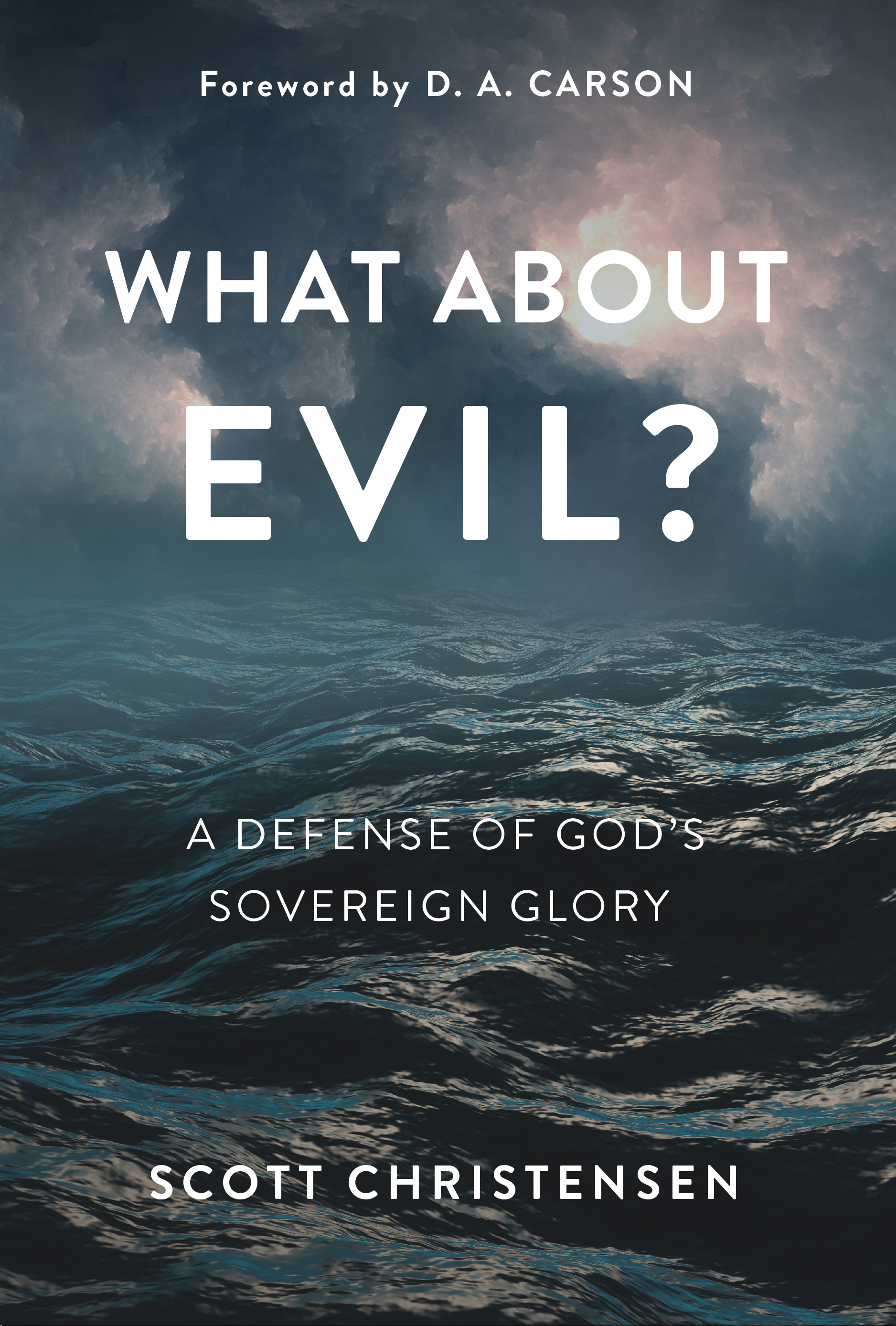
What About Evil? by Scott Christensen


What About Evil cover

Full disclosure: The following is a review of What About Evil? by Scott Christensen.  I am friends with Christensen on Facebook, although I cannot remember precisely the details of how we became Facebook friends. I suspect it’s either because of Triablogue or because of Steve Hays directly. I also received a review copy for free.  However, the following views are my own and are an honest assessment of Christensen’s book.

- - -

Christensen’s writing style is one that definitely connected with me.  When reading some authors, you can get the sense of overwhelming intellect. They use large words and technical phrases with skill, and you learn a lot from them but it also takes a lot of extra thinking to parse out those sentences.  Christensen’s style is the opposite.  It’s not that his writing is simplistic—far from it—but rather that he writes in such a manner that it is effortless to take in what he is writing about.  In other words, his meaning is plain, not convoluted. His metaphors are obvious, not strained.  And the end result is that reading a paragraph from his book is effortless.  Unlike reading a massive tome where it is a chore to grind out every sentence, Christensen’s style lends to quick, and enjoyable, reading.

Where this becomes a bit unusual is in instances where Christensen lists examples of what he is referring to.  For instance, when giving a list of natural disasters in his introduction (page 2), he includes “...the European Black Death (1347–51), Chilean earthquakes (1647), Krakatoan volcanoes (1883), Spanish flu pandemics (1918), Indonesian tsunamis (2004), Chinese coronavirus pandemics (2020), and endless twisters in Tornado Alley.” Because I am used to reading many technical treatises, my mind immediately asked “why do tornadoes not have any dates listed?  And why did he suddenly move from specific examples to the general example of tornados?  And why only tornadoes and not, say, hurricanes?” 

But of course, Christensen wasn’t trying to make any extra point by including tornadoes there.  He’s simply listing some common examples of natural evils, and the “oddity” of having tornados at the end, not fitting the format of the other items in the list, fits into Christensen’s folksy style.  This is the sort of list someone would make if they were talking extemporaneously in a conversation.

I hope none of that is taken as a criticism. In fact, I think the style of the book helps make it easier for a lay person to read.  And by pointing out the style is “folksy” that in no way means that the arguments Christensen puts forth have no weight.  Instead, it means that (in my opinion) more people will be able to benefit from this writing than if Christensen had used a more academic style.

Christensen quickly gets to the point in the book. He is looking into the various theodicies presented to oppose those who question the existence of God based on the existence of evil.  He looks at some of the more common theodicies, such as the “Free-Will Defense”, “The Natural-Law Defense”, and the “Greater-Good Theodicy” (among many others), concluding that while there are some good things in most defenses, for a Biblically-minded Christian, the view that is most faithful to Scripture is a version of the “greater-good theodicy” with “the best-of-all-possible-worlds defense.”  He dubs his own view the “Greater-glory theodicy”, in his words, “because it seeks to resolve the problem by examining what brings God the greatest glory” (p. 7).

The reason I like Christensen’s method is because he is geared so closely to holding to what the Bible teaches, and using that as the foundation for all else.  It places Christ, and His work in defeating evil, at the center of the entire context of evil in the first place.  As he writes, “[…]Christ is no conventional hero, and the cross is no conventional weapon. We do not naturally associate a hero’s victory with his death. … Yet surprisingly, in the cross, Jesus defeats evil.  Jesus defeats death by dying…. He becomes our hero by being treated as a villain” (pp. 8-9).

If you feel I’m giving away too much of the book, perhaps the low value of those page numbers will assuage you.  Christensen fully tells us all of this within the very introduction of his book!  This isn’t something he’s trying to hold off for later, to bait you in before revealing where he’s going.  As is keeping with Christensen’s “folksy” language, he has no reason to obscure anything with rhetoric and seems almost excited to get through the background information to get to the main point: the glorification of Christ.

Honestly, as someone who’s read a lot of philosophy on theodicies—and many of them quite well reasoned and argued—it’s nice to have one where the focus is so clearly on the majesty of Christ.

This is why I especially enjoyed that while Christensen took several chapters to discuss evil from a historical and philosophical standpoint, including discussing how the term can even be defined, he so quickly delves into what would even constitute a theodicy that honors God, especially in light of how secular the world is in modern days.  He examines the strengths and weaknesses of the common arguments in Chapters 5 and 6, (the weaknesses being where they lack Biblical support, and the strengths being where they have sufficient Biblical support), and then spends chapters 7 and 8 discussing the nature of God Himself and how the Bible discusses evil.  It is that Biblically-centered focus that I very much appreciated, and that’s not even getting into the section that Christensen himself identifies as the “heart” of his book: Chapters 10 – 13, where the redemptive theme of Scripture is seen as a monomyth—“one universal storyline that evokes a human longing for redemption.”  And if you’re looking for shortcuts, first of all I suggest not doing so.  But if you really want to get to the main argument, Chapter 12 of the book (specifically, beginning on page 281) presents the “greater-good theodicy” in detail.

Much more could, and should, be said about this work by Christensen.  There is a treasure of introductory-level Reformed theology throughout all its pages, and his defense being grounded in Scripture is definitely a breath of fresh air.  The Bible is the strength of the Reformed position, and Christensen does a wonderful job pulling together the various threads to support his view: philosophical, historical, and most of all theological.  While I am more intellectually driven and love the logic of the Reformed view, Chapters 10 and 11 (where Christensen spends time talking about the entire story of the Bible) was a nice change of pace.  As a dabbler in fiction, the purpose and intent of stories also speaks to me, and it’s nice for someone to remind me that God is an Author, just as much as He is an Architect or Mathematician.

My only regret is that when I read the majority of this book, it was during an unexpected foot surgery I had, and as a result the experience was not as physically pleasant as I wish it could have been.  I hope in another couple of months to re-read the book, from a new (unmedicated and pain-free) point of view to get another take on it.  It will be well worth reading again, and I highly recommend this to anyone who wants to increase their theodicy arsenal.  I rate this a solid A+, or 5 stars if we go by the Amazon scale, because it is well written, well researched, well informed, and, most of all, Biblically grounded.

Sunday, November 03, 2019

Bejon on Judges

Alastair Roberts interviews James Bejon on the book of Judges, but also discusses biblical theology and several other things that'd likely be interesting to Christians. (Note: It seems like there are a couple of technological glitches along the way.)

Monday, July 15, 2019

Schreiner on Ecclesiastes

The following is from Tom Schreiner's The King in His Beauty: A Biblical Theology of the Old and New Testaments, pp 300-312.


Introduction

Waltke says, "The book of Ecclesiastes is the black sheep of the canon of biblical books. It is the delight of skeptics and the despair of saints."1 It is typical for scholars to read the message of the book in bleak terms, but Waltke rightly says that "the view that Qoheleth lost faith in God's justice and goodness depends on proof texting and not on interpreting the book holistically."2 If Proverbs focuses on the regularities of life, Ecclesiastes concentrates on the anomalies. I should add immediately that such a dichotomy between Proverbs and Ecclesiastes is too rigid, for Proverbs, as noted above, has often been interpreted simplistically. A careful reading of Proverbs demonstrates that Solomon and the other proverb writers were well aware that those who worked hard did not always get rich, that the poor were often victims of injustice, and that tragedies struck the righteous and not just the wicked. Nevertheless, the popular perception of Proverbs exists for a reason, for the book often emphasizes that good comes to those who do good. Ecclesiastes gazes at another dimension of reality and reflects on the irrationality and perverseness of life under the sun. Both Proverbs and Ecclesiastes are part of what is called Wisdom literature, but their profoundly different emphases demonstrate that wisdom cannot be captured by a simple formula. Wisdom perceives what ordinarily happens in life, and it attempts to discern and understand the mysteries and injustices of human existence. Ecclesiastes probes the latter. House rightly emphasizes that Ecclesiastes must be read as part of the canon, noting that apart from the canon a multiplicity of interpretations can be defended, from existentialism to pessimism.3

Saturday, July 13, 2019

Schreiner on Revelation

Fred Zaspel at Books at a Glance has a good interview with Thomas Schreiner on Revelation.

Also, some might enjoy the Tom Schreiner and Greg Beale series "Unraveling Revelation".

Wednesday, March 21, 2018

Common Grace and the ‘Already and Not Yet’ Theme of Scripture

Already spring, and not yet finished shoveling snow.
We’ve been treated to at least one more snowfall, this one having been “inaugurated” on the first day of spring. It looks as if the snowfall will continue for another day or so.

While I was out shoveling, I was reminded of the phrase “already and not yet” as it applies to our redemption in Christ, as we still live in this fallen world.

It’s already spring, but I’m still shoveling.

One of the striking themes in the NT is that of the “already–not yet.” God has inaugurated his kingdom, but he has not consummated it. He has begun to fulfil his saving promises, but he has not yet completed all that he has started. No one can grasp the message of the NT if redemptive history is slighted. The NT does not negate the OT but fulfills it (Thomas Schreiner, “New Testament Theology”, Grand Rapids, MI: Baker Academic, ©2001, p. 14).

I’m amazed at the common grace of God, enabling us to see (foresee) traces of His plan in the midst of common, everyday life. I wonder how many people will be complaining of the snow, all the while, missing this quite evident symbol of our current place in redemptive history.

The promised new creation will become a reality at the coming of Jesus Christ. God’s covenantal promises will then be fulfilled, and the groaning of the old creation will end when the new world dawns with all its stunning beauty.

What will make the new creation so ravishing is a vision of God and his dwelling with his people. Believers will enter the new creation with the resurrected bodies that they have been awaiting eagerly in the interval between the already and the not yet.

They will receive the reward of eternal life and the kingdom promises that they grasped by faith while on this earth. The final inheritance and salvation that were longed for will then become a reality (p. 864).

We are already redeemed. Until then, the task of shoveling snow is made lighter, knowing that it’s already spring, and the snow won’t last long at all.

Wednesday, May 11, 2016

Christianity at ground level

A while back, atheist philosopher Keith Parsons had a lengthy exchange with Thomist Ed Feser. But Parsons is still an atheist!

Atheists like Parsons don't really care about the mere theism or classical theism of people like Feser. Parsons had a Christian upbringing, and that's his frame of reference. 

In a sense he's right. Christianity is a Bible-based religion. You can't just pole-vault over that to classical theism. Classical theism is about the attributes of God rather than the acts of God (other than God as Creator). It's a common denominator view of God shared by some Christians, Muslims, and Jews (e.g. Aquinas, Maimonides, Al-Ghazâlî).

In the nature of the case, it doesn't include the acts of God (beyond creation), because Christians, Muslims, and Jews differ on what God has done in human history. Christians agree with Jews regarding OT history, but Jews disagree with Christians regarding NT history. Both Jews and Christians disagree with Muslims regarding Koranic history, and Muslims return the favor. 

By the same token, you have many Christian apologists who defend particular events in Scripture rather than defending Scripture itself. 

These approaches are naturally unsatisfactory to many atheists because it's too abstract. At some point the debate has to touch ground. Come down to the level of the God depicted in the Bible. What he does as well as what he is. 

Friday, May 06, 2016

God Has Spoken in His Son

Peter T. O'Brien has published God Has Spoken in His Son: a biblical theology of Hebrews. This is a complement to his splendid commentary on Hebrews. 

Saturday, January 04, 2014

Beale interviewed at SCRBPC 2013

A few video clips from an interview with G.K. Beale. Beale was recently the keynote speaker at the SoCal Reformed Baptist Pastors' conference.

Thursday, July 18, 2013

Schreiner's biblical theology


I was thumbing through Tom Schreiner's new monograph: The King in his Beauty. From what I've read, his interpretations don't break any new ground. His interpretations are often indebted to writers like Desi Alexander, G. K. Beale, Brevard Childs, Stephen Dempster, William Dumbrell, Peter Gentry, Paul House, Meredith Kline, Jon Levenson, von Rad, Bruce Waltke, Barry Webb, and Stephen Wellum. As you'd expect, he has a Baptist view of the covenants. 

I think this would be a good book to give a recent convert to Christianity. It's a roadmap, guiding them through the Bible. Gives them a good overview of the Biblical storyline. How various book of the Bible contribute to an integrated message. 

Monday, March 04, 2013

As deserts are with sands

Jim Hamilton has preached a five-sermon series addressed mainly to college students on the theme of "Finding Your Place in God’s Story."

Saturday, February 23, 2013