A couple of years ago, I wrote a response to the sections of Anita Gregory's doctoral thesis that discuss the Enfield Poltergeist. But I wrote that response before listening to Maurice Grosse and Guy Playfair's Enfield tapes. I've now listened to all of them, and I want to supplement my response to Gregory's thesis with what I've learned since then from the tapes and other sources.
When I make reference to the tapes below, I'll use "MG" to cite Grosse's tapes and "GP" to cite Playfair's. Therefore, MG74B refers to Grosse's tape 74B, and GP15B refers to tape 15B in Playfair's collection, for example.

Showing posts with label Anita Gregory. Show all posts
Showing posts with label Anita Gregory. Show all posts
Sunday, November 01, 2020


Friday, May 01, 2020
What Enfield Skeptics Actually Experienced At The Hodgsons' House
Some of the most prominent critics of the Enfield case are individuals who visited the house where most of the poltergeist phenomena occurred. People like Milbourne Christopher, John Beloff, and Anita Gregory claimed to have not experienced anything at the house, and their skepticism has been cited against the case for decades. Because I've now listened to Maurice Grosse and Guy Playfair's audio cassettes and because of some other information that's recently come to light, I want to revisit the subject of what these skeptics actually experienced when they were at the house. As we'll see, their experiences have often been misrepresented, and they do more to support than to undermine the authenticity of the case.
It's useful to know the layout of the house, so go here to see a floor plan. I'll use "MG" to designate a tape from Grosse's collection and "GP" to designate one from Playfair's. MG8A is Grosse's tape 8A, GP21A is Playfair's 21A, etc.
It's useful to know the layout of the house, so go here to see a floor plan. I'll use "MG" to designate a tape from Grosse's collection and "GP" to designate one from Playfair's. MG8A is Grosse's tape 8A, GP21A is Playfair's 21A, etc.
Thursday, April 02, 2020
How Much Of The Enfield Case Was Faked?
I've argued at length for the authenticity of the Enfield case, such as in a recent post about the credibility of the witnesses. But how much of the case was inauthentic?
I'll be making a lot of references to Maurice Grosse and Guy Playfair's Enfield tapes below, and I'll use "MG" to designate Grosse's tapes and "GP" to designate Playfair's. MG79A refers to Grosse's tape 79A, GP2B refers to Playfair's tape 2B, etc.
I don't know of any significant evidence that anybody other than the Hodgson children was involved in fraud. That's important, given the large number of other people involved in the case. You occasionally come across skeptics of a more ignorant variety who claim, without justification, that other individuals faked events. But, in my experience, those are skeptics who take that sort of approach toward the paranormal in general. They speculate that all sorts of witnesses in all sorts of contexts are lying for money or faking things in an attempt to get attention, for example. But that sort of approach toward the paranormal is more of an assertion than an argument. It's a highly unlikely hypothetical that I've never seen anybody substantiate. (For a discussion of why such hypotheticals should be considered highly unlikely, see my earlier post on the credibility of the Enfield witnesses.) More knowledgeable skeptics limit their accusations of fraud to a small percentage of the witnesses, namely the Hodgson children. See the opening paragraph of the post here for documentation that skeptics who are more knowledgeable argue that way.
No less a critic of Enfield than Anita Gregory made the point in her doctoral thesis that she didn't want to be accused of claiming that an entire paranormal case is falsified if any event within it is discovered to have been faked. I noticed multiple places in her thesis where she made the point. She acknowledges that it would be "crude and simplistic" to think that "any play-acting by the children" proves that nothing paranormal occurred in the entire case (189-90). In a 1982 article included as supplemental material in her thesis (section G), she writes:
I'll be making a lot of references to Maurice Grosse and Guy Playfair's Enfield tapes below, and I'll use "MG" to designate Grosse's tapes and "GP" to designate Playfair's. MG79A refers to Grosse's tape 79A, GP2B refers to Playfair's tape 2B, etc.
I don't know of any significant evidence that anybody other than the Hodgson children was involved in fraud. That's important, given the large number of other people involved in the case. You occasionally come across skeptics of a more ignorant variety who claim, without justification, that other individuals faked events. But, in my experience, those are skeptics who take that sort of approach toward the paranormal in general. They speculate that all sorts of witnesses in all sorts of contexts are lying for money or faking things in an attempt to get attention, for example. But that sort of approach toward the paranormal is more of an assertion than an argument. It's a highly unlikely hypothetical that I've never seen anybody substantiate. (For a discussion of why such hypotheticals should be considered highly unlikely, see my earlier post on the credibility of the Enfield witnesses.) More knowledgeable skeptics limit their accusations of fraud to a small percentage of the witnesses, namely the Hodgson children. See the opening paragraph of the post here for documentation that skeptics who are more knowledgeable argue that way.
No less a critic of Enfield than Anita Gregory made the point in her doctoral thesis that she didn't want to be accused of claiming that an entire paranormal case is falsified if any event within it is discovered to have been faked. I noticed multiple places in her thesis where she made the point. She acknowledges that it would be "crude and simplistic" to think that "any play-acting by the children" proves that nothing paranormal occurred in the entire case (189-90). In a 1982 article included as supplemental material in her thesis (section G), she writes:
Monday, July 08, 2019
Police Officers Involved In The Enfield Case
An aspect of the Enfield Poltergeist that's impressed a lot of people is that some police officers reported witnessing paranormal events on the case's opening night. That auspicious start to the case is so formidable that even Enfield's most prominent critic, Anita Gregory, admitted its force and went to a lot of trouble to try to undermine it. I've responded to her arguments elsewhere (here and here), and I won't be reinventing the wheel in this post. Rather, I want to supplement what I wrote earlier with some material I've come across since then, while listening to Maurice Grosse and Guy Playfair's Enfield tapes.
My citations of the tapes below will use "MG" to designate a tape from Grosse's collection and "GP" to designate one from Playfair's. So, MG7A is tape 7A in Grosse's collection, and GP40A is tape 40A in Playfair's.
In her doctoral thesis, Gregory writes:
"She [Carolyn Heeps, one of the police officers who visited the Hodgsons' house on the opening night of the case] may also, and this is purely speculative though quite reasonable, have had to contend both with Sgt. Hyams, the colleague who was with her, who was apparently unmoved, and with her own original case notes for the events of the early hours of 1 September 1977." (191)
I've already discussed some of the problems with Gregory's speculation in my responses to her linked above. For example, Hyams is standing next to Heeps in the video of their BBC interview, and it makes far more sense for Hyams to stand next to Heeps if the two agree about at least most of what's being said. It's doubtful that they were fundamentally contradicting each other, yet were standing together for the interview, with Heeps doing all of the talking. And I discussed the interview with Stewart Lamont, the reporter who conducted it, a couple of years ago. In that discussion, Lamont told me that Hyams' comments didn't add anything substantial to Heeps', so they only aired Heeps' remarks. And the Enfield tapes give us more reason to reject Gregory's hypothesis.
My citations of the tapes below will use "MG" to designate a tape from Grosse's collection and "GP" to designate one from Playfair's. So, MG7A is tape 7A in Grosse's collection, and GP40A is tape 40A in Playfair's.
In her doctoral thesis, Gregory writes:
"She [Carolyn Heeps, one of the police officers who visited the Hodgsons' house on the opening night of the case] may also, and this is purely speculative though quite reasonable, have had to contend both with Sgt. Hyams, the colleague who was with her, who was apparently unmoved, and with her own original case notes for the events of the early hours of 1 September 1977." (191)
I've already discussed some of the problems with Gregory's speculation in my responses to her linked above. For example, Hyams is standing next to Heeps in the video of their BBC interview, and it makes far more sense for Hyams to stand next to Heeps if the two agree about at least most of what's being said. It's doubtful that they were fundamentally contradicting each other, yet were standing together for the interview, with Heeps doing all of the talking. And I discussed the interview with Stewart Lamont, the reporter who conducted it, a couple of years ago. In that discussion, Lamont told me that Hyams' comments didn't add anything substantial to Heeps', so they only aired Heeps' remarks. And the Enfield tapes give us more reason to reject Gregory's hypothesis.
Friday, June 08, 2018
A Response To Anita Gregory's Doctoral Thesis On Enfield
Abbreviations
JSPR = Journal of the Society for Psychical Research
SPR = Society for Psychical Research
THIH = Guy Playfair, This House Is Haunted (United States: White Crow Books, 2011)
For the background to this post and an explanation of why her thesis is important, see here. You can download the thesis here after registering with the site. I'll be responding to her thesis in hyphenated sections. If you aren't interested in the topic covered in one section, you can move on to another by following the hyphens. You can also use the Ctrl F feature on your keyboard to find what you're looking for.
JSPR = Journal of the Society for Psychical Research
SPR = Society for Psychical Research
THIH = Guy Playfair, This House Is Haunted (United States: White Crow Books, 2011)
For the background to this post and an explanation of why her thesis is important, see here. You can download the thesis here after registering with the site. I'll be responding to her thesis in hyphenated sections. If you aren't interested in the topic covered in one section, you can move on to another by following the hyphens. You can also use the Ctrl F feature on your keyboard to find what you're looking for.
Wednesday, May 30, 2018
David Robertson On The Enfield Poltergeist
Shortly after Guy Playfair's death, I received an email from David Robertson. He's the last of the major initial investigators of the Enfield case who's still alive. He's also done other paranormal research with John Hasted and in other contexts. In addition to being the last of the major initial investigators of the Enfield case, he's the individual who was most involved in the efforts at filming the poltergeist and, to my knowledge, the last person alive who's seen some of the videos that weren't released to the public. His filming work has had a major role in how Enfield has been analyzed over the years. Anita Gregory cited some of his videos as evidence against the authenticity of the Enfield case, Gregory and Maurice Grosse carried on a public exchange about those videos for years, and The Conjuring 2, a popular movie loosely based on Enfield, makes reference to Robertson's videos. He performed scientific tests on Janet Hodgson that provided evidence of her paranormal abilities. He spent a lot of time in the Hodgsons' home and was largely responsible for arranging and documenting the events of December 15, 1977. You may have heard or seen him in Enfield documentaries over the years. For example, here's a video of him discussing the testing he did to demonstrate Janet's ability to bend metal paranormally. And here you can listen to him discussing the December 15 events.
Robertson has given me permission to post some of what he wrote in our email exchange. His comments are lengthy, they address a large number and variety of topics, and some of what he mentions about Enfield has, as far as I know, never been said publicly before. Much of it is highly significant.
Two independent sources have verified that the email address of the individual who contacted me is Robertson's. There's also good internal evidence, within the emails, that the individual is Robertson.
Since his comments are easier to understand if you know the general layout of the Hodgsons' house, here's a floor plan from the original edition of Playfair's book (This House Is Haunted [Briarcliff Manor, New York: Stein and Day, 1984]):

I'll occasionally interrupt Robertson's comments to offer some explanatory material, but the large majority of what follows will be what he wrote.
Robertson has given me permission to post some of what he wrote in our email exchange. His comments are lengthy, they address a large number and variety of topics, and some of what he mentions about Enfield has, as far as I know, never been said publicly before. Much of it is highly significant.
Two independent sources have verified that the email address of the individual who contacted me is Robertson's. There's also good internal evidence, within the emails, that the individual is Robertson.
Since his comments are easier to understand if you know the general layout of the Hodgsons' house, here's a floor plan from the original edition of Playfair's book (This House Is Haunted [Briarcliff Manor, New York: Stein and Day, 1984]):
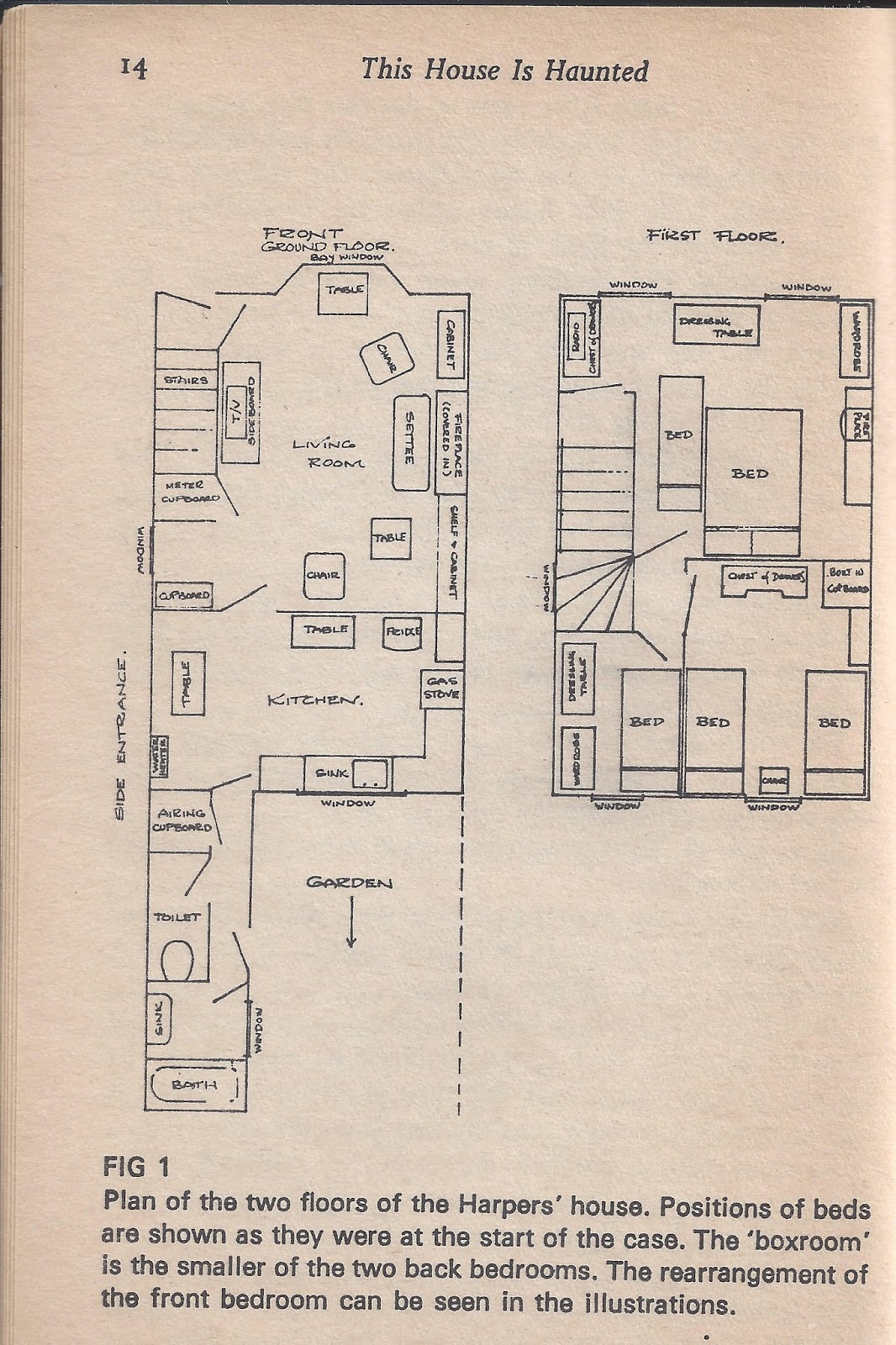
Click the floor plan for a larger image of it.
I'll occasionally interrupt Robertson's comments to offer some explanatory material, but the large majority of what follows will be what he wrote.
Sunday, May 20, 2018
Anita Gregory's Enfield Poltergeist Doctoral Thesis Available Online For Free
To learn more about the significance of this, go to my article here and do a Ctrl F search for "thesis". Read, especially, from the second use of the term onward.
To get Gregory's thesis, go here and register with the site, which doesn't take long and is free. I haven't yet found anybody discussing the availability of her thesis online. I don't know if it just recently became available or has been available for a long time. I've followed the Enfield case closely. I've read many hundreds of pages of material on it, I've been in contact with eyewitnesses of the events and some members of the Society for Psychical Research who are significantly knowledgeable about the case, and I've listened to many hours of audio about it, including recent podcasts, radio programs, etc. I've never heard anybody refer to having read Gregory's thesis, much less have I ever heard anybody say that the general public could download it for free online. I don't know if this is a recent development. I'm emailing some people to try to find out.
As my article linked above discusses, Will Storr wrote about his unsuccessful efforts to get Gregory's thesis a little over a decade ago. Apparently, it had been kept from the public up to that point because Maurice Grosse and Guy Playfair threatened to take legal action over it. You can read more about that situation in my article linked above and in Storr's book. My impression had been that nothing significant had changed since Storr's book was published. If the availability of Gregory's thesis is widely known, why haven't skeptics been citing it? Why didn't it come up in discussions about The Conjuring 2? Will Storr has occasionally discussed the Enfield case in recent years, and I've never seen him say anything about getting a copy of Gregory's thesis. It never came up in any of Guy Playfair's last interviews, as far as I know, and I don't think I missed any. Perhaps his recent death is what made the thesis available.
Whether this is a recent development or not, it deserves far more attention than it's gotten so far. This is a major advance in the public's ability to study the Enfield case.
To get Gregory's thesis, go here and register with the site, which doesn't take long and is free. I haven't yet found anybody discussing the availability of her thesis online. I don't know if it just recently became available or has been available for a long time. I've followed the Enfield case closely. I've read many hundreds of pages of material on it, I've been in contact with eyewitnesses of the events and some members of the Society for Psychical Research who are significantly knowledgeable about the case, and I've listened to many hours of audio about it, including recent podcasts, radio programs, etc. I've never heard anybody refer to having read Gregory's thesis, much less have I ever heard anybody say that the general public could download it for free online. I don't know if this is a recent development. I'm emailing some people to try to find out.
As my article linked above discusses, Will Storr wrote about his unsuccessful efforts to get Gregory's thesis a little over a decade ago. Apparently, it had been kept from the public up to that point because Maurice Grosse and Guy Playfair threatened to take legal action over it. You can read more about that situation in my article linked above and in Storr's book. My impression had been that nothing significant had changed since Storr's book was published. If the availability of Gregory's thesis is widely known, why haven't skeptics been citing it? Why didn't it come up in discussions about The Conjuring 2? Will Storr has occasionally discussed the Enfield case in recent years, and I've never seen him say anything about getting a copy of Gregory's thesis. It never came up in any of Guy Playfair's last interviews, as far as I know, and I don't think I missed any. Perhaps his recent death is what made the thesis available.
Whether this is a recent development or not, it deserves far more attention than it's gotten so far. This is a major advance in the public's ability to study the Enfield case.
Tuesday, July 18, 2017
Scientific Experiments On Janet Hodgson's Paranormality
Guy Playfair and Maurice Grosse wrote:
I've already discussed the experiments on Janet's ability to bend metal. Watch here until 19:13. But what about the "fully controlled experiment in a laboratory"?
Carrying out fully controlled experiments in somebody else's home is not easy, especially when the home is suffering from poltergeist activity. However, at least one fully instrumented experimental PK [psychokinesis] session was held under the supervision of David Robertson with Grosse as witness. Janet was asked to deform a piece of 'unbendable' eutectic alloy without contact. On separate occasions, a pulse counter and a three-channel chart recorder produced readings that could not be accounted for. The metal sample broke while under observation. (Playfair 1980, ch. 9).
With the cooperation of Professor J. B. Hasted, it was possible to carry out a fully controlled experiment in a laboratory. Janet was taken to Birkbeck College for an experiment in which she was seated on a specially constructed weighing platform and asked to alter her weight. She was one of three subjects out of more than 20 tested who managed to produce anomalous chart readings. (Journal Of The Society For Psychical Research, vol. 55, 1988-9, "Enfield Revisited: The Evaporation Of Positive Evidence", p. 213)
I've already discussed the experiments on Janet's ability to bend metal. Watch here until 19:13. But what about the "fully controlled experiment in a laboratory"?
Monday, May 08, 2017
The Enfield Poltergeist: Anita Gregory's Skepticism
(Earlier posts in the series: part 1, part 2, part 3, part 4, part 5, part 6, part 7.)
In some ways, Anita Gregory is the most formidable skeptic of the Enfield Poltergeist, even though she died in 1984. She was a prominent member of the SPR. She visited the Hodgson home during the months when the poltergeist's activity was at its height. She knew of some occasions when the Hodgson girls had faked phenomena, including on video, and she was largely responsible for publicizing that information. She knew Grosse and Playfair and often interacted with them about Enfield, including several times in the JSPR. She's the one who reviewed Playfair's book for the JSPR. She had discussions with some of the most significant witnesses in the case and used their testimony to argue against the authenticity of the Enfield phenomena. She wrote a doctoral thesis that argued against the authenticity of the Enfield case. Today's Enfield skeptics probably cite Gregory more than they cite any of the other original skeptics.
That record looks impressive at first sight. But it doesn't hold up well under closer examination.
In some ways, Anita Gregory is the most formidable skeptic of the Enfield Poltergeist, even though she died in 1984. She was a prominent member of the SPR. She visited the Hodgson home during the months when the poltergeist's activity was at its height. She knew of some occasions when the Hodgson girls had faked phenomena, including on video, and she was largely responsible for publicizing that information. She knew Grosse and Playfair and often interacted with them about Enfield, including several times in the JSPR. She's the one who reviewed Playfair's book for the JSPR. She had discussions with some of the most significant witnesses in the case and used their testimony to argue against the authenticity of the Enfield phenomena. She wrote a doctoral thesis that argued against the authenticity of the Enfield case. Today's Enfield skeptics probably cite Gregory more than they cite any of the other original skeptics.
That record looks impressive at first sight. But it doesn't hold up well under closer examination.
Subscribe to:
Posts (Atom)