
Sunday, December 23, 2012


Is the Father greater than the Son?
“The Father is greater than I” [Jn 14:28], has over the years occasioned an assortment of profound dogmatic discussions of the intratrinitarian ontological relationship between the Son and the Father and of the relationship between Jesus’ divine and human “natures.” Specifically in the ancient Christological conflicts, but also in later popular and scholarly discussion of the divine sonship of Christ. This led both to a subordinationist Christology like that of Arius and–on the orthodox side–to the view that 14:28 referred to the irreversible order in trinitarian relationships (the Father begets the Son and not vice versa and so is “greater” in that sense). Others have sought a solution in the fact that Jesus speaks here from within his human nature as a “servant” and not from within his divine nature [footnote 101].
But in the process these words have all too often been abstracted from the line of thought pursued in the text, where Jesus is obviously not concerned to teach his disciples about the nature of his divine personhood or the distinction between his human and his divine nature–or to detract from the glory in which he participated as the Son of God (cf. 5:20f.). All that is at issue here is what is “more,” “greater,” or “more profitable” (cf. 16:7) for the disciples: Jesus’ remaining with them on earth or his going away to the Father? In the context everything is focused on his departure. That the Father is “more” than Jesus means only that his return to the Father is the beginning of a new dispensation of grace, one based in heaven and therefore coming down from the Father. This new dispensation will exceed the limitations of the dispensation represented by Jesus’ presence on earth (cf. v12), just as the glory that Jesus will receive as the Son who returns to the Father will be greater than his earthly glory (17:5,24), even though both issue from his oneness with the Father. Jesus is not excluded from that “greater” reality that the Father will confer on the disciples after Jesus’ departure (cf. 17:11-13). He will, in fact, have a hand in it, as is evident from everything that has been said so far, especially about his “coming” to them.
H. Ridderbos, The Gospel of John: A Theological Commentary
(Eerdmans 1997), 512.
Anthropomorphic "Tritheism"
Anti-Trinitarian
Dale Tuggy likes to depict popular Trinitarian piety as tritheistic. Dale often lampoons the Christian faith with his smirky,
cutesy illustrations. For instance
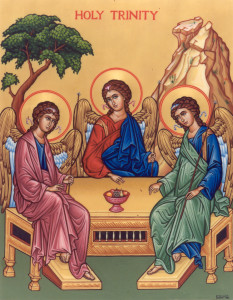
Now, it’s true that when Christians pray to the Trinity,
they may imagine or visualize the Trinity in “tritheistic” terms. However,
that’s simply an innocuous mental aid. We might dub this
anthropomorphic tritheism, in the sense that the worshipper is relating to God
in implicitly (or explicitly) tritheistic mental imagery.
But the Bible itself often depicts God in anthropomorphic or
angelomorphic terms. So there’s nothing inherently heretical or impious about
worshiping God in this rather cartoonish fashion. Anthropomorphic tritheism is
no more absurd or unorthodox than anthropomorphic monotheism. For instance:
The Lord says to my Lord:“Sit at my right hand,until I make your enemies your footstool.”(Ps 110:1)19 And Micaiah said, “Therefore hear the word of the Lord: I saw the Lord sitting on his throne, and all the host of heaven standing beside him on his right hand and on his left;(1 Kgs 22:19)In the year that King Uzziah died I saw the Lord sitting upon a throne, high and lifted up; and the train of his robe filled the temple. 2 Above him stood the seraphim. Each had six wings: with two he covered his face, and with two he covered his feet, and with two he flew. 3 And one called to another and said:“Holy, holy, holy is the Lord of hosts;the whole earth is full of his glory!”4 And the foundations of the thresholds shook at the voice of him who called, and the house was filled with smoke. 5 And I said: “Woe is me! For I am lost; for I am a man of unclean lips, and I dwell in the midst of a people of unclean lips; for my eyes have seen the King, the Lord of hosts!”6 Then one of the seraphim flew to me, having in his hand a burning coal that he had taken with tongs from the altar. 7 And he touched my mouth and said: “Behold, this has touched your lips; your guilt is taken away, and your sin atoned for.”(Isa 6:1-7)7 Then the earth reeled and rocked;the foundations also of the mountains trembledand quaked, because he was angry.8 Smoke went up from his nostrils,and devouring fire from his mouth;glowing coals flamed forth from him.9 He bowed the heavens and came down;thick darkness was under his feet.10 He rode on a cherub and flew;he came swiftly on the wings of the wind.11 He made darkness his covering, his canopy around him,thick clouds dark with water.12 Out of the brightness before himhailstones and coals of fire broke through his clouds.13 The Lord also thundered in the heavens,and the Most High uttered his voice,hailstones and coals of fire.14 And he sent out his arrows and scattered them;he flashed forth lightnings and routed them.(Ps 18:7-14)9 “As I looked,thrones were placed,and the Ancient of Days took his seat;his clothing was white as snow,and the hair of his head like pure wool;his throne was fiery flames;its wheels were burning fire.10 A stream of fire issuedand came out from before him;a thousand thousands served him,and ten thousand times ten thousand stood before him;the court sat in judgment,and the books were opened.(Dan 7:9)55 But he, full of the Holy Spirit, gazed into heaven and saw the glory of God, and Jesus standing at the right hand of God. 56 And he said, “Behold, I see the heavens opened, and the Son of Man standing at the right hand of God.”(Acts 7:55-56)After this I looked, and behold, a door standing open in heaven! And the first voice, which I had heard speaking to me like a trumpet, said, “Come up here, and I will show you what must take place after this.” 2 At once I was in the Spirit, and behold, a throne stood in heaven, with one seated on the throne. 3 And he who sat there had the appearance of jasper and carnelian, and around the throne was a rainbow that had the appearance of an emerald. 4 Around the throne were twenty-four thrones, and seated on the thrones were twenty-four elders, clothed in white garments, with golden crowns on their heads. 5 From the throne came flashes of lightning, and rumblings[a] and peals of thunder, and before the throne were burning seven torches of fire, which are the seven spirits of God, 6 and before the throne there was as it were a sea of glass, like crystal.And around the throne, on each side of the throne, are four living creatures, full of eyes in front and behind: 7 the first living creature like a lion, the second living creature like an ox, the third living creature with the face of a man, and the fourth living creature like an eagle in flight. 8 And the four living creatures, each of them with six wings, are full of eyes all around and within, and day and night they never cease to say,“Holy, holy, holy, is the Lord God Almighty,who was and is and is to come!”9 And whenever the living creatures give glory and honor and thanks to him who is seated on the throne, who lives forever and ever, 10 the twenty-four elders fall down before him who is seated on the throne and worship him who lives forever and ever. They cast their crowns before the throne, saying,11 “Worthy are you, our Lord and God,to receive glory and honor and power,for you created all things,and by your will they existed and were created.”(Rev 4)
The Eternal Sonship of Christ
I’m
discussing this issue for two reasons. It seems to me that
Scripturalism/Clarkianism has come to a crossroads. Will it take the unitarian
fork in the road?
I’m not an insider to the world of Clark’s would-be
disciples. Viewed from the outside, it appears to me that the
Clarkian/Scripturalist movement is increasingly fragmented and diminished. This
is, in large part, because it lacks any institutional patronage to unify it and
conserve it.
Issues raised by the unitarian turn in some
Clarkian/Scripturalist circles also concerns me from a missional standpoint.
This sends mixed signals to Muslims. It complicates the task of Christians who
evangelize Muslims.
Not that Clarkian/Scripturalist splinter groups have any
appreciable impact on outreach to Muslims. That’s a miniscule fringe group. But
it draws attention to fault-lines in Nicene subordination. So I’m using
it to illustrate larger issues.
I’m going to use D. A. Carson’s recent book Jesus the Son of
God to frame my discussion. I don’t always agree with him, but his book
supplies a useful backdrop even when he and I differ.
i) In chap. 1 he points out that “sonship” had broader
connotations in the ancient world than biological derivation. It had
sociological as well as biological connotations. As a rule, your father’s
social class determined your social class. If he was a king, you’d become the
next king. If he was a commoner, you’d be a commoner. If he was a blacksmith,
you’d be a blacksmith.
This stands in contrast to modern 1st world men
and women. Our culture has great social mobility, including upward (as well as
downward) mobility. So sonship tends to have a narrower connotation in our own
culture.
Therefore, when we come to NT passages about the sonship of
Christ, we need to guard against assuming a particular connotation, like
eternal generation.
ii) Carson also distinguishes between different connotations
of sonship in the OT, as well as how that carries over into the NT. The OT
sometimes speaks of Israel as God’s son. That’s a type of collective sonship.
It’s synonymous with God choosing Israel, but it uses an adoptive metaphor to
illustrate and enrich the concept of divine choice.
In some NT passages, Jesus is God’s “son” in this sense. He
assumes the role of the new and true Israel.
Then you have David sonship, with connotations of kingship
and anointed office. That theme is obviously picked up in the NT, where it
culminates in Jesus.
Both connotations of sonship also trigger further
associations with the eschatological notion of hereditary rights, viz. a royal
son as titular heir to his father’s throne.
Then, in the NT, there are passages where sonship connotes a
relationship which implies the deity of the Son, paralleling the deity of the
Father.
iii) Not only does Biblical sonship have various
connotations, but each connotation can have its own cluster of OT passages
which attest or develop that connotation. Indeed, these may constitute a chain
of passages threading through the OT, where a seminal motif is introduced in an
earlier book, and that, in turn, gives rise to a series of passages that begin
to unpack the implications of that idea. Different connotations of sonship have
their own literary allusions, running in tandem with each other. And sometimes
in the NT, these become interwoven. Parallel lines of development converge or
intersect. That’s not surprising, since these themes are fulfilled in one
person.
iv) In chap 2, argues for the functional subordination of
the Son to the Father. Up to a point I agree with Carson, but with some
important caveats:
a) We need to distinguish between the economic and the
immanent Trinity. To some extent the economic Trinity reveals the immanent
Trinity, but there are discontinuities as well as continuities. For instance,
things are true of God’s Incarnate Son which aren’t true and can’t be true of
God’s Son in isolation to the Incarnation. Jesus obviously has some
distinctively human characteristics. So you can’t simply read the economic
Trinity back into the immanent Trinity.
b) Moreover, even at the economic level, inequality
statements alternate with equality statements.
c) And that, in turn, suggests the direction in which we
should harmonize the respective types of claims. The Son can’t very well be
economically equal with the Father unless he is ontologically equal with the
Father. He can assume a role that’s less than he really is, but he can’t assume
a role that’s more than he really is. For no one can be more than he is. He
wouldn’t be up to the task assigned to him unless he was naturally suited to
the task. If he were genuinely inferior, he couldn’t discharge divine
prerogatives. His performance would inevitably be deficient.
Indeed, God sometimes delegates divine responsibilities to
human beings, and we see them fail. That’s a common theme in Scripture. God
does that to demonstrate our natural and moral inadequacies. But in the NT,
Jesus never falls short. His performance stands in stark and studied contrast
to merely human performance.
So there’s an asymmetry between equality statements and
inequality statements. An ontologically superior being can assume an
economically inferior role, but an ontologically inferior being can’t assume an
economically superior role.
v) In chap. 3, Carson reviews conventional prooftexts for
eternal generation, using Berkhof as his foil.
a) He notes that even Berkhof is ambivalent about Ps 2:7.
And he explains the irrelevance of Heb 11:17.
b) That leaves a handful of Johannine passages which talk
about the Son as monogenes. Berkhof renders that “only-begotten,” but Carson,
following most modern scholarship, renders it “one of a kind.”
c) I’m actually not convinced by that analysis. To begin
with, there’s a danger here of committing the etymological fallacy. Meaning is
determined by contemporary usage, not historical usage or the original root
word. Even if monogenes derives from genos rather than gennao, this doesn’t
mean that’s it was understood by John’s contemporaries.
In addition, Scripture often uses folk etymologies. John may
well be trading on verbal associations between generation and regeneration.
d) However, even if we retain the traditional rendering
(“only-begotten”), that doesn’t imply eternal generation. For one thing, we’re
still dealing with a metaphor. So we need to delimit and isolate the intended
scope of the figurative analogy. Is John emphasizing derivation, or something
else?
Is John’s point that the Son is derived from the Father, or
that the Son is divine, just like the Father? In controversial settings, where
Jesus is disputing with his opponents, as well as when they accuse him of
blasphemy, the stress is on the deity of Christ. Eternal generation isn’t very
meaningful in context. That’s not what the testy debates in the Johannine
narrative were about.
e) Likewise, the adjective (monogenes) may hold no special
significance. After all, John alternates between monogenes huios, or simply the
“Son”–often paired in rhetorical opposition to the “Father”–or the “Son of
God.” In the Fourth Gospel and 1 John, the Apostle John uses monogenes [huios] 5
times, the “Son of God” 15 times, and the “Son” 34 times. So monogenes huios
may just be a stylistic variation, interchangeable with John’s other sonship
usages. These linguistic variants may well function as rough synonyms in
Johannine usage.
vi)Jesus’ subordinate status is sometimes inferred from the
fact that the Father sends the Son. Sending is taken to be an act of authority.
The one sent is under the authority of the sender.
However, the Fourth Gospel often discusses the sender/sent
relation to accentuate where the Son comes from. To highlight his divine
preexistence.
He comes from above. He belongs to the divine realm rather
than the created realm. In the divide between God and the world, he occupies
the divine side of the divide. The Son can only be sent into the world because
he doesn’t come from the world in the first place–any more than God the Father.
You can’t artificially abstract the sender/sent relation
from that larger narrative context.
vii) In addition, the Father-sender/Son-sent relationship
isn’t equivalent to God sending an angel or God sending a prophet. Notice, in
the Fourth Gospel, how the sending of John the Baptist is contrasted with the
sending of the Son. Although the Baptist can speak on behalf of God, he doesn’t
reveal God in his own person, as Jesus does. There’s a categorical difference.
viii) The upshot of all this is that it’s quite
possible–indeed, preferable–to affirm the eternal sonship of Christ, but deny
the eternal generation of the Son.
a) One might object that that’s arbitrary, that generation
and sonship are interrelated. They may be biologically related, but that
doesn’t mean substitutable metaphors in Scripture. Each can have its own set of
connotations. Each can have its own set of literary trajectories. They don’t
necessarily (or even probably) bleed or blur into each other, any more than
Davidic sonship is equivalent to divine sonship.
Even where metaphors overlap, that doesn’t tell you in
advance where they overlap in a particular writer’s argument or narrative.
Related metaphors may intersect at various points, but that doesn’t mean an
author intends all those potential connotations to be active connotations.
Indeed, that could be quite confusing.
A writer may just as well exploit what’s distinctive to a particular
metaphor, rather than what is common to two related metaphors.
For instance, here are four theological metaphors for God
in Scripture: king, father, potter, shepherd. These have overlapping
connotations, but they also have distinctive connotations. Indeed, that’s why
Scripture uses four rather than one. In some respect they’re comparable, in
other respect they’re contrastive.
Moreover, even considered individually, they are
intentionally limited metaphors. Many things which are true of human kings,
fathers, potters, and shepherds are not true of God. So we must be sensitive to
what a bible writer specifically means by any particular metaphor. We must
carefully study the context.
b) And that’s even assuming that Scripture uses
“only-begotten.” Or that “only-begotten” retains a distinctive semantic nuance.
Or that the metaphor is meant to single out source of origin.
vii) Taken to a logical extreme, the alleged monarchy of the
Father shifts the Christian faith off-center. NT piety is pervasively centered
on the Son, not the Father. Indeed, it’s a tribute to the deferential humility
of the Father and the Spirit that the Son takes center stage while they largely
remain in the shadows. And that’s because there’s no rivalry among equals. They
have nothing to lose or gain. There’s no one-upmanship in the Trinity. Instead
of vying for top billing, they honor each other.
"Begotten, not made"
The core of Clarke's subordinationism is as follows. Certain names or titles in the Bible, including “God”, always or nearly always refer to the Father, giving him a kind of primacy among the three. The word “God” is used in higher and lower senses, and in his view the former always refers to the Father. The God of Israel, the one true God, just is the Father of Jesus. Further, he is the main and the primary and ultimate object of Christian worship and prayer, and as the sole recipient of the highest kind of worship. In his view, the Son of God has all the divine attributes but one, that of existing a se that is, existing and not being in any sense derivative of or dependent on anything else. To the contrary, “The Father Alone is Self-existent, Underived, Unoriginated, Independent” (Clarke 1738, 123). It is contradictory to suppose that something has this property in any sense because of another thing. In his view the Son and the Holy Spirit (like the Son, a personal agent or self distinct from the Father) exist and have their perfections because of the Father. Both are functionally and ontologically subordinate to him, and in the Spirit is at least functionally subordinate to the Son. What sort of dependence relations are these? The Son and Spirit derive their being from the Father as from a “Supreme Cause”, but we are not to infer from this that the Father existed before them. The Bible doesn't enlighten us on the nature of this dependence relationship, but seems to presuppose that it always was (i.e., that infinitely back in time, the Son and Spirit existed in dependence on the Father). Thus, “Arian” subordinationists (see section 3.1 above) are speculating groundlessly when they say there was a time when the Son didn't exist. And if a “creature” must at some time begin to exist, then neither Son nor Spirit are creatures. Still, Clarke thinks that we should affirm with some of the early church fathers that this derivation of the Son from the Father is “not by mere Necessity of Nature, (which would be in reality Self-existence, not Filiation;) But by an Act of the Father's incomprehensible Power and Will” (141, original emphases). Clarke argues that the New Testament teaches the eternal existence of the Son, and that he is (co-) creator of the world. Further, it teaches that the Holy Spirit is a personal agent distinct from God (and not a power of God, or an exercise of such). And against the mainstream tradition, “The word God, in Scripture, never signifies a complex Notion of more Persons (or Intelligent Agents) than One; but always means One Person only, viz., either the Person of the Father singly, or the Person of the Son singly” (155, original emphases). While the Spirit is nowhere called “God” or held up for worship, Clarke holds that his divinity is implied, and thus so is the appropriateness of his being worshiped as the Son is worshiped. The early Fathers, he holds, thought Father and Son to be homoousios only in the sense that the latter is ineffably derived from the former—not in the sense of their being the same thing or the exact same kind of thing.
i) Assuming the accuracy of this summary, what’s striking is
the degree to which Clarke is using Nicene subordination as his frame of reference.
The degree to which he shares certain fundamental assumptions in common with
Nicene orthodoxy, but develops them in a “semi-Arian” direction.
From what I can tell, both he and Nicene subordinationists regard
the Father as the ontological source of the Son and the Spirit. They share that
fundamental underlying presupposition.
Where they differ is how they construe the implications of
that presupposition. At best, Clarke is a “homoian Arian.” Father, Son, and
Spirit are of “like” substance rather than the same substance (or
consubstantial).
The upshot is that Nicene subordination plays into
variations of unitarianism. For that reason, Calvin was right to question this
framework. Some subsequent Reformed thinkers, to forge a more consistent
overall position, have since developed his approach. The only way to avoid the
unitarian potential of so-called Nicene orthodoxy is to scrap the fundamental
presupposition of the Father’s monarchy.
In that respect, I think contemporary Calvinists should
follow the lead of Frame, Warfield, and Helm rather than Roger Beckwith, Sam
Waldron, and Douglas Kelly–for the latter represents a throwback to a flawed
paradigm that’s vulnerable to unitarianism.
ii) Nicene subordination represents an unstable
compromise. Take the distinction between making and begetting.
“Begetting” is a biological metaphor. So we need to isolate
and identify the intended scope of the figurative analogy. At what level does
the comparison operate?
To my knowledge, Nicene subordination takes the position that
the Son and Spirit derive their existence and essence from the Father. But if
that’s the case, then that seems like a pretty good definition of what it means
to make something. What does it mean to say something is made if not to say it
owes its existence and/or essence to something else? If anything, that’s a
stronger definition of making something than is necessary. In common parlance,
to make something doesn’t mean it has to derive its entire existence or essence
from whoever or whatever made it. The maker may employ preexisting parts or
materials.
So if something can be an artifact in even that weaker
sense, then surely it’s an artifact in the stronger sense, when its entire
substance and subsistence derives from another.
Hence, I don’t see a principled contrast between begetting
and making in Nicene subordination. Once we strip away the incidental, figurative
connotations of begetting, the residual concept seems to collapse into
something made. A product. A creature.
Of course, in its historical setting, the distinction is
more specific, contrasting the Nicene position with the Arian position, where
the distinction between begetting and making boils down to a special kind of
production. Making by means of eternal generation is qualified in the sense
that there was never a time when the Son did not exist, in contrast to the
world. Likewise, making by means of eternal generation is qualified in the
sense that the producer and the product share the same nature or essence, in
contrast to creation ex nihilo.
So the Son isn’t made in the same sense that the world is
made. The Son is coessential and coeternal with the Father. Still, if he owes his
existence and essence to the Father, then there’s an unavoidable sense in which
the Father made him. That seems to be true by definition, an analytical truth,
given the causal dependence of the Son on the Father for his entire substance
and subsistence. Within this framework, we might say the Son is an eternal
creature or eternal artifact of the Father. We might say the Father
communicates his essence to the Son (and Spirit). But the Son is still an
artifact of the Father’s action. Father is the producer while the Son is the
product.
One might try to deny that eternal generation is a causal
concept. But if the Father is the source of the Son’s being, then a
cause/effect relationship seems to be undeniable. It may not be temporal, but
it surely is causal.
iii) This also has implications for worship. If we grant the
monarchy of the Father, then isn’t the Father a greater being than the Son or
Spirit? The inoriginate originator of the Son and the Spirit? And in that case,
isn’t he entitled to greater adoration than the Spirit or the Son? Doesn’t
everything trace back to the Father?
That’s assuming the monarchy of the Father is correct. Nicene subordination was a great improvement over Arianism. But it’s easy
to improve on Nicene subordination. The time is past due to cut the apron strings.
The church fathers did the best they could with the available resources, but
we’re in a position to do better, for we’re much further down the line of
historical, theological, and exegetical reflection.
iv) To my knowledge, Origen was the first writer to
introduce the theory of eternal generation into Christian theology:
If then I set before you, with respect to the Savior, that the Father has not begotten the Son and then severed him from his generation, but always begets him, I will also present something similar for the righteous man.If then the Savior is always begotten–because of this he also says, Before all the hills he begets me, (and not, “Before all the hills he has begotten me,” but, Before all of the hills he begets me [Prov 8:25)–and the Savior is always begotten by the Father…
Homily 9.4-5, in J. Smith, ed. Origin. Homilies on
Jeremiah. Homily on 1 Kings 28
(CUA 1998), 92-93.
It would be highly ironic if the Christology of a formally
condemned heretic like Origen becomes the touchstone of Christian orthodoxy.
Moreover, this is founded on a dubious appeal to Prov 8.
Closet Arians
Drake Shelton:
And I dare you to study the way this scripture is interpreted in the Pre-Nicene and Nicene Fathers. You will be most horrified to find that it is I who am holding to Orthodoxy while your party has followed a Roman innovation designed to conflate the ontological trinity with the economical and thus weave ther Church into the Godhead.
Several issues:
i) I appreciate Drake’s candor in giving me straight answers
to my questions. He didn’t dodge the questions. Mind you, I think his answers
are damning. They confirm my worst suspicions. But at least he’s forthright
about saying what he believes. Unfortunately, Drake’s “semi-Arian” Jesus is
literally a second-rate deity.
ii) I don’t grant Drake’s interpretation of the church
fathers or the Nicene creed. Drake is not a patrologist. And he’s done very
little reading in contemporary scholarship on the church fathers. Instant
expert syndrome leaves me unimpressed.
For instance, in the Nicene creed, “One God the Father” is
paired with “One Lord Jesus Christ,” where “Lord” stands for Yahweh. Both “God”
and “Lord” are divine titles in the Nicene creeds. Drake fails to distinguish
between “God” as a common noun and “God” as a proper noun.
In addition, it’s not as if the Nicene creed reserves the
name of “God” for the Father alone. To the contrary, it goes on to call Jesus
the “true God,” paralleling the same designation for the Father.
iii) Likewise, I don’t grant Clarke’s interpretation of the
church fathers. Clarke’s interpretation was challenged
in his own day. Cf. Edward Hawarden, An answer to Dr. Clark, and Mr. Whiston,
concerning the divinity of the Son, and of the Holy Spirit (Gale ECCO, 2010).
Keep in mind that Clarke may well be playing his cards close to his vest. England has a national church. Back in the 17-18C, expressing certain theological views could get you into hot water with the authorities. To hold an appointment at Oxford, Cambridge, &c., you had to be an Anglican in good standing with your ecclesiastical superiors. You could lose your job if you were too outspoken. Indeed, you could be prosecuted. Blasphemy was a crime.
Keep in mind that Clarke may well be playing his cards close to his vest. England has a national church. Back in the 17-18C, expressing certain theological views could get you into hot water with the authorities. To hold an appointment at Oxford, Cambridge, &c., you had to be an Anglican in good standing with your ecclesiastical superiors. You could lose your job if you were too outspoken. Indeed, you could be prosecuted. Blasphemy was a crime.
So men like Clarke may well have more radical views than
they held forth in public. Take Isaac Newton’s posthumous writings on the
Trinity. Newton was held in awe by his contemporaries. An object of national
pride. Buried at Westminster Chapel. If a man of his unrivaled standing didn’t
think it was politically safe to publish his theological views, a far lesser
figure like Samuel Clarke would be much more vulnerable.
What often happens in situations like this is that heretical
writers will say less than they think. But what they do say is a softening-up
exercise to begin lowering resistance to their true position. Cf. P. Dixon,
Nice and Hot Disputes: The Doctrine of the Trinity in the Seventeenth Century (T.
& T. Clark 2003), chap. 6.
iii) Acquainting myself with patristic exegesis is not my
priority. The church fathers are not authority figures. And exegetical theology
has made great strides since their day and age.
BTW, I’m not suggesting that whatever is newer is truer. I’m
not saying there’s a presumption in favor of modernity. But by the same token,
there’s no presumption in favor of antiquity. You need to judge things on a
case-by-case basis. Who has the best argument.
Because Drake isn’t a student at a seminary or university
with a major library collection, and because he probably can’t afford to spend
much on books, he’s very reliant on whatever he can find for free on the
internet. That includes old writers like Samuel Clarke, quaint
editions/translations of church fathers, a quaint edition of the Catholic
encyclopedia, Wikipedia, &c. Whatever is old enough to be in the public
domain.
That doesn’t include modern commentaries on the Bible,
modern exegetical monographs, or other up-to-date reference works. Likewise, it
doesn’t include modern scholarship on historical theology. So Drake is making a
virtue of economic necessity. He doesn’t have access to the best resources.
Drake is largely self-taught. There’s nothing wrong with
that, but the potential downside of being self-taught is that you’re only as
good as what you read. You’re at the mercy of your reading material. In Drake’s
case, his reading material is atrocious, of which Samuel Clarke is Exhibit A.
Moreover, people like Drake find serious Biblical exegesis
too confining. It doesn’t give free rein to their imagination. Serious exegesis
puts you at the service of the text. By contrast, philosophizing about the
Trinity feeds their intellectual pride.
Dietrich Bonhoeffer’s Last Letter, Christmas 1944

Dietrich was moved to the Gestapo prison in October 1944. It was then impossible to obtain visitation permits, and it is improbable that any of my letters reached him there. When the prison was badly damaged during an air raid in February he was moved out of Berlin and my attempts to find him in either Dachau, Buchenwald, or Flossenburg failed. In his last letter to me at Christmas, 1944, he wrote:
These will be quiet days in our homes. But I have had the experience over and over again that the quieter it is around me, the clearer do I feel the connection to you. It is as though in solitude the soul develops senses which we hardly know in everyday life. Therefore I have not felt lonely or abandoned for one moment. You, the parents, all of you, the friends and students of mine at the front, all are constantly present to me. Your prayers and good thoughts, words from the Bible, discussions long past, pieces of music, and books, -- [all these] gain life and reality as never before. It is a great invisible sphere in which one lives and in whose reality there is no doubt. If it says in the old children’s song about angels: ‘Two, to cover me, tow, to wake me,’ so is this guardianship, by good invisible powers in the morning and at night, something which grown ups need today no less than children. Therefore you must not think that I am unhappy. What is happiness and unhappiness? It depends so little on the circumstances; it depends really only on that which happens inside a person. I am grateful every day that I have you, and that makes me happy (19 December 1944).
From Dietrich Bonhoeffer, “Letters and Papers from Prison”, New York, NY: Macmillan Publishing Co, ©1953, 1967, 1971, Enlarged Edition, pp 418–419.
Saturday, December 22, 2012
Parsing the problem of evil
I would argue that the ontological existence of gratuitous, pointless, unnecessary evil makes much more sense of Christian theology and human experience than its nonexistence does.
This is Ragozine’s Arminian take on the problem of evil.
But, ironically, an atheist would argue that the ontological existence of
gratuitous, pointless, unnecessary evil makes much more sense if a world
without God. That the existence of gratuitous, pointless, unnecessary evil is
just what we’d expect if there is no God. Suffering is random because there is
no cosmic purpose or cosmic justice. It’s just your bad luck if you happen to
find yourself in the wrong place at the wrong time.
How would Ragozine empirically distinguish his
interpretation of events from the atheist?
Friday, December 21, 2012
Practical Trinitarianism
The
Trinity is frequently, indeed, usually, discussed in rather abstract,
theoretical terms. Expounding and debating various philosophical models of the
Trinity.
Of late,
the Trinity is coming under increasing attack on various fronts. There are
different culprits. The Trinity is offensive to Muslims. The Trinity is an
obstacle to ecumenists like the late John Hick. And the Trinity has been
targeted by Unitarians like Dale Tuggy. Strikingly, we even see the reputation
of “semi-Arians” like Samuel Clarke rehabilitated by some followers of Gordon
Clark.
Overemphasis
on the theoretical or philosophical aspects of the Trinity can obscure the
indispensable practical value of the Trinity in Christian piety. Let’s pause
for a moment how much the Trinity contributes to our understanding of God.
Consider
how much we learn about God when we read about Jesus in the Gospels. How much
we learn about God by observing Jesus in the Gospels. Eavesdropping on Jesus in
the Gospels. Watching him. Hearing him.
Then
consider how much less we’d know about God if Jesus wasn’t the Incarnate Son of
God. Consider how much less we’d know about God if we didn’t have the Gospels.
If we didn’t have that historical record of a time when God came to dwell among
us.
Likewise,
consider how much the Spirit teaches us about God. For the Spirit is the
primary author of Scripture. The agent of inspiration.
Without
the Spirit, we wouldn’t have the Bible. Consider how much less we’d know about
God without the Bible.
Try to
mentally blank out Jesus, then consider what’s left in your knowledge of God.
Try to mentally blank out the Spirit's role in giving us the Scriptures,
then consider what’s left in your knowledge of God. This is so engrained in
Christian consciousness–and rightly so–that it’s almost unimaginable to consider the cost of
losing it.
Moreover,
absent the Trinity, not only would we know less about God, but there would be
less about God to know. Indeed, we’d know less about a lesser God. For a
unitarian deity is a very different kind of deity. A more distant deity.
Unitarians deny the Incarnation.
And a
unitarian deity has no internal social life. No inner fellowship. In that
respect, he has far less in common with social creatures like human beings than
a Trinitarian God.
A
unitarian deity is more in the nature of a background condition, like the way
time or logic conditions our existence. He’s the ground of being, but not much
else. An existential precondition rather than an object of worship. Less a person than a principle. Not
someone you look up to. Not someone whose character informs your ideal of
goodness. You trust him (or it) in the sense of trusting the law of gravity.
False ecumenism
Every Christian must be ecumenical. That is, every Christian must devote herself to the unity of Christ’s church–a unity that witnesses in the world to the love of the Father for the Son and to their love for those sealed by the Spirit of adoption. Ecumenism is part and parcel of the church’s mission, and it is no accident that the last century has seen an explosion in efforts toward the visible unity of the church and the fulfillment of the Great Commission.
i) Since I’m not a “her,” I guess I’m
exempt.
ii) He
doesn’t explain why it’s no accident that the 20C saw an explosion of ecumenical
activity–much less why that’s supposed to be a good thing.
iii) In
any case, I have a better recipe. Instead of insisting that every Christian
must devote “herself” to the unity of Christ’s church, I’d insist that every
Christian must devote himself (or herself) to Christ. If every Christian is
devoted to Christ, if that’s our goal, then church unity will take care of
itself. Devotion to Christ will unite like-minded believers. Multiplied
individual devotion results in collective devotion. And surely that’s the only
kind of unity worth having: unity grounded in common devotion to Christ. So
instead of making ecumenism our focus, shouldn’t we center our lives on Jesus?
Christian unity will be a side effect of that primary devotion.
"The peril of worshiping Jesus"
According
to Clarkian Scripturalist Drake Shelton,
Samuel Clarke was a semi-arian. Semi-Arians were clearly admitted into communion by Athanasius…Semi-arians are not heretics.
Drake
has now added the following claim:
My friend Mark Xu and I have come to an agreement, in our readings of Clarke, that when Clarke says that the Son and Spirit are not necessities of nature, he is simply affirming that they are not auto-theos. That is his essential point, when you take his statement in context. This interpretation would then be perfectly consistent with Nicene Orthodoxy.
However,
that’s not all there is to Clarke’s position. As Dale Tuggy notes, in his
summary exposition of his position:
The God of Israel, the one true God, just is the Father of Jesus. Further, he is the main and the primary and ultimate object of Christian worship and prayer, and as the sole recipient of the highest kind of worship.
And
that’s not an incidental or disposable feature of Clarke’s overall position.
Rather, that’s a logical and practical consequence of how he understands
Scriptural usage (“Certain names or titles in the Bible, including ‘God’,
always or nearly always refer to the Father, giving him a kind of primacy among
the three”), along with his theory of divine derivation.
Do
Clarkian Scripturalists like Drake Shelton, Mark Xu, and Ryan Hedrich, agree
with Clarke’s conclusion? Is the Father more worshipful than the Son and
Spirit? Are there different degrees of worship we should accord the different
members of the Trinity? Should we accord the Father the highest degree of
adoration?
If they
disagree with Clarke, how do they logically distinguish their position from
his?
Put
another way, was Fosdick right to say worshiping Jesus is perilous? Do
Christians run the risk of idolatry if we accord the Son and the Spirit the
same level of adoration we accord the Father?
If Jesus
is less worshipful than the Father, should Christians practice mental reservations
when worshipping Jesus? Should we reserve the highest adoration for the Father
alone?
Is
worshipping Jesus secondary to worshiping the Father? Is worshiping Jesus just
a means to an end? Is the Father the ultimate and true object of adoration and
devotion?
Are
Calvinists like B. B. Warfield, John Murray, John Frame, Paul Helm, and Calvin
himself, idolaters for worshiping Jesus too much? Must we guard our hearts against the grave danger of esteeming Jesus too highly?
What do
other Clarkian Scripturalists like Vincent Cheung, Daniel Chew, Gary Crampton
et al. think of these developments?
Pseudepigrapha
Moderate
to liberal scholars claim the Bible contains many pseudonymous writings, both
in the OT and NT. They claim Jews and Christians had lax standards of
canonicity, or were simply gullible about the claimants.
It’s instructive to compare
this claim with some testable examples. For instance, Joseph Smith and Brigham
Young claimed to rediscover long lost books of the Bible. Did Christian
denominations accept that claim? No. The Mormons “scriptures” have been
uniformly rejected outside their cult.
Only Mormons took seriously
the claim that he was merely recovering long-forgotten books of the Bible. And
even within Mormonism, you have liberal Mormons who reject the official
etiology. Even many cradle Mormons aren’t that credulous. Same thing with nominal
Muslims who are closet unbelievers.
You also have other would-be
prophets like Swedenborg, Sun Myung Moon, Ellen G. White, and Herbert W.
Armstrong who produce quasi-scriptures. But their “canon” is only honored
within their respective sects or cults.
Muhammad is yet another
example. The list is long.
Within Judaism, Menachem
Schneerson (the Lubavitcher Rebbe) is a handy example.
These examples illustrate the
implacable institutional resistance to the introduction of new books (sometimes
under the guise of pseudonymity) to the canon of Scripture.
The ‘people of God’: Old Testament expectations

That is, we have to ask, and understand, what was the church in the New Testament? What was the Old Testament expectation?
In understanding what “the church” is Edmund Clowney in his work “The Church”, (Downer’s Grove, IL: InterVarsity Press, ©1995), relates that there is no question it has reference to “the people of God”. He notes, “the Bible does not deliver shipments of doctrine on cargo containers. Rather, the new grows out of the old, as the flower opens from the bud”. And in understanding the entire process of this unfolding, you have to go back to the beginning.
[The story of what God is doing in the world] does not begin at Bethlehem’s manger: it begins in the Garden of Eden, when God promises that the son of the woman will crush the head of the serpent. It continues in God’s promise to Abraham, made with an oath, ‘because God wanted to make the unchanging nature of his purpose very clear to the heirs of what was promised’ (Hebrews 6:17). The story of the church begins with Israel, the Old Testament people of God (Clowney, pgs 27–28).
Clowney goes on to relate that, according to the Bible, “the church is the people of God, the assembly and body of Christ, and the fellowship of the Holy Spirit”.
Yes, man fell in the garden, and God promised to redeem him. But, the question is, “redeem him to what?” From what had he fallen?
What did it mean to God’s actually assembled people throughout history?
What is God trying to do in the world? Understanding God’s purpose in creation is a means of understanding what “the church” is today: what it means to be “God’s people”.
G.K. Beale, in his A New Testament Biblical Theology: The Unfolding of the Old Testament in the New, (Grand Rapids, MI: Baker Academic ©2011) notes:
We can speak of Gen 1:28 as the first “Great Commission,” which was repeatedly applied to humanity. The commission was to bless the earth, and part of the essence of this blessing was God’s salvific presence. Before the fall, Adam and Eve were to produce progeny who would fill the earth with God’s glory being reflected from each of them in the image of God. After the fall, a remnant, created by God in his restored image, was to go out and spread God’s glorious presence among the rest of darkened humanity. This witness was to continue until the entire world would be filled with divine glory. Thus, Israel’s witness was reflective of its role as corporate Adam, which highlights the notion of missions in the OT.
According to Beale, this was the ongoing theme of the Old Testament.
Without exception, the reapplications of the Adamic commission are stated positively in terms of what Noah, the patriarchs, Israel, and the eschatological Israel or its king should do or were promised to do. Always the expectation is that of actual conquering of the land, increasing and multiplying population, and filling the promised land and the earth with people who will reflect God’s glory.
Never is there a hint that this commission is to be carried out by what we might call a negative act—that is, by death. Of course, Isaiah 53, Daniel 9, and Zechariah 12 (and a handful of typological Davidic texts such as Psalm 22) prophesy the messiah’s death as crucial to achieving Israel’s restoration, but these texts are the minority, and they are never directly associated with the repetitions of the Adamic commission. Therefore, the Adamic expectations and promises of obedience for Israel’s partriarchs, the nation, and its king are always stated in positive terms of what they were to do or were promised to do (Beale, 58).
Christ’s incarnation, death, and resurrection were for the accomplishment of a purpose, that was to be fulfilled in the creation and ongoing mission of the people of God.
Beale outlines this story line as it appears in the Old Testament:
I am not positing a center or single topic as the key to OT theology but rather a storyline around which the major thematic strands of the OT narratives and writings revolve. Although story as a hermeneutical approach to biblical literature has become popular in recent biblical scholarship and accordingly has even been applied to the doing of whole biblical theologies, the older Dutch Reformed scholars sometimes employed the notion of tracing the “redemptive-historical story” of “creation-fall-restoration.” It is also significant to recall that all the ancient creeds and confessions had a basic skeletal plotline of creation, fall, redemption, and consummation. The threefold pattern of “sin-exile-restoration” of Israel has been proposed recently as the framework of a biblical theology, as has a six-act structure of the Bible as a drama with kingdom as the overarching motif:
1. Kingdom establishmentAs is evident from the preceding, both the threefold and the sixfold pattern are included here but compose only some of the elements of a larger overall cyclic pattern of sacred history.
2. Rebellion
3. The king chooses Israel
—interlude: the kingdom story awaits ending during the intertestamental period—
4. Coming of the king
5. Mission of the king’s message
6. Return of the king
In the light of the above, my formulation of the storyline of the OT is as follows:
The Old Testament is the story of God, who progressively reestablishes his new-creational kingdom out of chaos over a sinful people by his word and Spirit through promise, covenant, and redemption, resulting in worldwide commission to the faithful to advance this kingdom and judgment (defeat or exile) for the unfaithful, unto his glory.
Rather than referring to this as the “center” of the OT, I prefer to see it as the primary strand of the biblical storyline thread, composed of other minor strands that are held together by the primary one.
The kingdom of the new creation and its missional expansion likely form the major stepping-stone for the accomplishment of divine glory. Accordingly, in the classic fourfold division of the scriptural story as creation, fall, redemption, and consummation, the last two elements are better revised as redemption through new creation and consummation of that new creation. Thus, the story of the Bible in this formulation begins with creation and ends with the restoration of creation (61–62).
Next time, Lord willing, I’ll follow some of these threads through the Old Testament, and begin to tie them into expectations that Israel [the “people of God”] and the disciples carried with them in the New Testament.
Thursday, December 20, 2012
Consider the ant
The Bible points out that sometimes animals are wiser than sinners. This dog puts all the Barack Obamas, Sandra Flukes and Peter Singers to shame:
http://www.youtube.com/watch?v=JA8VJh0UJtg&feature=share
http://www.youtube.com/watch?v=JA8VJh0UJtg&feature=share
"Semi-arians are not heretics"
STEVE DELETED HIS POST “DRAKE’S TILTING WINDMILL’S”!!!!! WAS THE EMBARASMENT JUST TOO MUCH FOR YOU STEVE? I HOPE IT WAS.
No I
didn’t. It’s been there all along.
Now
let’s get to the best part...or should I say the worst part:
Clarke was not an Arian: http://eternalpropositions.wordpress.com/2012/10/05/richard-muller-vs-samuel-clarke-on-the-trinity/Clarke was a semi-arian. Semi-Arians were clearly admitted into communion by Athanasius as I showed in the 6 quotations at the bottom of this article: http://eternalpropositions.wordpress.com/2012/12/15/sean-gerety-unqualified/. Thanks David Waltz!Semi-arians are not heretics.
It’s
certainly damning (in every sense of the word) to see Drake sticking up for Samuel Clarke’s orthodoxy. Is
this what Scripturalism/Clarkianism has come to? BTW, isn't Walz into Bahaism?
Here are
some of Clarke’s positions:
The core of Clarke's subordinationism is as follows. Certain names or titles in the Bible, including “God”, always are nearly always refer to the Father, giving him a kind of primacy among the three. The word “God” is used in higher and lower senses, and in his view the former always refer to the Father. The God of Israel, the one true God, just is the Father of Jesus. Further, he is the main and the primary and ultimate object of Christian worship and prayer, and as the sole recipient of the highest kind of worship…And if a “creature” must at some time begin to exist, then neither Son nor Spirit are creatures. Still, Clarke thinks that we should affirm with some of the early church fathers that this derivation of the Son from the Father is “not by mere Necessity of Nature, (which would be in reality Self-existence, not Filiation;) But by an Act of the Father's incomprehensible Power and Will” (141, original emphases)…And against the mainstream tradition, “The word God, in Scripture, never signifies a complex Notion of more Persons (or Intelligent Agents) than One; but always means One Person only, viz., either the Person of the Father singly, or the Person of the Son singly” (155, original emphases).
Keep in
mind that this is a sympathetic summary of Clarke by a unitarian philosopher.
So that’s putting Clarke in the best possible light.
I do
hope that Ryan Hedrich will soon shake-off the baleful influence of Drake
Shelton. In the past, Ryan struck me as quite reasonable and level-headed by
Scripturalist standards. Not prone to the usual extremes. He doesn’t suffer
from Drake’s personality disorders.
Ryan,
come out from among them, and be ye separate!
A Ministry Worth Supporting
I've often written about the importance of donating to apologetic ministries. Brian Auten just put up a post about some ways you can support Apologetics315, which I recommend doing. Here's an example of the sort of work he does there. One of the ways you can support his ministry is by ordering books through his amazon.com link. Are there any books you've been thinking of getting lately? Why not order them now by clicking one of the three links found here? It doesn't cost you anything extra, but it benefits Apologetics315.
Subscribe to:
Posts (Atom)