In my post yesterday, I quoted some comments by Stephen Braude about how reports of paranormal events are sometimes "similar in so many peculiar details" (The Limits Of Influence [Lanham, Maryland: University Press of America, Inc., 1997], 26). An example I've noticed that goes across multiple types of paranormal phenomena is the involvement of disembodied hands. The appearance of disembodied hands is a recurring theme in Braude's discussions of various mediums in his book cited above (43, 142, 146, etc.). As I've discussed elsewhere, disembodied hands were sometimes reported in the Enfield Poltergeist. The post just linked refers to how Alan Gauld and A.D. Cornell discuss the appearance of disembodied hands in their book on poltergeists and hauntings.
It wouldn't be too hard for people to occasionally lie or be honestly mistaken about seeing a disembodied hand, but the frequency with which it's reported and the highly credible nature of some of those reports are significant. It seems more likely that something paranormal is going on than that all of the witnesses have been mistaken in the same unusual way.

Tuesday, May 04, 2021


Monday, May 03, 2021
How The Nature Of A Miracle Can Be Evidential
"Even if witnesses were biased or predisposed to experience paranormal phenomena, that would not explain why the biased misperceptions or reports are similar in so many peculiar details. One would need an elaborate psychological theory (to say the least) to explain why people of dissimilar backgrounds and cultures, with apparently no common needs to experience bizarre phenomena of any sort, independently report (for example) 'raining' stones inside a house or the intense heat of apports." (Stephen Braude, The Limits Of Influence [Lanham, Maryland: University Press of America, Inc., 1997], 26)
Saturday, May 01, 2021
Religious And Occultic Aspects Of The Enfield Poltergeist
In a conversation in 1978, Margaret Hodgson told Guy Playfair that she'd seen an apparition in the context of using a Ouija board a few years earlier, apparently in 1974, and that she'd recently seen the same apparition in the context of the Enfield case. See the relevant section of my post here for more about what Margaret and her sister reported regarding their use of a Ouija board leading up to what's typically considered the poltergeist's onset in August of 1977. Margaret's experience in 1974 could be identified as the start of the poltergeist instead, depending on what standards you apply. And both the use of a Ouija board leading up to late August of 1977 and the girls' impression that their Ouija board use was connected to the poltergeist make it relevant to an evaluation of the case. But it doesn't get discussed much.
There are many other aspects of the case that are of an occultic or religious nature that have likewise been neglected. More research needs to be done on the subject, but I want to provide an overview of what I know at this point. Some of what I'll be citing comes from Maurice Grosse and Guy Playfair's Enfield tapes. I'll make reference to them by using "MG" to designate a tape from Grosse's collection and "GP" to designate one from Playfair's. MG32A is Grosse's tape 32A, GP41B is Playfair's 41B, etc.
There are many other aspects of the case that are of an occultic or religious nature that have likewise been neglected. More research needs to be done on the subject, but I want to provide an overview of what I know at this point. Some of what I'll be citing comes from Maurice Grosse and Guy Playfair's Enfield tapes. I'll make reference to them by using "MG" to designate a tape from Grosse's collection and "GP" to designate one from Playfair's. MG32A is Grosse's tape 32A, GP41B is Playfair's 41B, etc.
Thursday, April 29, 2021
Drifting Off Course Into Comforts
"Is this not a beautiful thing, when a man has a great, worthy, single passion in life and burns for it all the way to the end?...I would rather see a man die abruptly, on his way to one last conquest, than to see him drift off course into the comforts of old age." (John Piper, Why I Love The Apostle Paul [Wheaton, Illinois: Crossway, 2019], 28)
Tuesday, April 27, 2021
A Good Resource On The Virgin Birth
Nick Peters just started a new web site on the subject. It features collections of material supporting the virgin birth in written, audio, and video form. If you have any ideas about other material to include, he's taking suggestions.
Monday, April 26, 2021
Death for Life
I have often heard the charge from atheists that the idea of divine justice requiring the death of Christ in order for us to be saved is simply a ludicrous belief to hold to. Of course, this conundrum isn't limited to atheists as there are many non-Christian theists (and even some who call themselves Christian) who have issues with substitutionary atonement as well, but I am most familiar with the atheist objections given the circles that I run in. Regardless of who makes the complaint, the objection seems to boil down to the fact that it seems to be illogical for someone to gain eternal life at the expense of the life of an innocent person.
What has struck me is that not only is it not illogical to have this understanding, but it's actually the way things already are in our everyday life. Recently, I've been in some discussions regarding diet. Specifically, I had surgery on my feet back in November, and through the recovery process I need to maintain a lot better control over blood sugar levels in my diet. As a result of this need, the wound care clinic that provides the post-op care required me to attend a diabetes nutrition class. Ironically enough, the dietitian in that class came to the conclusion that I need to eat even more carbohydrates. In fact, she recommended that I have upwards of 250 grams per day. I think anyone who's ever had to control their blood sugar ought to realize just how ridiculous following that advice would be. (Incidentally, I usually maintain around 50 grams of carbohydrates per day and still have fasting blood sugars that are a tad higher than they want.)
Anyway, the point is that I've been thinking about diet lately, so it was natural for my brain to consider that topic when I thought about the objection that penal substitution makes no sense. I made a simple observation, one that is obvious, but which most of us do not think about. That is, whether you are consuming meat products or vegetable products, you are eating things that were, at one point, alive.
We do not consume inanimate objects, like dirt. Our food is the product of living beings. And it's not just byproducts—some of which we can eat (e.g., milk, honey, fruit, etc.), but none of which provide enough nutrients on their own to sustain life. To live, we need to eat animals and entire plants, killing those creatures in the process.
In other words, to consider that eternal life requires the sacrifice of an eternal living Person is somehow incomprehensible is to ignore the fact that our mortal life already requires the sacrifice of mortal beings. We live every day because animals and plants have died. It didn't have to be this way. Plants, after all, can use photosynthesis and get their energy directly from the sun. In that aspect, there's no reason why God couldn't have created human beings, and even all other animals, with photosynthesis. So I have to think that the very fact that we consume plants and animals was already meant as a picture for us of the coming sacrifice Christ would make on our behalf as well.
Which, as a further thought exercise for the future, might also have some bearing on the supralapsarian vs. infralapsarian debate too. I leave that thought exercise up to the reader.
Sunday, April 25, 2021
Jesus' Career Reflected In His Teachings And Early Christianity
In a 2005 article ("What was Jesus' occupation?", Journal Of The Evangelical Theological Society, vol. 48, no. 3 [September 2005], 501-19), Ken Campbell argued that Jesus and Joseph should be thought of as builders rather than carpenters. They would have worked with wood, but mostly with other materials. What I want to highlight here, though, are some points Campbell makes about the characteristics of Jesus' teachings and how consistent they are with a traditional Christian view of Jesus' background. They're what you'd expect from somebody like Jesus. I wouldn't go as far as Campbell does (e.g., referring to his conclusion about Jesus' occupation as "incontrovertible"), but the information Campbell cites is useful. You'll have to read his entire article to get the full picture, but what's below is a portion of what he wrote. I'll follow his comments with some of my own:
Friday, April 23, 2021
Other Agreements Among The Gospels About Jesus' Nonverbal Characteristics
In my last post, I discussed how the gospels agree about an aspect of Jesus' posture in the context of prayer. Because the gospels are documents about a teacher, they give a lot of attention to what Jesus said, and readers have a tendency to focus on those parts of the gospels. So, we're more likely to notice patterns in the verbal aspects of Jesus' life than in his nonverbal characteristics. And I think far more research has been done on the former than the latter. But I want to provide some other neglected examples of agreements among the gospels about Jesus' nonverbal characteristics.
He sometimes wept publicly (Luke 19:41, John 11:35).
He sometimes used spit in his healings (Mark 7:33, 8:23, John 9:6). Though spit was viewed positively at times in ancient sources, it was often viewed negatively as well. Raymond Brown referred to how "[Matthew] is in confrontation with Pharisees and in his account of the ministry [of Jesus] he is most careful not to give them anything they can use against Jesus (e.g., his omitting the spittle miracle narrated in Mark 8:22-26)." (The Birth Of The Messiah [New York, New York: Doubleday, 1999], n. 28 on 143) So, including that sort of detail in these healing accounts caused unnecessary offense.
And notice something else about the healings in Mark 8 and John 9. Both involved blind men, and both healings were done in multiple stages. So, not only do Mark and John agree in having Jesus use spit, but they also agree that he used it in the context of healing the blind in particular and that he sometimes healed the blind in multiple stages. That's a highly unusual series of agreements, and it's highly unlikely that Mark and John (and/or their sources) hit upon such agreements by chance in the process of making up stories.
Jesus was sometimes very confrontational, as we see with the temple cleansings (Matthew 21:12-13, Mark 11:15-18, Luke 19:45-46, John 2:13-22). It's likely that he cleansed the temple twice, not just once. Something that can get lost in the controversy over how many times he cleansed the temple is that all of the gospels are agreeing that Jesus had such a character that he behaved that way and did so in such a public context.
And he seems to have been good at avoiding crowds and avoiding the assaults of his enemies when he wanted to (Matthew 8:18-23, Mark 1:35, 6:31-32, Luke 4:30, 5:15-16, John 8:59, 10:39). Notice the overlap between those nonverbal characteristics and his verbal skills of a similar nature (e.g., Mark 4:1-12, Luke 20:19-26, John 6:60-66). The harmony between his words and actions is striking. He seems to have been both physically and mentally agile.
These are just several examples. Much more could be said about agreements over Jesus' moral character, interests, ways of handling particular types of situations, etc. I've been focused on the gospels, those documents give us the most material to work with, and some of the agreements exist only among the gospels. But we should also look for overlap among other sources (e.g., Old Testament theophanies that we think involve Jesus, Old Testament prophecies about him, Acts, comments about Jesus in the New Testament letters, Revelation).
He sometimes wept publicly (Luke 19:41, John 11:35).
He sometimes used spit in his healings (Mark 7:33, 8:23, John 9:6). Though spit was viewed positively at times in ancient sources, it was often viewed negatively as well. Raymond Brown referred to how "[Matthew] is in confrontation with Pharisees and in his account of the ministry [of Jesus] he is most careful not to give them anything they can use against Jesus (e.g., his omitting the spittle miracle narrated in Mark 8:22-26)." (The Birth Of The Messiah [New York, New York: Doubleday, 1999], n. 28 on 143) So, including that sort of detail in these healing accounts caused unnecessary offense.
And notice something else about the healings in Mark 8 and John 9. Both involved blind men, and both healings were done in multiple stages. So, not only do Mark and John agree in having Jesus use spit, but they also agree that he used it in the context of healing the blind in particular and that he sometimes healed the blind in multiple stages. That's a highly unusual series of agreements, and it's highly unlikely that Mark and John (and/or their sources) hit upon such agreements by chance in the process of making up stories.
Jesus was sometimes very confrontational, as we see with the temple cleansings (Matthew 21:12-13, Mark 11:15-18, Luke 19:45-46, John 2:13-22). It's likely that he cleansed the temple twice, not just once. Something that can get lost in the controversy over how many times he cleansed the temple is that all of the gospels are agreeing that Jesus had such a character that he behaved that way and did so in such a public context.
And he seems to have been good at avoiding crowds and avoiding the assaults of his enemies when he wanted to (Matthew 8:18-23, Mark 1:35, 6:31-32, Luke 4:30, 5:15-16, John 8:59, 10:39). Notice the overlap between those nonverbal characteristics and his verbal skills of a similar nature (e.g., Mark 4:1-12, Luke 20:19-26, John 6:60-66). The harmony between his words and actions is striking. He seems to have been both physically and mentally agile.
These are just several examples. Much more could be said about agreements over Jesus' moral character, interests, ways of handling particular types of situations, etc. I've been focused on the gospels, those documents give us the most material to work with, and some of the agreements exist only among the gospels. But we should also look for overlap among other sources (e.g., Old Testament theophanies that we think involve Jesus, Old Testament prophecies about him, Acts, comments about Jesus in the New Testament letters, Revelation).
Wednesday, April 21, 2021
The 6%
George Barna teamed up with the Cultural Research Center at Arizona Christian University and conducted 30-minute long interviews with 2,000 people designed to discover what worldview they profess to hold, as well as what worldview they actually end up living in their lives (link to study here). It should not be much of a surprise that they found 88% of Americans “embrace an impure, unrecognizable worldview that blends ideas from these multiple perspectives.” In fact, “Biblical Theism” only scored a whopping 6% in the survey...but that still managed to get the majority out of the worldviews presented.
Those worldviews are:
- Biblical Theism (6%)
- Secular Humanism (2%)
- Moral Therapeutic Deism (1%)
- Postmodernism (1%)
- Nihilism (1%)
- Eastern Mysticism/New Age (< 1%)
- Marxism/Critical Race Theory (<1%)
This study shows one of the problems with trying to pigeonhole people into one of these worldviews. The vast majority of people are Syncretists, wherein they grab a mishmash of things they like from various worldviews and smash them all together. Barna even explicitly labels them as such in his own results.
Of even greater concern than just the fact that only 6% of Americans can be considered Biblical Theists is the fact that when you take the numbers of characteristics that match “a moderately high number of beliefs or behaviors that meet various worldview specifications, but not quite enough to qualify as being a true adherent of that worldview” then the highest scoring trend in the US is those who hold to Moralistic Therapeutic Deism at 38%. Biblical Theists are in second place at 31%. This means that not only are 94% of Americans not Biblical Theists, but 69% of them aren't even close to being Biblical Theists.
It would be easy to say that syncretism isn't that bad. There's quite a bit of overlap between various views that people hold to, and besides Exodus 20:3 just says not to have another god before Yahweh, not to not have any other gods at all.
Of course the command in Exodus 20:3, “You shall have no other gods before me”, does not mean “Yahweh must be first on the list, but the other gods are okay after that.” “Before me” has a different understanding in older English, meaning “in the presence of”. For example, “I am going to be presented before the king.” Thus, the passage in Exodus carries that connotation, as in: “When you are present before me, you shall have no other gods.”
Still, I gather most readers here already know that. What may be a bit less obvious is the fact that when Israel committed most of her sins against God, such as those that led up eventually to the Babylonian captivity, Israel never really turned her back completely on God. That is, they didn't cease to offer sacrifices to Yahweh in order to add sacrifices to Baal. They simply sacrificed to both. Elijah points this out in 1 Kings 18:21, for example, asking the people of Israel, “How long will you go limping between two different opinions? If the LORD is God, follow him; but if Baal, then follow him.”
More could be mentioned, but I believe the point is made for the purposes of this post. Namely, the sin that caused the downfall of Israel was the very sin of syncretism that currently plagues the United States. God never made a covenant with the United States, even though He has made a covenant with His Church. How do you think a post-Christian American society will fare in the grand scheme of history?
Tuesday, April 20, 2021
Humanists Being Humanists....
American Humanist Association Board Statement Withdrawing Honor from Richard Dawkins
[Richard Dawkins's] latest statement implies that the identities of transgender individuals are fraudulent, while also simultaneously attacking Black identity as one that can be assumed when convenient. ...Consequently, the AHA Board has concluded that Richard Dawkins is no longer deserving of being honored by the AHA, and has voted to withdraw, effective immediately, the 1996 Humanist of the Year award.
I'm sure he's devastated by the removal of something he probably forgot he received since it is worth exactly zero cups of coffee down at Starbucks. Frankly, it's somewhat ironic that you have the AHA "withdrawing honor", something which in the atheistic universe is just made up and has no basis in objective reality according to their own criteria.
Actually, I guess it makes perfect sense as to why criticizing something that was just made up and has no basis in objective reality would result in the removal of an award which is just made up and has no basis in objective reality after all...
Still, we live in a world where something can be memory-holed and treated like it never happened due to something you say 25 years after the fact. Isn't progress grand?
Sunday, April 18, 2021
Agreement Among The Gospels About Some Practices Of Jesus
When discussing issues like the credibility and consistency of the gospels, matters such as Jesus' language and teachings often get a lot of attention, as they should. For example, he frequently refers to himself as the Son of Man in the gospels, whereas he's referred to that way much less often elsewhere. Another category that ought to be brought up in this context is what the gospels report about various nonverbal practices of Jesus, such as his posture:
"Here I am drawing attention to the Gospels' agreement in both John and the Synoptics that it was Jesus' habit to look up to heaven when praying [Matthew 14:19, Mark 6:41, 7:34, Luke 9:16, John 11:41, 17:1]….Though lifting up one's hands to heaven was also a possibility, the Gospels do not say that Jesus did that; they mention only that he looked up to heaven. They did not have to note his physical gestures in prayer, and it is interesting that when they casually do so in the course of telling a story, they note the same gesture and that John agrees with Mark on this point, though in different contexts." (Lydia McGrew, The Eye Of The Beholder [Tampa, Florida: DeWard Publishing, 2021], 386)
"Here I am drawing attention to the Gospels' agreement in both John and the Synoptics that it was Jesus' habit to look up to heaven when praying [Matthew 14:19, Mark 6:41, 7:34, Luke 9:16, John 11:41, 17:1]….Though lifting up one's hands to heaven was also a possibility, the Gospels do not say that Jesus did that; they mention only that he looked up to heaven. They did not have to note his physical gestures in prayer, and it is interesting that when they casually do so in the course of telling a story, they note the same gesture and that John agrees with Mark on this point, though in different contexts." (Lydia McGrew, The Eye Of The Beholder [Tampa, Florida: DeWard Publishing, 2021], 386)
Thursday, April 15, 2021
The Significance Of The Early Patristic Sources
They support a high view of the New Testament documents, such as their authorship, genre, historicity, and Divine inspiration. Because of that, skeptics often try to cast doubt on the significance of those patristic sources. Critics will often take an unusually negative view of the dating of the documents, their authorship, the quality of the sources they had access to, the quality of their information, the degree to which they disseminated the more valuable information they had, etc. So, it's important to evaluate and reevaluate those issues from time to time.
There's an element of truth to the approach skeptics often take toward these sources. As a general principle, earlier sources are better than later ones. And even the earliest patristic sources are patristic sources, meaning that they generally postdate the New Testament documents. Memory fades over time. Though some contemporaries and eyewitnesses of Jesus and the apostles would have lived into the late first century and beyond, there were fewer of them as time passed. Some apostolic documents and other relevant literature would have been preserved over time, but there would be fewer such documents available later than earlier. Some patristic sources were significantly close to the apostles relationally, chronologically, geographically, and such, but others weren't. From a Christian perspective, the New Testament documents were Divinely inspired in a way in which the patristic sources weren't. And so on.
However, much more can be said on the other side, in support of the value of the early patristic sources, than skeptics suggest. There's a danger of overestimating these sources, but also a danger of underestimating them. And even some Christians underestimate them, as a result of overreacting to Roman Catholicism or for some other reason.
For example, there are some passages in First Clement that ought to receive more attention than they normally do in this context. Section 5 refers to the martyrdom of Peter and Paul as having occurred in "our own generation". The admonition in section 44 that it would be unjust to remove church leaders who were appointed by the apostles and have served well in those offices seems to assume that some leaders appointed by the apostles were still alive. Section 63 refers to messengers being sent who "from youth to old age have lived blameless lives among us". So, we have one apostolic church (Rome) writing to another (Corinth) and mentioning the presence of witnesses who had been part of their community "from youth to old age", which would go back to the middle of the first century. Those witnesses were contemporaries of the apostles, close witnesses of the apostles' interactions with the Roman church and more (they witnessed the activities of close associates of the apostles, like Mark and Luke, related to Rome; they witnessed apostolic documents sent from Rome, not just documents written to that city; etc.).
I've written elsewhere about similar evidence pertaining to Papias, Polycarp, Quadratus, etc. You can search our archives for other examples.
There's an element of truth to the approach skeptics often take toward these sources. As a general principle, earlier sources are better than later ones. And even the earliest patristic sources are patristic sources, meaning that they generally postdate the New Testament documents. Memory fades over time. Though some contemporaries and eyewitnesses of Jesus and the apostles would have lived into the late first century and beyond, there were fewer of them as time passed. Some apostolic documents and other relevant literature would have been preserved over time, but there would be fewer such documents available later than earlier. Some patristic sources were significantly close to the apostles relationally, chronologically, geographically, and such, but others weren't. From a Christian perspective, the New Testament documents were Divinely inspired in a way in which the patristic sources weren't. And so on.
However, much more can be said on the other side, in support of the value of the early patristic sources, than skeptics suggest. There's a danger of overestimating these sources, but also a danger of underestimating them. And even some Christians underestimate them, as a result of overreacting to Roman Catholicism or for some other reason.
For example, there are some passages in First Clement that ought to receive more attention than they normally do in this context. Section 5 refers to the martyrdom of Peter and Paul as having occurred in "our own generation". The admonition in section 44 that it would be unjust to remove church leaders who were appointed by the apostles and have served well in those offices seems to assume that some leaders appointed by the apostles were still alive. Section 63 refers to messengers being sent who "from youth to old age have lived blameless lives among us". So, we have one apostolic church (Rome) writing to another (Corinth) and mentioning the presence of witnesses who had been part of their community "from youth to old age", which would go back to the middle of the first century. Those witnesses were contemporaries of the apostles, close witnesses of the apostles' interactions with the Roman church and more (they witnessed the activities of close associates of the apostles, like Mark and Luke, related to Rome; they witnessed apostolic documents sent from Rome, not just documents written to that city; etc.).
I've written elsewhere about similar evidence pertaining to Papias, Polycarp, Quadratus, etc. You can search our archives for other examples.
Tuesday, April 13, 2021
The Problem Of Ignorance Of The Church Fathers
"Far too many Evangelicals in the modern day know next to nothing about these figures [the church fathers]. I will never forget being asked to give a mini-history conference at a church in southern Ontario. I suggested three talks on three figures from Latin-speaking North Africa: Perpetua, Cyprian, and Augustine. The leadership of the church came back to me seeking a different set of names, since they had never heard of the first two figures, and while they had heard of the third name, the famous bishop of Hippo Regius, they really knew nothing about him. I gave them another list of post-Reformation figures for the mini-conference, but privately thought that not knowing anything about these figures was possibly a very good reason to have a conference on them! I suspect that such ignorance is quite widespread among those who call themselves Evangelicals" (Michael Haykin, Patrick Of Ireland [Scotland: Christian Focus, 2017], 9-10)
That ignorance causes major problems in interactions with Roman Catholics, Eastern Orthodox, atheists, Muslims, and other people whose beliefs and practices are highly relevant to the church fathers. The situation isn't as bad everywhere as Haykin's experience in Ontario, but it doesn't have to be so bad in order to be a significant problem.
I wrote an overview of how to study the church fathers several years ago. And I'll have more to say about the earliest fathers later this week.
That ignorance causes major problems in interactions with Roman Catholics, Eastern Orthodox, atheists, Muslims, and other people whose beliefs and practices are highly relevant to the church fathers. The situation isn't as bad everywhere as Haykin's experience in Ontario, but it doesn't have to be so bad in order to be a significant problem.
I wrote an overview of how to study the church fathers several years ago. And I'll have more to say about the earliest fathers later this week.
Saturday, April 10, 2021
Marcion's Corroboration Of Lukan Authorship
Given Marcion's high view of Paul and low view of the other apostles, his acceptance of the gospel of Luke while rejecting the other gospels makes the most sense if Marcion thought the third gospel had a close connection to Paul.
Concerning Marcion's corroboration of the authorship attributions of the other gospels, see here.
Concerning Marcion's corroboration of the authorship attributions of the other gospels, see here.
Wednesday, April 07, 2021
The Beloved Disciple's Galilean Interests
I recently finished reading Lydia McGrew's The Eye Of The Beholder (Tampa, Florida: DeWard Publishing, 2021). There are portions of the book in which she interacts with Richard Bauckham's arguments that the author of the fourth gospel was a disciple of Jesus named John, but not the son of Zebedee, one who lived in Jerusalem and didn't travel much with Jesus. You can read Lydia's book for a lot of good responses to Bauckham's case. I want to highlight some points here that I don't recall seeing in Lydia's book. But some of my points are closely related to hers, and I may be forgetting some of what she said.
Monday, April 05, 2021
A Good Discussion Of Many Resurrection Issues
Last week, Jonathan McLatchie did a question and answer session with Tim and Lydia McGrew on Jesus' resurrection. A lot of issues came up during the discussion, and it's worth watching.
You may also want to occasionally check Lydia's YouTube channel for updates, since she keeps adding new videos, like her recent ones on the historicity of the fourth gospel.
You may also want to occasionally check Lydia's YouTube channel for updates, since she keeps adding new videos, like her recent ones on the historicity of the fourth gospel.
Sunday, April 04, 2021
The Hope Cherished By The Nations
"And it is in Him, too, we already see the concluding expression of the prophecy fulfilled: 'In His name shall the nations hope.' [Isaiah 11:10, Romans 15:12] And by this fulfillment, which no one can deny, men are encouraged to believe in that which is most impudently denied. For who could have hoped for that which even those who do not yet believe in Christ now see fulfilled among us, and which is so undeniable that they can but gnash their teeth and pine away? Who, I say, could have hoped that the nations would hope in the name of Christ, when He was arrested, bound, scourged, mocked, crucified, when even the disciples themselves had lost the hope which they had begun to have in Him? The hope which was then entertained scarcely by the one thief on the cross, is now cherished by nations everywhere on the earth, who are marked with the sign of the cross on which He died that they may not die eternally." (Augustine, The City Of God, 20:30)
Thursday, April 01, 2021
How To Begin Studying The Enfield Poltergeist
Different people have different interests, so I'll recommend a broad range of resources. You can choose which ones are best under your circumstances (e.g., what sort of balance of written, audio, and video resources you want).
It's helpful to have some background information on poltergeists in general, so you could start with a Psi Encyclopedia article that provides an overview of the subject. A good book on the topic is Alan Gauld and A.D. Cornell, Poltergeists (United States: White Crow Books, 2017).
I wrote an article that outlines some of the evidential issues involved in evaluating the credibility of witnesses. It provides many examples from the Enfield case.
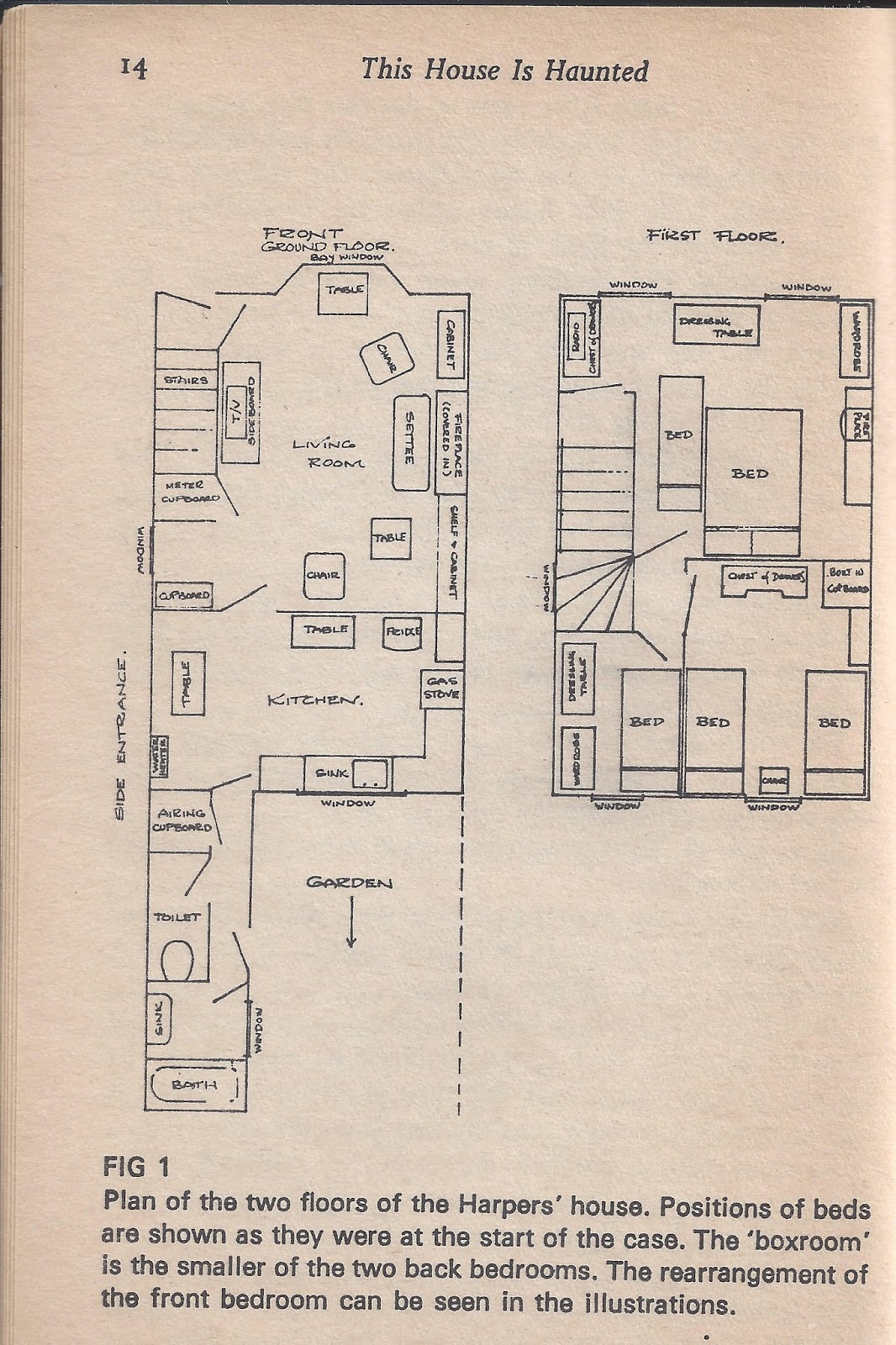
It's good to know the layout of the house where most of the activity occurred. You can find an image of a floor plan online here. Look over it before you start studying the case, and have it on hand to consult when needed. If you want a paper copy, you can print the one just linked or find it in the first edition of Guy Playfair's book mentioned below. The latest edition of the book, which I'll be recommending below, doesn't have the floor plan.
After you've consulted however much of that background material you're interested in, watch this BBC television segment from November of 1977 as an introduction to the case. It's about twelve minutes long.
The best documentary is one that aired on Apple TV+ in October of 2023. The second-best one aired on BBC Radio on December 26, 1978. The host, Rosalind Morris, was an eyewitness of some of the events, she interviews a lot of other eyewitnesses, and they're given a lot of time to speak.
If you want some other video documentaries, start with Interview With A Poltergeist, which came out in 2007. Another one aired on the Paranormal Channel the following year. It's not as good, but each has some strengths the other one doesn't have.
I've written tributes to four of the most important figures in the case. Those tributes will give you a lot of information about those individuals, their involvement in the case, and their credibility: Peggy Hodgson, Maurice Grosse, Guy Playfair, and John Burcombe. Those posts provide a lot of biographical information and references to other sources you can consult, but the posts aren't biographies. They're tributes that focus on the individuals' involvement in the Enfield case. Though the post on Peggy Hodgson is the longest, it's the one you should read if you only want to read one of them. She's the most important witness in the case, and she's often been underestimated and misrepresented.
The two books to get on Enfield (as opposed to poltergeists in general) are Guy Playfair's This House Is Haunted (United States: White Crow Books, 2011) and Melvyn Willin's The Enfield Poltergeist Tapes (United States: White Crow Books, 2019). Read them in that order.
For an introduction to skepticism about the case, you could start with Anita Gregory's review of Playfair's book mentioned above ("This House Is Haunted, An Investigation Of The Enfield Poltergeist", Journal Of The Society For Psychical Research, vol. 50, 1979-80, pp. 538-41). You can access the article at the Library of Exploratory Science site. Other skeptical overviews have been written by Joe Nickell and Deborah Hyde, among others. You can listen to a 2017 edition of the MonsterTalk podcast to hear from a few skeptics discussing Enfield.
If you want to research the case further, see my series of posts here. That material goes beyond an introductory level (e.g., discussing Maurice Grosse and Guy Playfair's audio tapes recorded during their investigation of the case; addressing Anita Gregory's doctoral thesis, which covers Enfield). I reference a lot of articles, books, videos, and other resources along the way, so you can find many more sources to consult there. The page just linked includes descriptions of some of the contents of each post, so you can use Ctrl F to search for what you're interested in, in addition to using a search engine.
It's helpful to have some background information on poltergeists in general, so you could start with a Psi Encyclopedia article that provides an overview of the subject. A good book on the topic is Alan Gauld and A.D. Cornell, Poltergeists (United States: White Crow Books, 2017).
I wrote an article that outlines some of the evidential issues involved in evaluating the credibility of witnesses. It provides many examples from the Enfield case.
It's good to know the layout of the house where most of the activity occurred. You can find an image of a floor plan online here. Look over it before you start studying the case, and have it on hand to consult when needed. If you want a paper copy, you can print the one just linked or find it in the first edition of Guy Playfair's book mentioned below. The latest edition of the book, which I'll be recommending below, doesn't have the floor plan.
After you've consulted however much of that background material you're interested in, watch this BBC television segment from November of 1977 as an introduction to the case. It's about twelve minutes long.
The best documentary is one that aired on Apple TV+ in October of 2023. The second-best one aired on BBC Radio on December 26, 1978. The host, Rosalind Morris, was an eyewitness of some of the events, she interviews a lot of other eyewitnesses, and they're given a lot of time to speak.
If you want some other video documentaries, start with Interview With A Poltergeist, which came out in 2007. Another one aired on the Paranormal Channel the following year. It's not as good, but each has some strengths the other one doesn't have.
I've written tributes to four of the most important figures in the case. Those tributes will give you a lot of information about those individuals, their involvement in the case, and their credibility: Peggy Hodgson, Maurice Grosse, Guy Playfair, and John Burcombe. Those posts provide a lot of biographical information and references to other sources you can consult, but the posts aren't biographies. They're tributes that focus on the individuals' involvement in the Enfield case. Though the post on Peggy Hodgson is the longest, it's the one you should read if you only want to read one of them. She's the most important witness in the case, and she's often been underestimated and misrepresented.
The two books to get on Enfield (as opposed to poltergeists in general) are Guy Playfair's This House Is Haunted (United States: White Crow Books, 2011) and Melvyn Willin's The Enfield Poltergeist Tapes (United States: White Crow Books, 2019). Read them in that order.
For an introduction to skepticism about the case, you could start with Anita Gregory's review of Playfair's book mentioned above ("This House Is Haunted, An Investigation Of The Enfield Poltergeist", Journal Of The Society For Psychical Research, vol. 50, 1979-80, pp. 538-41). You can access the article at the Library of Exploratory Science site. Other skeptical overviews have been written by Joe Nickell and Deborah Hyde, among others. You can listen to a 2017 edition of the MonsterTalk podcast to hear from a few skeptics discussing Enfield.
If you want to research the case further, see my series of posts here. That material goes beyond an introductory level (e.g., discussing Maurice Grosse and Guy Playfair's audio tapes recorded during their investigation of the case; addressing Anita Gregory's doctoral thesis, which covers Enfield). I reference a lot of articles, books, videos, and other resources along the way, so you can find many more sources to consult there. The page just linked includes descriptions of some of the contents of each post, so you can use Ctrl F to search for what you're interested in, in addition to using a search engine.
Tuesday, March 30, 2021
The Garden Of Suffering For Our Joy
"Every time we walk in a garden I think we ought to recollect the garden [of Gethsemane] where the Saviour walked, and the sorrows that befell him there. Did he select a garden, I wonder, because we are all so fond of such places, thus linking our seasons of recreation with the most solemn mementoes of himself?" (Charles Spurgeon)
Sunday, March 28, 2021
The Contrasting Ordinariness And Extraordinariness Of The Risen Jesus In Luke
I've often referred to the significance of the ordinariness of Jesus' body in the resurrection accounts in the gospels and Acts (e.g., here). An especially striking example is what we see in Luke's writings. The ordinariness of Jesus' resurrected body comes between the glorious appearance of the angels in Luke 24:4-5 and the gloriousness of Jesus' resurrected body after the ascension in Acts 9:3 (see, also, 26:13-14). Luke recognized the significance of that sort of impressive appearance and wanted to highlight it in passages like the ones I just cited. But he doesn't refer to Jesus as having had such a body prior to the ascension. Instead, he and the other gospel authors describe Jesus' pre-ascension resurrection body in more ordinary terms. That's best explained as a historically accurate memory of what was experienced with Jesus after he rose from the dead, a memory that was contrary to common expectation and reflects significant restraint on the part of the early Christians. We see that in sources other than Luke as well, but what's significant about Luke is how Jesus' ordinariness there contrasts so much with the extraordinariness of the appearance of Jesus and other figures in the nearby context.
Subscribe to:
Posts (Atom)