
Thursday, September 27, 2012


Progressive covenantalism
I already did a little post
on Kingdom through Covenant:
But this book has proven to
be unexpectedly controversial, so I’m going to spend more time interacting with
some of the arguments.
The book has even been
boycotted in some quarters. I think that’s unnecessary. The position of the
authors is a respectable position. And they make a case for their position. So
even if you disagree with them (as I do), their argument ought to be taken
seriously.
The authors label the old
covenant as the “covenant with Israel” (635). The implication of this
designation is that the new covenant is not a covenant with Israel. Yet their
OT prooftexts for the new covenant consist of passages in which God is speaking
to Israel. Where God is making promises to Israel. For instance, Ezk 36:22-36
is explicitly and specifically addressed to Israel. In terms of the historic
setting, moreover, God is addressing the Jewish exiles in Babylon. God is
evidently referring to their postexilic restoration.
As noted above, the old covenant has a built-in tension. God demands obedience from Israel, yet they disobey. The law holds out life, but due to sin it cannot ultimately save. There is nothing in the law-covenant that changes the human heart, which is what the people desperately need (639).
But don’t we see the same
tension in the NT church? Don’t many NT epistles bear witness to a similar
tension?
Isn’t this tension inevitable
in a fallen world? In inaugurated eschatology, we have a foot in both the
fallen world order and the new world order.
In the New Testament, it is clear that the new covenant texts are applied to Christ and the church (cf. Lk 22:20; 2 Cor 3; Hebrews 8, 10). Even though the new covenant is made with the “house of Israel and with the house of Judah” (Jer 31:31)…the NT applies it to the church through the mediatorial work of Jesus Christ (645-46).
i) The authors spend a lot of
time exegeting the OT. But they need to show how their application arises from
their OT prooftexts.
ii) It’s one thing to say
their OT prooftexts apply to the church, quite another to say their OT
prooftexts include the church to the exclusion of Israel, even when their OT
prooftexts have specific reference to Israel. How can they use their OT
passages to erect an antithetical contrast between Israel and the church
despite the setting and the wording of the very passages they adduce? Even if
you say Israel typifies the church, those are not polar opposites. And from a
Presbyterian standpoint, “the church” is another phase in the history of the
God’s people.
Their OT prooftexts don’t
single out the church to the exclusion of Israel. It wasn’t given as a promise
to the church rather than Israel. At least, that’s not something you can derive
from the OT passages on their own terms.
iii) The mediatorial work of
Christ can apply to Israel as well as the church. That’s not a differential
factor that uniquely selects for the church. Jesus is Israel’s Messiah, as well
as the Savior of the nations.
iv) They appeal to Heb 8-10,
but that’s arguably a Jewish church. A messianic congregation. That’s how many
scholars and commentators classify the audience. Because the members of that
church were messianic Jews, they were tempted to revert to Judaism (i.e. the
Mosaic covenant) in the face of persecution. Unlike Christianity, Judaism was a
religio licita.
It’s counterintuitive to
invoke Heb 8-10 as a way of contrasting Israel to the church when that very
letter was addressed to Jewish Christians.
[The new covenant] will indeed have a (human) covenant mediator, namely Jesus Christ, who is prophet, priest, and king in one person. In the old covenant community, these covenant mediators sinned and the community suffered because of faulty mediators. In the new covenant, however, our covenant mediator is without sin and as a result, the community will never suffer because of a faulty mediator (510).
i) But this fails to
distinguish the Baptist position from the Presbyterian position (e.g. WCF). Presbyterians can draw the same
distinction.
ii) In addition, this
distinction can stand on its own. It doesn’t need to be grounded in a theory of
immediate revelation.
Under the new covenant all will know the Lord, not in a mediate but in an immediate fashion, and all will have the law written on their hearts and will experience the full forgiveness of sin (649).
It’s unclear what the authors
mean by this:
i) Christians don’t enjoy
innate knowledge of the gospel. Knowledge of the Gospel is mediated by the
written word (i.e. the NT). And that’s something the new covenant shares in
common with the old covenant.
Indeed, why to the authors
spend so much time prooftexting their position from Scripture if the Holy
Spirit gives Christians direct knowledge of the gospel? Their methodology
contradicts their argument.
ii) Inscribing the law on the
heart is a picturesque metaphor. They seem to think it denotes regeneration
(649). Does that mean they think regeneration was mediate under the old
covenant, but immediate under the new covenant? Surely they don’t believe
Levitical priests mediated regeneration.
Therefore in the new covenant community there will no longer be a situation where some members urge other members to know the Lord (510).
Really? Christian parents
shouldn’t urge their kids to know the Lord? A pastor shouldn’t urge his
parishioners to know the Lord? We can just take that for granted?
The newness of the new covenant, at its heart, is found in the promise of complete forgiveness of sin (650).
That’s unclear. Weren’t OT
saints completely forgiven? Are the authors suggesting the old covenant only
offered partial forgiveness whereas the new covenant offers full forgiveness?
If OT saints weren’t completely forgiven, did they go to hell when they died?
Fact is, the sacrificial
system didn’t actually confer forgiveness–not even partial forgiveness. Rather,
it symbolized forgiveness, and prefigured forgiveness. It’s not a difference of
degree. OT saints were fully forgiven through the retroactive merits of Christ.
The church, unlike Israel, is new because she is comprised of a regenerate, believing people rather than a “mixed” group. The true members of the new covenant community are only those who have professed that they have entered into union with Christ by repentance and faith… (685).
i) Profession, regeneration,
and faith are not mutually inclusive. It’s possible to be regenerate, yet lack
conscious faith. It’s possible to have conscious faith, yet lack profession.
Consider infants, the retarded, or the senile.
ii) How does their claim
operate at a concrete level? As a rule, families form the core constituency of
churches. Nuclear families or extended families. “Tribal groupings.” This is no
less true in Baptist churches than in Presbyterian churches. And it’s often the
case that some family members are pious while other members are impious. This
gives rise to a distinction between the invisible church and the visible
church.
There are ways of finessing
this distinction in practice. A church can reserve communicant membership for
those who make a credible profession of faith.
iii) It’s unclear how our
authors define membership. Do they mean formal church membership? A public rite
of initiation (e.g. baptism)? Or do they mean what God does to constitute
members of the covenant community, irrespective of what we do by way of
membership ceremonies?
Under the new covenant, what was true of the remnant (elect) within Israel will now be true of the entire covenant community and in greater ways (688).
Remnant themes aren’t
confined to the OT. The same themes are sounded in the NT. Cf. G. Hasel,
“Remnant,” ISBE 4:134; M. Elliot, “Remnant,” New Dictionary of Biblical
Theology, 725.
First, the “mixed” community interpretation of the warning passages assumes that the nature of Israel and the church is basically the same, but this begs the question (692).
i) It doesn’t require that
assumption. For passages like Heb 6:4-6 & 10:26-39 have reference to the
church. That doesn’t necessitate comparing the church to Israel. Rather, that
stands on its own two feet.
ii) But as a matter of fact,
the author of Hebrews does compare NT apostates to OT apostates. He begins with
OT apostates (Heb 3-4), then draws a parallel with NT apostates. So the old
covenant community and new covenant community are analogous in that respect. It
supplies an ominous precedent.
To the extent that they
differ, it’s a difference of degree, not of kind. NT apostates are even more
culpable than OT apostates.
Second, this interpretation contradicts biblical teaching regarding the nature of the new covenant church (692).
That rejoinder begs the
question. The nature of the new covenant church is the very issue under review.
And the apostasy passages are part of the evidence we use in defining the
nature of the new covenant community.
No one disputes the fact that
apostasy takes place in the new covenant age. What is at dispute is the status
of those apostates. Should they be viewed as “new covenant breakers” (assuming
they were once full covenant members) or, as those who professed faith, who
identified with the church, but who, by their rejection of the gospel,
demonstrated that they were never one with us? (692-93).
i) That’s a false dichotomy.
ii) Doesn’t the author of Hebrews
describe the would-be apostates as covenant members on the brink of becoming
covenant-breakers (e.g. Heb 6:1-5; 10:26,29)? If that’s not the language of
covenant incorporation, what terminology would he use to describe covenant
incorporation?
When apostasy takes place, we reevaluate the person’s former profession and thus their covenant status (693).
Why bundle those together?
Certainly we reevaluate their former profession, but must we also reevaluate
their covenant status? The authors assume what they need to prove.
Wednesday, September 26, 2012
Scholarship and Scripture
In
responding to Catholic spooftexting, Protestants like me emphasize the
grammatico-historical method. But this raises a question: what about
Protestants who lived and died before biblical archaeology shed so much new
light on Biblical languages, customs, and historical allusions?
To begin with, Scripture has
a macro meaning as well as a micro meaning. The micro meaning consists of
individual words and sentences. But over and above that are larger units of
meaning, viz., the flow of argument or narrative arc. You can often get the
gist of a story even if certain culturally coded references elude you.
Likewise, much of Scripture
was written to be heard, and the spoken word is more redundant than the written
word. So even if you miss certain things, repetition often compensates for the
loss.
But there’s another point to
be made. In commenting on a book like Daniel, Calvin or Matthew Henry lack the
specific knowledge that someone like Terence Mitchell would bring to bear. In
some respects their interpretation will be less precise, less detailed, than a
scholar with a better knowledge of the period.
Yet that can be offset by
another consideration. Daniel deals with themes like tyrannical government,
official idolatry, and religious persecution. And these are things which men
like Calvin and Matthew Henry experienced firsthand. In certain respects, their
historical situation was analogous to the situation of Daniel. They understood
what it was like to be a persecuted religious minority. Calvin understood what
it was like to be an exile. They personally knew what it felt like to remain
faithful in the face of a hostile regime. To some degree, their experience
recapitulates the experience of a man like Daniel.
In that regard they can
identify with aspects of Daniel better than a scholar who has a more accurate
knowledge of the period. Up to a point, they are living out the message of the
book. Their situation is comparable. So their situation automatically
contextualizes the interpretation. These are tradeoffs.
New York Times story, “Jesus Wife Fragment,” judged to be a fake

Mark Goodacre, on his academic “NT Blog”, has carried four stories by Francis Watson that pretty much definitively debunk the story.
This morning, Dan Wallace published this news:
Jesus’ Wife fragment judged a fake
Posted by Daniel B. Wallace on 26 September 2012
“News flash: Harvard Theological Review has decided not to publish Karen King¹s paper on the Coptic papyrus fragment on the grounds that the fragment is probably a fake.” This from an email Dr. Craig Evans, the Payzant Distinguished Professor of New Testament at Acadia University and Divinity College, sent to me earlier today. He said that Helmut Koester (Harvard University), Bentley Layton (Yale University), Stephen Emmel (University of Münster), and Gesine Robinson (Claremont Graduate School)–all first-rate scholars in Coptic studies–have weighed in and have found the fragment wanting. No doubt Francis Watson’s comprehensive work showing the fragment’s dependence on the Gospel of Thomas was a contributing factor for this judgment, as well as the rather odd look of the Coptic that already raised several questions as to its authenticity.
This episode, in my opinion, shows the power of the Internet as a tool that can be a servant of the truth: and New Testament scholars as a (rather disparate group) used it as a tool to quickly respond to a piece of information that has “news media” glitz. I wonder if these results will be trumpeted as loudly by the NY Times as the first story was? The world of academic New Testament scholarship responded very quickly to debunk this “discovery”. It’s true that anyone can do anything and anyone can say anything to get their five minutes of fame in the Internet age. But a group of people intent on knowing the truth and disseminating the truth have the ability to respond quickly and with certainty and to just as quickly tamp down the media glitz.
It’s a kind of “truth serum”, if honest people will only use it that way.
* * *
Update: Wallace has now published a quasi-correction:
http://danielbwallace.com/2012/09/26/htr-not-rejecting-the-jesus-wife-fragment-now/
After I posted the news which I received from Dr. Craig Evans that HTR was not going to publish the fragment because it had been judged to be a fake, I then got news that HTR was going to publish it. Here’s the link that gives the data: http://www.religionnews.com/faith/beliefs/harvard-theological-review-gospel-of-jesus-wife-not-rejected ...
* * *
Update 5:15 am September 27:
Hurtado and Wallace have both linked to further updates which eventually lead to a Huffington Post column by Jaweed Kaleem where the conclusion is a bit more muddy.
Hurtado says “According to the article, a number of Coptologists are raising doubts about the authenticity of the item (and it’s significant that they’re Coptologists, not theologians)”. But King (the Harvard scholar who made the initial announcement) says there will be “ongoing studies about the ‘scientific dating and further reports from Coptic papyrologists and grammarians.’” Hurtado says “It’s too bad that the tests in question, however, weren’t conducted earlier.”
The bottom line here seems to be that King (and the New York Times story) jumped the gun with the announcement. It still seems to me that Evans, Watson, et. al. responded appropriately in their rapid response to the news story that something significant had happened.
Stay tuned.
Tuesday, September 25, 2012
Savonarola: A Reformer Prior to Luther
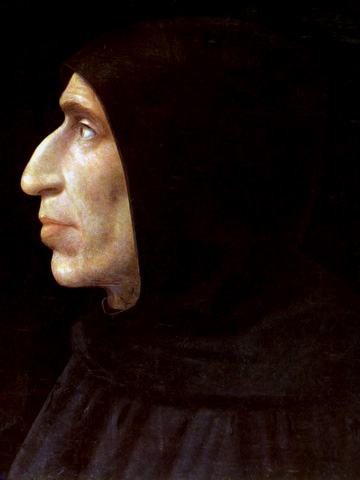
Now, let us begin with the reasons that I have cited to you in the several years that have passed until now, which demonstrate and prove the renovation of the church. Some of the reasons are probable and can be contradicted; some are demonstrable and cannot be contradicted, for they are based on Holy Scripture.
The first is propter pollutionem praelatorum [because of the pollution of the prelates]. When you see a good head, you know that the body is well; when the head is wicked, woe to that body. However, when God permits that there be at the head of government ambition, lust and other vices, believe that God’s flagellation is near…. Therefore, when you see that God permits the heads of the Church to be weighed down by evils and simonies, say that the flagellation of the people is near. I am not saying that this condition is found in the heads of the Church, but I am saying, “when you will see it.”
The second is because of the assumption [i.e. the death] of the good and the just. Every time that God takes away saints and good people, say that the flagellation is near…. Behold the number of men that can be found today who can be called just and good! Say, therefore, that the flagellation is near, and that the wrath and the sword of God are in motion.
The third is per exclusionem iustorum [through the exclusion of the just]. When you see that some lord or head of government does not want good and just men near him, but drives them away, because he does not want to hear the truth, say that the flagellation of God is near.
The fourth is propter desiderium iustorum [because of the desire of the just]. When you see that all good men desire and call for the flagellation, believe that it is soon to come. See whether there is anyone today whom you think is calling for the flagellation! Believe me, Florence [Italy], that your punishment would have already come, were it not for the prayers and sermons of the good. Believe me, today you would have been a garden.
The fifth is propter obstinationem peccatorum [because of the stubbornness of sinners]. When sinners are stubborn and do not want to turn to God and do not value or appreciate those who call them to lead good lives, but always proceed from bad to worse and are obstinate in their vices, say that God is angry. And yet, Florence, wait for the flagellation, for you know how long it has been said to you that you should mend your ways, and you have always been obstinate. And it has also been said to you, Rome, and you too remain obstinate; yet you wait for God’s anger.
The sixth is propter mulititudinem peccatorum [because of the multitude of sinners]. It was because of David’s pride that the plague was sent. See if Rome is full of pride, lust, avarice, and simony! See if in Rome the wicked are not always multiplying! And then say that the flagellation is near and that the renovation of the Church is near.
The seventh is propter excussionem primorum, scilicet, charitatis et fidei [because of the driving out of the chief virtues, that is to say, charity and faith]. In the time of the primitive Church one lived only with complete faith and complete charity. Look, how many there are in the world today who live thus! You, Florence, also seek your ambition, and everyone exalts himself. Believe, there is no cure except in repentance, for the flagellation of God is near.
The eighth is propter negationem credendorum [because of the denial of the articles of faith]. Look, today it seems as though no one believes and has faith, and everyone says: “What will happen afterwards?”
The ninth is propter perditum cultum divinum [because of the ruin of sacred worship]. Go, see what is done for the churches of God and what devotion is there, for the worship of God seems and is today lost. You will say: “Oh, there are so many religious and so many prelates, more than there have ever been!” Would that there were fewer of them! O tonsured ones, tonsured ones! per te orta est haec tempestas [through you this tempest has arisen]! You are the cause of all this evil! And nowadays everyone thinks he is holy, if he has a priest in his house; and I say to you that the time will come when it will be said: “Blessed is that house that does not have a shaved head!” [Referring to the tonsure].
The tenth is propter universalem opinionem [because of universal opinion]. Look at everyone who seems to be preaching and waiting for the flagellation and tribulations; and to each one it seems that it is a just thing that the punishment of so many iniquities must come. The abbot Joachim and many others preach and announce that this flagellation is to come at this time.
It is for these reasons that I have preached the renovation of the Church…. [From John C. Olin, The Catholic Reformation: Savonarola to Ignatius Loyola, New York, NY: Fordham University Press ©1969, 1992, pgs 5-6]
The author of this work notes, “The climactic act of his life’s drama is his contest with the notorious Borgia Pope then reigning, Alexander VI (1492-1503), whose immoral life stands in startling contrast to that of the saintly friar. Defiant of this Pope and overcome by his enemies at home, he was arrested, tried, and brought to the scaffold in the spring of 1498” (pg 3).
Kasich vs Romney?
http://online.wsj.com/article/SB10000872396390444165804578010573648201546.html (subscription required).
During the 33 years he’s spent in political office, Ohio Gov. John Kasich has been blamed for a lot of things. However, he’s probably never stood accused of contributing to a Republican presidential candidate’s defeat, and by a member of his party no less.
But such was the case on Friday when House Speaker John Boehner suggested Gov. Kasich was undercutting the Romney campaign in Ohio, perhaps the most significant state this election. “One of the things that probably works against Romney in Ohio is the fact that Gov. Kasich has done such a good job of fixing government regulations in the state, attracting new businesses to the state,” said Mr. Boehner, who’s represented Ohio in Congress since 1991.
“Our unemployment rate in Ohio is lower than the national average as a matter of fact, I think it’s a full point lower than the national average,” he added. “So as a result people are still concerned about jobs in Ohio but it certainly isn’t like you see in some other states.”
Mr. Boehner isn’t the first Republican to suggest that reformist governors’ successes could be hurting Mr. Romney in key states like Ohio and Florida. The thing is, there’s no evidence to back up that theory. Mr. Romney has trailed President Obama in most swing states since the rising class of Republican governors took office nearly two years ago. His performance, however, has slipped universally in recent weeks, regardless of states’ economies….
Monday, September 24, 2012
Augustine, Pelagius, and lost councils
Following up with my previous post, “How the early church lost its understanding of grace”, I’m picking up with Bavinck’s discussion of Pelagianism and Semi-Pelagianism, from Chapter 9, “The Order of Salvation”, of Volume 3: Sin and Salvation in Christ.
Here is where we begin to see some resemblance between Pelagianism and Roman Catholicism. Roman Catholicism holds that human nature “is wounded in the natural powers proper to it”, compared with the Reformed doctrine of “total depravity”. Not that this resemblance with Pelagianism is causation. There is some more history here, and Bavinck captures it well.
Pelagius (ca. AD 354 – ca. AD 420/440) strayed much farther from the doctrine of grace than any of his predecessors; he abandoned the Christian foundation on which all of them still based themselves and renewed the self-sufficient principle of pagan philosophy, specifically that of the Stoics. Not only did he sever all connections between Adam’s sin and ours, so that neither guilt nor pollution nor even death was a consequence of the first transgression, but Christianity itself lost its absolute significance. Salvation was not bound to Christ but could also be obtained by following the natural law (lex naturae) and positive law (lex positiva). Hence, in Pelagius’s theology there could be no internal grace, no regenerating grace of the Holy Spirit which not only illumined the mind but also bent the will (508).
Here is where we begin to see some resemblance between Pelagianism and Roman Catholicism. Roman Catholicism holds that human nature “is wounded in the natural powers proper to it”, compared with the Reformed doctrine of “total depravity”. Not that this resemblance with Pelagianism is causation. There is some more history here, and Bavinck captures it well.
Precious in the sight of the Lord is the death of his saints

This is a friend of a friend of a friend.
Precious in the sight of the Lord is the death of his saints.
Psalm 116:15 (ESV)
“O death, where is your victory? O death, where is your
sting?”
1 Corinthians 15:55
Sunday, September 23, 2012
Chronos and cloning
One of
the staple objections to young-earth creationism is the allegation that God
would be guilty of deception if he made a world that appeared to be younger
than it really is. I’ve responded to this objection before, but now I’d like to
consider the issue from another angle.
Medical science may well be
nearing the point where it can clone replacement organs. Suppose you’re going
blind due to glaucoma or macular degeneration. Or suppose you’re congenitally
blind. In 10-20 years, science may be able to clone you a brand new pair of
eyes. An eye transplant based on your own DNA.
Of course, normally, adult
eyes take years to develop, from conception through gestation and maturation.
Yet your “instant” eyes might only take a few weeks to clone in the laboratory.
Would the medical profession be guilty of deception under those circumstances?
Should we discourage the development of cloned replacement organs on ethical
grounds because the cloned organs appear to be fully mature organs which only
took a tiny fraction of the normal time to cultivate?
A "spiritual resurrection"
Orthodox
Christians take the position that if Jesus didn’t rise from the dead, then
Christianity is false. To put it more graphically, unless the tomb of Jesus is
empty, Christianity is false. If we discovered the skeletal remains of Jesus,
that would disprove the Christian faith at one stroke.
However, some unbelievers
argue for a “spiritual resurrection.” They do that to discount postmortem
appearances of Jesus. They chalk these up to subjective visions or
hallucinations.
But there’s a catch. If you
use that argument, then even if you discovered the skeletal remains of Jesus in
Joseph of Arimathea’s tomb, that wouldn’t falsify the Christianity faith. That
wouldn’t even falsify the resurrection of Christ. So that argument poses a
dilemma for the unbeliever.
What would it take to lose your faith?
David
Marshall recently had an abortive exchange with militant atheist Peter
Boghossian:
Boghossian’s attitude is
irrational. He acts as if it’s useless to debate someone unless your opponent
is open to persuasion. But public debates aren’t about convincing your
opponent. Marshall is a published Christian apologist who’s debated other
atheists. Assuming, for the sake of argument, that Marshall is a fideist, if
Boghossian had debated him and demonstrated that Marshall’s faith is
irrational, that would be a notch in Boghossian’s belt.
Be that as it may, I’d like
to address Boghossian’s challenge. He said:
Answer this question: What would it take for you to lose your faith?This does not answer the question. Please answer the question or this will be our last communication. What reasons would have to be mistaken? Give me an example of a reason and how you know it would be mistaken. What would this look like?
But that’s a deceptively
simple question.
i) For one thing, professing
Christians can lose their faith for emotional reasons rather than intellectual
reasons. Disappointment is a common factor.
ii) Presumably, Boghossian’s
is getting at the issue of whether Christian faith is falsifiable. And there’s
a qualified sense in which, hypothetically speaking, Christianity must be falsifiable.
Christianity can’t be true and still be made consistent with just anything.
Christianity is not constantly redefinable. If Christianity is true, then some
other things are false. And if some other things are true, then Christianity is
false. For instance, if Islam were true, that would falsify Christianity.
iii) Also, from a Reformed
standpoint, faith is something only God can give, and something which, by the
same token, God can take away.
iv) However, some beliefs are
more far-reaching than others. Let’s alter Boghossian’s question:
What would it take for you to
cease believing in other minds or the external world?
Now that’s not a question which
is easy to answer. Indeed, the question may be unanswerable. That’s because
belief in other minds or the external world are beliefs by which we evaluate
other beliefs. But if you ask me to consider what reality is like assuming that
my friends, parents, siblings, spouse, and kids are computer simulations, that
my memories are implanted, then that’s a question I can’t answer, for at that
point I have lost any frame of reference. I have nothing left to go on.
v) Perhaps Boghossian would
say that’s an extreme case, which is hardly analogous to losing your Christian
faith. But is it? Actually, a godless world is even more reductionistic than
the scenario I just outlined. Consider some implications of the Christian
faith:
a) Our minds, memories, and
senses are trustworthy in performing what God designed them to do.
b) There’s objective
morality.
c) There’s a good reason for
everything that happens.
But suppose you deny
Christianity, and thereby deny those implications. If you go down that road,
you begin to lose your bearings. You can’t find your way back. Deny (a-c), and
what’s left? What’s your standard of comparison?
vi) Which brings me back to
(ii). Hypothetically speaking, Christianity is falsifiable. Yet even
falsification takes certain truth-conditions for granted. But what if denying
Christianity ends up denying the ability to evaluate anything?
Boghossian’s question is
superficial. It fails to take the alternative into account.
Saturday, September 22, 2012
Peter Waldo and the Waldensians
http://www.ligonier.org/learn/articles/peter-waldo-and-the-waldensians/
HT: Scott Clark
The Waldensians were not only forerunners but also witnesses to the presence of Christ’s Word and Spirit in the church through the centuries. They gave expression to aspects of Apostolic religion that were threatened with extinction in the dominant church. They remind us that in every era, Christ fulfills His promise: “I will build my church and the gates of hell shall not prevail against it” (Matt. 16:18).
HT: Scott Clark
“Family Feud”; or, “Our American Christian Heritage”

It’s brilliant not merely because he addresses (in an irenic way) the substance of all the contentions that are made in that book, not least of which is Two Kingdoms theology. He discusses the issue of who is the proper bearer of “the Reformed tradition”. He brings a sharp focus to bear upon “Christless Christianity” (and it’s “Gospel-Driven” counterpart, the “Lost Soul of Protestantism, and more). He discusses Protestant Scholasticism and Richard Muller (the real heroes of this story); and lots, lots more. (The whole thing is more than 7500 words, but still, I highly recommend giving it a look).
But beyond the issues, he talks about something that’s a lot deeper:
Michael Horton, who ends up bearing the brunt of the critique, described the book as “a new low in intra-Reformed polemics.”
To be the nastiest and most unfair polemicist in the Reformed community would be quite the accomplishment. Prof. Frame would have to outpace several of the Escondido men themselves, along with any number of Clarkians and theonomists – and that would only take into account the American cranksters! As biting and even sometimes inflammatory as some of Prof. Frame’s writing may be, this book does not take the prize for nastiness. And it is certainly a long way off from the battles of those golden years of Reformed confession-writing. We should never forget that the debates carried out by our Reformed ancestors, even the men now idolized by the Reformed gatekeepers, at times involved literal hatchet jobs.
Wedgeworth is spot-on when he says “We should never forget that the debates carried out by our Reformed ancestors, even the men now idolized by the Reformed gatekeepers, at times involved literal hatchet jobs”.
I’ve been hanging out at D.G. Hart’s blog recently because of his fun interactions with Bryan Cross. I came to Reformed theology largely through Hart’s books about Machen, whom I came to regard as the heir of Calvin through “Old Princeton” (though I tend to tune out Hart’s disagreements with Turretinfan over 2K views). While I agree with Steve Hays that “natural law” fails to address some very difficult moral issues, I don’t think anyone is going to hell over the Westminster “Two Kingdoms” theology, either.
I’ve known Scott Clark for about as long as there has been an Internet through which we could email. I’ve met Michael Horton. I write for a blog where Steve Hays, who calls himself a Biblicist, has been strongly influenced by the writings of John Frame (and presumably his “Something Close to Biblicism), which I like a lot, and with which I fundamentally agree. Clark writes scathingly about Frame. Clark is not well-regarded by Hays, but I’ve learned more about historical theology from Scott Clark than anyone else, I think.
Cyril of Alexandria was apparently a pretty good theologian. But he was just simply a thug as well. He can be a lesson for folks today.

American Christianity certainly has its problems. But Christianity has always had problems. And despite the problems in American Christianity, it is our Christianity now.
I’m no fan of things like “bishops”, but I’m a very big fan of an old fart who goes by the handle “Embryo Parson”. There was a time when I despised him, but our more recent friendship shows us how (“in the Lord”) such transformations are possible. And I do think he has a very healthy attitude toward American Christianity.
Wedgeworth does not simply point out the problems. He points to a solution:
Instead, we do need a Reformed ressourcement. It needs to move forward by building upon the tradition. It should be a Reformed irenicism that is really Reformed, having clearly-stated and definitively Reformational principles. It should be an irenic catholicity that achieves peace through courageous and rational dialogue and debate, charitable but assertive. And it must always be truth-telling, with regards to itself and its opponents. Prof. Frame possesses the latter qualities of peace and honest integrity. The Escondido men aspire towards the former qualities of consistency with the great Reformed tradition, ….
Closing:
We think we have begun to point to a way beyond the dead ends and impasses of ultra-confessionalism on the one hand, and a Neo-Calvinism so “neo” it is no longer really Calvinist on the other. And we are finding that many young pastors and churchmen, seeing the problems of the two opposing camps which have so far dominated the American Reformed world, are quite ready to step out onto that road.
Friday, September 21, 2012
Essential Works in New Testament Textual Criticism
Tommy Wasserman at the cleverly-named Evangelical Textual Criticism blog has provided his list of Top Ten Essential Works in New Testament Textual Criticism. You get more than a baker's dozen: there are really about 46 (by my admittedly quick count) publications listed, with the top ten being marked by asterisk.
Hurtado: more thoughts on the “wife” fragment:
http://larryhurtado.wordpress.com/2012/09/21/jesus-wife-fragment-further-thoughts/
As part of this blogpost, he also links to this interview with Simon Gathercole, who analyzes the text a bit and comes to this conclusion:
That the fragment may derive from a larger text is a reasonable possibility, but an inference, not a datum. That this larger text might have been some sort of “Jesus book” (my term, which I really do commend over “gospel”, which is used so widely that it has no generic content other than a book about Jesus, so why not “Jesus book”?) is also plausible, though again an inference, and not the only plausible one. (It could derive, e.g., from a sermon, a treatise of some sort, or something else.)
Whatever that larger text, it’s unlikely that it was wholly given over to Jesus’ marital status. So, it’s a bit misleading to refer to a supposed “Gospel of Jesus’ Wife”. It’s just not helpful. It plays to the news media, but it’s close to being chaff.
As part of this blogpost, he also links to this interview with Simon Gathercole, who analyzes the text a bit and comes to this conclusion:
Harvard Professor Karen King, who is the person who has been entrusted with the text, has rightly warned us that this does not say anything about the historical Jesus. She is correct that “its possible date of composition in the second half of the second century, argues against its value as evidence for the life of the historical Jesus”. But she is also right that this is a fascinating discovery which offers us a window into debates about sex and marriage in the early church, and the way Jesus could be adapted to play a part in a particular debate, but only if it is genuine.
How the early church lost its understanding of grace
Salvation is all grace.
Bavinck begins his discussion of “The Scriptural View of Salvation” (pgs 491 ff.) noting that “In the Old Testament already, it is God who immediately after the fall, out of grace, puts enmity between humanity and the serpent and brings humanity to his side (Gen. 3:15). It is he who elects Abraham and the people of Israel born to him to be his possession (Gen 12:1; Exod. 15:13, 16,; 19:4; 20:2; Deut 7:7f.), who makes a covenant with them and gives his laws to them (Gen. 15:1; 17:2; Exod. 2:24-25; Deut 4:5-13), who gives the blood on the altar for atonement (Lev. 17:11), and does all that is needed for his vineyard (Isa. 5; Jer 2:21). To be sure, Israel incurs some obligation with the law, but the covenant relationship “did not depend on the observance of the law as an antecedent condition; it was not a covenant of works, but rested solely in God’s electing love” (493-494).
In Christ, God consolidated His own reign in the The Kingdom of God, with the ascension (2 Cor 3:17-18) and the outpouring of the Holy Spirit, who dwells “at Christ’s initiative in the church as in his temple” (500).
Here, Bavinck picks up the “historical-theological” account of salvation through the earliest church:
He speaks of “grace” being “anterior to our works”, and traces this through Justin and Irenaeus and Origen. “The moral corruption of humanity and the necessity of the grace of the Holy Spirit have been even more strongly expressed by the Latin fathers (Tertullian, Cyprian, Ambrose), on whose pronouncements Augustine therefore based himself. Tertullian says, ‘This will be the power of the grace of God, more potent indeed than nature, exercising its sway over the faculty that underlies itself within us—even the freedom of our own will.’ From Cyprian come the words that are repeatedly cited by Augustine: ‘We must boast in nothing since nothing is our own.’”
Bavinck begins his discussion of “The Scriptural View of Salvation” (pgs 491 ff.) noting that “In the Old Testament already, it is God who immediately after the fall, out of grace, puts enmity between humanity and the serpent and brings humanity to his side (Gen. 3:15). It is he who elects Abraham and the people of Israel born to him to be his possession (Gen 12:1; Exod. 15:13, 16,; 19:4; 20:2; Deut 7:7f.), who makes a covenant with them and gives his laws to them (Gen. 15:1; 17:2; Exod. 2:24-25; Deut 4:5-13), who gives the blood on the altar for atonement (Lev. 17:11), and does all that is needed for his vineyard (Isa. 5; Jer 2:21). To be sure, Israel incurs some obligation with the law, but the covenant relationship “did not depend on the observance of the law as an antecedent condition; it was not a covenant of works, but rested solely in God’s electing love” (493-494).
In Christ, God consolidated His own reign in the The Kingdom of God, with the ascension (2 Cor 3:17-18) and the outpouring of the Holy Spirit, who dwells “at Christ’s initiative in the church as in his temple” (500).
Here, Bavinck picks up the “historical-theological” account of salvation through the earliest church:
That faith in Christ was the way to salvation was, of course, a certainty in the church from the beginning. Believers, after all, knew themselves to have been placed in a special relationship to God and continuously preserved in it by his grace. They were the elect of God adopted by Jesus Christ to be his own people. By the agency of Christ they had taken refuge in his mercy and were the new people with whom God had established his covenant. And this Christ not only was the revelation of God by whom they had learned to know God but also gave his blood for their sins. He gave himself up to purify them by the forgiveness of sins, to vivify them by his wounds. In that way, then, he is the Lord and high priest of their confession, the object of their faith who also continually preserves them and builds them up in the faith.
He speaks of “grace” being “anterior to our works”, and traces this through Justin and Irenaeus and Origen. “The moral corruption of humanity and the necessity of the grace of the Holy Spirit have been even more strongly expressed by the Latin fathers (Tertullian, Cyprian, Ambrose), on whose pronouncements Augustine therefore based himself. Tertullian says, ‘This will be the power of the grace of God, more potent indeed than nature, exercising its sway over the faculty that underlies itself within us—even the freedom of our own will.’ From Cyprian come the words that are repeatedly cited by Augustine: ‘We must boast in nothing since nothing is our own.’”
Yet in those first centuries, the doctrine of the application of salvation was not at all developed and in part already steered in wrong directions early on. Although there are a few “testimonies of evangelical truth” here and there, on the whole the gospel was soon construed as a new law. Faith and repentance were generally regarded as the necessary way to salvation but were ultimately the product of human freedom. Though salvation had objectively been acquired by Christ, to become participants in it the free cooperation of humans was needed. Faith as a rule was no more than the conviction of the truth of Christianity, and repentance soon acquired the character of a penance that satisfies for sins. The sins committed before one’s baptism were indeed forgiven in baptism, but those committed after baptism had to be made good by penance. Penitence was frequently still viewed as sincere contrition over sin, but the emphasis shifted increasingly to the external acts in which it had to manifest itself, such as prayer, fasting, almsgiving, and so on, and these good works were viewed as a “satisfaction of work.” Soteriology was altogether externalized. Not the application of salvation by the Holy Spirit to the heart of the sinner but the achievement of so-called good—often totally arbitrary—works was regarded as the way of salvation. Christian discipleship consisted in copying the life and suffering of Christ, which was vividly portrayed before people’s eyes. Martyrs, ascetics, and monks were the best Christians (508).
Thursday, September 20, 2012
More reason to doubt "the Jesus's Wife" fragment
Larry Hurtado has provided a link to this blog post by Dirk Jongkind which suggests that "the Gospel of Jesus's Wife" fragment has indeed been tampered with:
Hurtado says "This is just the sort of testing of scholarly claims that characterizes good scholarly discussion.... Dirk does raise an interesting point about the curious shape and dimensions of the fragment, and that all agree that it has this shape and size likely because someone (in the current scene) shaped it."
Let's assume for the sake of the argument that the fragment is genuine. And let's assume that originally it was written somewhere in Egypt before the eighth century. Then we are still faced with a massive issue. Why does the fragment look so neatly rectangular?
The answer given by Roger Bagnall in the NYT is the following:
"The piece is torn into a rough rectangle, so that the document is missing its adjoining text on the left, right, top and bottom — most likely the work of a dealer who divided up a larger piece to maximize his profit, Dr. Bagnall said."...
So clearly, Bagnall thinks that current shape of the fragment is modern, and that it was deliberately forced into its current shape 'to maximize profit'.
Is it too far-fetched to suggest that the lamentable loss of the words immediately following the famed words 'My wife' might not have been accidental, but perhaps made in order 'to maximize profit'?...
Here we have a fragment which has been deliberately altered, 'most likely' by a modern dealer seeking to maximize profit, who gets rid of 'something'. And this 'something' might well be in the same league as the oil refinery – it might be a spoiler that affected the value of this fragment negatively. The fragment may have been torn in the shape it is now in order to coax the reader into a certain interpretation.
Whatever the reason, that even supporters of authenticity of the fragment such as Bagnall believe that there has been modern interference with this manuscript, should give some reason to pause and think again.
Hurtado says "This is just the sort of testing of scholarly claims that characterizes good scholarly discussion.... Dirk does raise an interesting point about the curious shape and dimensions of the fragment, and that all agree that it has this shape and size likely because someone (in the current scene) shaped it."
WSCal Professor R. Scott Clark’s “Heidelblog” is back.

The last HB post was in May 2011. Much has happened since. It’s not possible to fill in the blank created by the interim so I won’t try. The two concerns, however, that animated the HB from 2006-2011 continue to fuel my teaching and writing: 1) getting the gospel right (and getting it out) and 2) getting worship right (to the glory of God and the edification of the church). I remain committed to Recovering the Reformed Confession.
As I look about it does not seem that the world has changed much since May, 2011 but I have changed, however, mainly through loss, which has been sobering and saddening. I’m sure that I am worse for it. Nevertheless, as I continue to learn the greatness of my sin and misery I also learn the magnificence of the mystery of grace (unconditional acceptance with God on the ground of Christ’s righteousness imputed and received through trusting in Christ alone) and grace is sustaining.
For some of the interim I’ve been helping to finish work on a long-term translation project that should (Dv) appear in 2013. I’ve been working on a project that considers the relations between the Reformed faith, rhetoric, love, truth, and ethos in the late modern era.
In response to the several email queries I’ve received: I don’t know what happened to Jason Stellman. We have not talked. He has my mobile number and a standing invitation to call any time.
In case you’re troubled by Jason’s apparent defection from the biblical, evangelical, faith and are tempted to follow him you should know this: whatever her apologists may say, Rome is not home. She is a way station to other even more unhappy destinations. She is most certainly not a path to the faith and practice of the Scriptures nor is she a path back to the early church. The Patristic (100-500 AD) and medieval (500-1500 AD) churches in the West were gradually Romanized but they were not the Roman Church we know today.
Properly speaking, there is no “Roman Catholic Church.” Such a claim may be clever marketing but it’s oxymoronic. A church is either Roman (local) or catholic (universal). By definition she cannot be both simultaneously any more than Jesus’ humanity can be at the right hand of the Father and in Berlin at the same time.
As a matter of history, the Roman communion came into being in 1547, midway through the Council of Trent, when that council condemned the Holy Gospel. From a historian’s perspective, Rome is a sect, whose identity, theology, piety, and practice is so tied to Trent that it would be entirely unrecognizable to the apostolic and early post-apostolic (Patristic) church and to much of the medieval church. Were most of the theologians of the first nine or ten centuries to look at Rome in the 21st century, they would be shocked and disappointed to learn that doctrines that were marginal in their day have become Romanist orthodoxy and orthopraxy. There would be much face-palming and head slapping from the host of Patristic and early medieval theologians.
The whole archive seems to be back in place. I for one am glad of that, because I had cited a number of his articles on Reformation History. Those links had been broken when he took the site down.
Welcome back Scott.
Small Bible Study Groups Attract Roman Catholics
While a small number of Protestants are converting to Rome based on highly convoluted methods of reasoning, far more Roman Catholics are finding the reality of Christ in the fellowship of small Bible study groups in evangelical Protestant churches. Chris Castaldo points this out in a Gospel Coalition article entitled Small Groups that Attract Catholics. In the article, Castaldo says:
Noting that “Catholic small groups are uncommon”, he suggests that “the fundamental reason is the Catholic legacy of clericalism”. He cites one Roman Catholic author:
He continues, “To be sure, Vatican II (1962-1965) initiated a trajectory of equipping Catholic laity for service, as evidenced in current movements such as the "New Evangelization" of Pope John Paul II, but old patterns die hard, especially when they have been reinforced through centuries.”
Elsewhere, Castaldo reminds readers that many similar small groups were at the heart and soul of the Protestant Reformation:
One key reason why the Roman Catholic Church survived the Protestant Reformation was because it had the power of the inquisition to have people “publically beheaded and burned for heresy”. Without that power now, how will Roman Catholic ideas survive when pressed by Protestant phenomena such as these small Bible Study groups?
The [small Bible-study group] movement is probably bigger than you realize. More than 10 million men and women in the United States were raised Catholic and now worship in an evangelical Protestant church. A great deal can be said about the dynamics surrounding the movement, but our concern here is to understand their point of entry.
Noting that “Catholic small groups are uncommon”, he suggests that “the fundamental reason is the Catholic legacy of clericalism”. He cites one Roman Catholic author:
In a 1906 encyclical, Pius X said that the "one duty" of the laity “is to allow themselves to be led, and like a docile flock, to follow the Pastors.” In 1907 the American hierarchy followed suit with a similar directive: “The Church is not a republic or a democracy, but a monarchy . . . all her authority is from above and rests in her Hierarchy. . . [While] the faithful of the laity have divinely given rights to receive all the blessed ministrations of the Church, they have absolutely no right whatever to rule and govern.”
He continues, “To be sure, Vatican II (1962-1965) initiated a trajectory of equipping Catholic laity for service, as evidenced in current movements such as the "New Evangelization" of Pope John Paul II, but old patterns die hard, especially when they have been reinforced through centuries.”
Elsewhere, Castaldo reminds readers that many similar small groups were at the heart and soul of the Protestant Reformation:
Here is one example of a Bible study group which met in Naples, Italy, in between 1536-41. Led by the Spaniard, Juan De Valdés, this circle of friends often picnicked together in the countryside each Sunday. It comprised influential theologians and laypeople alike, including Bernardino Ochino, General of the Capuchins and the most famous preacher in Italy, Peter Martyr Vermigli, then abbot, soon to be Reformed theologian, Pietro Carnesecchi, a canon lawyer, and the Countess of Fondi, Giulia da Gonzaga. So what did this group do in their meetings?
Fortunately, we have some idea from extant writings, the most important of which is the work of Valdés titled One Hundred and Ten Divine Considerations , a volume that functioned as a basis of discussion and tool for discipleship among the group’s members. In their gatherings, they studied books of the Bible (starting with Romans followed by 1 Corinthians). The discussed theology, and especially wrestled through the doctrine of justification by faith alone. They read pseudonymous works from Northern Reformers, such as Luther, Bucer, and Zwingli. They prayed, debated, and conducted evangelistic outreach. Vermigli, for instance, shared the gospel with Galeazzo Caracciolo, a convert who became a Reformer and went on to found the Italian Church in Calvin’s Geneva. By most standards, this was a thriving small group.
Perhaps the most poignant summary of Valdés Neapolitan fellowship was expressed decades later by one of its members, Pietro Carnesecchi, before he was publically beheaded and burned for heresy by the Inquisition (1567). Describing the quality of friendship, theological interaction, and enthusiasm for biblical renewal, Carnesecchi described the Valdésian gatherings as a “regno di Dio,” “kingdom of God.”
Here is the theological pearl—when the rule of Christ is treasured as our preeminent value, now as it was then, we will find our small groups generating spiritual fruit which transforms today and endures through every tomorrow.
One key reason why the Roman Catholic Church survived the Protestant Reformation was because it had the power of the inquisition to have people “publically beheaded and burned for heresy”. Without that power now, how will Roman Catholic ideas survive when pressed by Protestant phenomena such as these small Bible Study groups?
Possible forgery, possible Gnostic text, definitely late

"There's no indication we have that Jesus was married," said Darrell Bock, a senior research professor of New Testament studies at Dallas Theological Seminary. "One could say the text is silent on Jesus' marital status is because there was nothing to say." …
Bock agreed with the notion that the text fragment shared similarities with those gospels, called the Gnostic Gospels, which were the writings of an early outlier sect of Christians. He said the text could be referring to a gnostic rite of marriage but "it's a small text with very little context. We don't know what's wrapped around it to know what it's saying."
Bock said it's likely to be a gnostic text if it proves to be authentic. "The whole text needs vetting. She's doing the right thing to release it and let scholars take a look at," he said, adding "it's a little bit like trying to analyze the game in the first quarter."
"It's a historical curiosity but doesn't really tell us who Jesus was," Bock said. "It's one small speck of a text in a mountain of texts of about Jesus."
Michael Kruger has provided an article for The Gospel Coalition. He says:
Here are several considerations.
Authenticity
Forgery is not uncommon in the antiquities market. I am not an expert in Coptic palaeography (my work is in Greek manuscripts), but I had concerns about the initial appearance of the manuscript. In particular, the sloppy nature of the scribal hand, and the wide and undifferentiated strokes of the pen seemed problematic. In addition, the color of the ink seems off---it's too dark, almost as if it were painted. Ancient inks tend to be lighter in color, though there are exceptions. This scenario is exacerbated by the ambiguity about the place of its discovery and the identity of its anonymous owner.
However, according to Karen King's forthcoming paper, this manuscript was examined by Roger Bagnall and AnnMarie Luijendijk, two reputable scholars, who both found it to be authentic and attributed the odd style to the blunt pen of the scribe. Other indications of authenticity are the use of the nomina sacra (abbreviations of certain words) and the faded ink on the back of the page (something that would have required considerable time). But my friend and Coptic scholar, Christian Askeland, is skeptical of its authenticity due to, among other things, the odd formation of some of its letters (particularly the epsilon) and omissions in the Coptic text. Other scholars have also expressed skepticism about the fragment.
At this point, there is no way to know whether it is genuine or a forgery. We cannot be certain until more scholars have an opportunity to examine it.
Composition
Assuming for the moment that the manuscript is genuine, questions remain about its composition. First, what kind of document are we dealing with here? At first glance, the document appears to be composed as a gospel-like text that contained stories and sayings of Jesus. In fact, Jesus seems to be doing what he often does in other gospel texts: he is having a conversation with his disciples. Some scholars have suggested this fragment may be a magical text like an amulet, particularly given its small size. However, amulets normally did not have writing on the back of the page (the verso). If the writing on the back of this fragment is continuous with the front (which is unknown at this point) then it may simply be a miniature codex. Miniature codices were popular in early Christianity and often contained apocryphal texts. …
Most important, there is nothing that would indicate that the composition of this gospel should be dated to the first century. It was produced long after the time of the apostles, along with all other known apocryphal gospels.
Historical Value
The key question is whether this particular gospel account can tell us anything about what Jesus was really like. Does this text prove that Jesus had a wife? Does this gospel provide reliable historical information? No and no. There is no reason to think this gospel retains authentic tradition about Jesus. It is a late production, not based on eyewitness testimony, and likely draws on other apocryphal works like Thomas and Phillip.
Moreover---and this is critical---we do not have a single historical source in all of early Christianity that suggests Jesus was married. None. There is nothing about Jesus being married in the canonical gospels, in apocryphal gospels, in the church fathers, or anywhere else. Even if this new gospel claims that Jesus was married, it is out of step with all the other credible historical evidence we have about his life. As King herself noted, "This is the only extant ancient text which explicitly portrays Jesus as referring to a wife. It does not, however, provide evidence that the historical Jesus was married".
Conspiracies and the Canonical Gospels
Everybody loves a good conspiracy theory. It would certainly be far more entertaining for our culture if one could show that apocryphal books were really the Scripture of the early church and that they have been suppressed by the political machinations of the later church (e.g., Constantine). But the truth is far less sensational. While apocryphal books were given some scriptural status from time to time, the overwhelming majority of early Christians preferred the books now in our New Testament canon. Thus, we are reminded again that the canon was not arbitrarily "created" by the church in the fourth or fifth century. The affirmations of the later church simply reflected what had already been the case for many, many years.
When it comes to these sorts of questions I like to remind my students of a simple---but often overlooked---fact: of all the gospels in early Christianity, only Matthew, Mark, Luke, and John are dated to the first century. Sure, there are minority attempts to put books like the Gospel of Thomas in the first century---but such attempts have not been well received by biblical scholars. Thus, if we really want to know what Jesus was like, our best bet is to rely on books that were at least written during the time period when eyewitnesses were still alive. And only four gospels meet that standard.
Wednesday, September 19, 2012
Grace and Salvation: Is it Personal? Or is it Mystical?

Grace in the New Testament: An Overview
Grace Part 1: Ancient Greek Conceptions of Grace
Grace Part 2: Biblical (OT and NT) Conceptions of Grace
And I worked through the letter of First Clement and showed how Clement misunderstands not only “grace” but also a number of other things in the New Testament.
Just a short while ago I came across a work by Donald Fairbairn, who picks up some of these “misunderstandings” and traces them further through church history.
Fairbairn is the Robert E. Cooley Professor of Early Christianity at Gordon-Conwell Theological Seminary. He is the author of (among other things), a work called Grace and Christology in the Early Church (Oxford, UK: Oxford University Press ©2002), in which he traces a “personal” (in contrast with a “mediated”) view of grace through a number of fourth and fifth century church fathers.
More recently, he’s published a work entitled Patristic Soteriology: Three Trajectories, which again traces three “trajectories” of salvation (and hence grace) through patristic soteriology.
One of these is the Western, or “personal” understanding, as espoused by Irenaeus and later Cyril of Alexandria (in a more “precise” way). The other two are those espoused first by Origen, and later modified by Gregory of Nyssa. Here are some of his comments on both of those “trajectories”.
First, he describes the view of Irenaeus and the “personal” understanding of salvation:
The centrality of a personal understanding of salvation in Irenaeus’s thought, the gift (described as eternal life, adoption, and incorruption) is connected to the Logos himself, to Christ. To be united to Christ is to share in his eternal life, his incorruption. Moreover, we again see that adoption lies at the heart of Irenaeus’s soteriology. When we receive the Logos, the true Son of God, he makes us adopted sons and daughters, and then we are able to share in the Son’s incorruption.
The centrality of a personal understanding of salvation in Irenaeus’s thought is further illustrated by his later work Demonstratio praedicationis apostolicae (written ca. 190). As he introduces the three articles of faith (that is, the three persons of the Trinity), Irenaeus writes that the Son “became a man amongst men, visible and palpable, in order to abolish death, to demonstrate life, and to effect communion between God and man.” Later, he writes of Christ’s preeminence: “Thus, in this way, is the Word of God preeminent in all things, for He is true man and ‘Wonderful Counsellor and Mighty God,’ calling man back again to communion
with God, that by communion with Him we may receive participation in incorruptibility.” Here one should note the order of the statements: communion with God is foundational, and incorruptibility is the result of sharing communion with God …. Participation, for Irenaeus, does not mean merely sharing in some qualities of God, and it emphatically does not mean virtual absorption into God’s being. Instead, Irenaeus uses the idea of participation in a decidedly personal way: through our union with the natural Son of God, we become adopted sons and daughters, and thus we share fellowship or communion with God. Sharing in God’s qualities (such as incorruptibility) follows from this primarily personal way of looking at salvation. By using the idea of participation in God to refer to adoption and communion, Irenaeus plots what I call a personal trajectory, which part of the Church will subsequently follow in describing salvation [emphasis added].
This sounds very much like Calvin’s [monergistic] doctrine of Union with Christ – a thing effected by God’s grace, to which man can never aspire on his own efforts.
Eastern writers Origen and Gregory of Nyssa went in a different direction:
Here one should recognize how sharp the difference between Irenaeus and Origen is, even though both are arguing against the same opponent, Gnosticism. Irenaeus’s rejection of Gnostic dualism enables him to accentuate the importance of the whole person, body and soul. He is then able to describe salvation in personal terms, as the communion of a human being with God through adoption into God’s family, with the result that the whole person shares God’s incorruption. In contrast, Origen’s rejection of Gnostic fatalism pushes him, ironically, toward somewhat of an acceptance of Gnostic dualism: he postulates a cosmos in which the very existence of the physical realm is a result of sin. In such a cosmos, the pre-existence of the souls gives those souls a kinship with God that the bodies, created later, can never have. This, in turn, prevents him from seeing human beings as whole persons, and thus makes it difficult for him to see salvation in personal terms. As a result, in Origen’s system salvation becomes the task of the human soul to achieve mystical union with God, and this soteriology bears an unmistakable resemblance to the Middle Platonic philosophy that had seeped into second-century Alexandrian Christianity through Philo and Clement.
This strong emphasis on salvation as the task of the human soul leads Origen to view participation in God primarily as sharing in God’s holiness, wisdom, and other qualities, not as sharing in his personal fellowship.
Fairbairn calls this the “mystical” trajectory, and it seems to lead to such things as the “chain of being” types of theology (to which a lot of Eastern theologians and some Medieval western theologians adhered).
There are several ways in which Origen’s understanding of salvation serves to plot what I am calling the mystical trajectory. His focus on the free human action to ascend to God, in contrast to a paradigm in which God’s downward action is the primary focus, promotes a view of Christian life in which our action is the key to union with God. His depiction of salvation as participation in God’s qualities, as purification so that we can see God as he really is, creates a climate in which the personal dimensions of salvation are underemphasized. And his insistence that the final state of believers (and indeed, of all creatures) will be immaterial paves the way for a view of salvation that comes dangerously close to blurring the distinctions between individual creatures, and even the distinction between God and all creatures [emphasis added].
That sounds very much like the kinds of things I’ve cited Joseph Ratzinger as saying.
Of Gregory of Nyssa, who provided “a minimalist correction” to Origen, he says, “Gregory continues to see through Origen’s eyes in many ways”.
Where does this “mystical trajectory” lead?
it seems to me that what I am calling the mystical trajectory was the one that gained preeminence during the Byzantine period. The emphases of Origen and Gregory of Nyssa were echoed prominently in the writings of Pseudo-Dionysius early in the sixth century [upon whom Aquinas relied, mistakenly thinking that “Pseudo” Dionysius was the real Dionysius from Acts 17]. Later, Maximus the Confessor (ca. 580–662) launched an extensive critique of Origen’s cosmology, allegedly solving once-for-all the problems inherent in it, but in my opinion he did not significantly depart from the overall vision of Origen and Gregory of Nyssa. This trajectory may be traced further through Gregory Palamas (ca. 1269–1359), who crystallized the distinction between God’s essence (in which we do not share) and his energies (in which we do share through salvation). With Palamas the Eastern Orthodox Church was locked onto a trajectory in which salvation consists more of participation in God’s qualities, his energies, rather than participation in a relationship [between persons].
Finally, he discusses Cyril of Alexandria, who distinguishes between “unity of substance (which God does not share with us at all), and unity of fellowship (which is the heart of what he does share with us)”:
like Irenaeus and Athanasius, and unlike Origen and Gregory of Nyssa, he places his dominant emphasis on salvation as personal participation. In fact, Cyril’s treatment of this theme is more extensive than that of other patristic writers. He emphasizes that Christians receive both the status of adopted sons and communion with the Father and the Son. More important, Cyril develops technical terminology to emphasize that believers do not share in any way at all in the substance of God, but that we nevertheless do participate in the fellowship that the persons of the Trinity have with one another because they are of the same substance. By developing this terminology, Cyril guards against a mystical concept of salvation (in which the distinction between the saved person and God is blurred) and also affirms the most personal concept of salvation possible. …
…[I]t should be clear that Cyril of Alexandria represents the same trajectory as Irenaeus and Athanasius, but he is considerably more precise than either of them. He guards sedulously against any idea of mystical absorption into God, and he tirelessly promotes a personal concept of participation in which we share in the very love between the Father and the Son. Cyril also places a great deal of emphasis on our human inability to rise up to God, and thus on God’s downward action through the incarnation and crucifixion in order to make us his adopted sons and daughters. These emphases stand in marked contrast to Origen and Gregory of Nyssa. Virtually all Greek Fathers use the words “participation” and “deification,” but as I have sought to show, there are at least two quite different ways of understanding these concepts in the patristic period. And I believe that the personal participatory way of understanding salvation deserves a great deal of our attention. We should not let the problems of the mystical pattern lead us to write off altogether the concept of salvation as participation.
Of course, I’m certain that understanding these “trajectories” will require a great deal more study. He applies this to a current evangelical understanding:
Of course, evangelical spirituality, the typical concept of Christian life present among the people in evangelical churches, is abundantly personal. We focus on Jesus as our friend. We speak about “a personal relationship with Christ” or “knowing God personally.” Evangelical sermons and Bible studies stress that Christ is there for us, pulling for us. But I fear that this personal spirituality is often rather distantly removed from the primarily juridical theology common in evangelicalism. Most laypeople—and perhaps even many pastors—are unable to connect the juridical and the personal aspects of evangelical faith, and these aspects remain in separate boxes in people’s minds, relegated to separate sermons from evangelical pulpits.
This is just a very broad-brush view, but my hope is that many more Reformed and Evangelical scholars will follow these threads through history.
Meanwhile, around the turn of the third century, Tertullian asked, “What has Athens to do with Jerusalem?” The context for this notes that importing secular ideas into Christs teaching is mixing chalk and cheese together.
It seems important to be able to understand how they got mixed, and what the effects were.
Tuesday, September 18, 2012
The Innocence of Mormons

On the other hand, if you can afford to shell out several hundred bucks for a seat, then you can watch a Mormon missionary get his holy book stuffed—well, I can't tell you about that, either. Let's just say it has New York City audiences roaring with laughter.
The "Book of Mormon"—a performance of which Hillary Clinton attended last year, without registering a complaint—comes to mind as the administration falls over itself denouncing "Innocence of Muslims." This is a film that may or may not exist; whose makers are likely not who they say they are; whose actors claim to have known neither the plot nor purpose of the film; and which has never been seen by any member of the public except as a video clip on the Internet.
No matter. The film, the administration says, is "hateful and offensive" (Susan Rice), "reprehensible and disgusting" (Jay Carney) and, in a twist, "disgusting and reprehensible" (Hillary Clinton). Mr. Carney, the White House spokesman, also lays sole blame on the film for inciting the riots that have swept the Muslim world and claimed the lives of Ambassador Chris Stevens and three of his staff in Libya.
So let's get this straight: In the consensus view of modern American liberalism, it is hilarious to mock Mormons and Mormonism but outrageous to mock Muslims and Islam. Why? Maybe it's because nobody has ever been harmed, much less killed, making fun of Mormons....
President Obama came to office promising that he would start a new conversation with the Muslim world, one that lectured less and listened more. After nearly four years of listening, we can now hear more clearly where the U.S. stands in the estimation of that world: equally despised but considerably less feared. Just imagine what four more years of instinctive deference will do.
On the bright side, dear liberals, you'll still be able to mock Mormons. They tend not to punch back, which is part of what makes so many of them so successful in life.
The Mind of a Sex Abuser

Photo caption: Jerry Sandusky built a sophisticated grooming operation, outsourcing to child-care professionals the task of locating vulnerable children—all the while playing the role of lovable goofball.
The New Yorker Magazine provided this graphic look inside the mind of a typical child abuser: someone who plans and schemes. These are not chance meetings; there is a pattern of deceit that goes on as they live their lives and search for their next victim.
Now imagine the 6115 priests all accused of child molestation, and what’s going through their minds, as they’re going through their daily routines, saying Mass, hearing confessions, and serving as the local mouthpiece for the Magisterium du jour, etc. Of course, Roman Catholics need not worry about this, because these men, once ordained, are priests, their "sacraments" "valid", no matter how, uh, dirty their hands have been.
Graphic Warning: this is the New Yorker Magazine:
We now know what Sandusky was really doing with the Second Mile. He was setting up a pipeline of young troubled boys. Just as important, though, he was establishing his bona fides. Psychologists call this “grooming”—the process by which child molesters ingratiate themselves into the communities they wish to exploit. “Many molesters confirmed that they would spend anywhere from two to three years getting established in a new community before molesting any children,” van Dam writes. One pedophile she interviewed would hang out in bars, looking for adults who seemed to be having difficulties at home. He would lend a comforting ear, and then start to help out. As he told van Dam:
I was just a friend doing things a friend would do. Helping them move, going to baseball games with them. What I found myself doing was getting close to the kids, becoming more of a father figure or a mentor, doing things for them that the parents weren’t doing because the parents were out getting drunk all the time. And, of course, it made it easy for me to baby-sit. They’d say, “Oh yeah. We can off-load the kids with Jimmy.”...
The pedophile is often imagined as the dishevelled old man baldly offering candy to preschoolers. But the truth is that most of the time we have no clue what we are dealing with. A fellow-teacher at Mr. Clay’s school, whose son was one of those who complained of being fondled, went directly to Clay after she heard the allegations. “I didn’t do anything to those little boys,” Clay responded. “I’m innocent. . . . Would you and your husband stand beside me if it goes to court?” Of course, they said. People didn’t believe that Clay was a pedophile because people liked Clay—without realizing that Clay was in the business of being likable.
Did anyone at Penn State understand what they were dealing with, either?
Do Roman Catholics who seek to give their “Church” a pass for the sex abuse scandal, because they are misled to believe that this is “the Church that Christ Founded®” understand what they are dealing with?
Sentencing date set for child molester Jerry Sandusky
Sandusky Sentencing Date Set
Meanwhile, hundreds if not thousands of pedophile priests, and hundreds of their “enabling” bishops continue to remain at large.
There have been only 37 criminal trials for pedophile priests.
Nearly three months after he was found guilty, Jerry Sandusky now knows when he will be sentenced.
McKean County Senior Judge John M. Cleland issued an order Monday morning setting Mr. Sandusky's sentencing for Oct. 9.
The judge also will conduct a hearing that day to determine if Mr. Sandusky is a sexually violent predator, a designation sought by the state attorney general's office that would require a lifetime of registration as a sex offender.
Mr. Sandusky, a former defensive coordinator for the Penn State University football team, was found guilty in June on 45 of 48 counts against him after a two-week trial in Centre County.
Prosecutors said he abused 10 boys over a 15-year period, including several on Penn State's campus. The victims came from Mr. Sandusky's charity for disadvantaged youth, The Second Mile.
Meanwhile, hundreds if not thousands of pedophile priests, and hundreds of their “enabling” bishops continue to remain at large.
There have been only 37 criminal trials for pedophile priests.
Subscribe to:
Posts (Atom)