https://ndpr.nd.edu/news/aristotles-revenge-the-metaphysical-foundations-of-physical-and-biological-science/
Relevant to debates over Catholic Thomism and Reformed Thomism.

Showing posts with label Thomas Aquinas. Show all posts
Showing posts with label Thomas Aquinas. Show all posts
Thursday, February 06, 2020


Thursday, August 15, 2019
Feser on simplicity redux
I commented on Ed Feser's reply to Ryan Mullins one before:
In his reply, Feser says he defends Thomistic simplicity at greater length in his book on Five Proofs of the Existence of God. So I'll turn to that. What he says on pp186-96 adds nothing of consequence to his response to Mullins. So I'll begin by sampling the argument in chap. 2:
The things of our experience are made up of parts…There is a sense in which, in each of these cases, the parts are less fundamental than the whole…Still, there is obviously also another sense in which each of these wholes is less fundamental than its parts. For the whole cannot exist unless the parts exist and are combined in the right way.So, the things of our experience are composite, or composed of parts. And a composite is less fundamental than its parts in the sense that its existence presupposes that its parts are put together in the right way…Composite things have causes (chap. 2).
Tuesday, August 13, 2019
Friday, July 19, 2019
Monday, July 01, 2019
Norman Geisler
Norm Geisler passed away today at 86. Geisler was an influential popularizer. He spread himself much too thin, so the quality of his work suffered accordingly. I regard his commitment to Thomism as a weakness, although one can appropriate and incorporate elements of Thomism into an overall apologetic or worldview. An outspoken champion of biblical inerrancy, he was rather better on offense than providing a sophisticated model of inerrancy. He mentored a number of younger apologists. To some extent he was overtaken by William Lane Craig.
Saturday, February 23, 2019
Monday, November 19, 2018
Peeling a bag of onions
I avoid debating Thomists, whether Catholic Thomists or Reformed Thomists. In my experience, Thomists are fanatics. It's all about Thomism all the time. That's their filter for everything. They buy expensive technical monographs on Thomistic metaphysics, epistemology, and ethics. They don't invest the same time and money in exegetical theology. In academic Bible commentaries or monographs on the theology of Scripture. Rather, it's commentaries on Aquinas.
They can give you detailed expositions on Thomistic metaphysics, epistemology, and ethics whereas they couldn't begin to provide the same detailed exposition regarding the theology of Isaiah, or Ephesians, or John's Gospel.
They subscribe to the entire package of Thomism. They recast every issue in Thomistic categories. They inhabit a parallel universe. They never surface for air.
I don't subscribe to off-the-shelf philosophical packages. I don't believe any one thinker has all the answers. I'm eclectic. I mix-and-match.
The problem with debating a Thomist is that you have to peel away so many layers. And each time you debate a Thomist, you're pulling another onion from the bag. You must repeat the same process. You must constantly reframe the issue.
It's just like debating the average atheist. So many layers to peel away. And each time you debate another atheist, you have to start peeling away all the same layers. All the unquestioned assumptions.
That's not a productive or constructive use of time. To some degree a Christian apologist or culture warrior has to engage atheism because that's a threat to Christianity. But Thomists are like guys who spend all their free time playing video games. It's their life.
Tuesday, October 09, 2018
Inside and outside
Thomistic simplicity, as I understand it, isn't a single claim but a set of claims. It includes the claim that God's attributes are mutually identical.
We might begin by asking what it means for something to be a composite object. What makes it composite? What are parts?
Suppose we begin with this example. Take a block of cheese. It has an inside and outside. Cut it in half. The halves have an inside and outside. Cut the halves in half. The quarters have an inside and outside. Up to a point, the process is repeatable, although cheese isn't indefinitely divisible. There's no subatomic cheese! To be cheese, it must exist at a certain scale and complexity. There are no quarks or atoms made of cheese.
The point, though, is that we can think of a composite object as an object with an inside and outside. Objects with surface boundaries. These can be taken apart. And the parts have surface boundaries. So the process of disassembling a composite object into its components is a progressive miniaturization, where the inside/outside relation continues at ever lower scales of magnitude. Where does it end–or does it? In physics, the Plank length is the lowest bound, although that's an artificial stipulation.
That raises the question of whether every object, however small, has an inside. That's a philosophically and scientifically important, interesting, and difficult question. However, I don't have to answer that question since I'm merely using this illustration as an opening gambit.
I began with an example of a physical object or solid object. But proponents of Thomistic simplicity subscribe to classical theism. In classical theism, God is akin to an abstract object. Timeless and spaceless or illocal.
Suppose that God's attributes are distinct. Not mutually identical. Does that make God a composite being? Are attributes parts?
It doesn't make much sense to say God has an inside and outside. It doesn't make much sense to say the divine attributes, even if distinct, have an inside and outside. So they can't be parts in that sense. So in what respect is an object a composite object if it lacks an inside and outside? In what respect can parts be parts if they lack an inside and outside?
If we view God as a discarnate mind, then you might say minds are insides without outsides. It's all on the inside (so to speak). Minds are essentially internal or interior. Self-referential. They have no surface boundaries. That's not what individuates and differentiates one mind from another.
Admittedly, I'm using a spatial metaphor. If we drop the metaphor, then the inside/outside relation is literally inapplicable to minds.
Likewise, if God is a discarnate mind, then divine attributes are mental properties. But even if distinct, mental attributes aren't parts of a composite entity. Mental properties have no inside and outside.
This is also germane to the Trinity. In the case of concrete individuals or particulars, one individual is external to another individual. So the inside/outside relation reasserts itself in that context.
But the Father isn't literally external to the Son and Spirit. In fact, there's a sense in which (albeit figurative or analogical) each member of the Trinity is "inside" the other two persons, and vice versa.
Sunday, June 10, 2018
Simplicity and aseity
He is necessary, self-existent. This means, for example, that God is not composed of elements that are more ultimate, in a logical or metaphysical sense, than he is.[Simplicity] denies that God is physically, logically, or metaphysically composite. Non-composition, it is argued, must characterize God inasmuch as every composite is a dependent thing that cannot account for its own existence or essence and stands in need of some composer outside itself. To be composite is to be composed by another and to be dependent upon the parts that enter into the composition. Furthermore, composition signifies the capacity of a thing to change or even be annihilated…no composite entity can be "most absolute" inasmuch as it requires some entity prior to itself to account for the composition and is thus relative to the entity. Also, each composite thing must possess the capacity to come into existence from nonexistence, go out of existence and, in most instances, change while in existence.George Joyce observes, "The real significance of the notion of Ens a se is to deny that God is, like creatures, caused by another. He is conceived as self-existent in the sense of unoriginated'"The basic logic is that if God were composed of parts he would, in some sense, depend upon those parts inasmuch as those parts would be indispensable to the explanation of his existence and essence. James E. Dolezal, God without Parts: Divine Simplicity and the Metaphysics of God's Absoluteness (Pickwick 2011), xii, 31-32, 71-72.
1. It's necessary to explicate and disambiguate all the dubious assumptions in the way Dolezal frames the issue.
2. I'll say more about this, but notions of composition, parts, &c. rely on explicit or implicit paradigm-examples.
3. What does Dolezal mean when he says that God is devoid of "logical" or "metaphysical" composition? One way to unpack this is to deny "real distinctions" in God.
4. What is a "part"? Parthood is a comparative concept. A part/whole relation.
5. Consider some definitions of parthood:
• Piece of something
• Subdivision
• Fraction
• Section
• Smaller unit
6. Parthood is typically a quantitative notion.
7. Parthood is typically based on physical objects, especially spatial objects.
8. Parthood can be extended to a process, like watching a move or hearing a musical performance. Temporal parts as well as spatial parts.
9. Physical parts are:
i) Contingent
ii) Detachable
iii) Replaceable
iv) Interchangeable
10. Stock examples of composite objects include:
i) A brick wall
ii) A car (auto parts)
iii) A Swiss watch
11. Sometimes a part of a system is physically separate from the system, viz. the remote on a radio control airplane. We might say the remote is a functional component rather than a unit it's made of.
12. One fundamental issue is whether parthood/composition is still meaningful if we attempt to extend that concept to abstract objects (i.e. timeless, spaceless entities). If we try extrapolate from paradigm examples of concrete objects to abstract objects, does the concept become so attenuated that the comparison is vitiated by equivocation?
Are abstract properties "parts"? Or is that characterization beset by so many qualifications, compared to the original basal examples, that it's too disanalogous to be an applicable category?
13. Suppose our starting-point is abstract objects rather than concrete objects. Consider some paradigm examples of abstract complexity:
i) The Mandelbrot set
ii) The number Pi
iii) Modus ponens
iv) Reflection symmetries
Their internal complexity doesn't imply a capacity to change, come into being, or pass out of existence. Their constituent elements aren't contingent, detachable/separable, replaceable, interchangeable. So they're not composite objects in the usual sense. Why aren't some abstract objects a better model to illustrate metaphysical complexity?
14. There's a sense in which Pi "depends" on having a unique decimal expansion. There's a sense in which the Mandelbrot set "depends" on self-similar iterations. There's a sense in which modus ponens "depends" on the elements of the logical formula. But that doesn't generate the same consequences as composite physical objects. They aren't created by adding or combining smaller units to form them.
15. God would not be God unless he were omnipotent. So doesn't his existence "depend" on his omnipotence?
16. In Nicene theology, the Father necessarily generates the Son. In that event, not only does the Son's existence "depend" on the Father, but the Father could not exist apart from the Son. That's a dependence-relation. A mutual dependence-relation, even though its asymmetrical. (I myself don't subscribe to eternal generation, but exponents of Thomistic simplicity typically do.)
17. If God has real internal relations, how does that imply that God is "caused" by his internal relations? Doesn't causation involve contingent relations and temporal relations?
18. Even if we grant for discussion purposes that God is "composed" of "parts", yet assuming those are divine "parts", then God isn't composed of something "outside" himself. Even in that case, God isn't caused by "another".
19. Perhaps Dolezal means "other than" in the sense of "lesser than". "Lesser" in the sense of "smaller" elements–smaller in relation to the whole.
You might say any finite sequence in the decimal expansion of Pi is less than the entire infinite series. And that's a "real distinction" inasmuch as one numerical sequence differs from another. But how is that a problem? Although any particular sequence is a "subdivision" of the whole, that's not contingent or detachable from the whole. You might say a particular iteration of the Mandelbrot set is a "subdivision" of the whole. Infinite self-similar iterations. But that's not contingent or detachable from the whole. Rather, these are static, necessary internal relations.
20. In addition, the part/whole framework is misleading. Take reflection symmetries. Each image of the "other" contains the whole image. In paired mirror images, it isn't part of the image; rather, the reflection contains the entire image of what it mirrors.
Assuming I understand Dolezal's position, I find it hopelessly equivocal and confused. It suffers from impoverished conceptual resources.
Friday, June 08, 2018
Wednesday, June 06, 2018
Museum piece
One reason I'm not a Thomist is because Thomism is a museum piece. Aquinas was an apologist for medieval Catholic theology. What else would he be?
But no one believes in medieval Catholic theology anymore, (apart from sedevacantists). That theological paradigm is defunct.
That doesn't mean one can't salvage some enduring elements from Thomism, but the success of the salvage operation depends in part on whether you're Catholic or Protestant. There's less continuity between Thomism and evangelicalism than Thomism and modern Catholicism.
It's necessary to dissemble the Thomistic package for spare parts. You can scrounge up some replacement parts in the junkyard, from totaled cars.
Saturday, December 09, 2017
Thomas Aquinas was the Problem; the Reformation was the Solution
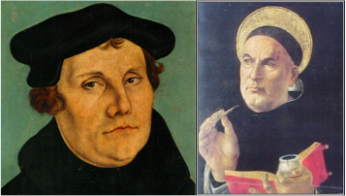
“Where was your Church before Aquinas”
Ever since the Reformation, Roman Catholics have been fond of asking, “Where was your Church before the Reformation”. Protestants have a good reply to that: “Where was your Church before Aquinas”.
Peter Lombard (in his “Sentences”) summarized church teaching up to that point (approximately 1150). Aquinas later opposed Lombard on one key point (“justification extra nos”, or the external righteousness of Christ), and Luther took up Lombard’s side:
In book 1, Distinction 17 of his famed Sentences, Lombard, discussing religious justification, asked: “Is the love by which we are saved a created habit in our soul, or is it the very person of the Holy Spirit dwelling within us?” Is that which heals and saves a person part of his own nature, something he himself has developed as his own possession [inherent righteousness], or is it the indwelling spirit of God, a divine power in him but not of him [alien righteousness]?
Lombard opted for the latter solution, maintaining that the love by which people love God and their fellow man so as to merit salvation [“merit” being a whole ’nother story] was the spirit of God working internally, without their aid or volition. Man is saved by an uncreated, not a created habit, by uncreated, not created, love, by the holy spirit within, not by an acquired talent he can call his very own. When the young Luther wrote hs commentary on the Sentences in 1509/10, he strongly agreed, against the majority of scholastics, with this interpretation by Lombard.
Thomas Aquinas opposed Lombard in this issue, arguing that saving charity [“charity” being “love” in the Roman Catholic schema] must be a voluntary act arising from a disposition man could call his own.
Roman Catholics claim that Martin Luther was the innovator, but in reality, Thomas Aquinas was a far more extensive innovator than Luther ever was. The problem was, “The Church of Rome” liked what Aquinas had to say, and they canonized it.
The Reformers sought to roll back many of the changes that Aquinas put into place. And in doing so, they relied on earlier traditions than did Aquinas.
It was Aquinas who not only introduced Aristotle to the Roman church, but he wrapped Aristotelian philosophy around Christian doctrine and handed it to “the Church” as a complete package. One that supported the Roman Church’s view of its own authority and necessity.
Friday, December 08, 2017
Pruss on God's simplicity
Some modern-day Calvinists are touting Thomistic simplicity. I'd like to partially interact with a sophisticated defense of divine simplicity:
The Fourth Lateran Council teaches that God is a “substantia seu natura simplex omnino”—an “altogether simple substance or nature”—and the First Vatican Council reiterated the teaching.
So faithful Catholics have to defend divine simplicity. Good thing Protestants aren't saddled with that precommitment.
The doctrine of divine simplicity had better not say that mercy and justice, in general, are one and the same property. For that would make meaningless a claim that a friend of ours had exhibited more mercy than justice in some situation.
i) I agree. However, it's hard to see how Pruss's denial in this regard differentiates his position from critics of simplicity like Frame, Craig, Plantinga, and Feinberg. Although he's defending simplicity, what he says here is consistent with what critics say.
ii) His position seems to be different from how simplicity is typically formulated by exponents. From what I've read, it's, in part, an inference. They infer that if God is identical with his attributes, then his attributes are mutually identical. The inference seems to be that if B is identical with A, and C is identical with A, then B is identical with C.
Pruss is at liberty to dissent from that inference or formulation and strike out on his own, but in that respect he appears to be defending simplicity by taking issue with how that's typically expounded.
Rather, the claim is that God’s mercy and God’s justice are the same ontologically. What makes it be true that Socrates is just? Surely it is something about Socrates, something that we might reasonably denote by “Socrates’ justice”, id est “that in virtue of which Socrates is just”. Socrates’ justice is not the same as Plato’s justice, because if they were the same, then the same thing would make it be true that Socrates is just as would make it be true that Plato is just. But if that were so, then it would follow that, necessarily, if Socrates is just, then that in virtue of which Plato is just exists, and hence Plato is just.The claim that God’s being merciful and God’s being just are identical is, I take it, the claim that the ontological basis of God’s being merciful is identical with the ontological basis of God’s being just. Or, in the above terminology, it is simply the claim that God’s justice is identical with God’s mercy. This does not entail that Cato’s justice is identical with Mother Teresa’s mercy, or even that Mother Teresa’s justice is identical with Mother Teresa’s mercy.
i) That's a coherent distinction. However, critics of simplicity could draw the same distinction. So I don't see how his distinction differentiates his position from those who deny simplicity. His explanation appears to be equally consonant with denying simplicity.
ii) In fact, I don't see how his distinction is even related to the claim that "there is no ontological composition in God of any sort, whether of matter and form, or of essence and accident, or of this attribute and that attribute considered as ontologically distinct."
Even if his distinction is consistent with divine simplicity, how is that relevant to the question at hand? After all, his own analogy involves comparing attribute-agreement in and between composite beings: Plato and Socrates, Cato and Mother Teresa. How does his distinction demarcate an incomposite God from a composite God like Zeus? Couldn't a Greek polytheist say Zeus's justice is not the same as Cato's justice?
If Curley freely chooses to take the bribe, then there is some time at which it was causally possible that he not take the bribe if offered it. Moreover, there is a time after which this is no longer causally possible—the choice has been made. Let t be the earliest time with the property that after t it is no longer causally possible that Curley take the bribe. There is such a time. Before this time, Curley’s rejection of the bribe is causally open and after this time it is causally closed. Moreover, I will assume that this time t is associated with Curley’s decision to take the bribe. The decision happens at t. This is an assumption that might not hold, for it might be that at t Curley made some earlier libertarian-free decision, for example a decision to do whatever it takes to get ahead financially, which causally necessitated that he eventually make a causally determined decision to take the bribe. In that case, the bribe-taking arguably inherits its freedom from the freedom of that earlier decision. But if we are to avoid a vicious regress, we will come to some decision with the property that the decision is made precisely at a time t such that after that time some deed is causally determined as far as Curley is concerned and before it it was not. This might not in fact be the decision to accept the bribe, but for simplicity I will assume it is.Thus, at t there was a branching. Before t it was possible for Curley still to reject the bribe and after t this was no longer possible. There are now two models of free will. On the first model, one accepted by Nuel Belnap among others, at t the branching has not yet happened: it is still causally possible for Curley to reject the bribe. It is only at t+d (for any d>0) that this is no longer possible. The time t is the last time at which matters are still open. On the second model, at t the branching has already happened: t is the first time at which matters are no longer open. I could give the argument for both cases, but that would make this talk unduly long. Instead, I will assume the first version to be correct, and for the purposes of making the talk self contained, I will say that for aught that we know, the first version is correct, and that should be all I need for my conclusions. Anyway, similar arguments apply in the second case, but are more complicated.Thus, at t Curley is deciding, but it is not yet true that he has decided. Let S be Curley’s state at t, i.e., the conjunction of all of Curley’s purely intrinsic properties at t (or, if we wish, the conjunction of all purely intrinsic properties occurrent up to and including time t). This state S occurs both in the actual world where Curley takes the bribe and in a possible world where he refuses it—I will call such a world “the alternate world”. Now, at any moment of time after t, the actual and the alternate worlds have already diverged. Curley has already done something: something he is morally responsible for. Perhaps his hand has not yet reached out for the money; maybe his enraged voice has not begun to refuse the bribe. But he is now in a state such that he is set to take or is set to refuse the bribe. (I am simplifying of course by assuming he can’t also temporize.) A deed has been done: his will has set into motion a causal chain leading up to the taking or the refusing of the bribe. Now the important thing to note is that the cause of the two different causal chains, the one in the actual world and the one in the alternate world, is the same as concerns intrinsic properties. Or the cause is Curley at t in state S. Since this state contains all of Curley’s intrinsic properties at t, and these are the same in the actual and the alternate world, it follows that we have one and the same person in one and the same intrinsic state being in one world responsible for setting into motion one causal chain and in another, another.But this seems to severely undercut the objection to divine simplicity based on the contingency of what God chooses. For we now see that one and the same person in one the same state could be in a position to initiate either of two incompatible causal chains. Moreover, note that Curley’s actual deciding was at t. During the deciding itself there was no difference in his intrinsic properties between the actual and the alternate worlds. The difference only appeared extrinsically to the decision, though as a result of the decision.
While his analysis is interesting in its own right, I don't see how that solves the problem. Doesn't a different result require a differential will? So we have to take the explanation back a step.
Monday, November 27, 2017
East meets West: from Thomism to Brahma
From a Facebook debate I had regarding James Dolezal's defense of Thomism:
Hays
Let's begin with some comments by Dolezal on his own position:
As a Christian who confesses God’s incomprehensibility based upon his pure actuality, I cannot see how I can avoid appealing to mystery in the sense of (1). Yet there seem to be good reasons for this appeal. Most notably, as pure act God is beyond all categorical being and thus beyond definition in any scientific sense. (Hence, my commitment to analogical predication about God) It is God as ipsum esse subsistens (or, in biblical terms, as “I AM”) that chiefly accounts for his incomprehensibility and the mystery that permeates any discussion of his existence, essence, or triunity. This is rather unlike that more popular form of mysterianism that locates the ground of mystery in the human mind’s evolutionary situation (as urged, for instance, by Colin McGinn).I confess divine mystery at the outset, at the moment I conceive of God as pure act (as “I AM”). Admittedly, I did not make this as clear as I should have in chapter 7 of my book. The mystery of the conjunction follows from the mystery of God’s purely actual existence. Indeed, the mystery of divine freedom itself follows from the same. It is for this reason that I don’t expect (or even desire) “resolution” to the difficulty; such resolution could only be achieved by eradicating the ontological distinction between God and his creatures (which I would regard as impossible since God cannot produce a purely actual being distinct from himself).Still, you are right to raise the question of God’s power for counterfactuals. How shall I explain the modality of such freedom? I confess that I cannot. I have no idea how to adequately express the modality of a free choice made by an agent who is pure act. And yet his pure actuality requires that his will for the world’s existence be free. I would not hesitate to affirm that human libertarian freedom is an analogue of this divine liberty; but it fails to convey the precise modality of that freedom as it is in God. Human acts of knowledge are also analogues of the divine act of knowledge and they too do not disclose an adequate (or univocal) notion of the modality of God’s knowledge. As I cannot form a univocal notion of God’s pure actuality, neither can I form a univocal notion of all he does in that actuality (knowing, willing, relating among the divine persons, creating, etc.).
Several problems:
i) Dolezal admits that Thomisic simplicity generates intractable conundra regarding divine freedom (not to mention the Trinity). He defends it by retreating into mystery.
That would be a legitimate move if we were dealing with a revealed truth. However, Thomistic simplicity is an elaborate philosophical construct. As such, it is properly liable to rational scrutiny. It doesn't enjoy the presumption or immunity to rational disproof that a revealed truth or necessary implication of a revealed truth enjoys.
ii) In addition, Dolezal's appeal is viciously circular. He cites the fact of divine simplicity (or God's pure actuality) to justify his theory of divine incomprehensibility. Yet Thomistic simplicity is not a given. To the contrary, the factual status of Thomistic simplicity is the very issue in dispute.
Therefore, he's hardly entitled to cite Thomistic simplicity as an unquestionable starting-point, which we must adhere to despite the intractable consequences. He's elevated a philosophical construct to the status of unimpeachable dogma, which we must accept in the face of irrefutable objections. But his confidence is wholly unwarranted, because it begs the question.
Saturday, November 18, 2017
Simplicity and necessity
Recently I asked some Reformed Thomists a couple of questions:
I've read a number of sympathetic expositions of the Thomistic understanding of divine simplicity, which I'll dub Thomistic simplicity for short. I've also read some criticisms. I have a couple of interpretive questions for the group:One interpretation goes something like this: on a classical understanding, God's attributes are essential to his being. "Essential" in the sense that God cannot be other than he is. If God is omniscient, he cannot be other than omniscient. Same with the other attributes.But if the divine attributes are mutually identical, then that generates a necessitarian scheme in which there are no contingent facts. If Thomistic simplicity is true, then whatever God wills, he wills essentially. If he wills the world to be, then he cannot will otherwise. If he willed to elect Peter and reprobate Judas, then it's not possible for Peter to have been other than elect or Judas to be other than reprobate. Thomistic simplicity collapses the distinction between actual and possible, contingent and necessary. God's choices/volitions are as essential to his being as his aseity, impassibility, omnipotence, &c.Is that a correct interpretation of Thomistic simplicity? If not, where does the analysis go awry?
I received a couple of erudite but murky explanations, one of which appealed to mystery.
Second interpretive question. According to Reformed theology, God's mercy and justice are not conterminous. Election and reprobation are distinct and divergent. Although God is never less than just in how he treats his rational creatures, God is often less than fully merciful or gracious (in the soteric sense) in how he treats some of his rational creatures. Roughly speaking, the elect receive divine mercy whereas the reprobate receive divine justice. Divine justice is essential whereas divine mercy is selective and discretionary.
Can Thomistic simplicity sustain that distinction?
I didn't receive any direct answer to that question.
Monday, April 24, 2017
Papists or Thomists?
I recently had an impromptu debate with a Catholic on Facebook. Here's the exchange (with minor editing):
Hays
To support Jerry's claim from another angle, there's the phenomenon of conservative Catholics who disregard the pacifism of recent popes. They justify their support for capital punishment or a particular military intervention by appealing to Thomism. Many conservative Catholic intellectuals are functional Thomists rather than papists. Their standard of comparison on just war and capital punishment is Thomism rather than the modern Magisterium. You can see the same phenomenon when they disregard the economic views of recent popes and bishops, or their views on illegal immigration.
Robinson
I forget, did a Pope declare ex cathedra a particular position on any of the issues you just listed?
Hays
You forgot that Catholics have a duty to submit to the ordinary magisterium and not merely the extraordinary magisterium. Anything else you'd like me to clear up for you?
892 Divine assistance is also given to the successors of the apostles, teaching in communion with the successor of Peter, and, in a particular way, to the bishop of Rome, pastor of the whole Church, when, without arriving at an infallible definition and without pronouncing in a "definitive manner," they propose in the exercise of the ordinary Magisterium a teaching that leads to better understanding of Revelation in matters of faith and morals. To this ordinary teaching the faithful "are to adhere to it with religious assent"422 which, though distinct from the assent of faith, is nonetheless an extension of it.
Robinson
Yes, actually; what level of doctrine do those things listed fall under?
Hays
You mean, recent papal opposition to the death penalty (for instance)?
But nice to see you having to backpedal from your initial criterion.
Robinson
Well, let me ask it like this, do the teachings you listed above, fall under ordinary, extraordinary, or ordinary universal magisterium teachings? Also, are these teachings considered dogma, definitive doctrine, authoritative doctrine, or prudential admonitions?
Hays
They don't need to be dogma or definitive doctrine to obligate assent. That's the point. And if you wish to retreat into uncertainty regarding how recent papal policy on capital punishment or default pacifism should be classified, that's a problem for Catholics, not Protestants. By what authority to does a Catholic layman classify recent papal policy as authoritative or unauthoritative? Your own authority?
Robinson
Since it's "a problem for Catholics," then probably not a thing for you to concern yourself with here.
Hays
Do you also think Christians are not entitled to concern themselves with problems internal to atheism? Should we just leave that to atheists to hash out among themselves? What a mistake for Plantinga, Swinburne, van Inwagen et al. to bother with atheism.
Robinson
Also, If the teachings you listed above do indeed fall under the last two categories, one is able to disagree with the magisterium regarding these teachings. See Richard Gaillardetz's By What Authority? on this point.
Hays
Your last two categories included "authoritative doctrine" (second to last). So you're saying faithful Catholics are at liberty to disagree with authoritative doctrine.
If you classify recent papal policy on capital punishment and default pacifism as merely "prudential admonitions," what's your criterion? By what authority do you apply your criterion? Same thing with recent papal teaching on economics.
I notice that you cast the issue in conditional terms (if–then). So is the classification uncertain? But isn't a divine teaching office supposed to compensate for the lack of certainty that allegedly besets Protestant theology?
Robinson
Well, we are back at my above question, how did these teachings come to be ( ordinary, extraordinary, or ordinary universal magisterium)?
Hays
Are you claiming there's some sort of quantitative threshold that distinguishes the ordinary universal magisterium? Can you point to an unambiguous criterion or sufficient condition?
Does the Vatican issue labels: "ordinary magisterial teaching," "ordinary universal magisterial teaching"?
Or is that left to the private judgment of individual Catholics to tell which is which?
Robinson
No, actually, basic Catholic ecclesiology.
Hays
Oh, but we're discussing how individuals, including lay Catholics, apply "basic Catholic ecclesiology. Are you saying the classification of papal teaching as merely prudential admonitions is not an exercise in private judgment at the level of application?
Given the development of doctrine, what may prospectively appear to be merely prudential advice may retrospectively be seen as authoritative, as a pattern emerges. Or do you deny that?
Robinson
Ordinary Magisterium consist of teachings by individual bishops, groups of bishops, or the Pope (non-infallible).
Extraordinary Magisterium are things taught by the College of Bishops while gathered in Ecumenical Council, or the Pope doing so, as headof the College of Bishops, declared Ex Cathedra.
Ordinary Universal Magisterium is something made by the bishops while dispersed throughout the world, united in judgment indicating that a teaching is held definitively.
Hays
Your definition of the ordinary universal magisterium fails to provide any identifiable event or discernible criterion for when that threshold has been crossed. Care to try again?
Your distinction between "groups of bishops" and bishops "dispersed throughout the world" is fuzzy, especially given the fact that the geographical extension of the Catholic church has varied in the course of church history.
Not to mention weasel words like "united in judgment" and "definitively held". Do you have a noncircular criterion or condition?
Robinson
Wait, why do you care, again?
Hays
So now you're trying to deflect.
Robinson
No, I'm just noting above you said this was a Catholic problem. I explained that there are different types of Church teachings.
Also, are you trying to learn about Catholic ecclesiology, or just being a troll?
Hays
So exposing the incoherence of Catholic claims is trollish. Well, if that's the best you can do.
Robinson
So because the process isn't neat, somehow it is incoherent?
Hays
The process isn't "neat". What a lovely euphemism. So that's your backdoor admission that you don't really have any objective way to differentiate ordinary magisterial teaching from ordinary universal magisterial teaching.
Why can't evangelicals say the process of Protestant theology isn't "neat".
Robinson
1) There are some "objective" criteria, as I stated above, how were the teachings stated? Ecumenical council? Ex Cathedra? Statements made by the Pope in a homily?
2) It isn't exactly a neat process. Takes time, as the first few hundred years of christological debates should show.
3)I am not exactly sure what it means to have a process of Protestant theology.
Hays
To repeat, what's the threshold for knowing when or if ordinary magisterial teaching has passed or will pass into ordinary universal magisterial teaching? At best, that can only be known in hindsight, which leaves much Catholic teaching uncertain or practically unauthoritative since the future is out of sight. And this isn't just a question of development or reiteration, but dramatic reversals in the status quo ante, for centuries.
To my knowledge, no papal statements are labeled "ex cathedra".
BTW, is there an infallible list of ecumenical councils? Clearly Roman Catholics, Eastern Orthodox, and Oriental Orthodox have different lists.
Robinson
The threshold is when the bishops, as members of the college of bishops even though they are dispersed globally, are united in a judgment that a teaching should be considered definitive doctrine. In other words, a judgment made by only the USCCB, cannot be anything more than ordinary magisterium (therefore not infallible).
Hays
Once again, how do you know if or when that threshold has been crossed? Does the Vatican stage a fireworks display?
Since the Catholic church wasn't global for most of its history, does that mean ordinary universal magisterial teaching only became possible since the 19C (give or take)? How do you determine that the bishops are "united in judgment"? That doesn't even occur during so-called ecumenical councils. If, in some or many cases, the distinction between ordinary and ordinary universal magisterial teaching can only be seen after the fact, then how do you achieve any certainty in distinguishing the two in advance of the fact?
Robinson
The statement about bishops being global isn't meant to imply that there must be a bishop on every continent. Rather, it is meant to reference the bishops dispersed to their diocese, wherever they might be found, rather than together at a council.
Hays
But you'd have to determine (taking a poll?) that the bishops are united in judgment. Presumably, moreover, that must be diachronic as well as synchronic. Bishops over a span of time. What's the minimal sample group in space and time? Presumably you don't think "united in judgment" means unanimity since, as I pointed out, that's not even a necessary condition for an ecumenical council. So it's a fuzzy criterion, too. A matter of degree. What's the threshold?
Robinson
How do you determine, before the Council of Nicaea, whether or not Nicaea should be considered authoritative?
Hays
I don't consider church councils to be intrinsically authoritative. That's not my paradigm. If, for argument's sake, we wish to cast the issue in authoritarian terms, then the product of a council is "authoritative" insofar as it happens to be true.
Robinson
What's not the question here?: your paradigm or what you think is authoritative in these matters. Rather the question is whether or not your initial comment that sparked this is back and forth makes a worthwhile contribution and criticism within the Catholic paradigm. It doesn't. Whether the catholic paradigm is complicated, or satisfies your emotive self isn't too interesting, since you aren't a Catholic, and is to be expected beforehand.However, what is interesting is that you continually pontificate about Catholic authority, and yet did not seem to know about the distinctions within the magisterium....
Hays
You were the one who asked for my personal opinion. My objection wasn't that the Catholic paradigm is "complicated" or that it fails to satisfies an "emotive self". And what's interesting is your persistent inability to show how the abstract distinctions are tenable in practice.
Thursday, January 12, 2017
Roman Catholicism: “simply making up things to justify pet doctrines and practices”
 |
| St Thomas the Train Wreck Aquinas |
R. Scott Clark, a professor of Historical Theology at Westminster Seminary, California, published an original piece of work dealing with Aquinas’s inability to find biblical evidence in favor of “images”. Perhaps he is still feeling the sting of a WSCal grad like Jason Stellman having turned “Drunk”, or maybe there is a “Reformed Thomist” somewhere in his life. Whatever the reason, in this blog post, Clark, who reads Aquinas in the original Latin, unloads with both barrels:
The Allure Of Unwritten Tradition:
The earliest post-apostolic Christians (some of whom are denominated the Apostolic Fathers) knew of an apostolic tradition but they did not know about a secret and unwritten apostolic tradition on the authority of which the church could justify virtually anything it wanted. Remarkably, however, over time this is just what happened in the life of the church. In preparation for the annual [“Is the Reformation Over?” conference] this Friday and Saturday (January 13–14, 2017) I have been looking at Thomas Aquinas’ appeal to an unwritten tradition to justify practices that he freely admits are not biblical. In Summa Theologica 1a2ae 25.3, where he was defending the veneration of the cross, he faced a very sensible and eminently biblical objection:
Wednesday, November 02, 2016
Hylomorphism
I usually agree with Paul Helm. Here's a rare exception:
http://paulhelmsdeep.blogspot.com/2016/11/the-puritans-soul.html
I agree with Helm on the importance of the body in Christian anthropology. But we don't need Thomistic hylomorphism to value the body. Indeed, a dreaded Cartesian dualist can value the body, without the obscurities of hylomorphism. It's a philosophically and theologically problematic position. Consider the view of analytical Thomist, Elizabeth Anscombe:
This is why I call "immaterial substance" a delusive conception…There is no reason whatever for believing in a temporal immortality of the soul apart from the resurrection…I take the Christian doctrine of immortality to be the doctrine of an unending human life, happy or unhappy, after the resurrection, and not the doctrine of an immortal sort of substance, the soul., to which is appended the doctrine of the resurrection because a disembodied soul is not a complete man, "The Immortality of the Soul," Faith in a Hard Ground, 72,77.
Now, it's possible, I suppose, that her position was partially influenced by Wittgenstein. Wittgenstein once made a skeptical comment about dreams, which his student, Norman Malcolm developed. If we conceive the intermediate state as analogous to dreaming, and if, following Wittgenstein, we're dubious about the "folk psychology" of dreaming, then perhaps that has something to due with her skepticism. But I have no actual evidence that was a factor in her thinking.
It is, of course, possible, that her skepticism isn't specifically Thomistic, although she devotes time to analyzing the Thomistic category of substance. And I'm not suggesting that Helm ought to be persuaded by her arguments.
But it's no mystery that hylomorphism, even of the Thomistic variety, is hard to square with the intermediate state. As I recall, Peter Geach, another analytical Thomist (and Anscombe's husband) raises similar difficulties in God and the Soul. From what I've read, Thomists must make ad hoc qualifications to adapt hylomorphism to the intermediate state. And that's from astute Catholic philosophers who are highly sympathetic to Thomism.
Saturday, August 06, 2016
Why I'm not a Reformed Thomist
I. Introduction
In some Calvinist circles there's been a resurgence of interest in Thomism or Reformed Thomism. I don't share their enthusiasm. In this post I'll explain why.
II. Philosophical predilections
When it comes to philosophy and philosophical theology, I find metaphysics more interesting than epistemology. I take an interest in philosophical issues like the nature of time, personal identity, abstract objects (e.g. numbers, possible worlds), and thought-experiments.
I think it's important for Christians to have a considered religious epistemology, of course, but there's an obvious sense in which metaphysics is more fundamental than epistemology. Metaphysics supplies the objects of knowledge.
Because I find metaphysics more interesting than epistemology, I generally find "rationalist" philosophers more interesting than empiricist philosophers. "Rationalist" philosophers are far more inclined to delve into metaphysical questions than empiricist philosophers. That doesn't mean I generally agree with "rationalist" philosophers. But I prefer their orientation.
Because Aristotle is more down-to-earth than Plato, Aquinas is more down-to-earth than Augustine. I think Aquinas's interest in the empirical dimension of reality is a salutary corrective to Augustine. Nevertheless, Aquinas neglects philosophical issues that interest me. The nature world is fascinating, and frequently awesome, beautiful, and enjoyable. However, I also takes an interest in what lies behind the natural world.
As I've also said, developments in math, science, and philosophy have given us conceptual models and analogies that were unavailable to Aquinas.
III. Theological predilections
Unlike Aquinas, I'm not a medieval Catholic. Rather, I'm Protestant. That makes a difference. For instance, I start with the Bible and take that as far as I can. When the Bible doesn't address certain issues, I supplement Scripture with reason and empirical evidence.
IV. Thomistic categories
i) Thomistic metaphysics is based on his categorial scheme. That's carryover from Aristotle's taxonomy, although Aquinas modifies it.
Aquinas's taxonomy comprises the transcendentals (being, truth, goodness, unicity); material, formal, efficient, and final causes; essence, existence; form, matter; potentiality, actuality; substance, accident; privation.
Moreover, some of these categories correspond to each other, viz.
form>actuality
matter>potentiality
ii) I think it makes sense to base metaphysics on categories. Categories are the most fundamental kinds of things. Metaphysics is concerned with what there is. So to that extent I'm sympathetic to Aquinas's program.
ii) There are, however, problems with his choices. There's nothing inherently or distinctively personal about any of his categories. They could all be impersonal entities or kinds of things.
iii) In Plato, there's a clear-cut distinction between form and matter. But in Aristotle and Aquinas, the form tends to dissolve in the concrete object.
iv) There's also the problem of "pure" forms (e.g. God, angels) that are not a form of anything. That's a throwback to Plato's theory. So the classification breaks down.
v) I think sufficient condition better captures the notion of efficient cause.
vi) What's the justification for classifying formal, material, efficient, and final causes as causes? What do they share in common that makes all of them causes? For instance, teleology is an important category, but why claim it's a causal category? Put another way, in what respect are these four very different categories causes?
vii) Thomistic epistemology is naturally related to Thomistic metaphysics. As I understand him, Aquinas doesn't think we have direct knowledge of particulars. Rather, we discern the form in the particular. But what's the justification for that restriction?
V. Deriving categories
i) A deeper problem I have with Aquinas's categorial scheme is how he arrives at that taxonomy. What's his source of information? What makes those categories to be the ultimate categories rather than some other categories? In the history of philosophy, different metaphysicians have drawn up different lists of categories.
How are humans in a position to know what are the ultimate kinds of things? How do we even get started in developing a theory of categories?
ii) From a Christian standpoint, God is the ultimate source of reality. God's nature, existence, and imagination constitute the source of what's actual or possible. Therefore, in developing a theory of categories, it makes sense to begin with God. In particular, to correlate our categories with the communicable and incommunicable attributes of God. To some degree, communicable attributes function like abstract universals.
iii) There are different ways to classify the divine attributes. One way is to use Scriptural terminology. Biblical usage is sometimes redundant. For instance, God's "justice" and God's "righteousness" are synonymous. Those are not two different attributes.
You also have overlapping attributes: Holiness overlaps goodness and transcendence. Wisdom overlaps goodness and knowledge. So a classification of divine attributes needs to consolidate Biblical usage.
iv) Another way to classify divine attributes is to translate Biblical terminology into philosophical nomenclature, viz. aseity, omnipotence, omniscience, impassibility, timelessness, spacelessness. In deriving metaphysical categories from divine attributes, that makes sense.
V. Categories as communicable/incommunicable attributes
Let's list the divine attributes, and correlate them to categories:
1. The Trinity
The Trinity has several properties:
i) Personality
ii) Relation
iii) Resemblance
iv) Variation
v) Number (one, three)
vi) Symmetry (a category that combines ii-iv).
2. Timelessness & spacelessness
i) On the face of it, that seems to be apophatic. Negative theology. What God is not. God is not spatial (physical, material) or temporal.
If is, however, possible to lend positive meaning to timelessness and spacelessness. Consider an actual abstract infinite. That's a given totality. Complete. By contrast, time and space are limits. In that respect, this involves a distinction between finitude and infinitude. God's existence is complete. We might use the word plenity to designate the fullness of God's existence. That stands in contrast to creatures whose existence is subdivided into spatial and/or temporal parts.
3. Aseity
We could designate aseity as a kind of metaphysical necessity. Necessary existence. That stands in contrast to contingent existence. That distinguishes God from creatures and events.
4. Truth and speech
i) Scripture makes truth a divine attribute. Likewise, Scripture ascribes speech to God. Arguably, speech is an economic attribute.
Truth and speech have certain properties:
ii) Meaning
iii) Mentality
iv) Logic
It's arguable that truth is a property of thought or concepts. Truth inheres in minds.
5. Omniscience
i) Knowledge presumes mentality. Knowledge is a property of minds.
ii) Knowledge can include imagination. Conceiving possibilities, including unexemplified possibilities.
6. Omnipotence
This involves causality. Will and power. The ability to exercise power. The ability to convert abstract possibilities into concrete realities. Possible worlds are ground in God's omnipotence and omniscience.
VI. A Christian categorial scheme
1. Based on (V), we can derive the following categories:
i) Mentality
ii) Necessity/contingency
iii) Causality
iv) Symmetry (relation, resemblance, variation)
v) Plenity (actual infinity)/limits (time, space)
vi) Meaning
vii) Goodness
viii) Abstract objects (e.g. number, universals, possible worlds, logic)
2. The point of this exercise is illustrative rather than exhaustive. I'm not attempting to generate a complete categorial scheme, but to present a strategy for how a Christian metaphysician could do so. And I think that has a sounder basis in philosophical theology than Aquinas's rather arbitrary set of categories. I'm not a Thomist, in part because I don't see the value of squeezing or stretching philosophical analysis into his categorial scheme.
Subscribe to:
Posts (Atom)