Showing posts with label Culture Wars. Show all posts

Thursday, September 02, 2021

The Worrying State of Medicine

I spent about four hours today at a local Urgent Care facility. Without going into too much detail, the reason I had to do this was because the doctor's appointment I had scheduled for yesterday got canceled because my doctor got sent to cover ER shifts because of labor shortages in the medical industry. The immediate problem I was seeing her for is that my oxygen saturation levels, especially early in the morning, were getting worryingly low, and after starting a new medication I had gained six pounds in a single week, which could be seen as visible swelling in my legs. Since I was measuring my O2 levels with my own pulse/ox, I used the patient portal to say, “This is what I'm measuring. What should I do for the next two weeks before our rescheduled appointment?” Thus, today, I received a call where my doctor informed me I should go to the Urgent Care facility to get examined to make sure there wasn't anything major going on.

Now the fact that my primary doctor wasn't available for a scheduled appointment due to workplace shortages of medical professionals isn't the main focus here. It is certainly worrisome, but I think what might even be more so is the exchange I had with the doctor at the Urgent Care clinic. Since I wasn't getting enough oxygen and had obvious fluid retention from swelling, he ran a litany of tests on me including EKG and a chest X-Ray, even the universal COVID test, all of which came back as “good news” (thank God). But after he got the results back and he was explaining them to me, the doctor mentioned at one point that they'd had a little difficulty with one of the tests because my chest is so large. He then immediately said, “Not that I'm saying there's anything bad about being so large.”

And this is the point I want to bring up. I actually immediately said, “No, I know it's bad. In fact, the increased weight is precisely one of the very things I pointed out to you that had me so concerned.” I immediately saw his demeanor change, as if he was relieved to be able to speak honestly instead of being terrified of offending me, and he said, “Yes, if we could get rid of that weight, it would almost certainly help across the board with everything else here.”

So why did I find this exchange so problematic that I decided to write a blog post about it, especially given that it means I had to divulge (albeit obscurely) some health details I'd rather not talk about? Because I just experienced a doctor telling me something we both knew was a lie because he was afraid that I might be offended had he told me the truth.

There's real danger in this, though. I could have easily come away from that conversation telling everyone, “I went to Urgent Care and the doctor said my weight is fine” when the reality is the exact opposite. If he was so unwilling to state the objective fact that being overweight is detrimental to one's health, then what else are doctors afraid to tell patients? It's extremely worrisome if doctors will lie for the sake of one's ego instead of telling the truth for the sake of one's life.

In the meantime, I still have a case of “We Don't Know”, but at least I know my heart and lungs are sound right now, and I don't have Wuhan Bat Lung either. Prayers would be appreciated that someone in the medical field discovers what the proximate cause is. Or, God could just zap me. I'm fine with that too.

Tuesday, February 23, 2021

"When Amazon erased my book"

As many know, conservative Catholic political philosopher and ethicist Ryan Anderson (PhD, Notre Dame) had his book When Harry Became Sally: Responding to the Transgender Moment removed from Amazon mere days ago. This represents the latest battle in the culture wars. A battle which is all the more pressing in light of Biden's Equality Act. The left and its sympathizers will seek to cancel even the most reasonable, informed, and charitable voices if the voices dissent from leftist convictions or commitments. Anderson writes about all this and more in his First Things article "When Amazon erased my book". I don't agree with everything, but it's still worth a read.

For now, people can still purchase Anderson's book on Encounter Books (the book's publisher), Christian Book, Barnes and Noble, and other bookstores.

Update. From Ryan Anderson:

Update 2. From Abigail Shrier:

Read the rest of the thread.

Saturday, January 23, 2021

"Inciting violence"

I recently got into a debate with a notable Christian leader (whom I won't name) who argues Trump did "incite violence" with the Capitol Hill "rioters", which of course is one of the bases for why Trump has been impeached again. Here are my (edited) replies.

Wednesday, January 20, 2021

"Democracy" in America

If we want to know who's really in power, then perhaps one way to know is to think about who or what we cannot openly criticize in a reasonable manner...

...without being shouted down.

...without being publicly shamed.

...without being called false names.

...without losing our reputations.

...without made into social pariahs in our own communities.

...without being ostracized in our own nation.

...without having our speech curtailed or even silenced.

...without being fined.

...without losing our jobs.

...without being imprisoned.

...without being forcibly "re-educated".

...without unjust corporeal punishment.

...without being "disappeared" in the middle of the night.

...without being publicly executed.

...without being (shall we say) "canceled".

In China, it is the CCP.

In North Korea, it is the Kim family.

In Russia, it is Putin.

In Iran, it is the ayatollah.

In many Middle Eastern nations, it is Islam.

In the US, are we still able to openly criticize in a reasonable manner people, organizations, institutions, the government, and so forth without significant cost to us or our families?

[O]ne theme in particular dominated all others: the growing tyranny of the majority, the ever-increasing and most formidable barriers raised by the majority around the free expression of opinion, and, as a result, the frightening oneness of American thinking, the absence of eccentricity and divergence from the norm.

A perfect liberty of the mind exists in America, said Tocqueville, just as long as the sovereign majority has yet to decide its course. But once the majority has made up its mind, then all contrary thought must cease, and all controversy must be abandoned, not at the risk of death or physical punishment, but rather at the more subtle and more intolerable pain of ostracism, of being shunned by one's fellows, of being rejected by society.

Throughout history kings and princely rulers had sought without success to control human thought, that most elusive and invisible power of all. Yet where absolute monarchs had failed, democracy succeeds, for the strength of the majority is unlimited and all pervasive, and the doctrines of equality and majority rule have substituted for the tyranny of the few over the many, the more absolute, imperious, and widely accepted tyranny of the many over the few. (Richard Heffner, Democracy in America)

Saturday, August 29, 2020

I See the Need for a Clearly Articulated Christian Worldview

Jason Engwer and I have been having some discussions in the comment threads from some of my recent blog posts about an idea, a hypothesis that I have been proposing, which involves a link between what the Roman Catholic Church of the past, and what “wokism” is and is doing in the present. He believes that it is not a good idea, not a good hypothesis, and I know that I have not provided a complete argument for it.

As I mentioned in the comments, I had been hoping to get some feedback with the intention that I would be able to work out my thoughts more fully. Jason would prefer that I not use Triablogue for that particular kind of thing, and of course I will defer to his wishes.

But I am interested in having a discussion.

As someone who is a conservative, Reformed, evangelical Christian, I am alarmed by recent trends in politics and culture, and I imagine that some of you are as well. Francis Schaeffer’s excellent question comes to mind: “how then should we live?” What role should Christians play in all of this? I have frequently in my life been a keen observer of politics. Other times, not so much, depending on what’s going on in my own life. I would imagine that’s true for most of you as well. I seem to be watching more closely these days.

As a writer, I am hugely aware that “words have meanings”. It should be evident to all that definitions are fluctuating almost by the day. Words and concepts such as “racism”, “anti-racism”, “justice”, “social justice”, even “liberal” and “conservative” get thrown about, and often, people today are using the same words, but using different definitions in their minds, and consequently while it looks as if they are having a conversation, in real life, they are talking at cross-purposes, and not having a genuine conversation at all.

The pure speed of conversation, through “social media” such as Twitter and Facebook enable us to see events, form opinions, and to dive into “discussions”, without even knowing the full details of a thing.

These are times, I believe, when people’s thoughts and concepts are in flux, and as a result, people are changing their ways of thinking. Some popular examples include someone like the former comedian Dave Rubin, who is a “gay” “married” “classical liberal” “atheist”, who recently has, through various discussions, found himself to be more apt to “believe there is a God” and to have a generally more conservative outlook in life.

The independent YouTube journalist Tim Pool, too, whom I watch, cut his teeth, so to speak, by “live streaming” news reports from the “Occupy Wall Street” protests from some years ago. Now he is watching closely as rioting is pretty much a constant thing in some Democrat-run cities, and though he considers himself a “social liberal”, in his commentaries, he currently despises the Democrats for allowing things, and he has placed himself firmly in the Trump column for this upcoming election.

Given that this is a time of flux, I believe that the times are ripe for, and needful of, a clearly articulated Christian worldview to make its way onto the public stage.


We can all see what the phenomenon that I am calling “wokism” is and is doing. It is having a profound effect on the national discussions, including everything from the rioting in cities, the role of police and police departments, the role of individuals (generally, a conservative viewpoint) vs the role of “aggrieved groups” (generally, a leftist viewpoint).

One reason for this may be found in academia. It is said (and many of you will be aware of this narrative) that anti-war protesters of the political left went into academia because of the draft deferrals that could be gained by following that path. They found movement there to be kind of “free and easy”, and over a few decades, new “fields of study” emerged, some legitimate, some not (in a parasitic kind of way) – “race studies”, “women’s studies”, “gender studies” – and concepts such as “intersectionality” and “anti-racism” have emerged. New methods, too, emerged. In the meanwhile, those in charge of some of these “studies” have found the concept of “Tenure” to be their ally, in the effort to spread these new lines of thought. Whole new moralities, and in fact, moralities pursued with religious fervor, seem to have taken root and bloomed to fruition before our eyes.

(For anyone who is interested, Roger Kimball is a constant and excellent observer of such things, and has documented the process in his work, “Tenured Radicals”.)

The subject matter is confused and confusing. Even the church is being caught up in things. When George Floyd was killed, I became involved in discussions with church members, and my pastor became involved. My church is located in a city area, where there are multiple college campuses, and inner-city churches nearby. The concept of “anti-racism” came to the forefront. The concept basically says, “if you’re not an anti-racist, you are a racist”. This of course involves definitions that have been changed, without us having been involved in the effort to change those definitions.

I found myself on the opposite side of the discussion from some church members who wanted to support the #BlackLivesMatter” movement. Of course as we have seen, that organization is owned and run and funded and staffed by self-described Marxists, and I just can’t see myself supporting anything that is Marxist.

That’s all for now. More later, Lord willing. Let me know if you have any comments or questions.

Thursday, June 25, 2020

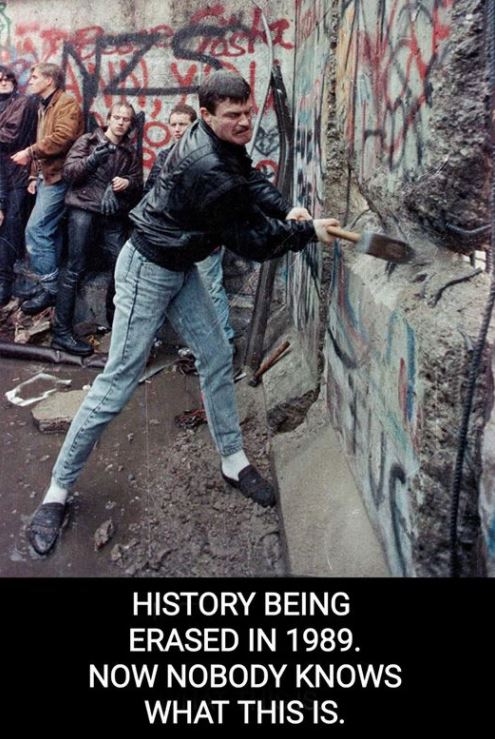
It's not about history...

I've seen several people posting this image in social media:


East Germany was unavailable for comment.

People have also compared the destruction of statues to the Boston Tea Party. The British Empire was likewise unavailable for comment.

When people destroy objects in their community, it is not because they want to distance themselves from history. They want to distance themselves from the government who built those objects.  That in and of itself is not a bad thing.  It's good that East Germany no longer exists.  It's good that the British Empire no longer exists.

Is it good if America no longer exists?  That depends on what replaces America.  But I find it pretty clear that those who tore down the Berlin Wall did so because they wanted more freedom for themselves, and those who dumped tea into the harbor did so because they wanted more freedom for themselves.  Those who are destroying statues of Jefferson, Washington, and Grant are the same people demanding that others bow to them, that you do not have the right to free speech (but they do), and that you do not have the right to freedom of religion or assembly (but they do).  After all, art is speech and they are destroying the art they disagree with, but if you tear down BLM posters you will get arrested.  And you don't have the right to sit in a car outside of church without getting a ticket because of COVID, but they have the right to gather face to face in the streets without risking jail.

I do not see how their replacement for America is objectively better than what we currently have; rather, it is objectively far worse.  But make no mistake, this isn't about history. It's about bringing down the United States and replacing it with something else.

Saturday, June 20, 2020

Yellow Lives Matter

I recently saw a popular Christian apologist post the following image on Facebook. He's also been making posts sympathetic to if not in support of BLM.

Let's take a comparison:

Asian-Americans hear similar things. You're a banana or Twinkie. You're fresh off the boat. No but where are you really from? Well of course you're good at math and science. You all look the same. And so on.

Asian-Americans face systemic racism in college admissions. For example, see the Harvard law suit which may go all the way to the Supreme Court.

Yet, are Asian-Americans going around demanding the cancellation of every movie or series with yellow face racism? Supporting a Marxist-influenced organization like BLM? Justifying the destruction of property? Tearing down railroad tracks from the First Transcontinental Railroad because Chinese immigrants were literally treated like pack animals? Using Japanese internment camps like Manzanar as a modern rallying cry against the evil US government?

Should Asian-Americans be doing these things?

I think other racial/ethnic groups could say similar things too (e.g. Latinos, Indigenous Americans, Jews, underprivileged whites). Where's the massive public outrage and support for them? Why aren't CNN and MSNBC covering their plight as much as BLM?

Tuesday, June 02, 2020

Non-conformists

On the Origins of the African Slave Trade

I posted this article in August of 2019, but it seems more than helpful in today's context.

With all the talk of “intersectionality” “privilege” and “oppression” and “reparations” and “racism” coming from the left, I’ve felt inclined, again, to look to the beginnings of what people are talking about.

I’ve located three excellent historical sources on the African slave trade – I’m open to reviewing more, but these are three that I’ve found:

Inhuman Bondage—David Bryon Davis, 2006. New York, NY and Oxford, UK: Oxford University Press.
Africa and Africans in the Making of the Atlantic World, 1400–1800—John Thornton, Second Edition, 1998 (Twelfth printing, 2006). New York, NY and Cambridge, UK: Cambridge University Press.
The Slave Trade: The Story of the Atlantic Slave Trade: 1440–1870—Hugh Thomas, 1997. New York, NY: Touchstone (Simon & Schuster).

These are (generally) long books, but here are a few relevant points:

Slavery is not simply the problem of one race, it’s a human problem. The Israelites were enslaved by the Egyptians, “Romans established the status of a slave by law and distinguished him from a serf” (Thomas, p. 26).

A white slave trade existed in Europe before the west coast of Africa was ever explored by the Portuguese. “In the early 1400s this white slave trade from the Black Sea foreshadowed almost every aspect of the African slave trade, which was about to begin, including complex organization, permanent posts or forts for trade, and long-distance shipment by sea to multinational markets” (Davis, p. 82).

The term “Slavs” – from Slovak to Yugoslavia – is derived from the word “slaves”. I’ve already written to the effect that my own ancestors were likely slaves at some point.

“African Americans” should be at least as incensed with “African Africans” about the on-going capture and sale of fellow Africans, as they are with anyone else. “Virtually all of the enslavement of Africans was carried out by other Africans” (Davis, p. 13). On the other hand, Europeans did not conquer the Africans, nor could they. “Not only did African naval power make raiding difficult, it also allowed Africans to conduct trade with the Europeans on their own terms, collecting customs and other duties as they liked” (Thornton, p. 38).

A series of popes – all prior to the Reformation – authorized the entire African slave trade enterprise, prior to Columbus’s voyage to the Americas. Popes “Eugenius IV” (Illius Qui, 1442), “Nicholas V” (Dum Diversas, 1452 and Romanus Pontifex, 1454), and “Callixtus III” (Inter Caetera, 1456), (Thomas, pp. 64–66) ostensibly felt a “need to act forcefully against Islam, seen, after the fall of Constantinople, as now menacing Italy itself” (66). But it was the fall of Constantinople in 1453 which left the pope “the uncontested first prince of Christendom” (65). The slave trade was, in its beginnings, purely a Roman Catholic enterprise.

Fewer than “5-6%” of all Africans who came to the New World came to North America. “By 1820, nearly 10.1 million slaves had departed from Africa for the New World” (Davis, p. 80). “Yet the region that became the United States … received less than 4 percent of the slaves shipped to the New World” (Davis, p. 61). But conditions were such that these thrived to the degree that “by 1850 over 30 percent of the African New World diaspora” lived here.

This is not to say that there wasn’t “inhuman” treatment of some – even of many slaves. But inhuman treatment was rampant everywhere, at all times prior to the 20th century. Ancient Rome first captured its empire and then protected its borders by brutal, even savage means (though couched in “honor”, as it was at the time). This empire fell through invasions of external peoples who attacked, raped, pillaged, and enslaved those they conquered every bit as brutally.

That is just human-on-human treatment, and it’s not to take into consideration at all treatment by nature through “climate”, famine, disease, wild animals, and other ravages of nature. By those standards, no human being faces “oppression” today. You might say we are all (even the most “intersectional” among us) “living the dream”.

Tuesday, March 10, 2020

Beyond binary

A friend asked me to comment on this:


A Christianity Beyond Binary
God is beyond gender binary, so why can't our faith be too?

I’m a Christian, training to be a minister, and LGBTQ affirming. I was affirming of gender non-conforming and transgender people before I supported people seeking same-sex relationships. This may seem like a bigger step than just acceptance of same-sex marriage, but this affirmation is backed up by medicine, scripture, and praxis that has only gotten stronger since I took this position a few years ago.

For a couple of reasons I'm skipping over the "medical evidence:

Sunday, March 08, 2020

International Women's Day

1. I'd argue Christianity has a higher regard for women than virtually any other religion or worldview. Perhaps a major exception is Judaism, though rabbinic Judaism is quite different than biblical Judaism. And secular humanism is parasitic on Judeo-Christian values about women. Anyway others better than I have written reams about all this so I won't belabor the point.

2. I don't know why we need an International Women's Day to celebrate women in general. I don't celebrate women in general, just like I don't celebrate men in general. There are good and bad among men and women.

3. It seems to me International Women's Day is just another diversity day to push feminism. I mean a mixture of second, third, and/or fourth wave feminism. Just like there are diversity days to push liberal or progressive values and goals about minorities like Native Americans, African-Americans, Latinos/Hispanics, and so on. Mind you, I support many minority issues, but what I don't support is the liberal or progressive use or manipulation of minorities to push their own agendas.

4. Besides, as far as that goes, why isn't there a UNESCO-recognized International Men's Day? Especially in light of all the issues and problems many men suffer today.

Wednesday, March 04, 2020

Is homosexuality genetic or learned?

Someone at Apologetics Academy asked "Is homosexuality genetic or learned?". My response:

1. So a more technical answer is it's multifactorial and polygenic. At the same time, the same could be said for any sexuality (e.g. heterosexuality, bisexuality).

2. Moreover, sexuality (in the way it's used in the post) isn't limited to physical properties alone. There are also significant psychological elements in sexuality. It's the distinction between biological male/female (which is physical and physiological) vs. what does it mean to be masculine/feminine (which is more psychological), even though the one can influence the other.

3. In fact, homosexuals and transgendered persons debate this. Many people aren't aware, but there's an internecine battle waged within the LGBTQ umbrella. In general, homosexuals want to argue biological sex is fixed, whereas sexuality is fluid. (I think I use "sexuality" differently from the way it's used in the post.) So one is a biological male since our genes are fixed, but sexual orientation, behavior, attraction, and so on are e fluid (e.g. butch, femme, dyke, boi, stud, top/bottom).

By contrast, in general, transgendered persons want to argue biological sex is fluid, while sexuality is (usually) fixed. So, for example, a biological man can have sex reassignment surgery and become a biological woman. This would mean biological sex is fluid. However, though they are now a (transgendered) woman, they will argue they continue to have sexual desires for women, hence they are akin to lesbians.

This, of course, angers the homosexual community in general. Such as lesbians. Lesbians don't wish to have sexual relations with a transgendered woman who used to be a man but now believes they are akin to a lesbian.

4. Finally, it depends on one's underlying worldview. If one is an atheist materialist (naturalism), then they might argue we can reduce everything to the physical. That presumably includes psychological properties being reducible to physical properties. Like how the mind is reducible to the brain.

Friday, February 28, 2020

12 hard questions

Here's a list of questions from recent book. Confronting Christianity: 12 Hard Questions for the World's Largest Religion

I haven't read it, but it's supposed to reflect up-to-date sociological data regarding how many younger-generation unbelievers view Christianity. So I'll take my own stab at answering the questions:

Monday, February 24, 2020

Sex appeal

1. It's a truism that men find pretty woman attractive while women find handsome men attractive. That's the physical dimension of sex appeal. Some Christians neglect their appearance because they focus on "inner beauty."

There's certainly something important to be said for that. It depends on part on natural endowment and the aging process, as well as priorities in life. It is, however, unrealistic to think members of the opposite sex are blind to physical appearance. So one needs to make allowance for the consequences. 

2. That said, attraction runs deeper than physical attraction. An attraction to something more abstract than bodies: men attracted to femininity and women attracted to masculinity. While those properties are literally embodied, they are not identical with their embodiment. 

In addition to the physical side of things, normal men and women have masculine and feminine psychological traits. And a deeper part of sex appeal is the appeal of masculinity to women and femininity to men. Psychological traits that translate into corresponding actions. 

3. Moreover, it isn't essentially romantic, although it figures in romantic dynamics. Young boys are drawn to manly role models while young girls are drawn to womanly role models. So unlike sex appeal in the narrow physical sense, masculinity and femininity can be appealing to members of the same sex. An ideal to emulate or aspire to. 

Masculinity and femininity have a platonic appeal as well as an erotic appeal. The erotic is more physical, concrete, and geared to attraction between the sexes whereas the platonic is more generic and abstract. The kind of man a man or boy would like to be. The kind of woman a woman or girl would like to be. To exemplify distinctive masculine or feminine virtues.  

Friday, February 21, 2020

Same person, different location

Someone recently posted this image of their baby:


(Source)

Pete Buttigieg said:

Now right now, they [pro-life Christians] hold everyone in line with this one kind of piece of doctrine about abortion, right? Which is obviously a tough issue for a lot of people to think through morally. Then again, you know, there are a lot of parts of the Bible that talk about how life begins with breath. And so even that is something we can interpret differently.

Mayor Pete assumes a baby doesn't "breathe" until the baby has been born and starts crying. I've pointed out how that's a false assumption.