They support a high view of the New Testament documents, such as their authorship, genre, historicity, and Divine inspiration. Because of that, skeptics often try to cast doubt on the significance of those patristic sources. Critics will often take an unusually negative view of the dating of the documents, their authorship, the quality of the sources they had access to, the quality of their information, the degree to which they disseminated the more valuable information they had, etc. So, it's important to evaluate and reevaluate those issues from time to time.
There's an element of truth to the approach skeptics often take toward these sources. As a general principle, earlier sources are better than later ones. And even the earliest patristic sources are patristic sources, meaning that they generally postdate the New Testament documents. Memory fades over time. Though some contemporaries and eyewitnesses of Jesus and the apostles would have lived into the late first century and beyond, there were fewer of them as time passed. Some apostolic documents and other relevant literature would have been preserved over time, but there would be fewer such documents available later than earlier. Some patristic sources were significantly close to the apostles relationally, chronologically, geographically, and such, but others weren't. From a Christian perspective, the New Testament documents were Divinely inspired in a way in which the patristic sources weren't. And so on.
However, much more can be said on the other side, in support of the value of the early patristic sources, than skeptics suggest. There's a danger of overestimating these sources, but also a danger of underestimating them. And even some Christians underestimate them, as a result of overreacting to Roman Catholicism or for some other reason.
For example, there are some passages in First Clement that ought to receive more attention than they normally do in this context. Section 5 refers to the martyrdom of Peter and Paul as having occurred in "our own generation". The admonition in section 44 that it would be unjust to remove church leaders who were appointed by the apostles and have served well in those offices seems to assume that some leaders appointed by the apostles were still alive. Section 63 refers to messengers being sent who "from youth to old age have lived blameless lives among us". So, we have one apostolic church (Rome) writing to another (Corinth) and mentioning the presence of witnesses who had been part of their community "from youth to old age", which would go back to the middle of the first century. Those witnesses were contemporaries of the apostles, close witnesses of the apostles' interactions with the Roman church and more (they witnessed the activities of close associates of the apostles, like Mark and Luke, related to Rome; they witnessed apostolic documents sent from Rome, not just documents written to that city; etc.).
I've written elsewhere about similar evidence pertaining to Papias, Polycarp, Quadratus, etc. You can search our archives for other examples.

Thursday, April 15, 2021


Tuesday, April 13, 2021
The Problem Of Ignorance Of The Church Fathers
"Far too many Evangelicals in the modern day know next to nothing about these figures [the church fathers]. I will never forget being asked to give a mini-history conference at a church in southern Ontario. I suggested three talks on three figures from Latin-speaking North Africa: Perpetua, Cyprian, and Augustine. The leadership of the church came back to me seeking a different set of names, since they had never heard of the first two figures, and while they had heard of the third name, the famous bishop of Hippo Regius, they really knew nothing about him. I gave them another list of post-Reformation figures for the mini-conference, but privately thought that not knowing anything about these figures was possibly a very good reason to have a conference on them! I suspect that such ignorance is quite widespread among those who call themselves Evangelicals" (Michael Haykin, Patrick Of Ireland [Scotland: Christian Focus, 2017], 9-10)
That ignorance causes major problems in interactions with Roman Catholics, Eastern Orthodox, atheists, Muslims, and other people whose beliefs and practices are highly relevant to the church fathers. The situation isn't as bad everywhere as Haykin's experience in Ontario, but it doesn't have to be so bad in order to be a significant problem.
I wrote an overview of how to study the church fathers several years ago. And I'll have more to say about the earliest fathers later this week.
That ignorance causes major problems in interactions with Roman Catholics, Eastern Orthodox, atheists, Muslims, and other people whose beliefs and practices are highly relevant to the church fathers. The situation isn't as bad everywhere as Haykin's experience in Ontario, but it doesn't have to be so bad in order to be a significant problem.
I wrote an overview of how to study the church fathers several years ago. And I'll have more to say about the earliest fathers later this week.
Saturday, April 10, 2021
Marcion's Corroboration Of Lukan Authorship
Given Marcion's high view of Paul and low view of the other apostles, his acceptance of the gospel of Luke while rejecting the other gospels makes the most sense if Marcion thought the third gospel had a close connection to Paul.
Concerning Marcion's corroboration of the authorship attributions of the other gospels, see here.
Concerning Marcion's corroboration of the authorship attributions of the other gospels, see here.
Wednesday, April 07, 2021
The Beloved Disciple's Galilean Interests
I recently finished reading Lydia McGrew's The Eye Of The Beholder (Tampa, Florida: DeWard Publishing, 2021). There are portions of the book in which she interacts with Richard Bauckham's arguments that the author of the fourth gospel was a disciple of Jesus named John, but not the son of Zebedee, one who lived in Jerusalem and didn't travel much with Jesus. You can read Lydia's book for a lot of good responses to Bauckham's case. I want to highlight some points here that I don't recall seeing in Lydia's book. But some of my points are closely related to hers, and I may be forgetting some of what she said.
Monday, April 05, 2021
A Good Discussion Of Many Resurrection Issues
Last week, Jonathan McLatchie did a question and answer session with Tim and Lydia McGrew on Jesus' resurrection. A lot of issues came up during the discussion, and it's worth watching.
You may also want to occasionally check Lydia's YouTube channel for updates, since she keeps adding new videos, like her recent ones on the historicity of the fourth gospel.
You may also want to occasionally check Lydia's YouTube channel for updates, since she keeps adding new videos, like her recent ones on the historicity of the fourth gospel.
Sunday, April 04, 2021
The Hope Cherished By The Nations
"And it is in Him, too, we already see the concluding expression of the prophecy fulfilled: 'In His name shall the nations hope.' [Isaiah 11:10, Romans 15:12] And by this fulfillment, which no one can deny, men are encouraged to believe in that which is most impudently denied. For who could have hoped for that which even those who do not yet believe in Christ now see fulfilled among us, and which is so undeniable that they can but gnash their teeth and pine away? Who, I say, could have hoped that the nations would hope in the name of Christ, when He was arrested, bound, scourged, mocked, crucified, when even the disciples themselves had lost the hope which they had begun to have in Him? The hope which was then entertained scarcely by the one thief on the cross, is now cherished by nations everywhere on the earth, who are marked with the sign of the cross on which He died that they may not die eternally." (Augustine, The City Of God, 20:30)
Thursday, April 01, 2021
How To Begin Studying The Enfield Poltergeist
Different people have different interests, so I'll recommend a broad range of resources. You can choose which ones are best under your circumstances (e.g., what sort of balance of written, audio, and video resources you want).
It's helpful to have some background information on poltergeists in general, so you could start with a Psi Encyclopedia article that provides an overview of the subject. A good book on the topic is Alan Gauld and A.D. Cornell, Poltergeists (United States: White Crow Books, 2017).
I wrote an article that outlines some of the evidential issues involved in evaluating the credibility of witnesses. It provides many examples from the Enfield case.
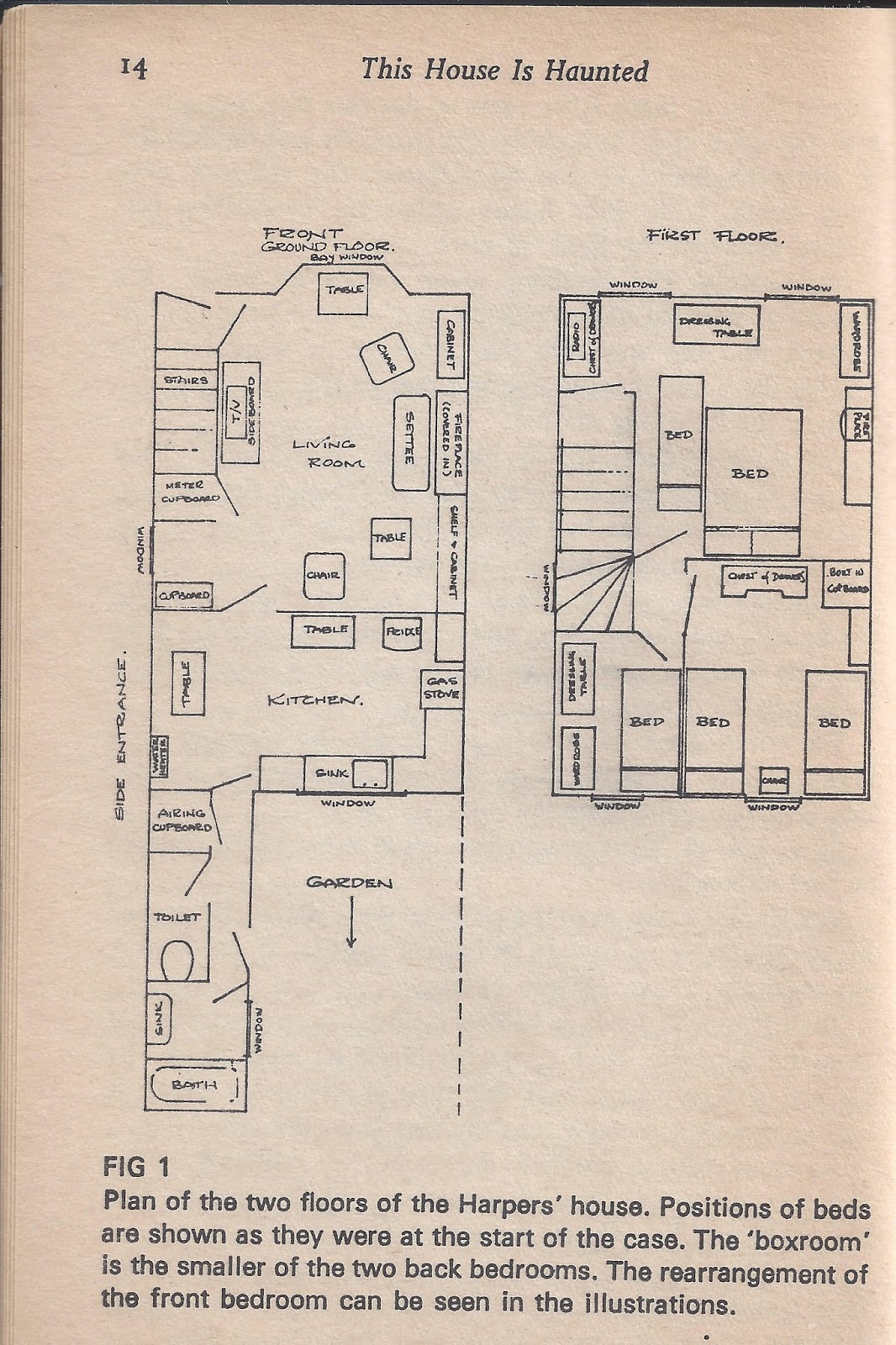
It's good to know the layout of the house where most of the activity occurred. You can find an image of a floor plan online here. Look over it before you start studying the case, and have it on hand to consult when needed. If you want a paper copy, you can print the one just linked or find it in the first edition of Guy Playfair's book mentioned below. The latest edition of the book, which I'll be recommending below, doesn't have the floor plan.
After you've consulted however much of that background material you're interested in, watch this BBC television segment from November of 1977 as an introduction to the case. It's about twelve minutes long.
The best documentary is one that aired on Apple TV+ in October of 2023. The second-best one aired on BBC Radio on December 26, 1978. The host, Rosalind Morris, was an eyewitness of some of the events, she interviews a lot of other eyewitnesses, and they're given a lot of time to speak.
If you want some other video documentaries, start with Interview With A Poltergeist, which came out in 2007. Another one aired on the Paranormal Channel the following year. It's not as good, but each has some strengths the other one doesn't have.
I've written tributes to four of the most important figures in the case. Those tributes will give you a lot of information about those individuals, their involvement in the case, and their credibility: Peggy Hodgson, Maurice Grosse, Guy Playfair, and John Burcombe. Those posts provide a lot of biographical information and references to other sources you can consult, but the posts aren't biographies. They're tributes that focus on the individuals' involvement in the Enfield case. Though the post on Peggy Hodgson is the longest, it's the one you should read if you only want to read one of them. She's the most important witness in the case, and she's often been underestimated and misrepresented.
The two books to get on Enfield (as opposed to poltergeists in general) are Guy Playfair's This House Is Haunted (United States: White Crow Books, 2011) and Melvyn Willin's The Enfield Poltergeist Tapes (United States: White Crow Books, 2019). Read them in that order.
For an introduction to skepticism about the case, you could start with Anita Gregory's review of Playfair's book mentioned above ("This House Is Haunted, An Investigation Of The Enfield Poltergeist", Journal Of The Society For Psychical Research, vol. 50, 1979-80, pp. 538-41). You can access the article at the Library of Exploratory Science site. Other skeptical overviews have been written by Joe Nickell and Deborah Hyde, among others. You can listen to a 2017 edition of the MonsterTalk podcast to hear from a few skeptics discussing Enfield.
If you want to research the case further, see my series of posts here. That material goes beyond an introductory level (e.g., discussing Maurice Grosse and Guy Playfair's audio tapes recorded during their investigation of the case; addressing Anita Gregory's doctoral thesis, which covers Enfield). I reference a lot of articles, books, videos, and other resources along the way, so you can find many more sources to consult there. The page just linked includes descriptions of some of the contents of each post, so you can use Ctrl F to search for what you're interested in, in addition to using a search engine.
It's helpful to have some background information on poltergeists in general, so you could start with a Psi Encyclopedia article that provides an overview of the subject. A good book on the topic is Alan Gauld and A.D. Cornell, Poltergeists (United States: White Crow Books, 2017).
I wrote an article that outlines some of the evidential issues involved in evaluating the credibility of witnesses. It provides many examples from the Enfield case.
It's good to know the layout of the house where most of the activity occurred. You can find an image of a floor plan online here. Look over it before you start studying the case, and have it on hand to consult when needed. If you want a paper copy, you can print the one just linked or find it in the first edition of Guy Playfair's book mentioned below. The latest edition of the book, which I'll be recommending below, doesn't have the floor plan.
After you've consulted however much of that background material you're interested in, watch this BBC television segment from November of 1977 as an introduction to the case. It's about twelve minutes long.
The best documentary is one that aired on Apple TV+ in October of 2023. The second-best one aired on BBC Radio on December 26, 1978. The host, Rosalind Morris, was an eyewitness of some of the events, she interviews a lot of other eyewitnesses, and they're given a lot of time to speak.
If you want some other video documentaries, start with Interview With A Poltergeist, which came out in 2007. Another one aired on the Paranormal Channel the following year. It's not as good, but each has some strengths the other one doesn't have.
I've written tributes to four of the most important figures in the case. Those tributes will give you a lot of information about those individuals, their involvement in the case, and their credibility: Peggy Hodgson, Maurice Grosse, Guy Playfair, and John Burcombe. Those posts provide a lot of biographical information and references to other sources you can consult, but the posts aren't biographies. They're tributes that focus on the individuals' involvement in the Enfield case. Though the post on Peggy Hodgson is the longest, it's the one you should read if you only want to read one of them. She's the most important witness in the case, and she's often been underestimated and misrepresented.
The two books to get on Enfield (as opposed to poltergeists in general) are Guy Playfair's This House Is Haunted (United States: White Crow Books, 2011) and Melvyn Willin's The Enfield Poltergeist Tapes (United States: White Crow Books, 2019). Read them in that order.
For an introduction to skepticism about the case, you could start with Anita Gregory's review of Playfair's book mentioned above ("This House Is Haunted, An Investigation Of The Enfield Poltergeist", Journal Of The Society For Psychical Research, vol. 50, 1979-80, pp. 538-41). You can access the article at the Library of Exploratory Science site. Other skeptical overviews have been written by Joe Nickell and Deborah Hyde, among others. You can listen to a 2017 edition of the MonsterTalk podcast to hear from a few skeptics discussing Enfield.
If you want to research the case further, see my series of posts here. That material goes beyond an introductory level (e.g., discussing Maurice Grosse and Guy Playfair's audio tapes recorded during their investigation of the case; addressing Anita Gregory's doctoral thesis, which covers Enfield). I reference a lot of articles, books, videos, and other resources along the way, so you can find many more sources to consult there. The page just linked includes descriptions of some of the contents of each post, so you can use Ctrl F to search for what you're interested in, in addition to using a search engine.
Tuesday, March 30, 2021
The Garden Of Suffering For Our Joy
"Every time we walk in a garden I think we ought to recollect the garden [of Gethsemane] where the Saviour walked, and the sorrows that befell him there. Did he select a garden, I wonder, because we are all so fond of such places, thus linking our seasons of recreation with the most solemn mementoes of himself?" (Charles Spurgeon)
Sunday, March 28, 2021
The Contrasting Ordinariness And Extraordinariness Of The Risen Jesus In Luke
I've often referred to the significance of the ordinariness of Jesus' body in the resurrection accounts in the gospels and Acts (e.g., here). An especially striking example is what we see in Luke's writings. The ordinariness of Jesus' resurrected body comes between the glorious appearance of the angels in Luke 24:4-5 and the gloriousness of Jesus' resurrected body after the ascension in Acts 9:3 (see, also, 26:13-14). Luke recognized the significance of that sort of impressive appearance and wanted to highlight it in passages like the ones I just cited. But he doesn't refer to Jesus as having had such a body prior to the ascension. Instead, he and the other gospel authors describe Jesus' pre-ascension resurrection body in more ordinary terms. That's best explained as a historically accurate memory of what was experienced with Jesus after he rose from the dead, a memory that was contrary to common expectation and reflects significant restraint on the part of the early Christians. We see that in sources other than Luke as well, but what's significant about Luke is how Jesus' ordinariness there contrasts so much with the extraordinariness of the appearance of Jesus and other figures in the nearby context.
Friday, March 26, 2021
The Beloved Disciple, A Fisherman
I've addressed this subject in the past, but Lydia McGrew has a fuller and better treatment of it in her new book on the fourth gospel:
Then there is the story of the disciples rowing across the Sea of Galilee…According to John 6.19, it was "about twenty-five or thirty stadia," which is simultaneously more precise than the Synoptics and also not hyper-precise. It is, in fact, just what one would expect from someone who was there, was capable of estimating distance under the unpropitious circumstances of a storm at night, and had a mind that tenaciously retained such details.
The mention of the Sea of Galilee relates to another matter: The Beloved Disciple does not seem to be a landlubber. Not only does he know multiple names for the Sea of Galilee (6.1), he has a good idea of how far the disciples had rowed when they were about halfway across it. Even more striking, when Peter decides in 21.3 to go fishing, the Beloved Disciple is one of six who immediately decide to go with him. While a normally stay-at-home Jerusalem disciple [like the one proposed by Richard Bauckham] probably would have traveled to Galilee to meet Jesus after the resurrection (cf. Matt. 28.10), it does not follow that he would jump at the chance to stay up all night fishing in Peter's boat [John 21:3-4]. Why would he? A "Beloved Disciple" from Jerusalem who was neither the son of Zebedee nor a traveler would presumably not be a fisherman and would have no particular reason to go on such an expedition. The disciples are not planning to see Jesus on this particular occasion nor expecting a miraculous catch of fish. They're just going fishing. It seems a reasonable inference from all of this that the Beloved Disciple was familiar with and comfortable on the Sea of Galilee, and even perhaps that he was familiar with fishing, which again does not fit well with the hypothesis that he was a non-itinerant Jerusalem resident. (The Eye Of The Beholder [Tampa, Florida: DeWard Publishing, 2021], 146-47)
Tuesday, March 23, 2021
Where To Begin In Discussions Of Gospel Authorship
I've become increasingly convinced that Luke 1:1-3 is a good place to start in discussions about gospel authorship. Luke refers to his use of prior sources in the opening of his gospel, and the written nature of his own work makes it unlikely that he's referring only to oral sources. (To read more on the subject, go here.) There's widespread agreement that Luke used at least one of the other canonical gospels as one of his sources. And once two or more gospels of such prominence were in use, there would be a need to distinguish among them in libraries, when using them during church services, and so on. We have a lot of evidence that the gospels were distinguished in such contexts by means of authorship attributions from the second century onward. And continuity is more likely than discontinuity. It makes more sense that the gospels were distinguished by means of author names in the first century than that they weren't. That scenario better explains the widespread acceptance of the practice later and the absence of any comparable or better alternative. If somebody is going to argue that the gospels circulated anonymously early on, he should be asked how he thinks the pre-Lukan documents Luke refers to in the opening of his gospel were distinguished from one another (the pre-Lukan context) and how Luke's gospel was distinguished from those other sources (the context from the time of Luke onward).
Sunday, March 21, 2021
Unusual Agreements In Terminology In Easter Passages
Peter Williams has noted that there are some Easter passages in the Synoptics and John that have some unusual language in common. Jesus addresses his disciples as "my brothers" in Matthew 28:10 and John 20:17. The gospel of John doesn't repeat what the Synoptics reported about Jesus' comments on letting the cup pass in the Garden of Gethsemane, but John does have Jesus referring to drinking the cup in 18:11 (Can We Trust The Gospels? [Wheaton, Illinois: Crossway, 2018], approximate Kindle location 1782).
Thursday, March 18, 2021
Hearing And Touching The Resurrected Jesus
Discussions of the resurrection appearances tend to focus on seeing Jesus. The tradition of referring to them as appearances is one factor, and there are other reasons for the focus on sight. People tend to value sight above the other senses. Paul focuses on seeing the risen Jesus when addressing his apostleship in 1 Corinthians 9:1, and other resurrection passages similarly emphasize sight (e.g., Mark 16:7, John 20:18). For these and other reasons, discussions of the resurrection appearances are often highly focused on the visual aspect of the encounters, often inordinately so. Critics of Christianity have an interest in simplifying the accounts, as if only a visual experience needs to be explained. And you sometimes come across the claim that only Luke and John refer to people touching the resurrected Jesus, with the suggestion that such details were fabricated in later accounts. The allegedly more developed nature of Luke and John's material is cited as evidence for the evolution of the gospels over time. What I want to do in this post is address some neglected evidence for the involvement of other senses, namely hearing and touch, in the encounters with the risen Jesus.
I'm going to discuss why we should think the resurrection appearances likely involved hearing and touching even if some or all of the resurrection accounts in the gospels and Acts are rejected. Those accounts shouldn't be rejected, and we and others have argued for that conclusion in depth elsewhere. But it's significant that the concept that the resurrection appearances only involved sight doesn't hold up well even under highly skeptical views of the material in the gospels and Acts.
I'm going to discuss why we should think the resurrection appearances likely involved hearing and touching even if some or all of the resurrection accounts in the gospels and Acts are rejected. Those accounts shouldn't be rejected, and we and others have argued for that conclusion in depth elsewhere. But it's significant that the concept that the resurrection appearances only involved sight doesn't hold up well even under highly skeptical views of the material in the gospels and Acts.
Tuesday, March 16, 2021
Another Reason Why A Resurrection Body With Wounds Wouldn't Be Fabricated
I've written about the significance of how Jesus is portrayed as having retained his crucifixion wounds after his resurrection in the gospels of Luke and John. Here's another reason why the early Christians are unlikely to have made up such a detail:
"They [critics of resurrection] also make eager use of all the deformities and blemishes which either accident or birth has produced, and accordingly, with horror and derision, cite monstrous births, and ask if every deformity will be preserved in the resurrection. For if we say that no such thing shall be reproduced in the body of a man, they suppose that they confute us by citing the marks of the wounds which we assert were found in the risen body of the Lord Christ." (Augustine, The City Of God, 22:12)
"They [critics of resurrection] also make eager use of all the deformities and blemishes which either accident or birth has produced, and accordingly, with horror and derision, cite monstrous births, and ask if every deformity will be preserved in the resurrection. For if we say that no such thing shall be reproduced in the body of a man, they suppose that they confute us by citing the marks of the wounds which we assert were found in the risen body of the Lord Christ." (Augustine, The City Of God, 22:12)
Sunday, March 14, 2021
Neglected Evidence For The Empty Tomb
Disputes over the historicity of the empty tomb usually focus on the gospel accounts. But there's a lot of evidence outside the gospels that should get more attention.
Notice the number and variety of contexts in which Christians were interested in Jesus' burial long before the gospels were written: prophecy (Isaiah 53:9), creeds (1 Corinthians 15:4), theology (1 Corinthians 15:36), ceremonies (Romans 6:4), tracking the location (the tradition behind the Holy Sepulchre site). And notice that these contexts involve more than the mere fact that Jesus was buried. If the empty tomb tradition that's so widely attested from the time of the gospels onward isn't the same tradition that was of such early and widespread interest to Christians before the writing of the gospels, then where is that earlier tradition? Did it universally disappear and get universally replaced by what we see in the gospels? Continuity is more likely than discontinuity. For more about these pre-gospel sources, see here.
The letters of Peter also contain some material that tends to be neglected in this context. See here regarding those letters.
Justin Martyr provides some evidence that's typically not discussed. He not only refers to Jewish corroboration of the empty tomb, as Matthew's gospel does, but also cites a first-century Jewish source in the process. And he refers to how the empty tomb was corroborated not only by the earliest Jewish opponents of Christianity, but also by pagans. For a discussion of all of this material in Justin, see here.
Notice the number and variety of contexts in which Christians were interested in Jesus' burial long before the gospels were written: prophecy (Isaiah 53:9), creeds (1 Corinthians 15:4), theology (1 Corinthians 15:36), ceremonies (Romans 6:4), tracking the location (the tradition behind the Holy Sepulchre site). And notice that these contexts involve more than the mere fact that Jesus was buried. If the empty tomb tradition that's so widely attested from the time of the gospels onward isn't the same tradition that was of such early and widespread interest to Christians before the writing of the gospels, then where is that earlier tradition? Did it universally disappear and get universally replaced by what we see in the gospels? Continuity is more likely than discontinuity. For more about these pre-gospel sources, see here.
The letters of Peter also contain some material that tends to be neglected in this context. See here regarding those letters.
Justin Martyr provides some evidence that's typically not discussed. He not only refers to Jewish corroboration of the empty tomb, as Matthew's gospel does, but also cites a first-century Jewish source in the process. And he refers to how the empty tomb was corroborated not only by the earliest Jewish opponents of Christianity, but also by pagans. For a discussion of all of this material in Justin, see here.
Thursday, March 11, 2021
Steve Hays' Contribution To Easter
"he who sows bountifully will also reap bountifully" (2 Corinthians 9:6)
When Steve went through last year's Easter season, he knew he was going to die soon. You couldn't tell from looking at how productive he was.
In a post about Steve last year, I mentioned that some of my earliest memories of him come from the context of working with him on This Joyful Eastertide, an e-book about Jesus' resurrection. Some of his other e-books and many articles he wrote over the years also addressed the resurrection. And he did it in a lot of depth. He often discussed the subject in private correspondence as well. He wrote a post in 2017 summarizing how he would make a case for the resurrection. Over his lifetime, he must have written thousands of pages of material on the subject, often interacting with the latest scholarship and skepticism.
He enjoyed light and often wrote about the subject. Thinking of his legacy in the context of Easter, I'm reminded of one of the great Old Testament passages about resurrection, with its reference to stars:
"Many of those who sleep in the dust of the ground will awake…Those who have insight will shine brightly like the brightness of the expanse of heaven, and those who lead the many to righteousness, like the stars forever and ever." (Daniel 12:2-3)
This joyful Easter-tide,
Away with care and sorrow!
My Love, the Crucified,
Hath sprung to life this morrow.
My flesh in hope shall rest,
And for a season slumber;
Till trump from east to west,
Shall wake the dead in number.
Death’s flood hath lost his chill,
Since Jesus crossed the river:
Lover of souls, from ill
My passing soul deliver.
Had Christ, that once was slain,
Ne’er burst His three day prison,
Our faith had been in vain;
But now hath Christ arisen,
Arisen, arisen, arisen!
(George Woodward, This Joyful Easter-Tide)
"Sunrise lies beyond the setting sun. It cannot be reborn in the east unless it dies in the west. And once it dies, there's nothing left to keep us here. Only darkness remains. Unbelievers rage against the dying light. But for the saints, our light must die below to then ascend to the zenith of meridian glory. Before we rise to light everlasting, our sun must set." (Steve Hays, A Backward Providence, 21-22)
When Steve went through last year's Easter season, he knew he was going to die soon. You couldn't tell from looking at how productive he was.
In a post about Steve last year, I mentioned that some of my earliest memories of him come from the context of working with him on This Joyful Eastertide, an e-book about Jesus' resurrection. Some of his other e-books and many articles he wrote over the years also addressed the resurrection. And he did it in a lot of depth. He often discussed the subject in private correspondence as well. He wrote a post in 2017 summarizing how he would make a case for the resurrection. Over his lifetime, he must have written thousands of pages of material on the subject, often interacting with the latest scholarship and skepticism.
He enjoyed light and often wrote about the subject. Thinking of his legacy in the context of Easter, I'm reminded of one of the great Old Testament passages about resurrection, with its reference to stars:
"Many of those who sleep in the dust of the ground will awake…Those who have insight will shine brightly like the brightness of the expanse of heaven, and those who lead the many to righteousness, like the stars forever and ever." (Daniel 12:2-3)
This joyful Easter-tide,
Away with care and sorrow!
My Love, the Crucified,
Hath sprung to life this morrow.
My flesh in hope shall rest,
And for a season slumber;
Till trump from east to west,
Shall wake the dead in number.
Death’s flood hath lost his chill,
Since Jesus crossed the river:
Lover of souls, from ill
My passing soul deliver.
Had Christ, that once was slain,
Ne’er burst His three day prison,
Our faith had been in vain;
But now hath Christ arisen,
Arisen, arisen, arisen!
(George Woodward, This Joyful Easter-Tide)
"Sunrise lies beyond the setting sun. It cannot be reborn in the east unless it dies in the west. And once it dies, there's nothing left to keep us here. Only darkness remains. Unbelievers rage against the dying light. But for the saints, our light must die below to then ascend to the zenith of meridian glory. Before we rise to light everlasting, our sun must set." (Steve Hays, A Backward Providence, 21-22)
Tuesday, March 09, 2021
Pierce on Dr. Seuss
Jeremy Pierce:
Here is what I don't see a lot of people saying in response to the Dr. Seuss books that the publisher will no longer be making. Theodore Geisel was a very progressive, liberal-minded person, anti-racist in the most literal sense of that term. Yet he portrayed people in ways that we today recognize to be stereotypical and somewhat offensive. People have been calling him a racist for years, when his views were anything but. How could the author of the Sneetches, an explicitly anti-racist story in the literal sense of that term, be counted as a racist just because he had absorbed some of the stereotypical imagery of his day and brought it out in his depictions of people from around the world when wanting to expose children to multi-cultural stuff and to think more globally?
A Good Discussion Of First Clement
James White recently had a good discussion with Stephen Boyce about First Clement. They talk about the letter's significance with regard to Trinitarianism, the canon of scripture, justification, church government, and other subjects.
Monday, March 08, 2021
Easter Resources 2021
Last year, I wrote a short post about which evidence for Jesus' resurrection we should be most focused on. A few years ago, Steve Hays wrote a lengthier article about how to make a case for the resurrection. Those are a couple of places you could go to start the process of studying Easter issues.
And here are some examples of other relevant issues we've addressed over the years:
And here are some examples of other relevant issues we've addressed over the years:
Sunday, March 07, 2021
Does everything we do have eternal significance?
What Really Matters in Life
James Bejon
What follows is an article written for my church newsletter. It is heavily influenced by thoughts prompted by David Field's "Not the Least Lash Lost", which I consider to be a simply superb and must-read piece of work.
Scripture does not provide us with many details about the afterlife, but it is profitable for us to think deeply about the fact and nature of it. Absent an afterlife, life is 'vanity'. The world goes round and round in circles, and who knows whether our brief lives' accomplishments will profit the wise or the foolish in the days to come? (Let us eat and drink, for 'tomorrow' we die.) Yet, as Christians, we have a sure hope. Our actions and their consequences continue on into the next world in some way. But in what way? Insofar as they are rewarded (or not) at the judgment seat? In part, no doubt. But might there not be more to it than that? Martin Luther is reported to have said, "If I knew the world would end tomorrow, I would still plant my apple tree today". Would we? It all depends on how we view life's continuity-discontinuity questions.
Consider the flood. The flood was a major discontinuity in world history. But the people who left the ark were the same people who boarded it. Like every other man in history, Noah was a product of his past life and past decisions. What he did before he boarded the ark determined the kind of man he would be when he left the ark and stepped out into God's new creation. (People, after all, are not abstract entities; they are the sum products of their pasts and past decisions.) So, what about the day of the Lord's return and of the Resurrection? To what extent does our pre-resurrection life affect our post-resurrection life? Might not what is true of Noah be true of us? Let us put the question in more practical terms. Does everything we do have eternal significance? Or just some things? Cooking the dinner, disciplining our children, doing a good day's work, caring for a relative who may or may not be saved: Are these tasks ultimately irrelevant necessities? Or is there more to it than that? My suspicion is as follows: everything we do, in some way or other, reverberates on into eternity. At times, Scripture emphasises the discontinuity between the present world and the world to come (e.g., 2 Pet. 3), while, at times, Scripture emphasises the continuity between the two worlds. (At Christ's return, for instance, the kingdoms of the world become his kingdoms, and the deeds of the saints follow them into the heavenly realms and clothe in preparation for their return, and the kings of the earth thereafter bring their glory to the city of God: Rev. 11.15, 14.13, 19.8, 21.23-26.) Both sides of the coin are vital for us to appreciate.
Consider, by way of illustration, Jesus' resurrection body—a body whose appearance marked the genesis of a new age. Weren't the hands with which Jesus broke the bread en route to Emmaus in some sense the same hands which were nailed to the cross a few days before hand? And which fashioned wood in Nazareth? And which Mary and Joseph held as they walked Jesus as a young child? Wouldn't Jesus have looked like Mary and inherited certain traits from her? Didn't Mary's actions in that sense at least survive on into the resurrection world? (And might not similar things be able to be said of our own hands and what they have done?) Consider, in this connection, Paul's statements in 1 Cor. 15. The bodies which we commit to the earth when we die are the same bodies which are raised. (Continuity and discontinuity again.) Our bodies together with whatever has affected them are the raw materials of the resurrection. What grows in the resurrection depends on what seed is planted. And, as a result, Paul says, our toils are not 'in vain' (15.58). Now, does that word 'vain' remind you of our initial reference to Ecclesiastes (vanitas vanitatum omnia vanitas)? The reminiscence, I suspect, is deliberate. Precisely those labours which are rendered vain by death—the labours of planting and plucking up, healing and punishing, keeping and casting away, weeping and laughing—are redeemed and preserved in value by the resurrection. As one writer puts it, "When we are raised,...the work we have done in the present, in the service of [our] new master, will, [no doubt to our great surprise], turn out to be part not only of who we are, but of the new world he will have brought into being".
But what about our sins? Well, we will not live in eternal regret at what we did or failed to do in the present life. (Our sins will not be 'remembered' against us.) Of that much I am sure. But just as, here on earth, our consciousness of our sins affects—and even heightens—our sense of gratitude as we worship (Luke 7.41-47), so too, I believe, they will do in eternity. When we sing, 'Worthy is the Lamb who was slain', we will know exactly what he was slain for, since the more we know about Christ's work, the more we will appreciate it. The nature of our failures will inform Christ's people of the scope and glory of Christ's work of forgiveness, just as the nature of our frailties and disabilities will inform Christ's people of the scope and glory of Christ's work of restoration. We may not all have the same ministries, bodies, or abilities as one another, but everything we do in life ultimately matters.
Subscribe to:
Posts (Atom)